Introduction
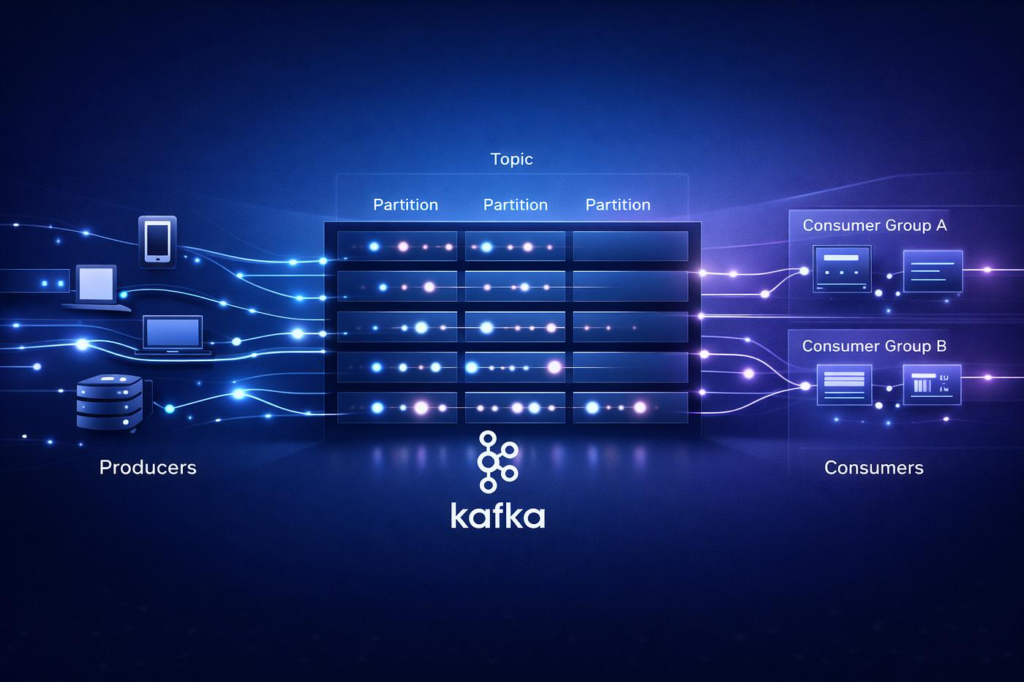
In today’s data-driven world, organizations generate millions of events every second—from online purchases and financial transactions to IoT sensor readings and user interactions. Processing this continuous stream of data efficiently requires a platform that is fast, scalable, reliable, and fault-tolerant. This is where Apache Kafka comes into the picture.
Apache Kafka has become the industry standard for building real-time data streaming applications, event-driven architectures, and large-scale distributed systems. Originally developed by LinkedIn and later open-sourced through the Apache Software Foundation, Kafka is now used by leading technology companies such as Netflix, Uber, Amazon, LinkedIn, Airbnb, Spotify, and many others to process billions of events every day.
Whether you’re building a microservices-based application, implementing event-driven architecture, creating streaming data pipelines, or processing real-time analytics, Apache Kafka provides the infrastructure needed to move and process data with exceptional speed and reliability.
In this comprehensive guide, you’ll learn everything about Apache Kafka, including its architecture, components, workflow, advantages, use cases, best practices, challenges, and why it has become one of the most important technologies in modern software engineering.
1.What is Apache Kafka?
Apache Kafka is an open-source distributed event streaming platform designed for high-throughput, fault-tolerant, and real-time data streaming.
It enables applications to publish, store, process, and consume streams of events efficiently across distributed systems.
Kafka acts as a highly scalable messaging platform where producers publish events to topics, and consumers subscribe to those topics to process data independently.
Unlike traditional messaging systems, Kafka stores events durably, allowing consumers to replay historical data whenever needed.
2.Why Apache Kafka is Important
Modern applications demand:
- Real-time communication
- Massive scalability
- High availability
- Reliable message delivery
- Low latency
- Fault tolerance
- Distributed processing
Apache Kafka addresses these challenges by providing a platform capable of handling millions of events per second while maintaining performance and reliability.
Organizations use Kafka to:
- Build event-driven applications
- Process streaming data
- Integrate microservices
- Collect application logs
- Power recommendation engines
- Detect fraud in real time
- Synchronize databases
- Monitor IoT devices
- Support machine learning pipelines
3.Key Features of Apache Kafka
Apache Kafka offers several features that make it suitable for enterprise-scale applications.
1.High Throughput
Kafka can process millions of messages per second without compromising performance.
2.Fault Tolerance
Data is replicated across multiple brokers, ensuring availability even if a server fails.
3.Horizontal Scalability
Kafka clusters can grow by adding more brokers without disrupting existing applications.
4.Durability
Messages are stored on disk and retained according to configurable policies.
5.Low Latency
Kafka delivers messages with minimal delay, making it ideal for real-time applications.
6.Event Replay
Consumers can replay previously stored events by resetting their offsets.
7.Distributed Architecture
Kafka distributes workloads across multiple servers to improve performance and reliability.
4.Core Components of Apache Kafka
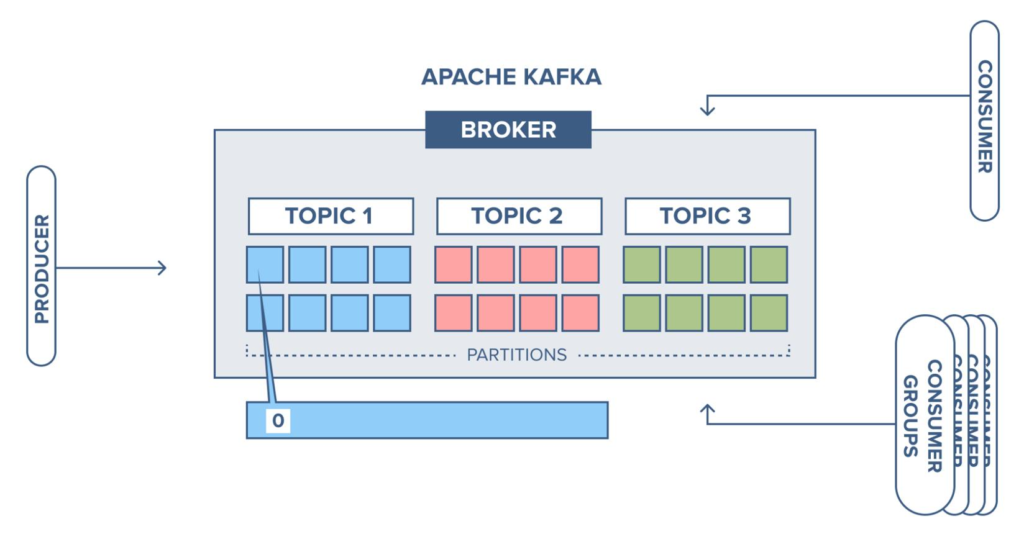
Understanding Kafka becomes much easier when you understand its core building blocks.
1. Producer
A Producer is an application that sends messages (events) to Kafka topics.
Examples include:
- Order Service
- Payment Service
- Inventory Service
- IoT Sensors
- Mobile Applications
- Web Applications
A producer publishes events without needing to know who will consume them.
2. Topic
A Topic is a logical category where Kafka stores events.
Examples:
- Orders
- Payments
- Notifications
- UserActivity
- Inventory
- Logs
Each topic can contain millions of events.
3. Partition
Topics are divided into Partitions.
Partitions allow Kafka to:
- Process data in parallel
- Increase throughput
- Scale horizontally
- Preserve message ordering within a partition
Example:
Orders Topic

Partition 0

Partition 1

Partition 2

Partition 3
4. Broker
A Broker is a Kafka server responsible for storing partitions and serving client requests.
A Kafka cluster typically consists of multiple brokers working together.
Responsibilities include:
- Storing messages
- Serving producers
- Serving consumers
- Replicating data
- Managing partitions
5. Consumer
A Consumer subscribes to Kafka topics and processes incoming events.
Examples include:
- Email Service
- Analytics Service
- Fraud Detection
- Recommendation Engine
- Shipping Service
Multiple consumers can independently process the same event.
6. Consumer Group
A Consumer Group allows multiple consumers to share the workload of processing a topic.
Each partition is consumed by only one consumer within the same group, enabling parallel processing while avoiding duplicate work.
7. Offset
Every message in a partition has a unique Offset.
Offsets help consumers:
- Track progress
- Resume processing after failures
- Replay messages
- Control consumption
5.Apache Kafka Architecture
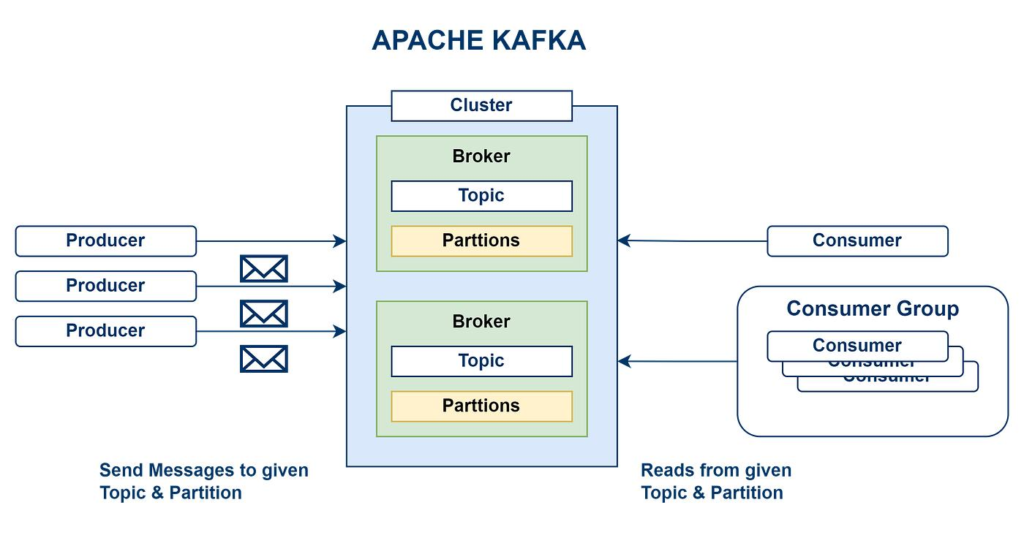
The architecture of Kafka is designed for distributed, scalable, and fault-tolerant messaging.
                Producers
                    │
                    ▼
             Apache Kafka Cluster
     ┌────────────┬────────────┐
     ▼            ▼            ▼
 Broker 1     Broker 2     Broker 3
     │            │            │
     └────── Topics & Partitions ──────┘
                    │
                    ▼
            Consumer Groups
                    │
     ┌──────────┬───────────┬──────────┐
     ▼          ▼           ▼
 Analytics   Notification  Inventory
   Service      Service      Service
This distributed design allows Kafka to handle massive workloads while maintaining reliability.
6.How Apache Kafka Works
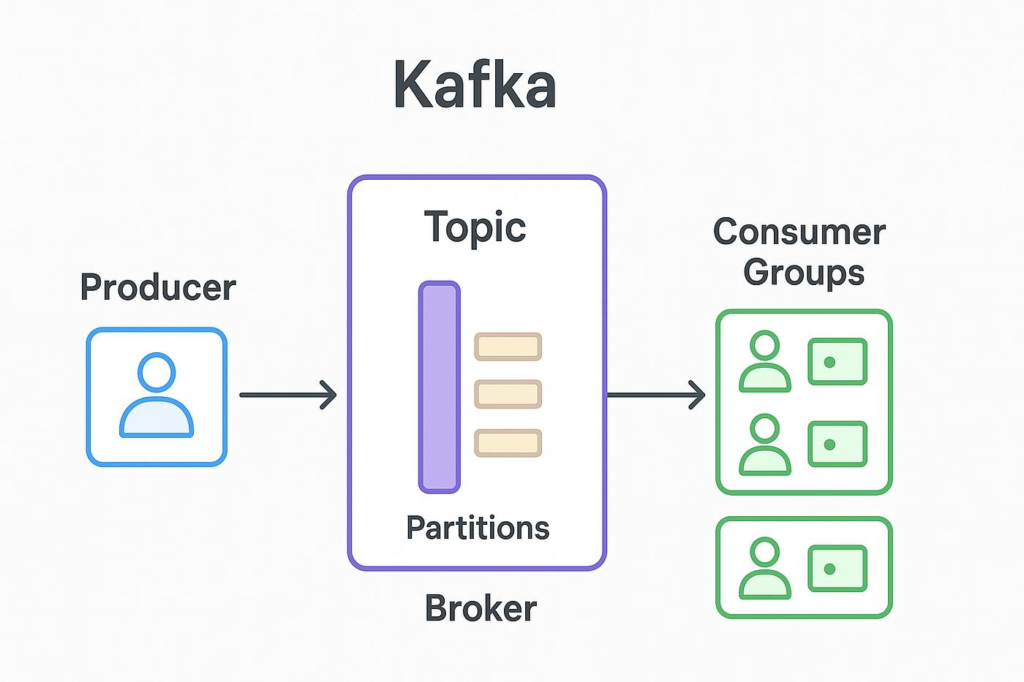
Kafka follows a simple but powerful workflow.
Step 1: Producer Sends Data
A producer publishes an event to a Kafka topic.
Example:
{
  "orderId": 1054,
  "customer": "Alice",
  "amount": 2499,
  "status": "Created"
}
Step 2: Kafka Stores the Event
Kafka writes the event to the appropriate partition and replicates it across brokers if replication is enabled.
Step 3: Consumers Read the Event
Consumers subscribed to the topic receive and process the event independently.
For example:
- Inventory Service updates stock.
- Email Service sends confirmation.
- Analytics Service records the transaction.
- Shipping Service initiates delivery.
Each service operates independently without direct communication with the producer.
7.Message Flow in Apache Kafka
User Places Order
        │
        ▼
 Order Service
        │
        ▼
Kafka Producer
        │
        ▼
Orders Topic
        │
        ▼
Kafka Broker
        │
 ┌──────┼──────────┬───────────┐
 ▼      ▼          ▼           ▼
Inventory  Email  Analytics  Shipping
 Service   Service  Service    Service
8.Apache Kafka vs Traditional Message Brokers
| Feature | Apache Kafka | Traditional Message Brokers |
|---|---|---|
| Scalability | Very High | Moderate |
| Message Retention | Persistent | Often temporary |
| Throughput | Millions of messages/sec | Lower |
| Event Replay | Supported | Limited |
| Horizontal Scaling | Excellent | Moderate |
| Distributed Storage | Yes | Limited |
| Real-Time Streaming | Excellent | Basic |
Kafka is designed not only as a messaging system but also as an event streaming platform.
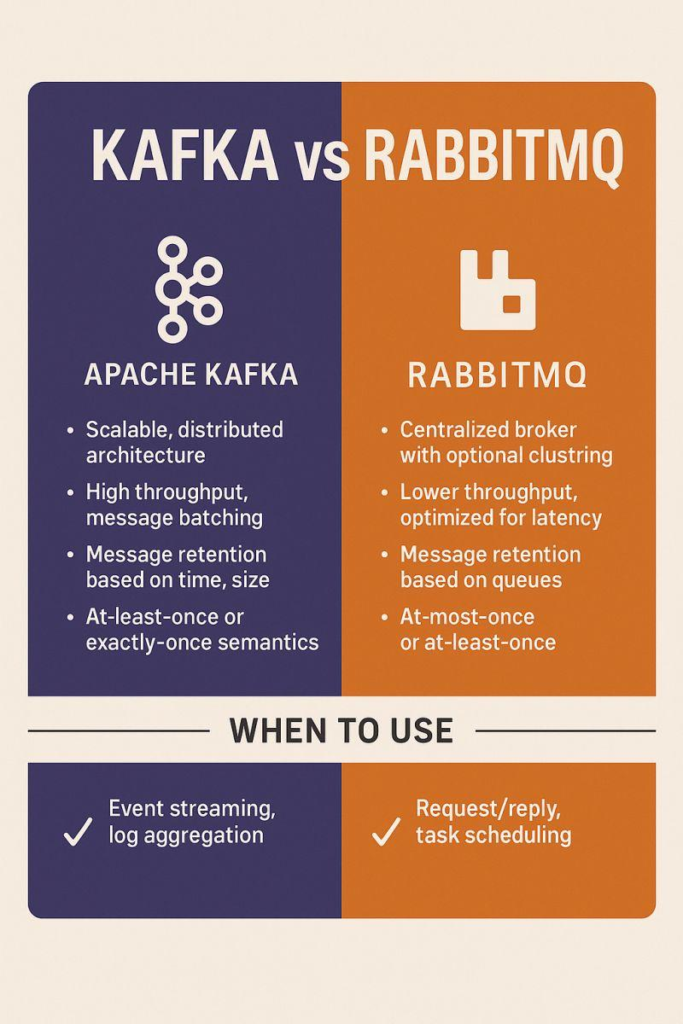
9.Apache Kafka vs RabbitMQ
| Feature | Apache Kafka | RabbitMQ |
|---|---|---|
| Primary Purpose | Event Streaming | Message Queue |
| Message Ordering | Partition-based | Queue-based |
| Throughput | Extremely High | High |
| Event Retention | Yes | Limited |
| Replay Messages | Yes | No (typically) |
| Best For | Streaming Data | Task Queues |
Both technologies are valuable but serve different architectural needs.
10.Advantages of Apache Kafka
1.High Performance
Kafka can process millions of messages every second.
2.Reliability
Replication protects against hardware failures.
3.Scalability
Adding brokers increases capacity with minimal disruption.
4.Loose Coupling
Producers and consumers remain independent.
5.Event Replay
Historical events can be replayed for debugging, analytics, or rebuilding application state.
6.Real-Time Processing
Kafka supports applications requiring immediate responses to incoming data.
7.Ecosystem Integration
Kafka integrates seamlessly with databases, cloud platforms, analytics tools, and stream processing frameworks.
11.Challenges of Apache Kafka
While Kafka is powerful, it introduces several challenges.
1.Operational Complexity
Managing distributed clusters requires expertise.
2.Partition Management
Poor partitioning strategies can create bottlenecks.
3.Monitoring
Continuous monitoring is necessary to maintain cluster health.
4.Schema Evolution
Changing message formats requires careful planning to avoid breaking consumers.
5.Storage Management
Retention policies must balance historical data needs with storage costs.
12.Best Practices for Using Apache Kafka
To build reliable Kafka-based systems:
- Choose meaningful topic names.
- Partition topics appropriately.
- Use replication for fault tolerance.
- Monitor consumer lag.
- Keep message payloads concise.
- Secure communication using SSL/TLS and authentication.
- Implement retry mechanisms.
- Design consumers to be idempotent.
- Version message schemas.
- Regularly monitor broker health and disk usage.
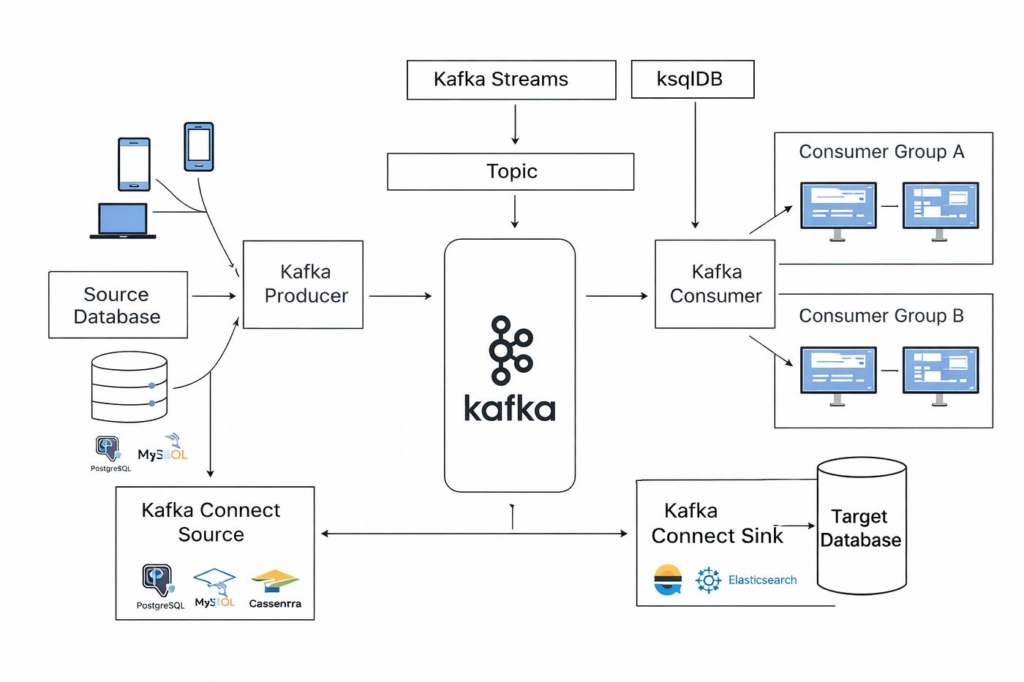
13.Popular Apache Kafka Ecosystem Tools
Kafka’s ecosystem extends beyond the core platform.
| Tool | Purpose |
|---|---|
| Kafka Connect | Data integration between Kafka and external systems |
| Kafka Streams | Stream processing library |
| Schema Registry | Manage message schemas |
| Apache Flink | Advanced stream processing |
| Apache Spark Structured Streaming | Real-time analytics |
| KSQL / ksqlDB | SQL-like stream processing |
| MirrorMaker | Replicate data between Kafka clusters |
These tools make Kafka a complete platform for event streaming and real-time data processing.
14.Real-World Applications of Apache Kafka
1.E-Commerce
Kafka processes orders, payments, inventory updates, shipping notifications, and customer activity in real time.
2.Banking and Finance
Banks use Kafka for fraud detection, transaction processing, compliance monitoring, and risk analysis.
3.IoT Platforms
Millions of connected devices continuously stream sensor data through Kafka for monitoring and automation.
4.Log Aggregation
Organizations collect application logs from multiple servers into Kafka for centralized monitoring and troubleshooting.
5.Recommendation Systems
Streaming user interactions through Kafka enables platforms like Netflix and Spotify to generate personalized recommendations.
6.Social Media Platforms
Kafka processes likes, comments, notifications, messaging events, and activity feeds at massive scale.
15.Apache Kafka in Microservices
Kafka is widely used to connect microservices through asynchronous communication.
Instead of services calling each other directly, they exchange events via Kafka.
Benefits include:
- Loose coupling
- Independent deployment
- Better fault isolation
- Higher scalability
- Faster communication
- Easier system evolution
This makes Kafka a foundational technology for event-driven microservices.
16.Security in Apache Kafka
Enterprise deployments should secure Kafka by implementing:
- SSL/TLS encryption
- SASL authentication
- Access Control Lists (ACLs)
- Role-based permissions
- Secure schema management
- Network isolation
- Audit logging
Security is essential when Kafka handles sensitive business or customer data.
17.When Should You Use Apache Kafka?
Apache Kafka is an excellent choice when your application requires:
- Real-time event streaming
- High-throughput messaging
- Event-driven architecture
- Streaming data pipelines
- Distributed systems
- Large-scale microservices
- Log aggregation
- IoT data processing
- Financial transaction streaming
- Real-time analytics
18.When Apache Kafka May Not Be the Best Choice
Kafka may not be the ideal solution when:
- The application is small and has low messaging requirements.
- Simple task queues are sufficient.
- Operational complexity outweighs the benefits.
- Strong request-response communication is the primary requirement.
Choosing the right messaging platform depends on your system’s scalability, latency, and operational needs.
19.Frequently Asked Questions (FAQs)
1.What is Apache Kafka?
Apache Kafka is an open-source distributed event streaming platform used to publish, store, process, and consume real-time streams of data.
2.Why is Apache Kafka so popular?
Kafka is popular because it offers high throughput, fault tolerance, scalability, durability, and support for real-time event streaming.
3.Is Apache Kafka a message queue?
Kafka can function as a messaging system, but it is more accurately described as a distributed event streaming platform with persistent storage and replay capabilities.
4.What is a Kafka Topic?
A Topic is a logical category where Kafka stores related events produced by applications.
5.What is a Kafka Partition?
A Partition divides a topic into smaller segments, allowing parallel processing, scalability, and ordered message storage within each partition.
6.What is a Kafka Broker?
A Broker is a server within a Kafka cluster responsible for storing data, managing partitions, and serving producers and consumers.
7.Can Apache Kafka be used with Microservices?
Yes. Kafka is one of the most popular technologies for connecting microservices through asynchronous event-based communication.
Conclusion
Apache Kafka has revolutionized the way modern applications handle data by providing a highly scalable, fault-tolerant, and distributed platform for real-time event streaming. Its ability to process massive volumes of events with low latency makes it an essential technology for event-driven architectures, streaming data pipelines, microservices, IoT platforms, financial systems, and real-time analytics.
By combining durable event storage, horizontal scalability, high throughput, and a rich ecosystem of tools, Kafka enables organizations to build resilient systems capable of handling continuously growing data streams. Although operating Kafka clusters requires careful planning and expertise, the long-term benefits in scalability, reliability, and flexibility make it one of the most valuable technologies in modern software engineering.
As businesses continue to prioritize real-time decision-making and event-driven applications, mastering Apache Kafka is becoming an indispensable skill for software developers, data engineers, cloud architects, and DevOps professionals who want to build next-generation distributed systems.
Developed by Shreya Vasagadekar

Leave a Reply