Introduction
Artificial intelligence is no longer defined solely by powerful models. As enterprises move AI into production, the platform responsible for deployment, orchestration, and scaling becomes just as important as the algorithms themselves. Kubernetes has emerged as the industry standard for running AI workloads reliably across cloud, on-premises, and hybrid environments.
According to the CNCF Annual Survey, 82% of container users run Kubernetes in production, while 66% of organizations hosting Generative AI models already rely on Kubernetes for inference workloads.
What Is Kubernetes for AI?
Kubernetes for AI refers to using Kubernetes as the orchestration platform for machine learning, deep learning, Generative AI, and autonomous AI workloads. Instead of managing separate infrastructure for training, inference, and deployment, Kubernetes provides one unified platform capable of orchestrating every stage of the AI lifecycle.
Prepare massive training datasets using distributed computing frameworks.
Train AI models across hundreds or thousands of GPUs with efficient resource scheduling.
Serve production AI models with automatic scaling and high availability.
Automate training, deployment, monitoring, and lifecycle management using Kubernetes-native workflows.
Deploy intelligent agents capable of maintaining state, communicating with external systems, and operating continuously.
Why Kubernetes Matters for AI
Unified Platform
Rather than maintaining separate infrastructure for model training, inference, data engineering, and AI agents, Kubernetes allows all workloads to coexist on one consistent platform.
Cost Efficiency
GPU resources are expensive. Kubernetes improves utilization through intelligent scheduling, resource sharing, and automatic scaling, ensuring compute resources are used only when needed.
Enterprise Scalability
Organizations can deploy AI applications consistently across cloud providers, private data centers, and edge environments using the same Kubernetes platform.
The AI Lifecycle on Kubernetes
Tools such as Kubeflow, KServe, Ray, Spark, Dask, Katib, and JobSet integrate seamlessly with Kubernetes to automate every stage of this lifecycle.
Kubernetes for AI: Building Scalable AI Infrastructure
Artificial intelligence is no longer defined solely by powerful models. As enterprises move AI into production, the platform responsible for deployment, orchestration, and scaling becomes just as important as the algorithms themselves. Kubernetes has emerged as the industry standard for running AI workloads reliably across cloud, on-premises, and hybrid environments.
According to the CNCF Annual Survey, 82% of container users run Kubernetes in production, while 66% of organizations hosting Generative AI models already rely on Kubernetes for inference workloads.
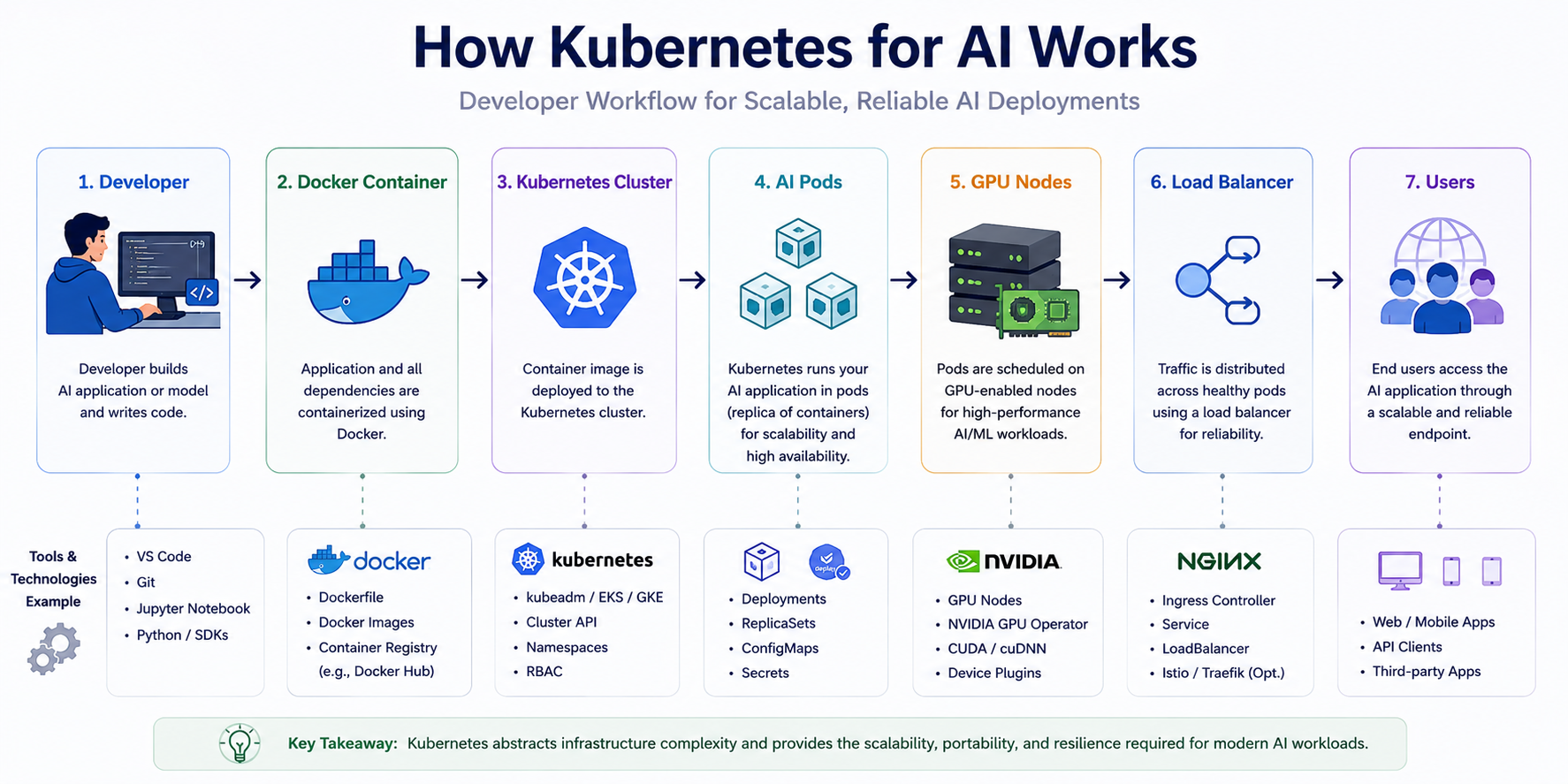
What Is Kubernetes for AI?
Kubernetes for AI refers to using Kubernetes as the orchestration platform for machine learning, deep learning, Generative AI, and autonomous AI workloads. Instead of managing separate infrastructure for training, inference, and deployment, Kubernetes provides one unified platform capable of orchestrating every stage of the AI lifecycle.
Prepare massive training datasets using distributed computing frameworks.
Train AI models across hundreds or thousands of GPUs with efficient resource scheduling.
Serve production AI models with automatic scaling and high availability.
Automate training, deployment, monitoring, and lifecycle management using Kubernetes-native workflows.
Deploy intelligent agents capable of maintaining state, communicating with external systems, and operating continuously.
Why Kubernetes Matters for AI
Unified Platform
Rather than maintaining separate infrastructure for model training, inference, data engineering, and AI agents, Kubernetes allows all workloads to coexist on one consistent platform.
Cost Efficiency
GPU resources are expensive. Kubernetes improves utilization through intelligent scheduling, resource sharing, and automatic scaling, ensuring compute resources are used only when needed.
Enterprise Scalability
Organizations can deploy AI applications consistently across cloud providers, private data centers, and edge environments using the same Kubernetes platform.
The AI Lifecycle on Kubernetes
Tools such as Kubeflow, KServe, Ray, Spark, Dask, Katib, and JobSet integrate seamlessly with Kubernetes to automate every stage of this lifecycle.
Benefits of Kubernetes for AI
Kubernetes simplifies AI infrastructure by bringing model training, inference, monitoring, and automation onto a unified platform. Instead of managing isolated environments, organizations gain a scalable ecosystem capable of supporting the complete AI lifecycle.
Run data pipelines, model training, inference, and AI agents on a single Kubernetes infrastructure.
Scale GPU workloads only when required and reduce idle infrastructure costs.
Automatically increase or decrease resources according to workload demand.
Deploy the same AI applications across cloud, on-premises, and edge environments.
Monitor infrastructure and AI metrics using Prometheus, Grafana, and OpenTelemetry.
GitOps deployment, workload identity, policy enforcement, and secure execution environments.
Challenges
Large language models consume significant GPU memory and compute resources. Efficient scheduling is required to maximize utilization while preventing resource waste.
Inference traffic can fluctuate rapidly. Kubernetes autoscalers require carefully tuned metrics to maintain performance without over-provisioning.
Monitoring AI behavior involves tracking GPU utilization, latency, token generation, traces, and application logs across distributed systems.
AI models and prompts evolve over time. Continuous evaluation and monitoring help maintain response quality and consistency.
Successful AI adoption requires DevOps, platform engineering, and data science teams to collaborate around shared infrastructure and workflows.
Technologies Behind Kubernetes for AI
| Technology | Purpose |
|---|---|
| Kubernetes | Container orchestration platform |
| Docker | Packages AI applications into containers |
| Kubeflow | Machine Learning workflows |
| KServe | Serverless AI model serving |
| Ray | Distributed AI computing |
| NVIDIA GPU Operator | GPU provisioning and management |
| Kueue | GPU-aware batch scheduling |
| Prometheus & Grafana | Monitoring and dashboards |
| Istio | Secure service communication |
| Argo Workflows | CI/CD and AI pipelines |
| KEDA & Knative | Event-driven autoscaling |
Best Practices
Future Trends
The Kubernetes ecosystem continues to evolve rapidly to support increasingly complex AI workloads. New scheduling capabilities, AI-specific APIs, and multi-cluster orchestration are making Kubernetes the default operating platform for enterprise AI.
AI agents are becoming persistent, stateful workloads capable of collaborating, using external tools, maintaining memory, and executing long-running tasks across Kubernetes clusters.
Organizations are increasingly managing AI workloads across hundreds of Kubernetes clusters using intelligent scheduling solutions that treat multiple clusters as one unified compute platform.
The Kubernetes community is defining standardized AI capabilities so applications can run consistently across different Kubernetes distributions and cloud providers.
Technologies like Dynamic Resource Allocation (DRA), GPU sharing, and intelligent scheduling continue improving GPU utilization while reducing infrastructure costs.
How MHTECHIN Supports Kubernetes for AI
Organizations adopting Kubernetes for AI often require guidance in designing scalable, secure, and production-ready infrastructure. MHTECHIN helps enterprises modernize AI platforms that operate consistently across cloud, on-premises, and hybrid environments.
By combining enterprise software engineering, cloud-native development, and AI expertise, MHTECHIN helps organizations design, deploy, monitor, and continuously optimize Kubernetes-based AI platforms that support modern intelligent applications.
Conclusion
Kubernetes has evolved beyond container orchestration into the foundation of modern AI infrastructure. From distributed model training to real-time inference and autonomous AI agents, it provides the scalability, automation, and resilience required for production AI deployments.
As organizations continue adopting generative AI and large language models, Kubernetes enables them to unify data processing, model serving, monitoring, and automation on one consistent platform. Enterprises investing in Kubernetes today are building the foundation for tomorrow’s intelligent applications.

Leave a Reply