🌐 Multimodal AI Applications: The Complete Guide to Building Intelligent Systems That Understand Text, Images, Audio, Video, and Real-World Data
The Customer Support Call That Changed Everything
You’ve just bought a new dishwasher. Something’s gone wrong. You open the customer support chat app, and the text-based AI agent asks you to describe the issue using only words. Are any lights on? Are they blinking? Is that ‘bleep’ a long note or more of a chirp?
Wouldn’t it be easier if you could just show what’s going on with a short video? This example shows where traditional text-based artificial intelligence fails—it can only interpret the world through written words, not through sights and sounds .
Now imagine a different scenario. You open the app, record a 15-second video of the blinking lights and unusual beeping, and the AI agent analyzes the visual and audio patterns to deliver a quick, accurate diagnosis. It suggests a specific fix and even identifies the exact component that needs replacement.
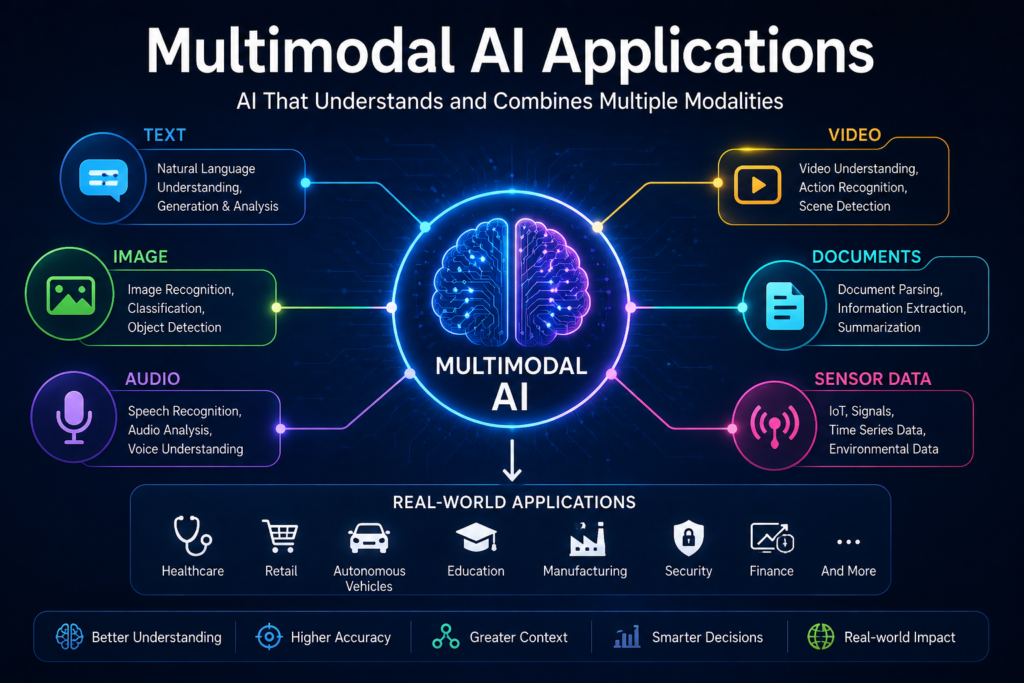
This is the promise of multimodal AI—systems that process and interpret different types of data inputs (voice, text, images, video, and sensor data) to create more natural, context-aware interactions . It’s AI that understands the world the way humans do: through multiple senses simultaneously.
📖 What Is Multimodal AI?
Multimodal AI refers to artificial intelligence systems capable of processing, interpreting, and reasoning across multiple data types or “modalities”—such as text, images, audio, video, sensor data, and more—to solve complex tasks .
Simple Analogy
Think of unimodal AI as a great pianist—it excels at one thing. Multimodal AI is the full band. Each instrument matters, but it’s the fusion that makes the music .
The human brain processes information from multiple sensory inputs (sight, sound, touch) to create a rich understanding of our environment. Similarly, a multimodal AI system can interpret multiple input signals to develop a deeper understanding of context and intent .
Multimodal vs. Unimodal AI
| Aspect | Unimodal AI | Multimodal AI |
|---|---|---|
| Inputs | One data type (e.g., text only) | Multiple data types (text, image, audio, video) |
| Context Capture | Limited to one channel | Cross-modal context, fewer ambiguities |
| Typical Use | Chatbots, text classification | Document understanding, visual Q&A, voice+vision assistants |
| Data Needs | Modality-specific | Larger, paired/linked datasets across modalities |
🧠 Evolution of Multimodal AI
Early Systems: Modular and Fragmented
Early multimodal systems relied on separate pipelines where distinct components processed each modality independently, with their representations combined only at the final stage. This approach required meticulous engineering for each specific task .
The Transformer Revolution
The introduction of the Transformer model for Natural Language Processing in 2017 marked the beginning of transformer-based model architectures. Subsequently, the Vision Transformer (ViT) and CLIP for the vision domain showcased the versatility of transformers in handling image-related tasks .
The Rise of Foundation Models
The success of foundation models in NLP and vision inspired a surge of new design elements in multimodal research. Since 2022, there has been consistent growth in Generalist Multimodal Models (GMMs) capable of operating across multiple modalities .
Native Multimodal Models
A visible milestone was GPT-4o (May 2024)—a natively multimodal model designed to handle audio, vision, and text in real-time with human-like latency . Unlike earlier systems that glued separate models together, native multimodal models align modalities with fewer layers, resulting in lower latency and better alignment.
Modern Systems: Language-Centric Architectures
Modern systems have shifted to unified, language-centric models where a large language model acts as the central reasoning “engine,” processing information from all modalities in a unified format .
🏗️ How Multimodal AI Works: The Architecture
Core Components of Generalist Multimodal Models
A typical GMM architecture pipeline from input data to output predictions can be divided into several phases :
- Tokenization: Converting raw data (text, images, audio) into tokens
- Encoding: Transforming tokens into vector embeddings using modality-specific encoders
- Projection: Aligning embeddings from different modalities into a shared representation space
- Universal Learning: Processing the combined representations through a foundation model
- Output Decoding: Generating responses in the required format (text, image, etc.)
Four Architecture Types
Recent research has identified four prevalent multimodal model architectural patterns :
Deep Fusion Architectures (Fusion occurs within internal layers):
- Type-A: Standard Cross-Attention Based Deep Fusion (SCDF) – Uses standard cross-attention layers to integrate multimodal inputs into the internal layers of a pretrained LLM. Models include Flamingo, OpenFlamingo, Otter, and IDEFICS .
- Type-B: Custom-Designed Layer Fusion – Utilizes custom-designed layers for modality fusion within internal layers.
Early Fusion Architectures (Fusion occurs at input stage):
- Type-C: Non-Tokenizing Multimodal Input – Modalities are processed through modality-specific encoders and fed directly to the model’s input without discrete tokenization.
- Type-D: Tokenized Multimodal Input – All modalities are converted into tokens (visual tokens, audio tokens) and concatenated with text tokens into a single stream. Models include GPT-4 and PaLM-E .
💡 Key Insight: Type-C and Type-D architectures are currently favored in the construction of any-to-any multimodal models .
Data Modalities
Generalist Multimodal Models can operate across a wide range of data types including but not limited to :
| Modality | Description | Example Use Cases |
|---|---|---|
| Text | Natural language input/output | Chatbots, document analysis |
| Images | Visual data (photos, scans, X-rays) | Visual search, medical imaging |
| Audio | Sound, speech, music | Voice assistants, audio analysis |
| Video | Sequential visual + audio data | Training analysis, surveillance |
| Documents | Scanned PDFs, forms, handwritten notes | Invoice processing, insurance claims |
| Sensor Data | IoT, time-series, telemetry | Manufacturing, smart cities |
🌍 Real-World Enterprise Applications
🏥 Healthcare: Comprehensive Diagnostics
Healthcare has inherently diverse data modalities, including text-based clinical reports, radiography images, and electrocardiogram signals. Generalist Multimodal Models can analyze combinations of these to aid in comprehensive diagnostics and treatment planning .
Example: VisionUnite—a vision-language foundation model for ophthalmology—was pretrained on 1.24 million image-text pairs and demonstrates diagnostic capabilities comparable to junior ophthalmologists. It excels in open-ended multi-disease diagnosis, clinical explanation, and patient interaction .
Case Study: A regional hospital’s intake team used a pilot app that accepts a photo of a prescription bottle, a short voice note describing symptoms, and a typed symptom list. Rather than three separate systems, one multimodal model cross-checks dosage, identifies likely interactions, and flags urgent cases for human review .
🏦 Finance: Fraud Detection and Trading
Financial Fraud Detection: Multimodal AI fuses textual (BERT), visual (Swin Transformer), and sentiment (RoBERTa) features through multi-head attention to detect cryptocurrency fake news with greater accuracy than unimodal systems .
Algorithmic Trading: AI decision layers can forecast weekly strategy profitability to activate automated expert advisors only when the outlook is favorable .
🛒 Retail and E-Commerce
Visual Search: Google reports that 1.5 billion people use Google Lens monthly, underscoring demand for visual search tools. Users can snap pictures of items and upload them to find similar styles from an online catalog .
Customer Support Copilots: Agents can upload a screenshot, error log, and user voicemail. The copilot aligns signals to suggest fixes and draft responses .
🏭 Manufacturing: Vision Language Models
Vision Language Models (VLMs) are gaining traction in manufacturing, enabling robots to go beyond programmed repetitive tasks. A VLM can look at a complex manufactured component, reason about what it sees against learned expert behavior, and make quality decisions autonomously .
How It Works: A legacy vision system might detect a faulty weld or incorrectly sized hole. A VLM can analyze that information and produce advice on why the weld might be faulty or the hole is the wrong size—because it has been trained with information defined with prompts and context .
💡 Expert Insight: “VLMs are your whole understanding with the eyes. Now, somebody who is doing assembly work in real-time can get active task guidance. If the operator makes a mistake, the VLM can flag that mistake and provide instructions on how to fix it. It’s almost like it converts everybody into an expert” .
🎓 Education: Virtual Coaching and Training
Language Learning: Apps can analyze video of a student’s pronunciation and give feedback on how to improve their mouth position for better results.
Fitness Coaching: AI agents can analyze users’ physical movements and provide real-time form correction.
Safety Training: Companies can assess health and safety protocols for potentially hazardous tasks like heavy lifting or ladder use .
📄 Document AI: Automating Knowledge Extraction
Multimodal AI automates insurance claims by reading scanned PDFs, photos, and handwritten notes together. A claims bot that sees the dent, reads the adjuster note, and checks the VIN dramatically reduces manual review .
🚗 Autonomous Vehicles and Robotics
Generalist Multimodal Models can integrate data from video cameras, audio devices, motion sensors, and social media for enhanced monitoring and safety .
💼 Customer Service: Voice + Text Agents
Multimodal customer service agents can combine voice inputs with text capabilities, allowing users to hold natural conversations while the agent cross-references documentation and text-based data .
Example: A customer calls their bank to report a stolen card. The AI agent authenticates their voice using biometrics, guides them through the incident, and scans transaction logs for suspicious activity .
🌍 Smart Cities and IoT
Multimodal AI can process data from temperature and humidity sensors, video feeds, and audio sensors for enhanced urban monitoring and anomaly detection. A user could ask, “Why is it so hot in here?” and the AI agent reads data from sensors to adjust the heating .
🇮🇳 Government and Public Services
BharatGen, India’s first government-funded multimodal LLM for Indian languages, integrates text, speech, and image modalities offering seamless AI solutions in 22 Indian languages. It aims to empower healthcare, education, agriculture, and governance with region-specific AI solutions .
🔧 Popular Multimodal AI Models
| Model | Developer | Key Capabilities | Architecture Type |
|---|---|---|---|
| GPT-4o | OpenAI | Native multimodal, real-time audio/vision/text | Type-D (Tokenized) |
| Gemini | Text, image, video, audio processing | Type-D | |
| Flamingo | DeepMind | Visual-language, few-shot learning | Type-A (Cross-Attention) |
| Claude | Anthropic | Vision + text, code testing | Type-C |
| LLaVA | Academic | Vision-language, open-source | Type-B |
| PaLM-E | Embodied robotics, vision + sensors | Type-D | |
| VisionUnite | Academic | Ophthalmology VLM | Type-C |
Model Selection Considerations
When choosing a multimodal model, consider :
- OpenAI GPT-4o: Excellent for general-purpose multitask models. For document extraction, vision capabilities perform better cost-wise compared to text-optimized models.
- Google Gemini: Faster response times—can extract each page in less than 10-15 seconds.
- Anthropic Claude: Agents can test code in real browsers like a real user would using multimodality.
💻 Code Examples
Vision-Language Model Example
python
import openai

# Initialize OpenAI client
client = openai.OpenAI()

# Multimodal analysis with GPT-4o
response = client.chat.completions.create(
    model="gpt-4o",
    messages=[
        {
            "role": "user",
            "content": [
                {
                    "type": "text",
                    "text": "Describe this product image in detail and suggest similar products a customer might like."
                },
                {
                    "type": "image_url",
                    "image_url": {
                        "url": "https://example.com/product-image.jpg"
                    }
                }
            ]
        }
    ],
    max_tokens=500
)

print(response.choices[0].message.content)
RAG with Multimodal Support
python
from langchain_openai import ChatOpenAI
from langchain_core.messages import HumanMessage

model = ChatOpenAI(model="gpt-4o")

message = HumanMessage(
    content=[
        {"type": "text", "text": "What's shown in this image?"},
        {"type": "image_url", "image_url": "data:image/jpeg;base64,/9j/4AAQSkZJRg..."}
    ]
)

response = model.invoke([message])
print(response.content)
🚀 Best Practices
✅ Data Quality and Preparation
- Invest in paired data: Multimodal systems need paired, high-variety data—image-caption, audio-transcript, video-action label. Collecting and curating this at scale is hard and where many pilots stall .
- Use synthetic data for domain-specific training: For unique environments where real-world data is limited, use synthetic data generated from digital twins .
- Ensure multimodal alignment: Data across modalities must be systematically aligned—a compute-intensive task .
✅ Implementation Strategy
- Start with workflow friction: Identify where different modalities can reduce manual effort .
- Choose the right architecture: Type-A for modular integration, Type-D for unified processing, or Type-C for flexibility .
- Design for latency: Once you add vision/audio, your latency and cost profiles shift. Plan for human-in-the-loop and caching in early releases .
✅ Security and Governance
- Governance from day one: Even a small pilot benefits from mapping risks to recognized frameworks .
- Privacy and safety: Images/audio can leak PII; logs may be sensitive .
- Test for bias across modalities: Two imperfect streams (image + text) won’t average out to neutral; design evaluations for each modality and the fusion step .
✅ Training and Deployment
- Consider resource requirements: Training VLMs requires large, environment-specific datasets and high computational power .
- Start with smaller, task-specific models: Before scaling to large multimodal models, validate with smaller models.
⚠️ Common Mistakes
| ❌ Mistake | ✅ Solution |
|---|---|
| Treating multimodal AI as just multiple unimodal models | Design for cross-modal reasoning and alignment |
| Underestimating data requirements | Plan for paired, diverse, and high-quality multimodal datasets |
| Ignoring latency impact | Design for performance; use caching and human-in-the-loop |
| No governance or bias testing | Test for bias in each modality and the fusion step |
| Underestimating computational requirements | Plan infrastructure; leverage cloud or edge GPUs |
| Not considering integration complexity | Choose appropriate architecture (Type-A, B, C, D) based on use case |
🔮 Future Trends
🧠 Generalist Multimodal Models
The ultimate goal of multimodal learning is to develop a single model that can learn to perform diverse multimodal tasks. Generalist Multimodal Models (GMMs) are expected to be a critical component to future advances in artificial intelligence .
🚀 Embodied AI
Models like PaLM-E combine language understanding with physical robot control, demonstrating “positive transfer”—training on general vision-language tasks improves robotics skills .
🤖 AI Agents with Multimodal Perception
Multimodal AI will power agents capable of visual reasoning, audio understanding, and sensor fusion, enabling truly autonomous systems.
📊 Intelligent Hyperautomation
The cognitive layer of hyperautomation pipelines will leverage multimodal AI to perceive, interpret, and act on context-rich information across smart cities, healthcare, manufacturing, and finance .
🎨 Multimodal Generation
Beyond understanding, models will generate content across modalities—text, images, video, and audio—creating cohesive, multimodal outputs.
📈 Enterprise Transformation
Multimodal AI will become a key enabler of operational intelligence by transforming siloed data into accessible knowledge .
🏁 Conclusion
Multimodal AI represents a fundamental shift in how we build intelligent systems—moving from single-sense to multi-sense understanding of the world. By processing text, images, audio, video, and sensor data together, these systems can understand context the way humans do.
Key Takeaways
- Multimodal AI processes and reasons across multiple data types—text, image, audio, video, sensor data—to create more natural, context-aware interactions .
- Enterprise use cases are already active across healthcare, finance, retail, manufacturing, and customer service .
- Architecture choices matter: Type-A (cross-attention), Type-B (custom layers), Type-C (non-tokenizing), and Type-D (tokenized) each have different trade-offs .
- Data is the moat: Paired, high-variety multimodal datasets are essential—and where many pilots stall .
- Security and governance from day one: Multimodal systems amplify bias and privacy risks .
Three Steps to Get Started
- Identify workflow friction where different modalities could reduce manual effort .
- Start with a pilot using a small, focused use case and appropriate architecture.
- Invest in data preparation—paired, diverse, and well-annotated multimodal datasets.
This article draws on production experience from teams deploying multimodal AI applications at enterprise scale, with insights from Google DeepMind, OpenAI, Rasa, and leading research organizations .

Leave a Reply