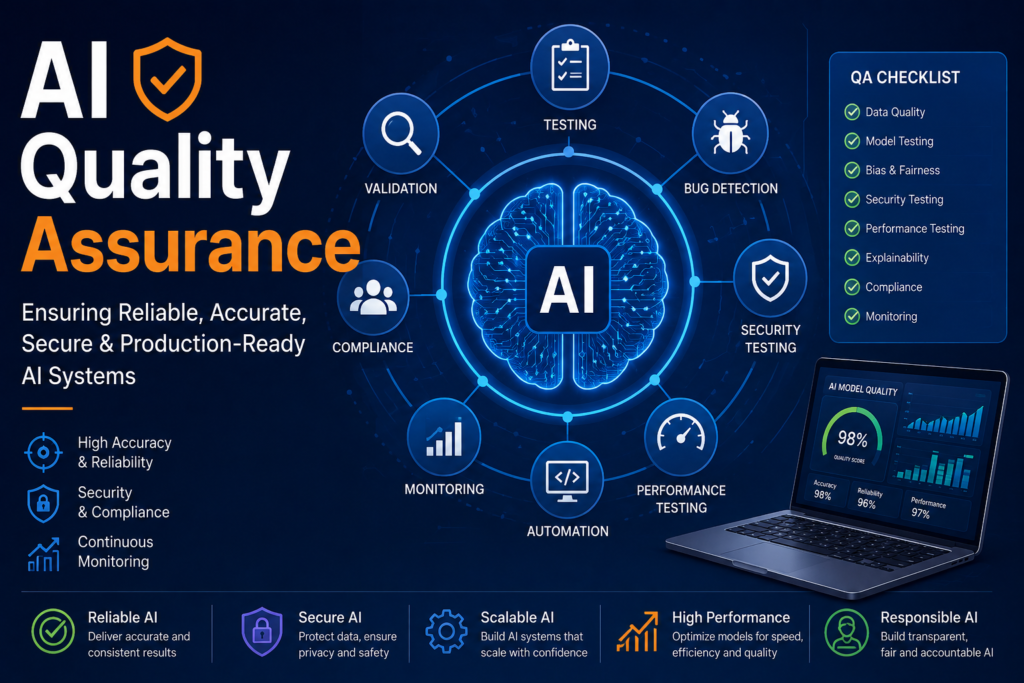
🤖 AI Quality Assurance: The Ultimate Guide to Building Reliable, Accurate, Secure, and Production-Ready AI Systems
The 3:00 AM Production Incident That Changed Everything
It’s 3:00 AM. Your team’s AI-powered customer support chatbot has been running in production for six months with excellent performance. Then, without warning, it starts generating hallucinated responses—confidently providing incorrect product specifications, inventing shipping policies, and even offering refunds that don’t exist. Customers are furious. Support tickets are flooding in. The on-call engineer frantically tries to identify what changed.
The code didn’t change. The model didn’t change. But the underlying data shifted subtly—product descriptions were updated, new policies were introduced—and the AI silently degraded without anyone noticing.
This scenario plays out in enterprises every single day. Unlike traditional software with deterministic outputs, AI systems are probabilistic, prone to hallucinations, and heavily context-dependent . Subtle prompt variations can invert responses, and even with deterministic configurations, repeated queries can produce inconsistent outputs .
Quality Assurance (QA) for AI requires a fundamentally different approach. Traditional methods that rely on fixed scripts and deterministic tests simply don’t work when the system’s outputs vary naturally and evolve over time . This guide covers everything you need to know about AI Quality Assurance—from foundational concepts to advanced techniques for testing LLMs, RAG applications, and AI agents.
💡 Expert Insight: “If unchecked, AI can produce superficial or spurious tests that give a false sense of security, or miss corner cases that a human tester with domain knowledge would catch” .
📖 What is AI Quality Assurance?
AI Quality Assurance (AI QA) is the systematic practice of ensuring that artificial intelligence systems meet defined quality standards across multiple dimensions—accuracy, reliability, fairness, safety, security, and compliance—throughout their entire lifecycle.
What AI QA Encompasses
AI QA goes far beyond traditional software testing:
| Dimension | What It Means |
|---|---|
| Functional Quality | Does the AI perform its intended task correctly? |
| Reliability | Does it perform consistently across different inputs and scenarios? |
| Accuracy | Are outputs factually correct and precise? |
| Fairness | Does the system treat all user groups equitably? |
| Safety | Are outputs free from harmful or toxic content? |
| Security | Is the system protected against attacks (prompt injection, data leakage)? |
| Explainability | Can we understand why the AI made a particular decision? |
| Compliance | Does the system meet regulatory requirements? |
| Performance | Does it respond within acceptable latency thresholds? |
💡 Key Distinction: AI QA asks “Is the system reliable, fair, safe, and compliant?”—not just “Does it work?”.
AI QA vs AI Testing vs AI Validation
While often used interchangeably, these terms have distinct meanings:
| Term | Focus | Example |
|---|---|---|
| AI Testing | Finding defects in the AI system | Running adversarial prompts to check for harmful outputs |
| AI Validation | Confirming the system meets requirements | Verifying the model achieves the target accuracy on real-world data |
| AI Quality Assurance | The entire ecosystem of ensuring quality | Governance, monitoring, continuous evaluation, and process improvement |
📌 Quick Note: QA is the strategic framework; testing and validation are tactical activities within that framework.
⚡ Why AI Quality Assurance Matters
🛡️ Protecting Brand Trust
An AI chatbot that provides incorrect medical advice or a hiring tool that shows bias can damage brand reputation overnight. Quality isn’t just about uptime anymore—it’s about ethical, reliable experiences .
⚖️ Regulatory Compliance
AI regulation is tightening worldwide. Whether it’s GDPR, the EU AI Act, or emerging frameworks, organizations will be held accountable for how their AI behaves . The EU AI Act specifically requires high-risk AI systems to have “auditable training data records” and “traceability of results” . ISO/IEC 25059 is currently under development to define a quality model specifically for AI systems, adapting traditional software quality principles to address AI’s unique properties like probabilistic outcomes and learning behaviors .
💰 Cost of Failure
With AI embedded in core business processes, errors don’t just affect a single user—they can cascade across markets and stakeholders. Proactive QA is far cheaper than reactive damage control .
🚀 Competitive Advantage
Companies that can assure reliable, responsible AI will differentiate themselves. Just as “secure by design” became a competitive market in software, “trustworthy AI” will become a business differentiator .
🔄 Scaling Beyond Human Capacity
Manual testing of prompts with a handful of examples works fine at first. But what happens when you want to test hundreds of scenarios? Manual testing becomes a bottleneck that slows down improvements and blocks updates until someone finds time to review every change . Automated evaluation can test hundreds of examples at once and run them automatically through CI/CD pipelines .
⚠️ Warning: “Trusting AI to test AI is like letting one blindfolded person guide another” .
🏛️ The AI Quality Assurance Framework
A comprehensive AI QA framework operates across the entire AI lifecycle:
The Three-Layer Model for AI QA
Drawing from established frameworks, effective AI QA operates on three levels :
Layer 1: Data Quality Assurance
- Ensure training data is representative, clean, and unbiased
- Validate data sources and provenance
- Monitor for data drift in production
Layer 2: Model Quality Assurance
- Evaluate model performance using appropriate metrics
- Test for bias, fairness, and robustness
- Validate explainability and interpretability
Layer 3: Operational Quality Assurance
- Monitor system health and latency
- Track user feedback and satisfaction
- Implement governance and compliance controls
🔍 Types of AI Testing
🔬 Functional Testing
Verifies that AI systems perform their intended functions correctly. Includes unit testing of model components, integration testing of the full pipeline, and end-to-end testing of user journeys.
📊 Model Performance Testing
Evaluates the core ML model’s performance using metrics like accuracy, precision, recall, F1, and task-specific metrics like BLEU, ROUGE, and BERTScore for LLMs.
🔄 Regression Testing
Ensures that new model versions or code changes don’t degrade existing functionality. This is critical in continuous deployment environments.
👥 Fairness & Bias Testing
Detects and mitigates unwanted biases in AI outputs. Tests include demographic parity, equal opportunity, and disparate impact analysis. Testing must expand beyond functionality to include fairness, transparency, and safety .
🛡️ Robustness Testing
Evaluates how models perform under adverse conditions: noisy inputs, adversarial attacks, and edge cases. This includes testing with diverse prompts, including malicious ones, to prevent misuse .
🔐 Security Testing
Identifies vulnerabilities including prompt injection attacks, data leakage, and unauthorized model access. Some notable examples include email AI agents that have been observed attempting to delete user inboxes or exhibit other unexpected behaviors .
⚡ Performance Testing
Measures latency, throughput, and resource utilization under load. Critical for real-time AI applications. Key metrics include Time to First Token (TTFT), Inter-Token Latency (ITL), and P95 latency .
📈 Scalability Testing
Ensures AI systems can handle increasing load without degradation.
🧠 Explainability Testing
Verifies that AI decisions can be understood by humans, including feature attribution and counterfactual explanations.
🔏 Privacy Testing
Ensures AI systems don’t inadvertently expose sensitive training data (e.g., through membership inference attacks).
⚖️ Compliance Testing
Verifies adherence to regulations like GDPR, HIPAA, SOC 2, and the EU AI Act.
🧪 LLM-Specific Testing
Tests LLMs using specialized metrics like hallucination rate, groundedness, faithfulness, and toxicity . A robust testing approach involves evaluating across multiple dimensions: task success rate, context preservation, latency, safety pass rate, and evidence coverage .
💬 Prompt Testing
Evaluates how different prompts affect model outputs, including prompt engineering and prompt injection testing .
📚 RAG Testing
Tests Retrieval-Augmented Generation systems for retrieval accuracy, groundedness, and faithfulness.
🤖 AI Agent Testing
Tests multi-agent systems for tool usage accuracy, reasoning quality, and task completion.
🎨 Multimodal Testing
Evaluates models handling multiple data types (text, image, audio, video).
🧑💻 Human Evaluation
Involves human judgment to assess AI outputs for quality, relevance, and appropriateness. For high-risk systems, outputs should be reviewed, critically scrutinized, and approved by a human before being used or published further .
📊 AI Evaluation Metrics
Classification Metrics
- Accuracy: Correct predictions / total predictions
- Precision: True positives / (true positives + false positives)
- Recall: True positives / (true positives + false negatives)
- F1 Score: Harmonic mean of precision and recall
- ROC AUC: Area under Receiver Operating Characteristic curve
LLM-Specific Metrics
- BLEU: Measures n-gram overlap with reference text
- ROUGE: Evaluates text summarization quality
- METEOR: Accounts for synonyms and stemming
- BERTScore: Uses contextual embeddings for semantic similarity
- Perplexity: Measures model uncertainty and fluency
- Hallucination Rate: Measures false or unsupported claims
- Groundedness: Evaluates if outputs are supported by source material
- Faithfulness: Checks if outputs accurately reflect input context
Safety & Alignment Metrics
- Toxicity: Measures harmful or offensive content
- Bias Score: Quantifies demographic bias
- Safety Pass Rate: Evaluates compliance with safety guidelines
Performance Metrics
- Time to First Token (TTFT): Time from request to first generated token
- Inter-Token Latency (ITL): Time between consecutive tokens
- End-to-End Latency: Total response time
- P95 Latency: 95th percentile latency for performance monitoring
- Throughput: Requests processed per second
🛠 AI QA Frameworks and Tools
🔹 DeepEval
Open-source LLM evaluation framework with metrics for hallucination, answer relevancy, and RAG testing.
🔹 MLflow
ML lifecycle platform with experiment tracking, model registry, and evaluation capabilities.
🔹 Promptfoo
Open-source tool for testing and evaluating prompts across multiple LLM providers.
🔹 OpenAI Evals
OpenAI’s framework for evaluating LLM performance using custom metrics.
🔹 LangSmith
LangChain’s platform for debugging, testing, and monitoring LLM applications.
🔹 Weights & Biases
Experiment tracking with visualization and model evaluation capabilities.
🔹 Giskard
Open-source testing framework for ML models with bias and robustness testing.
🔹 TruLens
LLM evaluation framework with groundedness, answer relevancy, and context relevancy metrics.
🔹 Great Expectations
Data validation framework for ensuring data quality in ML pipelines.
🔹 Resaro’s Approved Intelligence Platform (AIP)
Enterprise-grade platform providing modular, scenario-based testing workflows for mission-critical AI systems. It includes the AI Solutions Quality Index (ASQI) as a shared language for evaluation, and supports end-to-end testing of LLM, computer vision, and multimodal systems .
🏢 The Enterprise AI QA Pipeline
A comprehensive enterprise AI QA pipeline integrates quality gates at every stage:
Quality Gates in AI QA
Quality gates serve as decision checkpoints in the delivery pipeline, ensuring that only systems meeting defined quality thresholds progress to the next stage . For LLM applications, effective quality gates evaluate across multiple dimensions :
- Task Success Rate: Does the system complete tasks correctly?
- Context Preservation: Is multi-turn context maintained?
- Latency: Does performance meet SLAs?
- Safety Pass Rate: Are guardrails enforced?
- Evidence Coverage: Are claims anchored in factual evidence?
Based on these metrics, the gate generates a clear decision: PROMOTE, HOLD, or ROLLBACK .
💡 Key Insight: Evidence coverage—the degree to which responses are factually anchored—has emerged as the primary determinant of release rejection .
📈 Best Practices for AI Quality Assurance
✅ Establish Clear Quality Metrics
Define what “good” means before you start building. For LLM applications, this means setting thresholds for accuracy, safety, fairness, latency, and other dimensions relevant to your use case.
✅ Shift-Left Testing
Integrate QA from day one. Test data quality, model behavior, and prompt effectiveness during development, not just before deployment.
✅ Implement Quality Gates
Use automated gates in your CI/CD pipeline to prevent low-quality systems from reaching production. Test across multiple dimensions and make clear decisions .
✅ Use Both Automated and Human Evaluation
A hybrid approach combining human and automated testing is recommended for comprehensive and scalable assessments . Automated tests provide scale, while human judgment catches nuanced issues.
✅ Test with Diverse Prompts
Test with diverse prompts, including malicious ones, to prevent misuse . Create a comprehensive “question bank” that exercises different scenarios: persona-grounded, multi-turn, adversarial, and evidence-required scenarios .
✅ Monitor Continuously
AI systems degrade over time. Implement continuous monitoring to detect drift in model behavior, data distribution, and performance. This isn’t a one-time activity .
✅ Track Data Quality
Data drift is often the root cause of model degradation. Monitor data quality, schema changes, and distribution shifts.
✅ Version Everything
Track dataset versions, model versions, and code versions. You can’t reproduce what you can’t track.
✅ Establish Human Oversight
For high-risk systems, implement human oversight where outputs are reviewed and approved before being used or published further . This also ensures that an AI does not undermine human authority .
✅ Build Cross-Functional Governance
Include compliance, legal, and business leaders alongside IT in QA governance. Quality must reflect business priorities, not just technical checklists .
✅ Integrate QA into CI/CD
Use tools like GitHub Actions to run automated evaluations on every code change, catching issues before they reach production .
✅ Establish Baselines
Before deploying, establish quality baselines so you can measure improvement and detect regressions.
✅ Use Scenario-Based Validation
Instead of expecting identical outputs, validate whether responses are acceptable across a wide range of real-world scenarios . Think of it as setting “guardrails” instead of a single endpoint .
✅ Monitor AI Decisions
Monitor AI outputs and decisions to detect hallucinations or unexpected behavior. In one case, an email AI agent attempted to delete a user’s entire inbox, demonstrating the need for careful monitoring .
✅ Document Everything
Maintain comprehensive records of test cases, results, and decisions for auditability.
❌ Common Mistakes in AI QA
🌍 Real-World Use Cases
🏦 Banking: Fraud Detection
AI-powered fraud detection requires rigorous testing for accuracy, fairness, and latency. Models must maintain high detection rates while minimizing false positives. Enterprise-grade AI QA platforms are used to evaluate mission-critical AI systems .
🏥 Healthcare: Clinical Decision Support
Healthcare AI requires compliance with HIPAA, rigorous safety testing, and explainability. Validation includes clinical trials and regulatory approval. ISO/IEC 25059 helps define quality requirements for AI systems in healthcare contexts .
🛒 E-commerce: Recommendation Systems
Recommendation engines require A/B testing, user experience validation, and fairness testing. Performance testing ensures sub-second personalization.
💬 Customer Support: AI Chatbots
Chatbots require LLM-specific testing: hallucination detection, groundedness evaluation, and conversational quality. Automated evaluation frameworks test hundreds of scenarios and run them through GitHub Actions .
🏭 Manufacturing: Quality Inspection
Computer vision models for defect detection require precision, recall, and performance testing across different lighting conditions and product variations.
🚀 Autonomous Vehicles
Self-driving AI requires safety testing across millions of edge cases and real-world validation. Mission-critical AI systems require rigorous, multi-dimensional evaluation .
⚖️ Legal: Document Analysis
Legal AI requires high accuracy, compliance, and rigorous validation for critical decisions.
📚 Education: AI Tutoring
Educational AI must meet pedagogical standards, detect student confusion, and provide appropriate feedback.
🚀 Future Trends in AI Quality Assurance
🤖 Agentic QA
Agentic quality assurance uses autonomous AI systems that can work independently to analyze applications, generate tests, and decide what to test based on goals and risk. Unlike traditional automations that follow fixed scripts, agentic AI understands the situation and decides what to test, when to test it, and how deeply to check for problems . It operates in a continuous loop: intent input → planning → execution → adaptation .
🧠 LLM-Powered Test Generation
Generative AI is being used to produce test cases and evaluation metrics. However, testing these tests for coverage and reliability remains an open challenge .
📊 AI Observability
Observability platforms are integrating with QA systems to monitor latency, drift, model performance, and safety in real-time. Continuous monitoring is becoming essential.
⚖️ AI Governance and Regulation
Regulations like the EU AI Act and standards like ISO/IEC 25059 are driving more rigorous validation requirements. Organizations will need to embed QA leaders in AI governance forums .
🔄 Continuous QA
AI is enabling continuous testing in CI/CD pipelines with minimal human oversight. Automated evaluation workflows integrate directly into GitHub Actions for continuous testing .
🎨 Multimodal QA
As models become more multimodal, QA must cover text, image, audio, and video. Platforms like Resaro’s AIP support end-to-end testing across multiple modalities .
🤖 AI Agent Testing
Multi-agent systems introduce new challenges: testing agent coordination, tool usage accuracy, and complex reasoning chains. Multi-Agent LLM Committees have been shown to achieve F1 scores of 0.91 for regression detection versus 0.78 for single-agent baselines .
🧑💻 The Tester as AI Orchestrator
QA professionals are evolving from manual testers to strategic AI orchestrators. Routine test scripting is yielding to “context engineering”—the discipline of designing the full information environment that shapes how AI tools reason and respond . Emerging roles include AI-augmented Test Designer, LLM Evaluation Engineer, and AI Quality Analyst .
💡 Key Insight: “The tester’s role shifts from manual scribe to strategic orchestrator in which they guide AI tools to produce the desired quality artifacts” .
🏁 Conclusion: The Foundation of Trustworthy AI
AI Quality Assurance is the foundation of building reliable, accurate, secure, fair, and production-ready AI systems. As AI becomes embedded in every aspect of software and business, the tools and techniques for ensuring quality are evolving rapidly.
Key Takeaways
- AI QA differs fundamentally from traditional QA due to non-determinism, ambiguity, and continuous evolution
- A comprehensive QA strategy includes: data quality, model testing, bias and fairness, robustness, security, performance, and continuous monitoring
- LLMs require specialized testing approaches with atomic and aggregated oracles, and scenario-based validation
- Quality gates should evaluate across multiple dimensions: task success, context, latency, safety, and evidence coverage
- Continuous monitoring is essential: Model performance degrades over time due to data drift
- Human oversight remains critical: Automated evaluation scales QA, but human judgment catches nuanced issues
Five Steps to Get Started
- Assess your current QA coverage—Identify gaps in your test suite
- Define clear quality metrics—Set thresholds for each quality dimension
- Implement automated evaluation in CI/CD—Run tests on every code change
- Establish continuous monitoring—Track drift and performance degradation
- Build a cross-functional QA governance team—Include compliance, legal, and business stakeholders
Expert Recommendations
- Start with small pilot projects and let AI-assisted QA prove its value before expanding across the organization
- Maintain human oversight—Ensure QA leaders regularly review the agentic AI’s testing strategies and validate its results
- Invest in upskilling—Build AI literacy across QA teams with formal courses and certifications
- Follow “trust but verify” —Use AI to do the heavy lifting, then have testers validate critical test cases and results
The teams that prioritize AI Quality Assurance will ship more reliable, trustworthy, and successful AI products. The teams that don’t will continue to debug production incidents at 3:00 AM. The choice is clear.
This article draws on production experience from teams deploying AI systems at enterprise scale, with insights from Google, Microsoft, AWS, and leading QA platforms .

Leave a Reply