REST APIs for AI
The explosion of AI-powered applications has fundamentally changed how businesses think about integration. Large language models (LLMs), computer vision, speech recognition, and recommendation engines are no longer experimental—they are production services that must connect seamlessly with web applications, mobile apps, enterprise systems, and autonomous AI agents.
REST APIs have become the standard interface for exposing AI capabilities. Whether organizations integrate OpenAI GPT-4, Google Gemini, Azure OpenAI, AWS Bedrock, NVIDIA NIM, or custom AI models, REST APIs provide a consistent, stateless interface that enables secure and scalable communication across platforms.
What is a REST API?
REST (Representational State Transfer) is an architectural style for designing HTTP-based web services. REST APIs expose resources using standard HTTP methods while following principles such as stateless communication, client-server separation, cacheability, layered architecture, and a uniform interface.
| HTTP Method | Purpose in AI |
|---|---|
| POST | Send prompts or inference requests |
| GET | Retrieve available AI models |
| PUT | Update stored resources |
| DELETE | Delete sessions or resources |
Why REST APIs Are Ideal for AI
Platform Independence
REST APIs are language independent and can be consumed from Java, Python, JavaScript, Go, C#, Swift, and virtually every programming language.
Stateless Simplicity
Every request contains all required information, allowing requests to be processed independently and routed to any available server instance.
Easy Integration
Developers already understand HTTP and JSON, making REST APIs simple to integrate into existing applications.
Cloud Friendly
Major cloud providers expose AI models using REST endpoints, making deployment straightforward across hybrid and multi-cloud environments.
REST API Architecture for AI
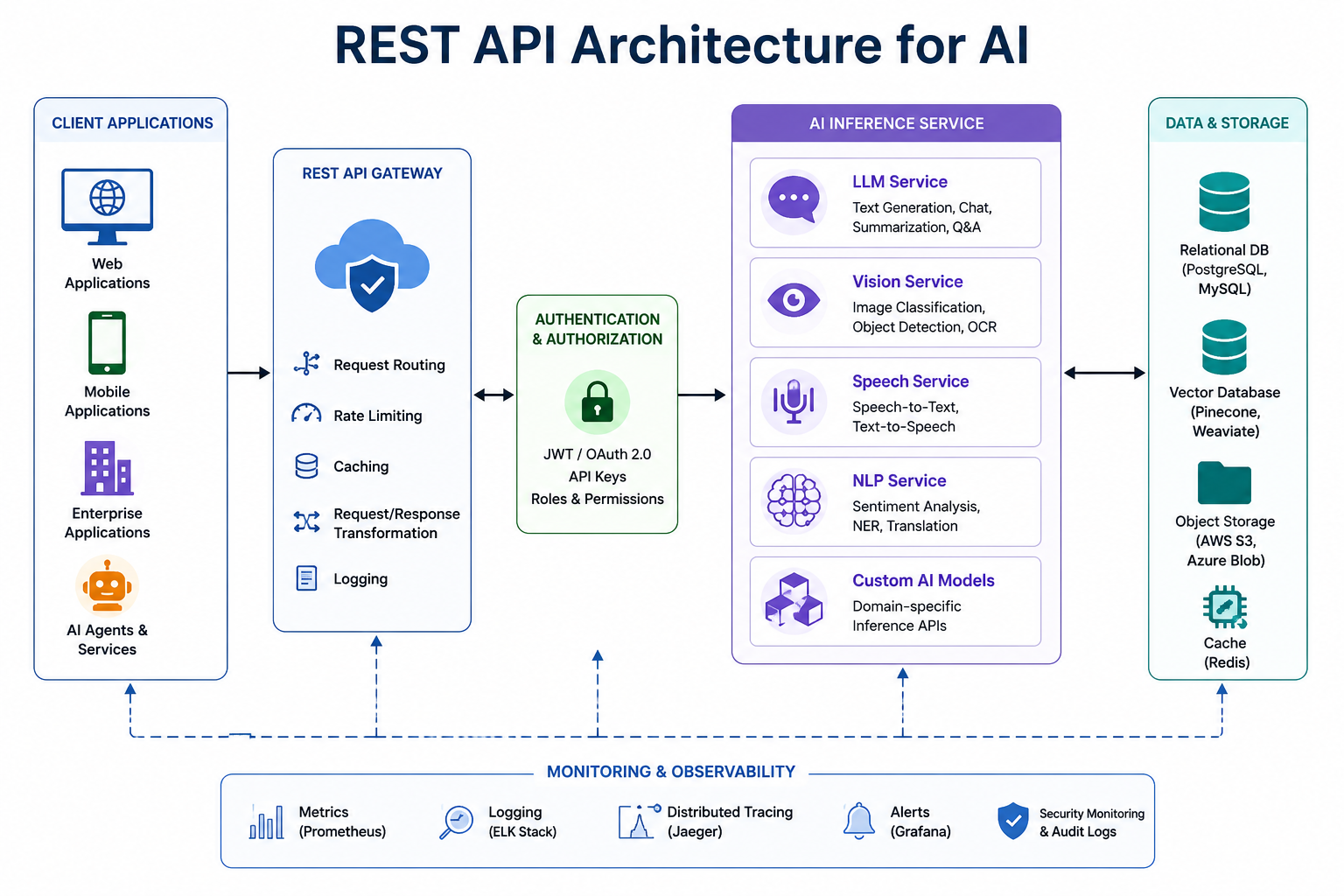
Client applications communicate with an API Gateway, which authenticates incoming requests before forwarding them to AI inference services. Depending on the workload, requests are processed by LLMs, vision models, speech models, or NLP services. Results may be stored inside databases or vector databases before returning structured JSON responses.
API Request Processing Workflow
Client Request
      ↓
Authentication
      ↓
Input Validation
      ↓
AI Model Processing
      ↓
Post Processing
      ↓
JSON Response
REST API Request Example
{
  "model":"gpt-4",
  "messages":[
    {
      "role":"system",
      "content":"You are a helpful assistant."
    },
    {
      "role":"user",
      "content":"Explain REST APIs for AI"
    }
  ],
  "temperature":0.7,
  "max_tokens":500
}
The request specifies the model, prompt, temperature, and maximum output tokens required for inference.
REST API Response Example
{
 "id":"chatcmpl-123",
 "object":"chat.completion",
 "model":"gpt-4",
 "choices":[
   {
     "message":{
       "role":"assistant",
       "content":"REST APIs are HTTP-based interfaces..."
     }
   }
 ]
}
The response includes generated content together with model metadata and token usage for monitoring and billing.
REST API Design Patterns for AI
Consistent Response Structure
A consistent response structure makes client-side development easier while improving debugging and monitoring. Every API should return predictable fields regardless of success or failure.
{
  "success": true,
  "data": {
      "prediction":"approved",
      "confidence":0.82,
      "model_version":"v44",
      "timestamp":"2025-03-01T13:55:00Z"
  },
  "sessionId":"abc123"
}
- Always return a success field.
- Include model_version for traceability.
- Return sessionId for debugging.
- Use standardized error responses.
Input Validation
Input validation protects AI systems from malformed requests, reduces inference costs, and improves API security by rejecting invalid requests before they reach the model.function validateAnalyzeRequest(req,res,next){
const { message } = req.body;
if(!message){
return res.status(400).json({
success:false,
error:"Message is required"
});
}
if(message.length > 10000){
return res.status(400).json({
success:false,
error:"Message too long"
});
}
next();
}
Idempotency for Safe Writes
Endpoints that perform billing, payments, messaging, or irreversible actions should support idempotency to prevent duplicate processing.
- Support Idempotency-Key headers.
- Use POST for creation and PUT for replacement.
- Return HTTP 409 Conflict for duplicate requests.
- Store request identifiers securely.
Structured Error Responses
AI APIs should follow RFC 7807 Problem Details so every error is predictable and machine-readable.
{
 "type":"https://api.example.com/errors/rate-limit",
 "title":"Too Many Requests",
 "status":429,
 "detail":"Rate limit exceeded.",
 "retry_after":60
}
AI REST API Endpoints
| Method | Endpoint | Purpose |
|---|---|---|
| POST | /v1/chat/completions | Generate chat responses |
| POST | /v1/embeddings | Generate embeddings |
| POST | /v1/image/generate | Generate images |
| POST | /v1/speech-to-text | Speech transcription |
| POST | /v1/text-to-speech | Generate speech |
| GET | /v1/models | List AI models |
| POST | /v1/predict | Custom prediction |
Authentication Methods
| Method | Typical Use |
|---|---|
| API Keys | Server-to-server integration |
| JWT | User authentication |
| OAuth 2.0 | Enterprise authorization |
| Bearer Token | HTTP Authorization header |
REST vs GraphQL vs gRPC
| Feature | REST | GraphQL | gRPC |
|---|---|---|---|
| Ease of Use | Excellent | Medium | Advanced |
| AI Inference | Excellent | Good | Excellent |
| Streaming | Limited | Good | Excellent |
| Performance | High | High | Very High |
Enterprise Use Cases
REST APIs enable organizations to integrate AI capabilities into production applications through standardized HTTP interfaces. From conversational AI to healthcare and financial analytics, REST endpoints make AI services secure, scalable, and easy to consume.
| Use Case | Description |
|---|---|
| Generative AI Chatbots | Deploy intelligent assistants capable of serving thousands of concurrent users through REST APIs. |
| Retrieval-Augmented Generation (RAG) | Connect vector databases, embedding models, and LLMs using REST endpoints. |
| Computer Vision | Process images and videos through AI inference APIs. |
| Speech AI | Provide speech-to-text and text-to-speech services through REST interfaces. |
| Recommendation Engines | Deliver personalized recommendations in real time. |
| Healthcare AI | Deploy secure diagnostic and clinical AI applications. |
| Financial AI | Implement fraud detection, compliance, and risk analysis solutions. |
Best Practices for REST APIs for AI
1. Implement Stateless APIs
Each request should contain all required context. Stateless APIs simplify scaling and improve reliability across distributed AI systems.
2. Use Strong API Schemas
Treat OpenAPI specifications as contracts rather than documentation. Clearly define request and response structures for every endpoint.
3. Design for AI Agents
AI agents retry requests more aggressively than humans. Implement dedicated rate limits, predictable responses, and reliable retry behavior.
4. Prevent Over-fetching
Return only the information required by the AI model. Smaller responses reduce latency and token consumption.
5. Implement Idempotency
Support idempotency keys for POST and PATCH operations to prevent duplicate execution during retries.
6. Maintain OpenAPI Documentation
Generate documentation automatically and keep API specifications synchronized with implementation.
7. Secure APIs with OAuth 2.1
Use fine-grained permissions, token rotation, and least-privilege access to secure AI services.
Common Challenges
| Challenge | Recommended Solution |
|---|---|
| Large Payloads | Compress requests and optimize response size. |
| Token Limits | Split long documents into manageable chunks. |
| High API Latency | Use caching, edge deployments, and load balancing. |
| Rate Limits | Implement retry mechanisms with exponential backoff. |
| Prompt Injection | Validate and sanitize all incoming inputs. |
| Version Compatibility | Adopt URL or header-based API versioning. |
| Cost Optimization | Monitor token usage and enforce quotas. |
REST vs MCP for AI Agents
REST APIs were originally designed for human-driven applications where a client sends a request, waits for a response, and completes the interaction. AI agents, however, operate differently. They work autonomously, perform thousands of API calls, retry requests aggressively, and need to discover available tools dynamically.
The Model Context Protocol (MCP) extends REST by providing AI-native capabilities such as runtime tool discovery, structured interactions, and stateful sessions. Rather than replacing REST, MCP acts as an intelligent layer that exposes existing REST APIs in a format AI agents can easily understand and use.
| REST APIs | Model Context Protocol (MCP) |
|---|---|
| Designed for traditional applications | Designed specifically for AI agents |
| Static endpoint access | Dynamic tool discovery |
| Stateless communication | Supports richer contextual interactions |
| Widely supported across applications | Optimized for autonomous AI workflows |
How MHTECHIN Supports REST APIs for AI
Building production-ready REST APIs for AI requires expertise in API architecture, authentication, cloud infrastructure, scalability, and observability. MHTECHIN helps organizations design and deploy secure, high-performance AI APIs that integrate seamlessly with enterprise applications.
| Service | How MHTECHIN Helps |
|---|---|
| AI API Architecture | Design scalable REST APIs for LLMs, vision, speech, and custom AI models. |
| LLM Integration | Integrate OpenAI, Google Gemini, Azure AI, AWS Bedrock, NVIDIA NIM, and other AI platforms. |
| Kubernetes Deployment | Deploy and scale AI APIs efficiently using Kubernetes and cloud-native technologies. |
| Monitoring & Observability | Implement centralized logging, metrics, tracing, and performance monitoring. |
By combining AI engineering, cloud-native development, API security, and DevOps best practices, MHTECHIN enables organizations to build reliable REST API platforms that power intelligent applications across web, mobile, enterprise, and edge environments.
Conclusion
REST APIs have become the backbone of modern AI integration. From large language models and computer vision systems to speech recognition and recommendation engines, standardized HTTP interfaces allow intelligent services to integrate seamlessly with virtually every application and platform.
As AI agents become more autonomous, API design is evolving beyond traditional human-centric interactions. Production-ready AI APIs must be secure, scalable, stateless, well-documented, and optimized for both developers and machine consumers.
Organizations that invest in well-designed REST APIs today will be better positioned to support future AI innovations, autonomous agents, and enterprise-scale intelligent applications. With the right API architecture, businesses can unlock secure, reliable, and scalable AI integration that drives long-term digital transformation.

Leave a Reply