Introduction
Modern enterprise applications consume data from numerous backend systems including databases, microservices, cloud platforms, and AI services. As applications become increasingly complex, traditional REST APIs often introduce unnecessary network requests, over-fetching of data, and multiple endpoint calls.
GraphQL addresses these challenges by allowing clients to request exactly the information they need through a single endpoint. Originally developed by Facebook in 2012 and released as open source in 2015, GraphQL has become one of the most widely adopted technologies for modern API development. Organizations including GitHub, Shopify, Netflix, and many enterprise software providers rely on GraphQL to simplify application development while improving performance.
Unlike REST APIs, where the server determines the response format, GraphQL places the client in control. Applications request only the required fields, reducing bandwidth usage and eliminating unnecessary API calls. This flexibility makes GraphQL particularly valuable for web applications, mobile applications, and AI-powered systems that require efficient data retrieval.
What Is GraphQL?
GraphQL is a query language for APIs and a runtime for executing those queries against existing data sources. Instead of exposing numerous REST endpoints that each return predefined data structures, GraphQL provides a single endpoint capable of returning exactly the information requested by the client.
Clients define the structure of the response by specifying the required fields within a query. The GraphQL server validates the request against its schema, executes the necessary resolvers, gathers data from databases or backend services, and returns a structured JSON response that mirrors the requested query.
GraphQL shifts control from the server to the client. Rather than exposing multiple endpoints with fixed responses, clients request only the exact data they need, improving efficiency and reducing unnecessary network traffic.
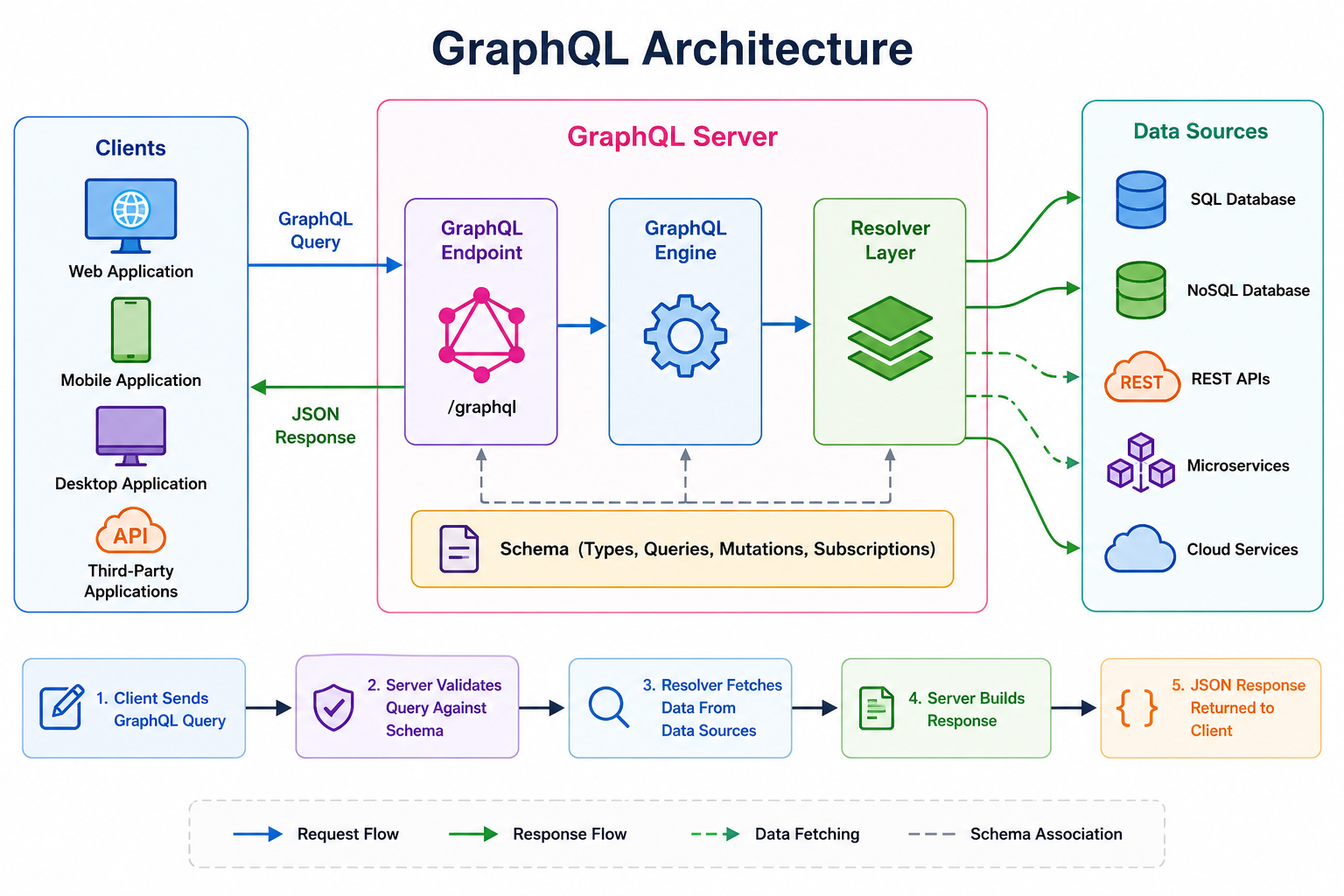
GraphQL Architecture
A typical GraphQL deployment places a GraphQL server between client applications and backend services. The GraphQL layer receives incoming queries, validates them against the schema, executes resolver functions, and retrieves data from one or more underlying systems before returning a unified JSON response.
Instead of exposing several REST endpoints, GraphQL acts as a centralized data layer that aggregates information from databases, REST services, and microservices. This architecture simplifies client applications while improving maintainability across enterprise systems.
REST vs GraphQL
| Feature | REST | GraphQL |
|---|---|---|
| Endpoints | Multiple | Single |
| Data Fetching | Fixed Response | Client Defined |
| Over-fetching | Common | Eliminated |
| Versioning | URL Based | Schema Evolution |
| Learning Curve | Easy | Moderate |
REST follows a resource-oriented architecture where each endpoint represents a specific resource. GraphQL, in contrast, focuses on relationships between data and allows clients to navigate these relationships within a single query.
How GraphQL Works
Every GraphQL request follows a structured lifecycle. A client submits a query to the GraphQL endpoint specifying the required fields. The server validates the query against its schema, executes resolver functions, retrieves information from backend systems, and constructs a JSON response that matches the original query structure.
This request-response model enables applications to retrieve information efficiently while reducing unnecessary network calls. Since only requested fields are returned, GraphQL significantly improves application responsiveness, especially for mobile applications and AI-driven systems.
The GraphQL Request-Response Cycle
Every GraphQL operation follows a well-defined execution flow that ensures only the requested information is returned. This efficient execution model is one of the primary reasons GraphQL has become popular for enterprise and AI-driven applications.
-
Client Sends Query
The client submits a GraphQL query to a single endpoint specifying exactly which fields are required. -
Schema Validation
The GraphQL server validates the query against the predefined schema to ensure requested fields and types exist. -
Resolver Execution
Resolvers fetch data from databases, REST APIs, cloud services, or microservices. -
Response Generation
The server returns a structured JSON response that mirrors the query hierarchy.
GraphQL Schemas and Types
The GraphQL schema acts as a contract between clients and servers. It defines available object types, fields, queries, mutations, and subscriptions while ensuring strong typing throughout the API.
Because every field has a predefined type, clients know exactly what data they can request before sending a query. This improves developer productivity and minimizes runtime errors.
user(id: ID!): User
posts(limit: Int): [Post!]!
}
type User {
id: ID!
name: String!
email: String!
posts: [Post!]!
}
Schemas provide built-in documentation, enforce consistency, validate requests automatically, and make GraphQL APIs easier to maintain as applications evolve.
Example GraphQL Query
A GraphQL query specifies only the fields required by the client. Unlike REST APIs, unnecessary information is never transferred.
user(id: $userId) {
name
posts {
title
content
publishedAt
}
}
}
Example JSON Response
The GraphQL response follows exactly the same structure as the query, making responses highly predictable and easy to consume.
“data”: {
“user”: {
“name”: “John Doe”,
“email”: “john@example.com”,
“posts”: [
{
“title”:”GraphQL for AI”
}
]
}
}
}
Why GraphQL Matters for Enterprise Applications
GraphQL improves enterprise application development by simplifying frontend integration while reducing backend complexity. Instead of creating numerous REST endpoints for different screens or devices, organizations expose a single GraphQL endpoint that supports multiple use cases.
- Developer Productivity — Frontend teams request exactly the fields they require without waiting for backend endpoint modifications.
- API Evolution — New fields can be added without breaking existing clients, eliminating traditional API versioning challenges.
- Better Performance — Reduced over-fetching and fewer network requests improve response times.
- Microservice Integration — GraphQL aggregates information from multiple services into one unified response.
GraphQL serves as a unified data layer between frontend applications and distributed backend services, simplifying development while improving scalability.
GraphQL for AI Applications
GraphQL is increasingly being adopted for AI-powered applications because AI systems often require information from multiple data sources. A single GraphQL query can combine structured database records, vector search results, user profiles, and external APIs into one response.
For Retrieval-Augmented Generation (RAG), GraphQL simplifies access to embeddings, vector databases, enterprise knowledge bases, and business applications while minimizing unnecessary data transfer.
AI agents also benefit from GraphQL’s introspection capabilities, allowing them to automatically discover available queries, mutations, and data structures without manual API documentation.
OpenAPI vs GraphQL
Although both OpenAPI and GraphQL are widely used for API development, they address different requirements. OpenAPI focuses on documenting REST endpoints, while GraphQL provides a strongly typed query language that enables clients to request exactly the information they need.
| Aspect | OpenAPI | GraphQL |
|---|---|---|
| API Discovery | Swagger / OpenAPI Documentation | Built-in Introspection |
| Query Flexibility | Fixed Responses | Client-defined Queries |
| Complexity Management | API Specifications | Strong Type System |
| AI Agent Integration | Manual Tool Definitions | Automatic Discovery |
| Security | Endpoint Level | Field Level |
GraphQL for AI Integration Workflow
Modern AI applications frequently combine structured business information, vector databases, external APIs, and machine learning models. GraphQL acts as a unified gateway that retrieves data from multiple systems before sending it to AI models for processing.
Instead of making several REST API calls, applications issue a single GraphQL query. The GraphQL gateway retrieves information from vector databases, SQL databases, REST services, and enterprise systems before returning a unified JSON response for AI inference.
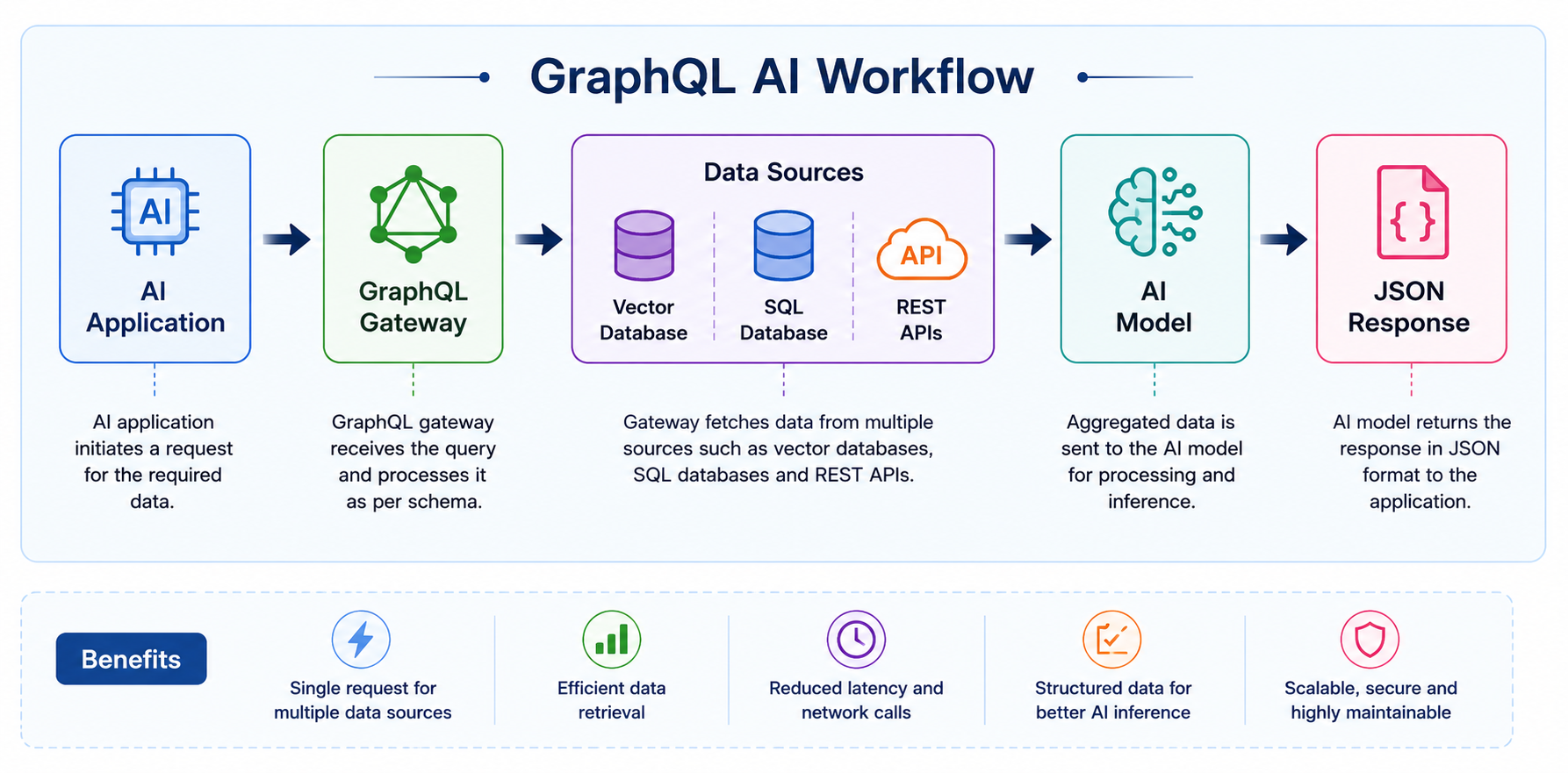
Enterprise GraphQL Integration
GraphQL is widely adopted in enterprise environments because it simplifies communication between frontend applications and distributed backend systems. A GraphQL gateway aggregates responses from databases, microservices, legacy systems, and cloud APIs into a single response.
This centralized approach reduces frontend complexity while improving scalability and maintainability across enterprise applications.
Benefits of GraphQL Integration
| Benefit | Business Impact |
|---|---|
| Single Endpoint | Simplifies client configuration and API management. |
| Client-driven Queries | Frontend teams evolve independently without backend modifications. |
| No Versioning | Schemas evolve without breaking existing applications. |
| Strong Typing | Built-in validation and self-documenting APIs. |
| Federation | Combine multiple backend services into one unified API. |
| Subscriptions | Support real-time updates for dashboards and AI applications. |
GraphQL Subscriptions for AI Streaming
Unlike REST APIs, GraphQL provides native support for subscriptions, enabling clients to maintain persistent connections and receive real-time updates from the server.
For AI-powered applications, subscriptions enable streaming chatbot responses, live document analysis, progress tracking for long-running inference tasks, and real-time notifications without repeated polling.
- Streaming Large Language Model (LLM) responses.
- Live AI document processing progress.
- Real-time recommendation updates.
- Instant notifications for AI-generated events.
- Continuous monitoring dashboards.
Challenges of GraphQL Integration
| Challenge | Mitigation |
|---|---|
| Caching Complexity | Use Apollo Client cache and normalized caching. |
| N+1 Query Problem | Implement DataLoader for batching and caching. |
| Security | Apply field-level authorization and query complexity analysis. |
| Performance | Use query depth limits and resolver optimization. |
| File Uploads | Support multipart upload specifications. |
| Learning Curve | Invest in GraphQL training and developer tooling. |
The N+1 Query Problem
One of the most common GraphQL performance issues is the N+1 query problem. It occurs when a query requests a list of objects and every object triggers another database query to retrieve related data.
The recommended solution is DataLoader, which batches similar database requests and caches results during execution. Instead of executing dozens or hundreds of database queries, DataLoader reduces them to only a few efficient operations.
Popular GraphQL Tools and Technologies
| Technology | Purpose |
|---|---|
| Apollo Server | GraphQL server implementation |
| Apollo Client | Frontend GraphQL client |
| GraphQL Yoga | Full-featured GraphQL server |
| GraphQL Code Generator | Generate strongly typed client code |
| GraphQL Inspector | Schema comparison and validation |
| DataLoader | Batch and cache database requests |
| GraphQL Shield | Authorization middleware |
| GraphQL Playground | Interactive GraphQL IDE |
GraphQL Gateway Comparison
| Aspect | GraphQL Gateway | REST API Gateway |
|---|---|---|
| Protocol | GraphQL | HTTP / REST |
| Data Fetching | Client-defined query | Multiple endpoints |
| Microservice Integration | Federation | Routing |
| AI Agent Support | Built-in Introspection | Manual Tool Discovery |
How MHTECHIN Supports GraphQL Integration
Successfully adopting GraphQL requires expertise in schema design, security, federation, API performance, and enterprise integration. MHTECHIN helps organizations implement scalable GraphQL solutions tailored to modern applications.
- Strongly typed schema development and governance.
- AI agent integration using.
- Field-level authorization and security policies.
- Performance optimization using DataLoader and resolver tuning.
By combining API engineering, cloud-native architecture, and AI integration expertise, MHTECHIN enables organizations to build secure, efficient, and developer-friendly GraphQL platforms.
Conclusion
GraphQL has evolved into a mature enterprise technology that enables flexible, client-driven data access while eliminating over-fetching and reducing unnecessary network requests. Its strongly typed schema, single endpoint architecture, and support for efficient microservice integration make it an excellent choice for modern enterprise systems.
As AI applications and autonomous agents continue to grow, GraphQL’s introspection capabilities and flexible query model provide significant advantages for intelligent software ecosystems. Organizations that invest in thoughtful schema design, security, and performance optimization will be well-positioned to build scalable, future-ready applications.
Whether integrating existing services or designing new AI-powered platforms, GraphQL offers a modern approach to API development that improves developer productivity, application performance, and long-term maintainability.

Leave a Reply