What Is Edge AI Deployment?
Edge AI Deployment is the practice of running artificial intelligence models directly on local hardware rather than sending all information to centralized cloud servers for inference. The AI model resides on—or very close to—the device generating the data, allowing decisions to happen immediately.
Sensors, cameras and connected devices continuously capture real-world data.
Embedded systems, gateways or AI accelerators execute inference locally.
Optimized neural networks process incoming data without depending on cloud latency.
Only selected results or summaries are synchronized back to the cloud for reporting or retraining.
Why Edge AI Matters
⚡ Real-Time Decisions
Applications such as autonomous driving and industrial inspection require responses within milliseconds, making cloud latency unacceptable.
🔒 Better Privacy
Sensitive information remains inside hospitals, factories or enterprise facilities instead of being continuously transmitted externally.
📶 Offline Operation
Edge AI continues functioning during internet outages, ensuring uninterrupted business operations.
💰 Lower Bandwidth Costs
Instead of sending continuous video or sensor streams, only meaningful insights need to be transferred.
How Edge AI Deployment Works
Unlike traditional cloud AI, Edge AI performs inference directly where data is generated. Instead of continuously transmitting raw information to remote servers, intelligent devices process data locally, make immediate decisions, and optionally synchronize only relevant insights with centralized cloud platforms.
This architecture dramatically reduces latency while improving privacy, minimizing bandwidth usage, and enabling systems to continue operating even when internet connectivity is unavailable.
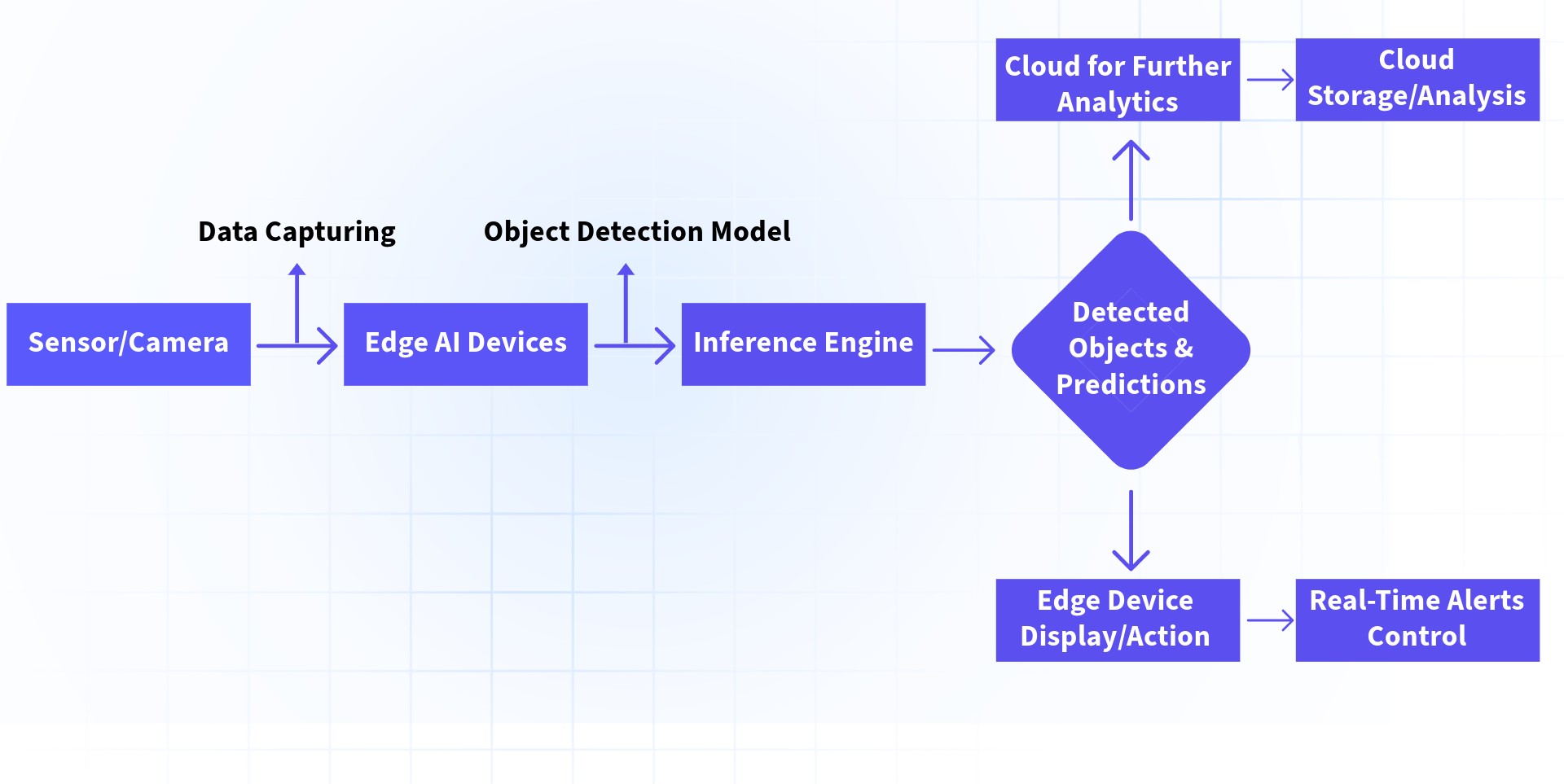
Typical Edge AI Workflow
Sensors, IoT devices, cameras, microphones, and industrial equipment continuously capture raw operational data.
The optimized AI model executes inference directly on nearby hardware without waiting for cloud communication.
Predictions are immediately converted into actions such as detecting defects, identifying obstacles, recognizing faces, or triggering alerts.
Machines, robots, industrial controllers, or applications respond instantly based on AI predictions.
Only selected results, logs, or aggregated insights are transmitted back to centralized cloud systems for monitoring, analytics, or future model retraining.
Core Components of an Edge AI System
📷 IoT Devices
Sensors, industrial machines, cameras, drones, wearable devices, and embedded hardware continuously generate operational data.
🖥 Edge Device
Embedded computers, AI gateways, industrial PCs, or dedicated accelerators execute inference close to the data source.
🧠 AI Model
Compressed, quantized, or optimized models deliver fast predictions while fitting within limited hardware resources.
💾 Local Storage
Stores temporary data, predictions, event logs, and buffered information before synchronization.
🏢 Enterprise Applications
Business applications consume AI predictions for automation, reporting, maintenance, and operational workflows.
☁ Cloud Dashboard
Provides centralized monitoring, analytics, fleet management, software updates, and long-term storage.
Cloud AI vs Edge AI
| Feature | Cloud AI | Edge AI |
|---|---|---|
| Processing Location | Centralized cloud infrastructure | Local device or nearby gateway |
| Latency | Higher | Milliseconds |
| Internet Dependency | Required | Can operate offline |
| Bandwidth Usage | High | Low |
| Privacy | Data transmitted externally | Data remains local |
| Scalability | Virtually unlimited | Limited by local hardware |
Edge AI Deployment Lifecycle
Unlike cloud AI, Edge AI requires an additional optimization stage before deployment. Models must be compressed and optimized to run efficiently on hardware with limited compute power, memory, and battery capacity while maintaining acceptable accuracy.
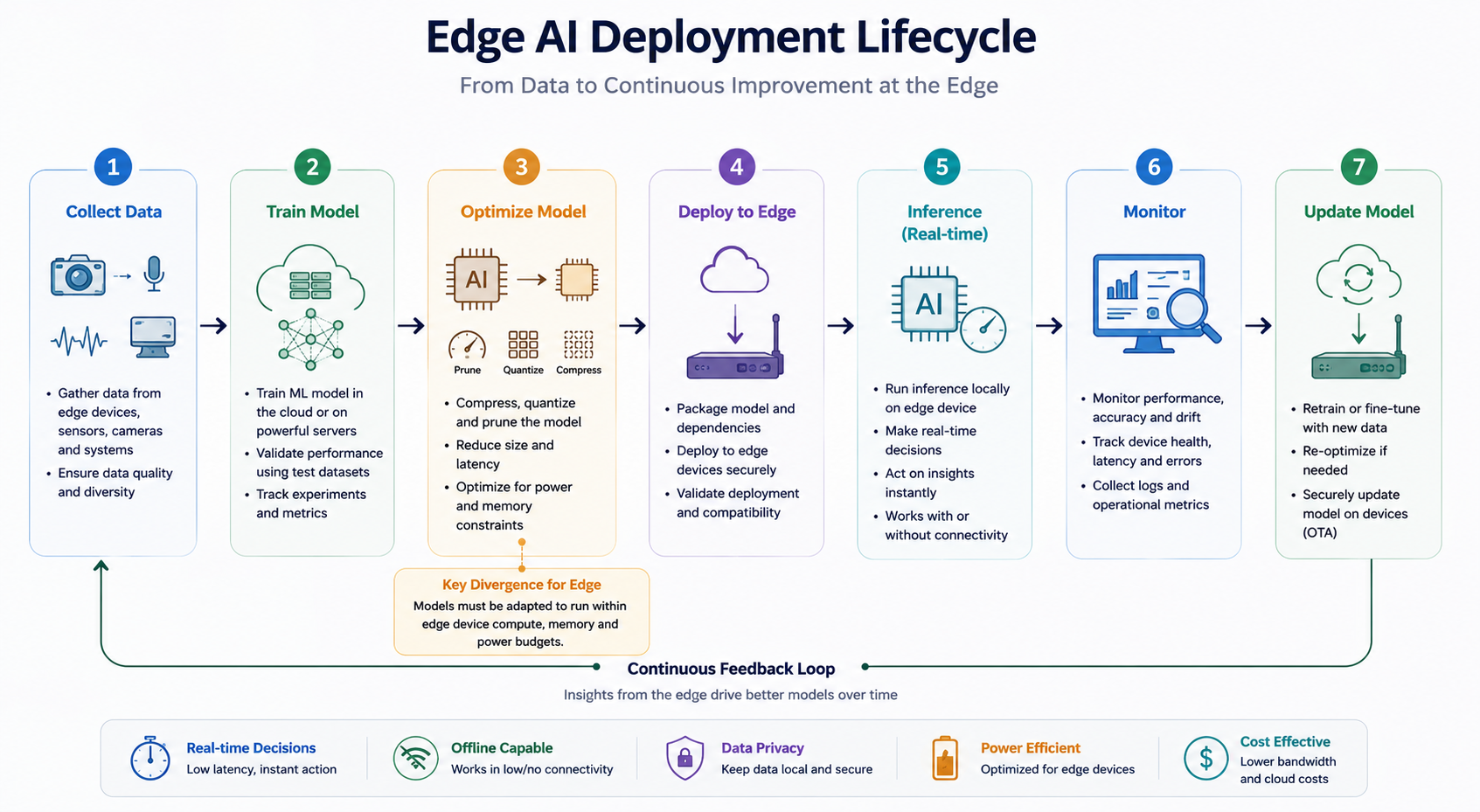
Deployment Stages
Gather images, sensor readings, video streams, and operational data from edge devices.
Build and train AI models using cloud infrastructure or high-performance GPU servers.
Apply quantization, pruning, compression, or TensorRT optimization to fit edge hardware limitations.
Install optimized models on embedded systems, gateways, cameras, or industrial controllers.
Execute real-time predictions directly on the device with minimal latency.
Track device health, monitor model performance, and securely distribute OTA (Over-The-Air) model updates.
Enterprise Use Cases
🏭 Smart Manufacturing
Real-time defect detection, predictive maintenance, quality inspection, and production monitoring directly on factory equipment.🚗 Autonomous Vehicles
Instant processing of camera, radar, and LiDAR data for navigation, obstacle detection, and safety decisions.🏥 Healthcare
Medical imaging analysis, patient monitoring, and diagnostic support while keeping sensitive data inside healthcare facilities.🛒 Retail Analytics
Smart shelves, customer analytics, inventory monitoring, and checkout automation using AI-enabled cameras.🌾 Agriculture
Crop monitoring, irrigation optimization, pest detection, and precision farming using AI-enabled sensors and drones.🎥 Smart Surveillance
Detect unusual activities and security threats locally without continuously streaming video to cloud servers.Benefits of Edge AI Deployment
| Benefit | Business Impact |
|---|---|
| ⚡ Real-Time Response | Millisecond decision making for critical applications. |
| 🔒 Improved Privacy | Sensitive information remains on local devices. |
| 📉 Lower Bandwidth | Only valuable insights are transmitted instead of raw data. |
| 🌐 Offline Capability | AI continues functioning without internet connectivity. |
| 💰 Reduced Cloud Costs | Routine inference shifts away from expensive cloud infrastructure. |
| 📈 Better Scalability | Deploy AI across thousands of distributed locations efficiently. |
Challenges of Edge AI Deployment
Edge hardware provides significantly less processing power than cloud GPU infrastructure.
Compressing models while maintaining prediction accuracy requires careful engineering.
Updating, monitoring, and securing thousands of distributed devices becomes operationally complex.
Physical devices are more vulnerable to theft, tampering, and unauthorized access.
Applications must continue functioning correctly even when internet access is unavailable.
Supporting different processors, operating systems, and AI accelerators increases deployment complexity.
Technologies Behind Edge AI
A successful Edge AI deployment combines lightweight AI frameworks, optimized runtimes, specialized hardware, IoT communication protocols, and cloud-edge management platforms. The technology stack varies depending on latency requirements, hardware capabilities, connectivity, and deployment scale.
| Technology | Purpose |
|---|---|
| TinyML | Machine learning on ultra-low-power microcontrollers. |
| TensorFlow Lite | Optimized runtime for mobile and embedded AI deployment. |
| ONNX Runtime | Cross-platform inference engine supporting multiple hardware vendors. |
| NVIDIA Jetson | GPU-accelerated embedded platform for Edge AI. |
| Intel OpenVINO | AI optimization toolkit for Intel processors and VPUs. |
| Edge TPU | Dedicated accelerator for fast and energy-efficient inference. |
| Docker & K3s | Containerization and lightweight Kubernetes for edge deployments. |
| MQTT | Lightweight messaging protocol for IoT communication. |
| AWS Greengrass / Azure IoT Edge | Cloud platforms for managing distributed Edge AI devices. |
Best Practices for Edge AI Deployment
⚙ Optimize Models
Compress, prune, and quantize models before deployment to maximize speed while minimizing hardware requirements.🔄 Secure OTA Updates
Implement reliable over-the-air updates for software patches and model improvements.🔐 Encrypt Everything
Protect stored data, communication channels, and deployed AI models using strong encryption.📊 Monitor Device Health
Track CPU, memory, storage, power consumption, inference latency, and hardware status continuously.☁ Sync Selectively
Transmit only meaningful events and summarized insights instead of streaming raw sensor data.🌐 Design for Offline Operation
Applications should continue functioning correctly even during network interruptions.Future Trends
🤖 TinyML Expansion
Ultra-efficient AI models will continue enabling intelligent microcontrollers and battery-powered devices.📷 AI Cameras
Vision systems capable of processing high-resolution video completely on-device will become increasingly common.🧠 Edge LLMs
Smaller language models will power intelligent assistants directly on laptops, phones, and industrial devices.🔄 Federated Learning
Models will improve collaboratively without transferring sensitive raw data to centralized servers.📡 6G Edge Computing
Future wireless networks will further reduce latency between cloud and edge environments.🚀 Autonomous Edge Agents
AI agents will independently make decisions directly on distributed edge devices with minimal cloud dependency.How MHTECHIN Supports Edge AI Deployment
Deploying AI across distributed edge devices requires much more than simply exporting a machine learning model. Organizations must balance latency, connectivity, security, hardware limitations, and operational scalability while ensuring consistent performance.
MHTECHIN helps enterprises build production-ready Edge AI solutions through:
- ✔ Enterprise Edge AI architecture and consulting
- ✔ AI model optimization for constrained hardware
- ✔ Edge-to-cloud integration and hybrid AI solutions
- ✔ Secure deployment and OTA update strategies
- ✔ AI monitoring, observability, and lifecycle management
- ✔ Enterprise-grade IoT and Edge AI system integration
With expertise spanning AI engineering, cloud-native technologies, IoT platforms, and enterprise integration, MHTECHIN enables organizations to deploy scalable, secure, and high-performance Edge AI solutions.
Conclusion
Edge AI extends artificial intelligence beyond centralized cloud environments by bringing intelligence directly to the devices where data is generated. Rather than replacing cloud AI, it complements existing architectures by delivering real-time responsiveness, enhanced privacy, and reliable offline operation.
As enterprises continue embracing hybrid AI strategies, Edge AI will play an increasingly important role in enabling intelligent manufacturing, healthcare, transportation, retail, agriculture, and industrial automation. Organizations that combine cloud scalability with local intelligence will be best positioned to build resilient and efficient AI-powered systems.
Frequently Asked Questions (FAQs)
1. What is Edge AI Deployment?
Running AI models directly on local hardware such as sensors, cameras, gateways, and embedded devices instead of relying entirely on cloud infrastructure.
2. How is Edge AI different from Cloud AI?
Edge AI processes data locally for low latency and offline operation, while Cloud AI relies on centralized computing resources with greater processing power.
3. Which industries benefit the most?
Manufacturing, healthcare, automotive, agriculture, retail, smart cities, logistics, and industrial IoT.
4. Can Edge AI work without an internet connection?
Yes. Since inference happens locally, Edge AI systems continue operating even during connectivity interruptions.
5. Is Edge AI replacing Cloud AI?
No. Modern enterprises increasingly combine both using hybrid architectures where each workload executes in the environment best suited for it.

Leave a Reply