Introduction
Enterprise search has a persistent tension. Purely keyword-based search is precise but brittle — it misses synonyms, paraphrasing, and natural language questions. Purely semantic search is more flexible but can lose exact product names, IDs, error codes, and other specific terms that matter a great deal in practice. Neither approach alone consistently meets enterprise accuracy expectations.
Hybrid search resolves this by combining both — not as a compromise between them, but as a way to capture the strengths of each. It has become close to a default expectation in production retrieval systems rather than an advanced option, which is exactly why it earns its own deep dive in this series.
If you’re new to Retrieval-Augmented Generation, read our guide on Advanced RAG Techniques to understand how hybrid search fits into modern enterprise AI pipelines. These articles explain the foundations of modern retrieval pipelines and the optimization techniques that make production AI systems more accurate and reliable.
What Is Hybrid Search?
Hybrid search combines two retrieval approaches:
- Semantic (vector) search — finds documents based on meaning, using embeddings to match a query to conceptually similar content, even when the wording differs
- Keyword (lexical/BM25) search — finds documents containing exact words or phrases, using a scoring model built on term frequency
Rather than replacing one approach with the other, hybrid search merges their strengths — running both in parallel and combining the results into a single, more reliable ranking.
Keyword Search vs Semantic Search vs Hybrid Search
| Keyword Search (BM25) | Semantic Search | Hybrid Search |
|---|---|---|
| Matches exact words | Matches meaning | Combines both approaches |
| Best for IDs, codes, and product names | Best for natural language and synonyms | Handles both precise terms and conversational queries |
| High precision for exact matches | High recall for conceptually related content | Improved accuracy and relevance |
| Uses inverted indexes | Uses vector embeddings | Uses both retrieval methods together |
| Limited understanding of context | Can miss exact terminology | Ideal for enterprise AI and RAG systems |
Why Hybrid Search Matters
A few recurring problems push enterprises toward hybrid search rather than picking one method:
- Exact keyword search misses synonyms — a query for “password reset” won’t reliably match a document titled “credential recovery process” without semantic matching
- Semantic search can overlook exact terms — embedding models trained on general text often represent domain-specific terminology, product names, SKUs, or error codes poorly, since a careful embedding model choice tuned to the actual corpus is a prerequisite that’s easy to skip
- Enterprise users expect both precision and understanding — a knowledge worker searching for an internal policy expects the system to handle both a specific document ID and a loosely phrased question
- Better search quality leads to more reliable AI responses — since hybrid search commonly sits underneath RAG, retrieval quality directly determines answer quality downstream
Hybrid Search Architecture
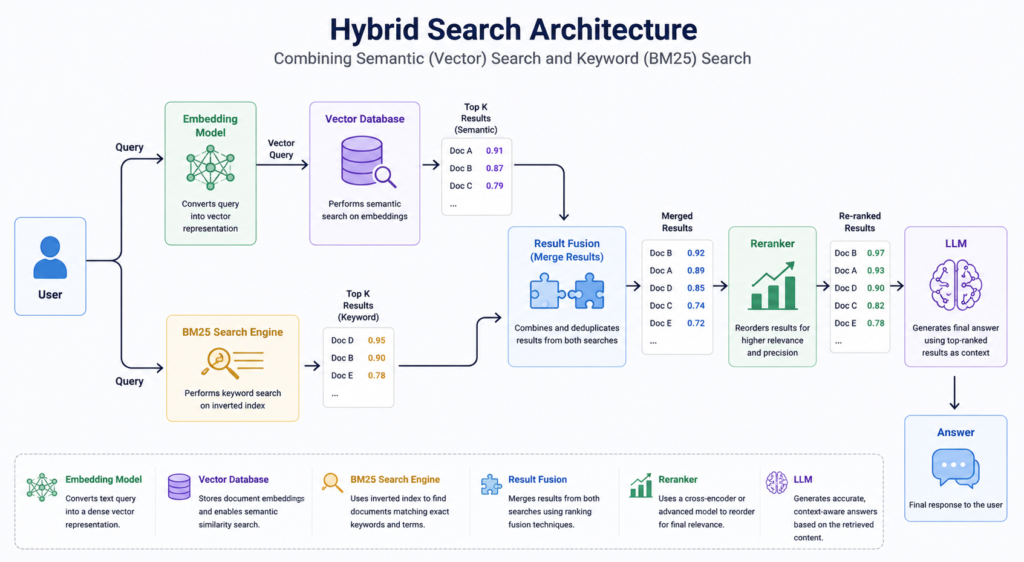
A production hybrid search system typically includes:
- User query — the incoming search request
- Embedding model — converts the query into a vector representation
- Vector database — performs the semantic search against stored embeddings
- BM25 search engine — performs the keyword search against an inverted index
- Result fusion — combines the two ranked lists into one
- Reranker — reorders the fused results for final precision
- LLM — generates the final answer using the top-ranked results
How Hybrid Search Works
A typical hybrid search pipeline follows this sequence:
User query → Query processing → Semantic search + Keyword search (in parallel) → Merge results → Reranking → LLM → Final response
The query is processed and sent to both retrieval methods simultaneously. Each returns its own ranked list of candidates. Those lists are merged into a single ranking, optionally reranked for additional precision, and the top results are passed to the LLM to generate the final response.
Result Fusion
Once semantic and keyword search each return a ranked list, those lists need to be merged into one. A few methods are commonly used:
- Weighted scoring — combining scores from each method using fixed or tuned weights
- Reciprocal Rank Fusion (RRF) — a widely used, practical approach that combines results based on rank position rather than raw scores, avoiding the problem of trying to compare two differently-scaled scoring systems directly
- Score normalization — rescaling scores from each method onto a common range before combining them
- Learning-to-rank — using a trained model to learn optimal fusion weights from evaluation data rather than setting them manually
Reciprocal Rank Fusion in particular has become close to a default in production systems — it requires no score calibration between the two retrievers, rewards documents that rank well across both methods, and is now natively supported in most major search and vector database platforms. It isn’t the most sophisticated fusion method available, but it’s difficult to beat for its simplicity and reliability, which is why it’s frequently the sensible starting point before investing in more complex fusion tuning.
Enterprise Use Cases
Hybrid search is well suited to any enterprise search context where both natural language and precise terminology matter:
- Enterprise document search — enables employees to find policies, manuals, and reports using either natural language or exact document names.
- IT helpdesk knowledge bases — retrieves troubleshooting guides, error codes, and support documentation more accurately.
- Legal document retrieval — combines semantic understanding with precise legal terminology.
- Product documentation — helps users locate technical specifications, API references, and product manuals.
- Healthcare knowledge systems — improves access to clinical guidelines, research papers, and patient documentation.
- Financial research — searches reports, regulatory filings, and market analysis using both keywords and contextual meaning.
Benefits
- Higher retrieval accuracy — capturing relevant results that either method alone would miss
- Better recall — a broader, more complete set of relevant candidates
- Fewer hallucinations — when hybrid search sits underneath RAG, better retrieval directly reduces the model’s need to fill gaps
- Improved user satisfaction — search that reliably understands both exact terms and natural phrasing
- Stronger enterprise search — a more robust default than either approach used alone
- Better RAG performance — more relevant context reaching the LLM
- Handles both exact terms and natural language — without forcing users to choose how they phrase a query
Challenges
Hybrid search isn’t free — it introduces its own operational considerations:
- Higher computational cost — running two retrieval methods, plus fusion and reranking, costs more than either alone
- Index synchronization — both the vector index and the keyword index need to stay in sync as documents change
- Score balancing — weighted fusion methods require ongoing tuning to avoid one method dominating the results
- Latency — additional retrieval and fusion steps add processing time, typically a modest but real overhead
- Duplicate results — the same document can appear in both result lists and needs to be deduplicated correctly during fusion
- Infrastructure complexity — maintaining two retrieval systems (plus fusion logic) is more involved than operating a single retriever
Best Practices
- Keep keyword indexes updated — stale indexes reintroduce the exact staleness problem hybrid search is meant to help solve
- Refresh embeddings when documents change — the vector side needs the same update discipline as the keyword side
- Apply reranking after merging results — fusion alone gets you close; reranking typically adds meaningful additional precision
- Tune fusion weights using evaluation data — fixed 50/50 weighting is a reasonable starting point, not a permanent answer; some query types should lean more heavily on keyword matching (exact codes, IDs) while others should lean toward semantic matching
- Test with real user queries — production query patterns are usually messier than clean development-time test queries
- Enforce document permissions before retrieval — access controls need to apply to both retrieval paths, not just the final merged results
Future Trends
- AI-powered query expansion — automatically broadening or clarifying queries before they reach either retriever
- Adaptive weighting — fusion weights that adjust dynamically based on query type rather than staying fixed
- Personalized search — retrieval that accounts for a user’s role or context, not just the query text
- Agentic retrieval — agents deciding when and how to invoke hybrid search as one tool among several
- Multimodal hybrid search — extending fusion approaches beyond text to images, tables, and other content types
- Graph-enhanced search — combining hybrid retrieval with knowledge graph relationships for deeper reasoning
Looking to improve enterprise AI search?
MHTECHIN helps organizations design scalable AI solutions that combine semantic search and keyword search to deliver accurate, secure, and enterprise-ready AI experiences.
Conclusion
Hybrid search combines the strengths of lexical and semantic retrieval, making it a cornerstone of enterprise AI search and modern RAG systems. It isn’t the most exotic technique in the retrieval toolkit, but it’s frequently the highest-leverage one — the difference between a search system that quietly frustrates users with missed results and one that reliably surfaces what they’re actually looking for, however they happen to phrase it.
Frequently Asked Questions (FAQs)
1. What is Hybrid Search? Hybrid search combines semantic (vector) search, which matches based on meaning, with keyword (BM25) search, which matches exact terms, merging both into a single, more accurate set of results.
2. How is Hybrid Search different from Semantic Search? Semantic search alone matches based on conceptual meaning and can miss exact terms like product codes or IDs. Hybrid search adds keyword matching alongside semantic search, capturing both.
3. What is BM25? BM25 is a widely used lexical ranking algorithm that scores documents based on term frequency and relevance to the exact words in a query, forming the keyword-matching half of a hybrid search system.
4. Why is Hybrid Search important for RAG? Because retrieval quality directly determines answer quality in a RAG system — hybrid search reduces the chance that relevant content is missed due to either vocabulary mismatch or overly loose semantic matching.
5. Does Hybrid Search reduce hallucinations? Indirectly, yes — by improving the relevance of retrieved context passed to the LLM, hybrid search reduces the gaps a model might otherwise fill with fabricated information.
6. Which industries benefit most from Hybrid Search? IT, healthcare, finance, HR, legal, and customer support are among the areas where hybrid search sees the most practical benefit, largely because these domains combine natural language questions with precise terminology, codes, or identifiers.
7. Is Hybrid Search expensive to implement? It adds real cost and complexity compared to a single retrieval method — running two retrievers, fusion, and often reranking — but most major vector databases and search platforms now support it natively, which has lowered the implementation barrier considerably.
8. When should organizations use Hybrid Search? When their content mixes natural language with exact terminology — product names, codes, IDs, or technical terms — which describes the majority of real enterprise document collections.

Leave a Reply