Introduction
Think about the last time you booked a flight, checked your bank balance, or ordered food online. Behind each of these actions, multiple software systems communicated with each other in seconds—sharing data, processing requests, and returning results. The invisible thread connecting all of them is the Application Programming Interface (API).
APIs are the plumbing of the digital world. They enable different software applications to talk to one another, exchange data, and work together seamlessly. Without APIs, the modern internet as we know it would not exist—there would be no connected apps, no cloud services, and no integrated digital experiences. They are the essential infrastructure that powers every smartphone app, web service, and enterprise system we rely on daily.
What Are APIs?
An Application Programming Interface (API) is a set of rules that allows one software application to interact with another. It acts as a bridge, enabling different systems to share data and functionality without requiring developers to understand how each system works internally .
Think of an API like a restaurant menu. The menu lists what the kitchen can prepare, along with a description of each dish. You, as the customer, place your order without needing to know how the kitchen operates or what ingredients are used. The kitchen prepares your meal and delivers it. Similarly, an API lists what data or services a system can provide. Developers request that data, and the API delivers it in a structured format—all without exposing the underlying code or infrastructure.
APIs are everywhere. When you use a weather app on your phone, it calls a weather service API to fetch the latest forecast. When you log in to a website using “Sign in with Google,” that website is using Google’s authentication API. Every major digital service today offers APIs to allow other developers and businesses to integrate with their platforms .
REST vs GraphQL: Two Popular API Architectures
When building APIs, developers typically choose between two primary approaches: REST and GraphQL. Both have distinct strengths, and the choice often depends on the use case .
REST APIs
REST (Representational State Transfer) is the older, more established architectural style for building web APIs. It has been the default since the early 2000s and remains the most widely deployed API style, used by more than 80% of developers surveyed .
REST APIs work by exposing resources through URLs. Each resource is identified by a unique endpoint, and standard HTTP methods (GET, POST, PUT, DELETE) are used to perform operations on them. For example:
GET /usersretrieves a list of usersGET /users/42retrieves the user with ID 42POST /userscreates a new user
REST’s strengths include its simplicity, compatibility with browser caches and CDNs, and straightforward error handling through HTTP status codes (200 OK, 404 Not Found, 500 Server Error) .
However, REST has limitations. When a client needs data from multiple resources, it often requires multiple round trips to the server—resulting in “under-fetching” (not enough data in one request) or “over-fetching” (receiving more data than needed) .
GraphQL APIs
GraphQL, developed by Facebook in 2012, offers a different approach. Instead of multiple endpoints, GraphQL provides a single endpoint where clients can ask for exactly the data they need—no more, no less .
A GraphQL query looks like this:
query {
user(id: 42) {
name
email
orders(last: 5) {
id
total
}
}
}
The response mirrors the query exactly, returning only the requested fields in a single round trip. This eliminates the over-fetching and under-fetching problems common in REST.
GraphQL adoption continues to climb, reaching roughly 28% of organizations . It is particularly valuable for:
- Multiple frontends (web, iOS, Android) needing different data shapes from the same backend
- Highly relational data where queries span multiple interconnected resources
- Rapid frontend iteration where new screens can ship without backend changes
However, GraphQL introduces new challenges. It doesn’t get HTTP caching for free (since all requests go to the same endpoint), and deeply nested queries can be computationally expensive—requiring application-layer protections like query depth limits and field cost analysis .
Choosing Between REST and GraphQL
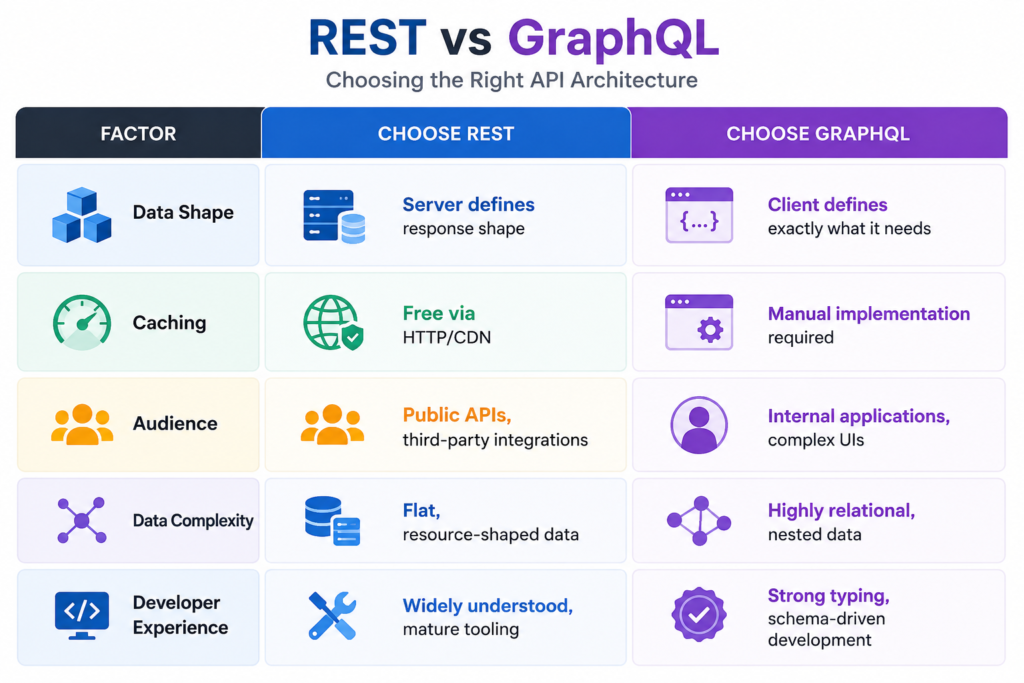
A common pattern in 2026 is to use both in the same organization: REST for stable, cacheable public APIs and GraphQL as an internal aggregation layer for frontend applications .
API Security: A Critical Priority
As APIs become the backbone of modern software, securing them has never been more important. APIs expose sensitive business logic and data to external systems, making them attractive targets for attackers .
In May 2026, the National Institute of Standards and Technology (NIST) released draft guidelines—SP 800-228A—specifically focused on the secure deployment of RESTful web APIs . This document highlights several key threats:
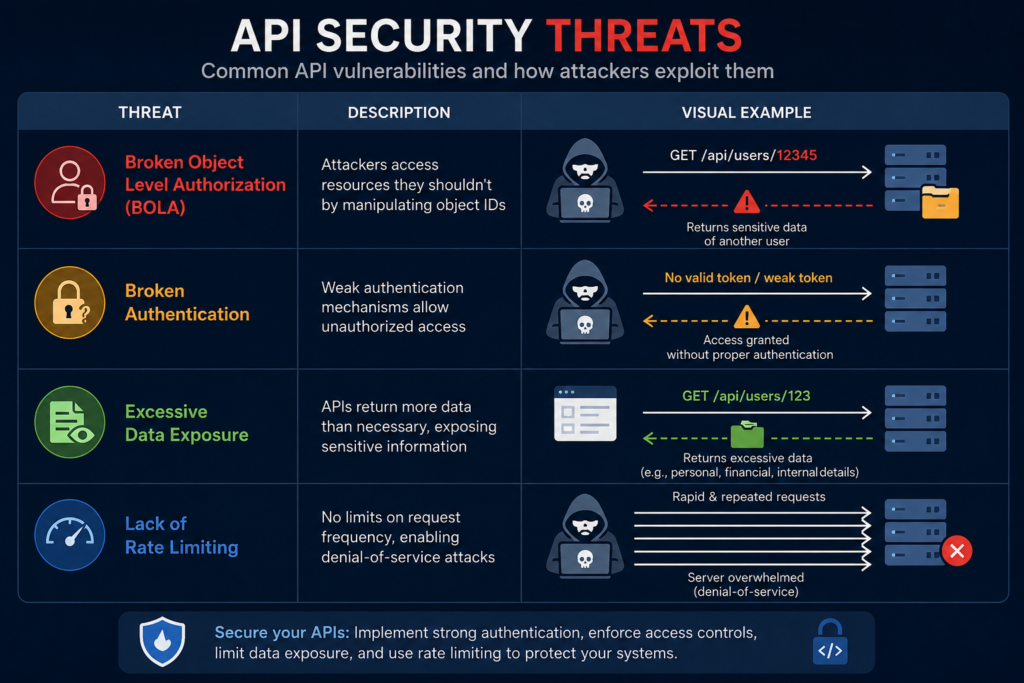
These vulnerabilities are well-documented in the OWASP API Security Top 10, a widely referenced industry standard for API threat identification .
Best Practices for API Protection
To build secure APIs, organizations should implement:
- Authentication and Authorization – Strong identity verification and fine-grained access controls
- Rate Limiting – Restricting the number of requests to prevent abuse
- Input Validation – Validating all incoming data to prevent injection attacks
- Encryption – Using HTTPS to protect data in transit
- Monitoring and Logging – Detecting anomalies and maintaining audit trails
Real-World Integrations: APIs in Action
APIs enable some of the most powerful digital experiences we use today:
- Open Banking – APIs allow third-party financial apps to access bank account data and initiate payments (with user consent), enabling services like budgeting apps and automated savings tools
- Healthcare Data Exchange – APIs facilitate secure sharing of electronic health records between hospitals, clinics, and patients
- Government APIs – Public sector APIs provide access to data on transportation, weather, and civic services, powering everything from navigation apps to emergency response systems
- AI Agent Integration – AI agents now call APIs to execute real-world tasks. A recent report found that AI agents completed approximately 176 million transactions on blockchain networks between May 2025 and April 2026, with each functioning as an independent API consumer
Business Benefits of the API Economy
APIs are not just technical tools—they are business drivers. Organizations that embrace the API economy gain:
- Monetization – Companies can charge for API access, creating new revenue streams
- Digital Transformation – APIs enable legacy systems to integrate with modern applications
- Partner Ecosystems – APIs facilitate seamless collaboration with third-party developers and business partners
- Innovation Speed – Teams can build new features by composing existing APIs rather than reinventing functionality
By 2030, the API economy is projected to reach $38.73 billion, growing at a compound annual rate of nearly 18% . This growth is driven, in part, by AI agents becoming independent API consumers—automated systems that call APIs at machine speed, 24/7, without human intervention .
Building modern digital solutions requires expertise in software architecture, system integration, cloud technologies, and secure application development. Organizations often need scalable, connected systems that enable applications and services to work seamlessly together.
MHTECHIN supports businesses by delivering:
• Custom Software Development – Building scalable enterprise applications and tailored software solutions.
• Web & Mobile Application Development – Developing responsive web applications and native or cross-platform mobile apps.
• Cloud Solutions – Supporting cloud migration, infrastructure optimization, and scalable digital environments.
• Enterprise Solutions – Implementing CRM, ERP, and workflow automation systems to improve operational efficiency.
• System Integration – Connecting applications and business processes to enable smooth data exchange across platforms.
By combining software engineering, cloud technologies, and enterprise solutions, MHTECHIN helps organizations build secure, scalable digital systems that support long-term business growth.
Conclusion
APIs are the invisible backbone of modern software. They connect applications, enable integrations, power real-world services, and drive business growth. Understanding how APIs work—and how to build them securely—is essential for any organization operating in the digital economy.
APIs have also become the bridge between the digital and physical worlds. AI agents, automated systems, and machines are now calling APIs independently, creating new opportunities—and new challenges—in the machine economy.
When AI agents call APIs to book travel, monitor energy grids, or power smart hospitals, it’s the API economy enabling intelligence to move from software into the world . The API economy isn’t just about connecting software anymore—it’s about connecting intelligence to action.
Key Takeaways
- APIs enable software applications to communicate and exchange data
- REST is the most widely used API style (>80% of developers); GraphQL (~28% adoption) offers more flexibility for complex data needs
- NIST SP 800-228A provides updated guidance for secure API deployment (May 2026)
- API security threats include BOLA, broken authentication, excessive data exposure, and lack of rate limiting
- Real-world integrations span banking, healthcare, government, and AI agent systems
- The API economy is projected to reach $38.73 billion by 2030
- MHTECHIN helps organizations design, build, and secure the APIs that power modern digital business
References
- Gate.io – AI Agent and API Economy Report, 2026
- Vercel – GraphQL vs REST: Key Differences and How to Choose, 2026
- NIST SP 800-228 – Guidelines for API Protection for Cloud-Native Systems, March 2026
- NIST SP 800-228A (Draft) – Guidelines for the Secure Deployment of RESTful Web APIs, May 2026
- Requestly – GraphQL vs REST: How to Choose and Test Both, June 2026

Leave a Reply