Introduction
Imagine an AI that doesn’t just answer your questions but actively works toward goals—researching, planning, and executing complex tasks with minimal supervision. This is the promise of agentic AI, a paradigm shift that is reshaping how businesses approach automation and decision-making .
Traditional AI systems, including chatbots and generative AI tools, are fundamentally reactive. They wait for prompts, respond to queries, and operate within narrow boundaries. Agentic AI, by contrast, takes initiative. It perceives its environment, reasons about goals, makes decisions, and takes action—all while adapting to changing circumstances .
The global agentic AI market is exploding. Projections show growth from $5.4 billion in 2024 to over $50 billion by 2030, with some estimates reaching $196 billion by 2034 . Industry leaders like Google, Microsoft, and OpenAI are racing to dominate this space, with Gartner recently naming Google the leader in enterprise agentic AI platforms .
This comprehensive guide explores everything you need to know about agentic AI: its definition, core principles, architecture, enterprise applications, implementation strategies, and future outlook. Whether you’re a business leader evaluating AI investments or a technologist building autonomous systems, this article provides actionable insights to navigate the agentic AI landscape.
What Is Agentic AI? A Clear Definition
Agentic AI refers to artificial intelligence systems designed for goal-directed autonomy—the ability to pursue complex objectives independently, without continuous human intervention . These systems, composed of one or more AI agents, combine reasoning, planning, memory, and tool-use capabilities to execute multi-step workflows.
At its core, agentic AI represents a shift from reactive AI (responding to inputs) to proactive AI (initiating actions to achieve goals). While a traditional chatbot waits for a user to ask a question, an agentic AI system might monitor inventory levels, predict demand, and automatically place orders with suppliers—all without human prompting.
Agentic AI vs. Traditional AI: Key Differences
| Aspect | Traditional AI | Agentic AI |
|---|---|---|
| Autonomy | Requires human prompts | Operates independently toward goals |
| Scope | Single-task focused | Multi-step, complex workflows |
| Adaptability | Fixed responses | Learns and adjusts strategies |
| Tool Use | Limited or none | Actively uses APIs, databases, MCP servers |
| Memory | Session-based | Persistent short-term and long-term memory |
| Decision-Making | Predefined rules | Dynamic reasoning and planning |
Agentic AI vs. Generative AI
The distinction between agentic AI and generative AI (GenAI) is particularly important. Generative AI tools like ChatGPT or image generators create content in response to user prompts—they are fundamentally reactive . Agentic AI systems, however, can:
- Set sub-goals: Break complex objectives into manageable tasks
- Select tools: Choose which APIs or databases to query
- Learn from feedback: Adjust strategies based on outcomes
- Collaborate: Work with other agents or humans in coordinated workflows
As Sam Altman of OpenAI noted at the 2026 Cisco AI Summit, the industry is transitioning from “transactional chatbots to persistent AI ‘teammates’” that function as autonomous collaborators rather than simple query responders .
The Core Principles of Agentic AI
Understanding agentic AI requires examining its foundational principles—the mechanisms that enable autonomous behavior.
1. Perception: Sensing the Environment
Agentic AI systems begin by perceiving their environment. This involves ingesting and interpreting diverse data sources:
- Structured data: Databases, APIs, sensor readings
- Unstructured data: Emails, documents, images, conversations
- Real-time inputs: User interactions, system events, environmental changes
Perception enables agents to build a contextual understanding of the current state, which informs subsequent reasoning and action .
2. Reasoning: The “Thought” Layer
Reasoning is the cognitive engine of agentic AI. Using large language models (LLMs) or multimodal models, agents analyze perceived information, evaluate options, and determine optimal actions. Key reasoning approaches include:
- ReAct (Reason + Act): Interleaves reasoning traces with task-specific actions
- Plan-Execute: Develops a plan before taking action, then executes step by step
- Reflexion: Evaluates outcomes and adjusts future behavior based on feedback
- RAFA (Reasoning, Acting, Feedback, Adaptation): A cyclical approach combining all elements
IBM Research’s 2026 tutorial on multimodal agentic AI highlights these reasoning strategies as essential for deploying trustworthy systems in industrial environments .
3. Action: Executing Decisions
Action capabilities distinguish agentic AI from purely analytical systems. Agents can execute actions through:
- API calls: Interacting with external services and applications
- MCP (Model Context Protocol) servers: Standardized interfaces for tool access
- Agent-to-Agent (A2A) communication: Collaborating with other AI agents
- System commands: Directly manipulating software or hardware
This action layer gives agents “hands” to effect change in the digital or physical world .
4. Feedback and Learning: The Iterative Loop
Agentic AI operates on continuous feedback cycles. After each action, agents observe outcomes and use this information to refine future decisions. This creates a Perception-Reasoning-Action-Feedback loop—sometimes described as the Thought-Action-Observation cycle .
Through techniques like reinforcement learning and memory storage, agents improve over time, adapting to new situations and optimizing performance.
5. Memory: Short-Term and Long-Term
Effective agentic AI requires robust memory systems:
- Short-term memory: Maintains context within a session or workflow
- Long-term memory: Stores knowledge across sessions, enabling cumulative learning
- Episodic memory: Tracks past actions and outcomes for reflection
Memory enables agents to maintain consistency, avoid repeating mistakes, and build comprehensive understanding of specific domains .
6. Orchestration and Collaboration
Complex tasks often require multiple agents working together. Agentic AI systems coordinate through:
- Task decomposition: Breaking goals into subtasks
- Agent assignment: Routing tasks to specialized agents
- Synchronization: Managing dependencies and timing
- Result aggregation: Combining outputs from multiple agents
This orchestration layer is critical for enterprise-scale deployments .
The Agentic AI Lifecycle
Deploying agentic AI systems requires understanding their full lifecycle—from inception to production. IBM Research’s 2026 tutorial outlines a comprehensive framework :
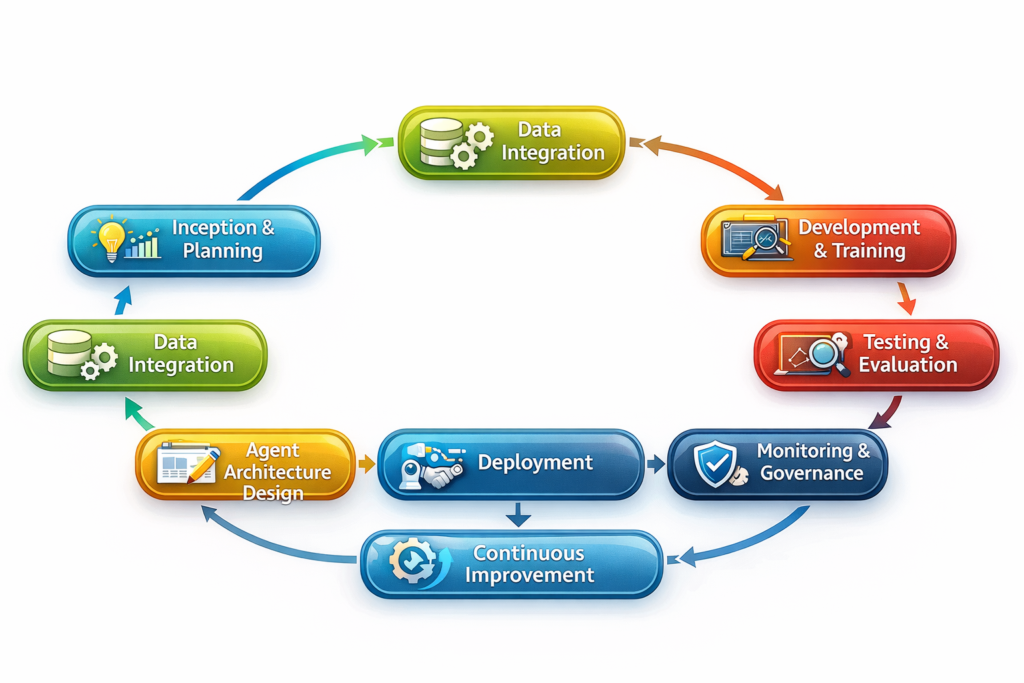
Figure 1: The Agentic AI Lifecycle—a continuous loop from planning to improvement
Stage 1: Inception and Planning
- Define business objectives and success metrics
- Identify appropriate use cases (low-to-moderate risk initially)
- Assess data readiness and infrastructure requirements
Stage 2: Data Integration
- Connect to relevant data sources (databases, APIs, documents)
- Establish access controls and security protocols
- Ensure data quality and governance
Stage 3: Agent Architecture Design
- Select reasoning frameworks (ReAct, Plan-Execute, etc.)
- Define tool access and permissions
- Design human-in-the-loop intervention points
Stage 4: Development and Training
- Build or configure AI agents
- Train on domain-specific data
- Implement memory and learning mechanisms
Stage 5: Testing and Evaluation
- Benchmark performance using standardized tests (AgentBench, ALFWorld, etc.)
- Validate reasoning and decision-making
- Test edge cases and failure scenarios
Stage 6: Deployment
- Start with controlled pilots
- Gradually expand scope and autonomy
- Implement monitoring and logging
Stage 7: Monitoring and Governance
- Track agent actions and decisions
- Ensure compliance with regulations (GDPR, EU AI Act)
- Maintain audit trails for accountability
Stage 8: Continuous Improvement
- Incorporate feedback from outcomes
- Update models with new data
- Refine workflows based on performance data
Agentic AI Architecture: Building Blocks
Enterprise agentic AI systems require sophisticated architecture to ensure security, scalability, and reliability.
The Seven-Stage Maturity Model
According to Sinequa’s 2026 whitepaper on enterprise agentic AI, organizations progress through seven stages of maturity :
- Keyword Search: Basic document retrieval
- Simple Chatbot: Question-answering with limited context
- RAG-Grounded Assistant: Retrieval-augmented generation with cited sources
- Workflow Automation: Predefined sequences with AI assistance
- Document Expert: Specialized AI for specific knowledge domains
- Semi-Autonomous Agent: Goal-directed action with human oversight
- Full Agentic Ecosystem: Multi-agent systems with dynamic orchestration
Each stage requires increasingly sophisticated architecture, particularly in:
- RAG (Retrieval-Augmented Generation): Evolving from simple retrieval to multi-step, tool-augmented, access-controlled retrieval
- Orchestration: Progressing from linear workflows to dynamic agent coordination
- Governance: Developing audit trails and access controls that scale with autonomy
Key Architectural Components
Tool Integration
Agents interact with the world through tools: APIs, databases, MCP servers, and external services. Enterprise architectures must provide:
- Standardized tool interfaces
- Permission management
- Rate limiting and resource controls
- Audit logging for all tool calls
Access Control
AI agents require context-aware permissions. Unlike human users, agents may need temporary, process-linked access to sensitive data. The Noumena Access model demonstrated in Swisscom’s insurance claims PoC provides:
Auditability and Traceability
Regulatory compliance demands complete visibility into agent actions. Enterprise architectures must:
- Log all decisions and actions
- Link actions to authorized users or processes
- Support data minimization and deletion requirements
- Enable post-hoc analysis of failures
Human-in-the-Loop Integration
Responsible agentic AI incorporates human oversight at strategic intervention points. Architecture should support:
- Approval workflows for high-stakes actions
- Escalation paths for uncertain situations
- Real-time monitoring dashboards
- Kill switches for emergency stops
Enterprise Applications and Use Cases
Agentic AI is transforming industries across the board. Here are the most impactful enterprise applications.
Customer Service
AI agents are revolutionizing customer support by orchestrating complex service workflows. Unlike simple chatbots, agentic systems can:
- Analyze customer queries and route to appropriate resources
- Access CRM data to personalize responses
- Trigger workflows for returns, refunds, or escalations
- Coordinate with human agents when needed
MHTECHIN’s AI-powered customer service robots leverage natural language processing and machine learning to provide 24/7 support while seamlessly integrating with human teams .
Insurance Claims Processing
Swisscom’s proof-of-concept for insurance claims demonstrates agentic AI in action :
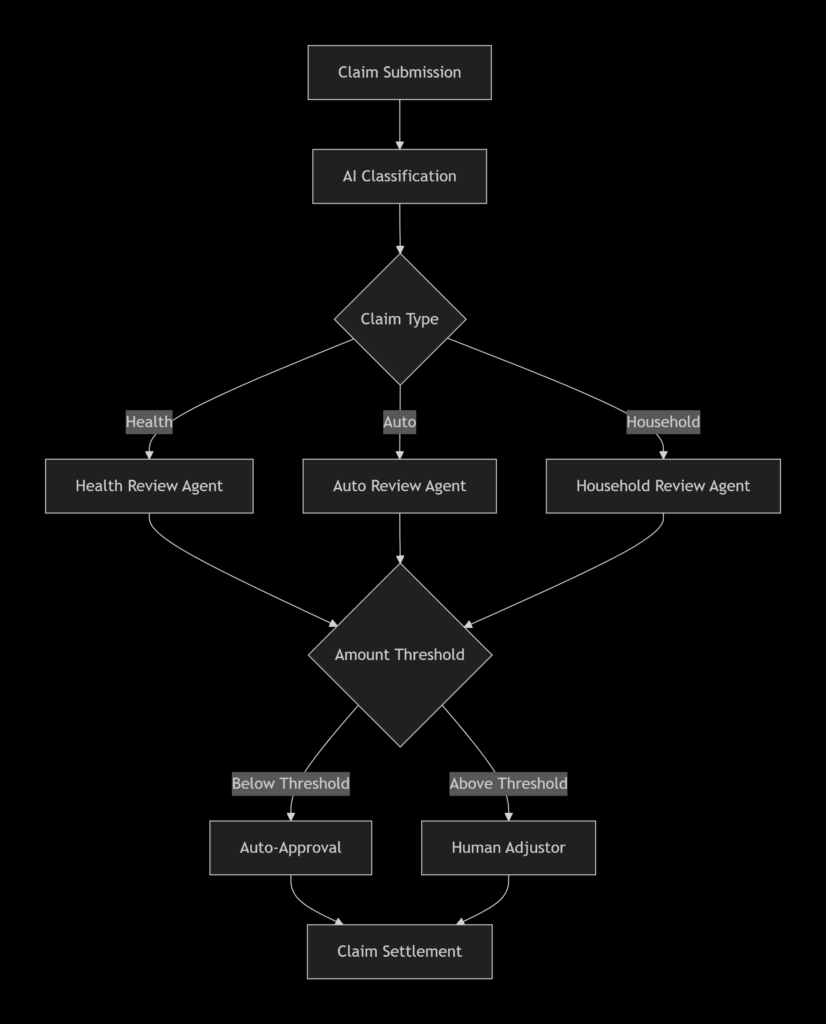
Figure 2: Agentic AI workflow for insurance claims processing
Results showed successful automation of classification and review tasks, with human oversight only required for exceptions .
Manufacturing and Industry 4.0
Agentic AI is enabling smart manufacturing through:
- Predictive maintenance: AI agents analyze IoT sensor data to predict equipment failures and trigger maintenance workflows
- Digital twins: Virtual autonomous agents manage warehouse operations, optimizing routes and inventory
- Quality control: Multimodal agents inspect products using computer vision and sensor data
IBM Research’s AssetOpsBench platform provides 141 curated industrial scenarios for evaluating agentic AI in manufacturing environments .
Supply Chain Management
AI agents excel at managing complex supply chain workflows:
- Demand forecasting using historical and real-time data
- Inventory optimization across multiple locations
- Shipment coordination with dynamic rerouting for disruptions
- Supplier communication and order management
Agentic systems can autonomously respond to disruptions like weather events or transportation delays without human intervention .
Healthcare
The healthcare sector is embracing agentic AI for:
- Appointment scheduling: Coordinating patient schedules with provider availability
- Claims processing: Automating insurance verification and billing
- Clinical decision support: Analyzing electronic health records for diagnostics
- Drug discovery: Orchestrating research workflows across data sources
Security and Threat Detection
Agentic AI is becoming essential for cybersecurity operations:
- Threat scanning: Continuously monitoring networks for anomalies
- Incident response: Automatically investigating and containing threats
- Adversarial readiness: Preparing for “machine-on-machine” attacks
As noted at the 2026 Cisco AI Summit, securing AI itself is now a foundational prerequisite for enterprise adoption .
Scientific Research
Agentic AI accelerates research by:
- Orchestrating experiments across distributed systems
- Analyzing massive datasets to identify patterns
- Generating and testing hypotheses
- Coordinating collaboration between research teams
AWS is partnering with pharmaceutical companies to streamline drug discovery R&D using AI agents .
Benefits of Agentic AI
Organizations implementing agentic AI realize significant benefits:
Autonomy and Efficiency
Agentic systems operate without constant human oversight, saving time and manual effort. Research from BCG shows AI-powered workflows can accelerate business processes by 30-50% while reducing low-value work time by 25-40% .
Flexibility and Adaptability
AI agents dynamically adjust behavior in response to environmental changes, handling new or ambiguous information without requiring human guidance .
Enhanced Problem-Solving
With planning, reasoning, and goal-setting capabilities, agentic AI solves problems beyond traditional AI’s scope. Multi-agent systems can address complex scenarios through collaboration .
Creativity and Innovation
Agentic AI generates novel insights by analyzing data in ways humans don’t. While different from human creativity, this pattern-driven innovation accelerates R&D and discovery .
Consistency and Quality
By automating repetitive tasks, agentic AI reduces human error and ensures consistent execution. Agents can self-optimize by analyzing their own behavior .
Scalability
Agentic systems scale effortlessly with demand, handling increased workloads without proportional staff increases .
Risks, Challenges, and Ethical Considerations
The autonomous nature of agentic AI introduces significant risks that organizations must address.
Security Vulnerabilities
Agentic AI systems create new attack surfaces. A compromised AI agent could be manipulated to make harmful decisions, and adversarial attacks can cause unintended outcomes through subtle input manipulations .
Unexpected Behavior
Even traditional AI can behave unpredictably; agentic AI’s autonomy increases this risk. Since agents operate without real-time oversight, they might execute tasks in unintended ways .
Compliance and Governance
Agentic AI touches multiple infrastructure layers and data sources, creating compliance challenges. Organizations must ensure:
- Data privacy and sovereignty
- Regulatory compliance (GDPR, EU AI Act)
- Audit trails for accountability
- Copyright and IP protection
Accountability
Determining responsibility for AI-caused harm remains challenging. When an AI agent makes a harmful decision, accountability may fall on developers, organizations, or the system itself—with no clear framework .
Bias and Fairness
AI agents may reflect biases in their training data, leading to discriminatory outcomes in areas like hiring, lending, or law enforcement .
Resource Consumption
Complex agentic systems consume significant energy and computing resources, raising environmental concerns and operational costs .
The “Capabilities Overhang”
Despite rapid model advancement, most enterprises struggle to deploy AI at scale. This “capabilities overhang”—the gap between what AI can do and what organizations successfully deploy—represents a major challenge .
Implementing Agentic AI: Strategic Pathways
Successful agentic AI implementation requires a phased, strategic approach.
Phase 1: Controlled Pilot
- Scope: Low-to-moderate risk internal tasks
- Oversight: Heavy human supervision
- Goal: Validate core functionality
- Duration: 2-3 months
Phase 2: Beta Deployment
- Scope: Limited production with restricted users
- Oversight: Monitored autonomy
- Goal: Test scalability and real-world performance
- Duration: 3-6 months
Phase 3: Broad Adoption
- Scope: Wider rollout across use cases
- Oversight: Strategic governance
- Goal: Formal integration into business processes
- Duration: Ongoing
Phase 4: Continuous Improvement
- Scope: All deployed systems
- Oversight: Performance monitoring
- Goal: Model updates and optimization
- Duration: Perpetual
Guiding Principles
1. Right Use Case Selection
Start with essential, low-risk internal tasks where failure consequences are manageable .
2. Clear Boundaries
Strictly limit agent capabilities and action space initially. Use human-in-the-loop strategies for critical decisions .
3. Measure and Log
Define success metrics and record all agent activities for audit and compliance .
4. Transparency and Cultural Readiness
Engage stakeholders early and foster organizational readiness for AI collaboration .
MHTECHIN’s Approach to Agentic AI Implementation
MHTECHIN specializes in developing cutting-edge AI solutions, including multi-agent reinforcement learning (MARL) systems that enable teams of agents to coordinate effectively. Their algorithms have been used to train robots for complex tasks like soccer, navigation, and cooperative problem-solving .
For organizations seeking to implement agentic AI, MHTECHIN offers expertise in:
- Multi-agent system design and orchestration
- Reinforcement learning for adaptive behavior
- Integration with existing enterprise infrastructure
- Governance and security frameworks
Contact MHTECHIN at rajeshmohanty@mhtechin.com to explore how agentic AI can transform your operations.
The Future of Agentic AI: Trends to Watch
2026: The Turning Point for Industrial-Scale Agentic AI
Industry leaders at the 2026 Cisco AI Summit declared 2026 a “second ChatGPT moment”—the year agentic AI shifts from experimental to industrial-scale deployment .
Key Trends
1. Spatial Intelligence and Physical AI
Beyond language models, “spatial intelligence” enables AI to navigate and interact with the 3D physical world. World models that understand causality, 3D geometry, and physical interaction will transform healthcare, manufacturing, and logistics .
2. Sovereign AI
Nations are prioritizing AI infrastructure resilience, leading to fragmented global markets where “sovereign cloud” capabilities are as important as raw model intelligence .
3. Agentic SEO
SEO is being transformed by agentic workflows. AI agents now autonomously research competitors, identify content gaps, map keyword clusters, and orchestrate multi-step optimization processes .
4. AI Teammates, Not Just Tools
The evolution from chatbots to persistent AI “teammates” will fundamentally change how work gets done. These agents will function as collaborators with persistent memory and context .
5. Enhanced Trust and Security Frameworks
As agentic AI matures, security and trust frameworks will become foundational prerequisites rather than afterthoughts. Organizations will demand:
6. Multi-Agent Ecosystems
The future belongs to multi-agent systems where specialized agents collaborate on complex tasks. This requires sophisticated orchestration, communication protocols (like A2A), and governance frameworks .
Getting Started with Agentic AI: Actionable Steps
For organizations ready to explore agentic AI, here’s a practical roadmap:
Step 1: Assess Readiness
- Evaluate data quality and accessibility
- Review security and compliance requirements
- Identify potential use cases (start with internal, low-risk)
- Assess infrastructure capabilities
Step 2: Build Foundational Capabilities
- Implement RAG (Retrieval-Augmented Generation) for grounded responses
- Establish access control frameworks
- Develop audit and logging mechanisms
- Create human-in-the-loop protocols
Step 3: Run a Pilot
- Select one use case for initial deployment
- Define clear success metrics
- Implement heavy oversight initially
- Document lessons learned
Step 4: Scale Gradually
- Expand to additional use cases
- Increase agent autonomy incrementally
- Refine governance based on pilot learnings
- Invest in monitoring and observability
Step 5: Optimize Continuously
- Use feedback to improve agent performance
- Update models with new data
- Refine workflows based on business outcomes
- Maintain compliance as regulations evolve
Conclusion
Agentic AI represents a fundamental shift in how artificial intelligence interacts with the world. Moving beyond reactive, prompt-driven systems, agentic AI enables autonomous goal-directed behavior that can transform business operations, scientific discovery, and daily work.
The core principles of agentic AI—perception, reasoning, action, feedback, memory, and orchestration—create systems capable of tackling complex, multi-step tasks with minimal human supervision. When implemented responsibly, these systems deliver significant benefits: 30-50% faster processes, reduced manual effort, enhanced problem-solving, and scalable operations.
However, the path to production is paved with challenges. Security vulnerabilities, unexpected behavior, compliance requirements, and the “capabilities overhang” between AI potential and enterprise deployment all demand careful attention. Success requires phased implementation, robust governance, and a commitment to transparency and human oversight.
As industry leaders like Google, Microsoft, OpenAI, and Anthropic race to dominate this space, 2026 is emerging as a turning point for industrial-scale agentic AI . Organizations that begin their agentic AI journey today—starting with controlled pilots, building foundational capabilities, and scaling gradually—will be positioned to lead in the AI-driven future.
The key is pragmatism. Experiment boldly but govern responsibly. Maintain human-in-the-loop for critical decisions. Invest in transparency tools and audit frameworks. And remember that the goal isn’t to replace human expertise but to amplify it—freeing people to focus on strategic thinking while AI handles the heavy lifting .
Agentic AI is not just another technology trend. It’s a new paradigm for human-AI collaboration that will redefine how work gets done across every industry. The question isn’t whether to adopt agentic AI, but how to do so responsibly, effectively, and at scale.
Frequently Asked Questions (FAQ)
What is agentic AI in simple terms?
Agentic AI is artificial intelligence that can work independently toward goals. Unlike chatbots that just answer questions, agentic AI can plan, make decisions, take actions, and learn from results—all without constant human guidance .
How is agentic AI different from generative AI?
Generative AI creates content in response to prompts (it’s reactive). Agentic AI actively pursues goals, uses tools, makes decisions, and adapts based on feedback (it’s proactive). An agentic system might research, plan, execute, and refine a strategy without being told each step .
What are examples of agentic AI?
Examples include AI systems that: process insurance claims by classifying, reviewing, and approving claims automatically; manage supply chains by predicting demand and placing orders; coordinate customer service across multiple channels; and conduct research by orchestrating experiments and analyzing data .
What are the core principles of agentic AI?
The core principles are: perception (sensing the environment), reasoning (planning and decision-making), action (executing tasks), feedback (learning from outcomes), memory (storing knowledge), and orchestration (coordinating multiple agents) .
Is agentic AI safe?
Agentic AI introduces new risks including security vulnerabilities, unexpected behavior, and accountability challenges. However, with proper guardrails—human-in-the-loop oversight, audit trails, access controls, and phased deployment—these risks can be managed effectively .
What industries are using agentic AI?
Insurance, manufacturing, healthcare, customer service, supply chain, security, scientific research, and marketing are leading adopters. Use cases include claims processing, predictive maintenance, clinical decision support, automated customer service, threat detection, and SEO optimization .
How do I implement agentic AI in my organization?
Start with a controlled pilot for a low-risk internal task. Build foundational capabilities in RAG, access control, and audit. Scale gradually, maintaining human oversight. Measure success and optimize continuously based on feedback .
What is the future of agentic AI?
The future includes spatial intelligence (AI that understands physical space), sovereign AI (nation-specific infrastructure), AI teammates (persistent collaborators), and multi-agent ecosystems. 2026 is seen as a turning point for industrial-scale deployment .

Leave a Reply