Introduction
Large language models are remarkably capable, but they share three limitations that matter a great deal in an enterprise setting: they can hallucinate confidently incorrect answers, their training data has a fixed cutoff and grows stale, and they have no inherent access to a company’s internal documents, policies, or records.
Retrieval-Augmented Generation (RAG) addresses all three by retrieving relevant, up-to-date information before the model generates a response — grounding the answer in real evidence instead of relying purely on what the model happened to learn during training. In 2026, RAG has moved well past being an experimental add-on. It’s now treated as core enterprise AI infrastructure, and it’s also the foundation underneath the AI agents and multi-agent systems covered elsewhere in this series — none of them are trustworthy without a reliable way to ground their reasoning in real, current, permission-aware data.
What Is Retrieval-Augmented Generation (RAG)?
RAG combines two AI techniques: retrieval and generation.
- Retrieval — before answering, the system searches a knowledge base for information relevant to the query
- Augmentation — the retrieved information is added to the model’s context as supporting evidence
- Generation — the language model produces a response grounded in that retrieved context, rather than relying solely on its training data
The basic workflow looks like this:
Question → Retrieve documents → Add context → Generate response
Why Traditional LLMs Need RAG
Without retrieval, a standalone LLM runs into predictable problems in enterprise use:
- Hallucinations — the model fills gaps in its knowledge with plausible-sounding but incorrect information
- Static training data — the model’s knowledge is frozen at its training cutoff and doesn’t reflect what’s changed since
- No company knowledge — the model has never seen a business’s internal documents, policies, or proprietary data
- Expensive retraining — updating a model’s actual knowledge through fine-tuning is costly and slow compared to updating a retrieval index
- Compliance concerns — answers generated purely from memorized training data are difficult to trace back to a verifiable source, which is a problem in regulated industries
How RAG Works
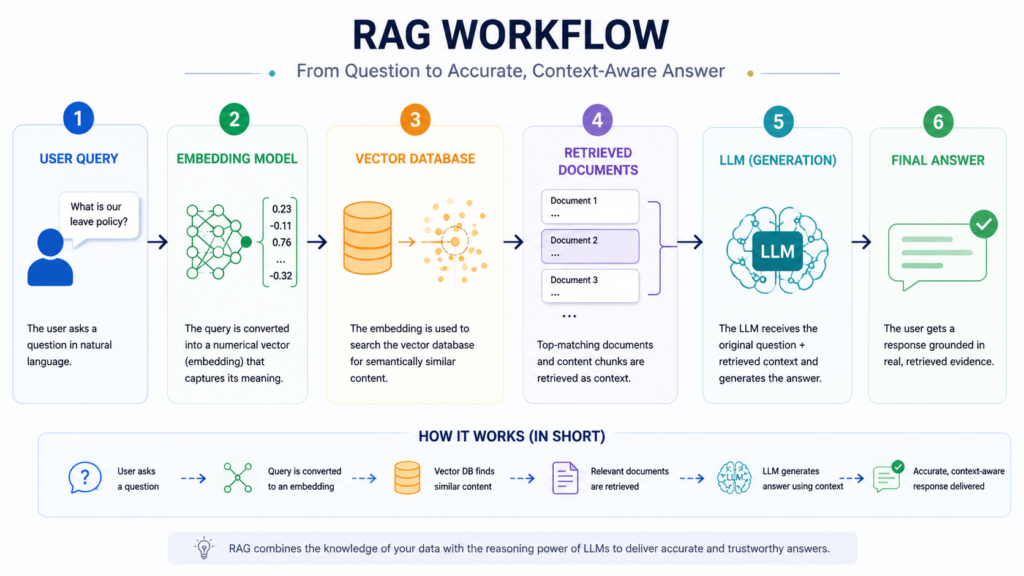
A typical RAG pipeline follows this sequence:
User query → Embedding model → Vector database → Relevant documents → LLM → Final answer
The query is converted into a numerical representation (an embedding), that embedding is used to search a vector database for the most semantically similar content, the top-matching documents are retrieved, and those documents are passed to the LLM along with the original question so the final answer is grounded in real, retrieved evidence.
Core Components of a RAG System
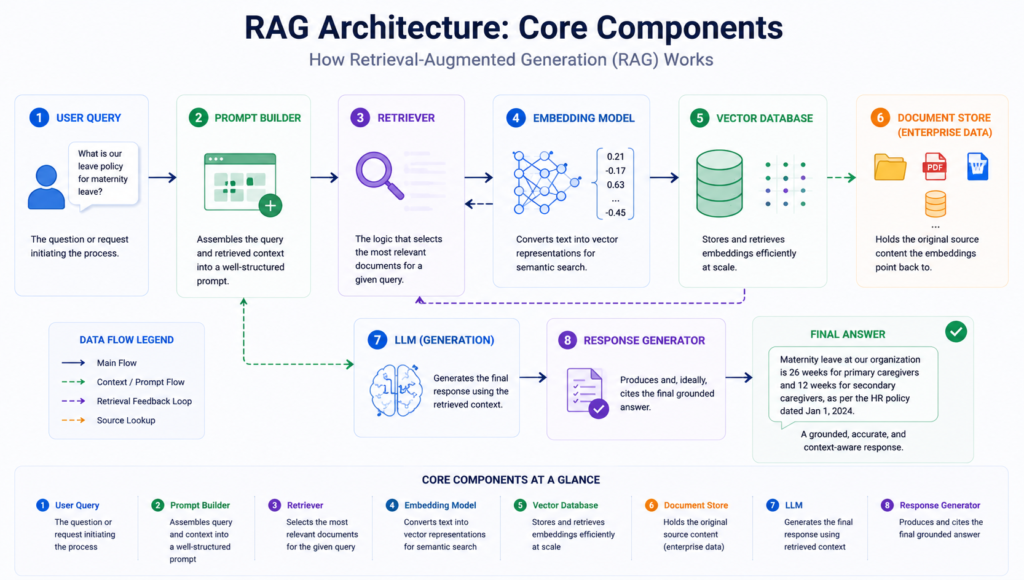
- User query — the question or request initiating the process
- Embedding model — converts text into vector representations for semantic search
- Vector database — stores and retrieves those embeddings efficiently at scale
- Document store — holds the original source content the embeddings point back to
- Retriever — the logic that selects the most relevant documents for a given query
- LLM — generates the final response using the retrieved context
- Prompt builder — assembles the query and retrieved context into a well-structured prompt
- Response generator — produces and, ideally, cites the final grounded answer
Types of RAG
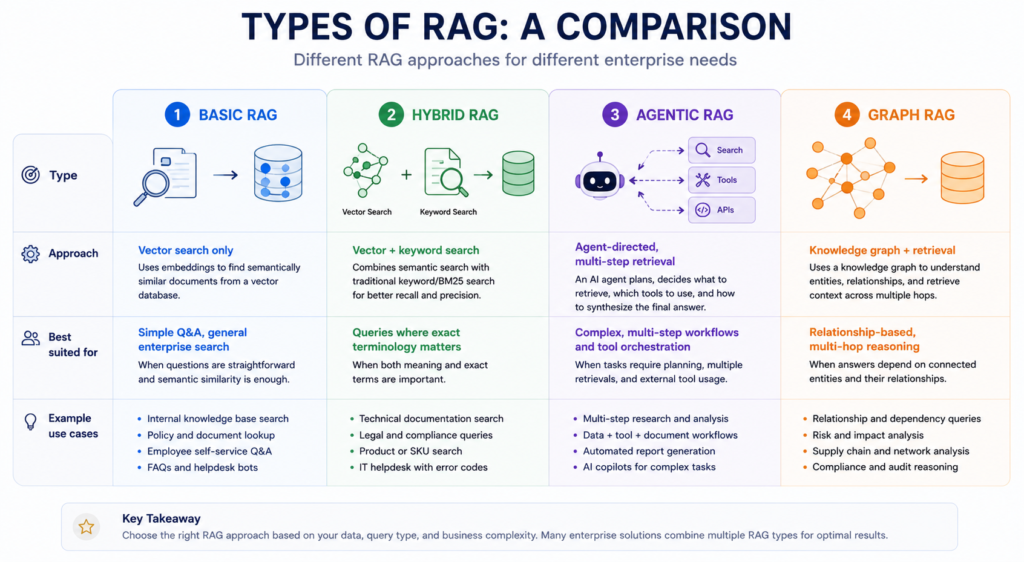
RAG has evolved well beyond a single “retrieve-then-generate” pattern:
Basic RAG — A straightforward vector search retrieves relevant chunks, which are passed to the LLM. Simple to implement, and sufficient for many enterprise search use cases.
Hybrid RAG — Combines keyword search with semantic (vector) search, improving retrieval accuracy for queries where exact terms matter as much as meaning.
Agentic RAG — An AI agent decides what to retrieve, when, and from where — potentially issuing multiple retrieval steps, validating results, or pulling from several sources before generating an answer. This has become the dominant pattern for complex, multi-step enterprise workflows in 2026.
Graph RAG — Adds a knowledge graph layer on top of retrieval, enabling multi-hop, relationship-aware reasoning across connected data rather than treating each document as an isolated chunk.
| Type | Approach | Best suited for |
|---|---|---|
| Basic RAG | Vector search only | Simple Q&A, general enterprise search |
| Hybrid RAG | Vector + keyword search | Queries where exact terminology matters |
| Agentic RAG | Agent-directed, multi-step retrieval | Complex, multi-step workflows and tool orchestration |
| Graph RAG | Knowledge graph + retrieval | Relationship-based, multi-hop reasoning |
Enterprise Use Cases
RAG is most valuable wherever accurate, current, and often sensitive knowledge needs to inform an AI response:
- Customer support
- Legal documents
- Healthcare records
- Financial reports
- IT documentation
Benefits
- Better accuracy — responses are grounded in real, retrieved evidence
- Less hallucination — the model has less need to fill gaps with fabricated information
- Real-time knowledge — updating the retrieval index is far faster than retraining a model
- No retraining required — new information becomes available to the system without touching the underlying LLM
- Enterprise security — retrieval can be scoped to respect existing access controls and permissions
- Lower costs — updating a knowledge base is significantly cheaper than fine-tuning a foundation model
- Better user experience — answers can cite their sources, making them easier to trust and verify
Challenges
RAG solves real problems, but it introduces its own points of failure:
- Poor retrieval — if the wrong documents are retrieved, the generated answer will be confidently wrong regardless of how good the LLM is
- Low-quality documents — retrieval is only as good as the underlying knowledge base; outdated or poorly written source content produces poor answers
- Chunking strategy — how documents are split into retrievable pieces significantly affects retrieval quality
- Embedding quality — the embedding model determines how well semantic meaning is captured and matched
- Latency — retrieval adds a processing step that can affect response time, especially with multi-step agentic retrieval
- Security — retrieval systems need to enforce the same access controls as the underlying source systems
- Access control — without governance, RAG can surface information a user shouldn’t be permitted to see
- Cost — embedding, storing, and querying large volumes of enterprise content at scale isn’t free
A theme showing up consistently across current enterprise RAG guidance is that governance has to come before retrieval, not after — access controls, metadata, and permission-aware indexing need to be built into the pipeline from the start, rather than bolted on once a system is already retrieving from sensitive sources.
Technologies Behind RAG
A common technology stack underlies most enterprise RAG implementations:
- Embedding models — converting text into vector representations
- Vector databases — including Pinecone, Milvus, Weaviate, Chroma, and FAISS
- LLMs — the generation layer that produces the final response
- LangChain and LlamaIndex — common frameworks for building retrieval pipelines
- MCP (Model Context Protocol) — a standard for connecting retrieval and other tools to AI systems
- APIs — connecting the RAG pipeline to enterprise data sources
- Cloud platforms — providing the infrastructure for embedding, storage, and retrieval at scale
These are presented as common industry technologies, not a specific vendor stack — the right combination depends on data volume, existing infrastructure, and governance requirements.
RAG vs. Fine-Tuning
| RAG | Fine-Tuning |
|---|---|
| External knowledge | Model retraining |
| Easy updates | Expensive updates |
| Dynamic data | Static knowledge |
| Lower cost | Higher cost |
| Enterprise documents | New model behavior |
The distinction matters: RAG is generally the better choice when the goal is giving a model access to current or proprietary information. Fine-tuning is more appropriate when the goal is changing the model’s behavior — its tone, format, or how it approaches a task — rather than what it knows. Many enterprise systems use both together.
Future of RAG
- Agentic RAG — continuing to become the default pattern for complex, multi-step enterprise workflows
- Graph RAG — growing adoption for use cases requiring relationship-aware, multi-hop reasoning
- Multimodal RAG — retrieval extending beyond text to images, audio, and video
- Enterprise search — RAG increasingly underlying internal search experiences, not just chatbots
- Hybrid search — combining keyword and semantic approaches as a practical default rather than an advanced option
- AI copilots — RAG as the grounding layer behind copilots embedded directly into everyday business tools
Why Businesses Are Adopting RAG
Organizations are adopting Retrieval-Augmented Generation to improve AI accuracy, reduce hallucinations, and enable large language models to access up-to-date enterprise knowledge. By combining semantic retrieval with language generation, RAG helps businesses deliver more relevant and trustworthy AI responses without retraining foundation models.
MHTECHIN focuses on enterprise AI solutions and intelligent knowledge systems — helping organizations design retrieval pipelines that are accurate, governed, and scoped correctly to existing access controls, rather than treating retrieval as an afterthought bolted onto a chatbot.
Frequently Asked Questions (FAQs)
1. What is Retrieval-Augmented Generation (RAG)? RAG is an AI architecture that retrieves relevant information from an external knowledge source before generating a response, grounding the output in real, current evidence rather than relying solely on a model’s training data.
2. How does RAG work? A user query is converted into an embedding, used to search a vector database for relevant content, and the retrieved documents are passed to the LLM along with the original question so it can generate a grounded, evidence-based answer.
3. Why is RAG important? It addresses core LLM limitations — hallucinations, outdated knowledge, and lack of access to proprietary or company-specific information — without the cost and delay of retraining the underlying model.
4. What is a vector database? A vector database stores numerical representations (embeddings) of content and enables fast semantic search, retrieving information based on meaning rather than exact keyword matches.
5. How is RAG different from fine-tuning? RAG gives a model access to external, updatable knowledge at the time of the query. Fine-tuning retrains the model itself, changing its underlying behavior. RAG is generally cheaper and easier to keep current; fine-tuning is better suited to changing how a model behaves rather than what it knows.
6. Can RAG reduce hallucinations? Yes — by grounding responses in retrieved, verifiable content rather than relying purely on the model’s memorized training data, though retrieval quality still determines how effective this is.
7. What industries use RAG? Healthcare, finance, legal, e-commerce, and customer service are among the sectors seeing the most practical use of RAG today, alongside broad adoption for internal knowledge bases and IT documentation across industries.
8. Is RAG secure for enterprise AI? It can be, but security has to be designed in from the start — retrieval systems need to respect existing access controls and permissions so users and agents only retrieve information they’re authorized to see.

Leave a Reply