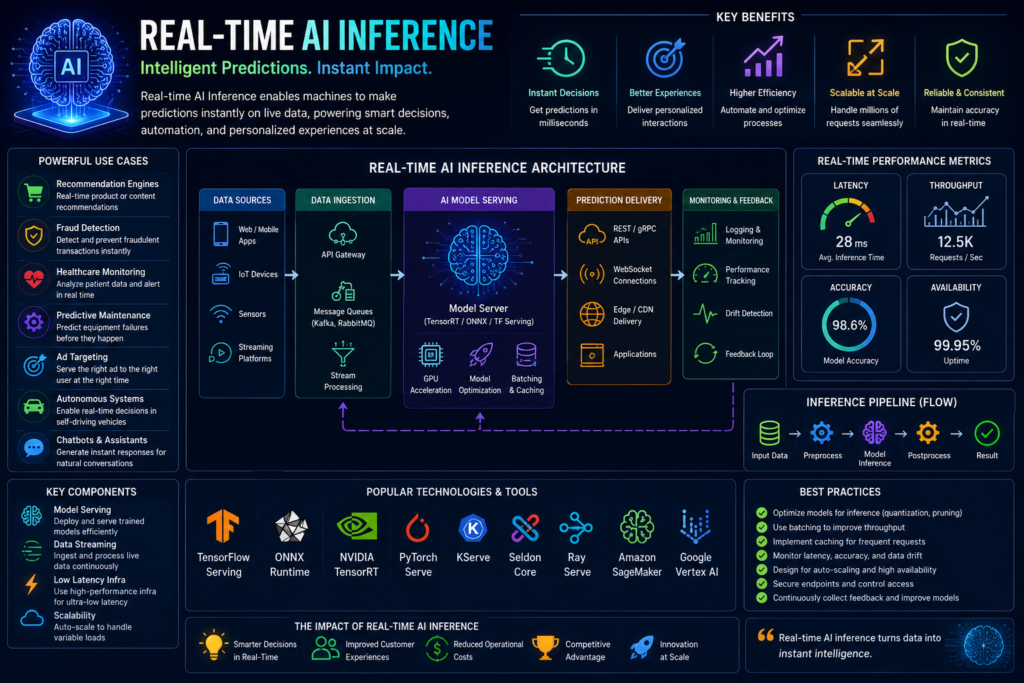
Real-Time AI Inference: The Complete Enterprise Guide to Building Ultra-Fast AI Systems at Scale
The 33-Millisecond Deadline That Separates Life and Death
It’s a crisp morning in Silicon Valley. A self-driving car’s AI system processes 2,400 frames per second from its camera array, LIDAR, and radar sensors. Each frame must be processed within 33 milliseconds—the time it takes for a video running at 30 frames per second to advance a single frame. Miss that window, and the car “sees” the world in the past. A pedestrian stepping into the road becomes a tragic statistic .
This is the brutal reality of real-time AI inference. Not “pretty fast.” Not “near real-time.” Real-time is measured in milliseconds, sometimes microseconds. And it’s no longer confined to autonomous vehicles. Fraud detection systems must score transactions before the payment completes. Recommendation engines must personalize content faster than a user can scroll. AI chatbots must respond within a heartbeat to feel natural.
Inference is the process of applying a trained machine learning model to new, unseen data to make predictions . When this happens on demand—when a client requests a prediction and waits for the response—it’s called dynamic inference, online inference, or real-time inference .
This guide is the complete playbook for building, deploying, and scaling real-time AI inference in the enterprise. We’ll cover everything from foundational concepts to production-grade architecture, from optimization techniques to real-world case studies.
What Is Real-Time AI Inference?
Real-time inference refers to the process where a trained machine learning model accepts live input data and generates predictions almost instantaneously . Unlike offline processing, where data is collected and analyzed in bulk at a later time, real-time inference occurs on the fly, enabling systems to react to their environment with speed and agility .
The Definition
At its core, real-time AI inference is predictions on demand. A model runs when a request arrives, processes the input, and returns the output before the client is willing to wait any longer.
Key characteristics:
- Low latency: Response times measured in milliseconds, not seconds
- Synchronous: The client waits for the response
- On-demand: Predictions only for requests that come in
- Individual or small batch: Usually processes single data points or very small batches
Simple Analogy
Think of real-time inference like ordering a custom pizza delivered to your door. A batch inference system is like ordering 50 pizzas for a corporate event—you plan ahead, place the order, and they arrive when they’re ready. Real-time inference is calling a pizzeria and having them make you a custom pizza right now because you’re hungry and you want it hot .
What Real-Time Inference Is NOT
Real-time inference is often confused with:
- Static inference (batch inference): Predictions generated in advance and cached. Great for common inputs, but cannot handle long-tail or uncommon requests .
- Streaming inference: Processing continuous data streams with low latency (often conflated, but streaming focuses on unbounded data volumes).
- Near real-time: A few seconds of latency—often acceptable for dashboards but far too slow for autonomous systems .
Why Real-Time AI Inference Is Critical for Enterprise AI
1. Instant Decisions That Matter
The primary metric for evaluating real-time performance is inference latency—the time delay between input and output . In many scenarios, latency isn’t just a performance metric; it’s a safety or business imperative.
- Autonomous vehicles: A car must detect a pedestrian and brake immediately. Every millisecond matters .
- Fraud detection: A credit card transaction must be scored before the payment completes. Delays mean fraud slips through or legitimate transactions are declined.
- Financial trading: Automated trading systems require near-zero latency to capture profitable deals .
2. Better Customer Experience
User-facing AI applications feel natural only when responses are instantaneous.
- AI chatbots: Users expect responses within 1-2 seconds. Longer delays break conversational flow.
- Personalized recommendations: Recommendations must appear before the user has scrolled past them.
- AI-powered search: Results must populate as the user types (autocomplete with AI).
3. Competitive Advantage
Organizations that deliver faster AI responses capture market share. Companies like Netflix, Amazon, and Uber have invested heavily in real-time inference because it directly impacts user engagement and revenue.
4. Scalability Without Breaking the Bank
Real-time inference systems must handle unpredictable traffic spikes without collapsing. Autoscaling, load balancing, and GPU optimization enable enterprises to scale efficiently .
5. Edge AI and Remote Environments
Not all operational environments have reliable cloud connectivity (oil rigs, remote logistics, defense applications). Edge inference makes it possible to deploy AI in disconnected or bandwidth-constrained locations .
How Real-Time AI Inference Works: The Complete Workflow
The complete real-time inference workflow spans request to response:
text
┌─────────────────────────────────────────────────────────────────┐
│                      USER REQUEST                               │
│  ┌────────────────────────────────────────────────────────────┐│
│  │  Client sends input data (image, text, sensor reading)   ││
│  └────────────────────────────────────────────────────────────┘│
└─────────────────────────────────────────────────────────────────┘
                               │
                               ▼
┌─────────────────────────────────────────────────────────────────┐
│                      API GATEWAY                                │
│  ┌────────────────────────────────────────────────────────────┐│
│  │  Authentication, rate limiting, routing                  ││
│  └────────────────────────────────────────────────────────────┘│
└─────────────────────────────────────────────────────────────────┘
                               │
                               ▼
┌─────────────────────────────────────────────────────────────────┐
│                     LOAD BALANCER                               │
│  ┌────────────────────────────────────────────────────────────┐│
│  │  Distribute requests across inference servers            ││
│  └────────────────────────────────────────────────────────────┘│
└─────────────────────────────────────────────────────────────────┘
                               │
                               ▼
┌─────────────────────────────────────────────────────────────────┐
│                   INFERENCE SERVER                              │
│  ┌────────────────────────────────────────────────────────────┐│
│  │  Model server (Triton, TensorFlow Serving, TorchServe)   ││
│  │  • Model optimization (quantization, pruning)           ││
│  │  • Request batching                                    ││
│  │  • GPU execution                                       ││
│  └────────────────────────────────────────────────────────────┘│
└─────────────────────────────────────────────────────────────────┘
                               │
          ┌────────────────────┼────────────────────┐
          ▼                    ▼                    ▼
┌─────────────────┐  ┌─────────────────┐  ┌─────────────────┐
│  FEATURE STORE   │  │  VECTOR         │  │   CACHE         │
│  (features)      │  │  DATABASE       │  │   (frequent     │
│                  │  │  (embeddings)   │  │    queries)     │
└─────────────────┘  └─────────────────┘  └─────────────────┘
                               │
                               ▼
┌─────────────────────────────────────────────────────────────────┐
│                         GPU CLUSTER                             │
│  ┌────────────────────────────────────────────────────────────┐│
│  │  • GPU-accelerated computation                           ││
│  │  • Model inference with GPU memory management           ││
│  │  • Multi-GPU load balancing                            ││
│  └────────────────────────────────────────────────────────────┘│
└─────────────────────────────────────────────────────────────────┘
                               │
                               ▼
┌─────────────────────────────────────────────────────────────────┐
│                   POST-PROCESSING                               │
│  ┌────────────────────────────────────────────────────────────┐│
│  │  Convert raw model output to usable response             ││
│  │  • Confidence thresholds                                ││
│  │  • Formatting / serialization                          ││
│  └────────────────────────────────────────────────────────────┘│
└─────────────────────────────────────────────────────────────────┘
                               │
                               ▼
┌─────────────────────────────────────────────────────────────────┐
│                      RESPONSE                                   │
│  ┌────────────────────────────────────────────────────────────┐│
│  │  Return prediction to client                             ││
│  └────────────────────────────────────────────────────────────┘│
└─────────────────────────────────────────────────────────────────┘
                               │
                               ▼
┌─────────────────────────────────────────────────────────────────┐
│                   MONITORING & FEEDBACK                         │
│  ┌────────────────────────────────────────────────────────────┐│
│  │  • Latency monitoring                                    ││
│  │  • Model drift detection                                ││
│  │  • Error tracking                                      ││
│  │  • Feedback loop for model improvement                 ││
│  └────────────────────────────────────────────────────────────┘│
└─────────────────────────────────────────────────────────────────┘
Core Components of Real-Time AI Inference
A production-grade real-time inference system requires these components:
🟢 AI Model
The trained model ready for serving. Must be optimized for low-latency inference.
🟢 Model Server
Specialized software for serving models:
- NVIDIA Triton Inference Server: Enterprise-grade serving with GPU optimization
- TensorFlow Serving: Google’s serving system for TF models
- TorchServe: PyTorch model serving
- ONNX Runtime: Cross-platform inference engine
🟢 API Gateway
Handles incoming requests, authentication, rate limiting, and routing.
🟢 Load Balancer
Distributes traffic across multiple inference server replicas.
🟢 GPU Infrastructure
High-performance compute for model inference. GPUs are essential for deep learning inference.
🟢 Cache
Stores frequent predictions or embedding vectors to reduce latency for common queries .
🟢 Message Queue
Buffers requests for asynchronous processing (when synchronous isn’t possible).
🟢 Monitoring & Logging
Tracks latency, throughput, error rates, and model performance.
🟢 Autoscaling
Automatically scales inference servers up or down based on traffic.
🟢 Feature Store & Vector Database
Provides real-time features and embeddings for model inference.
Static vs Dynamic Inference: Critical Distinction
Understanding the trade-offs between static and dynamic inference is fundamental to system design .
Key insight: Use static inference when prediction speed is critical and inputs are predictable. Use dynamic inference when flexibility and handling long-tail inputs are paramount .
Enterprise Use Cases
🏦 Banking: Fraud Detection
Real-time inference scores every credit card transaction. Features are retrieved from a feature store, the model evaluates the transaction, and the result is returned before the transaction completes. Low latency is critical—a delay means fraud slips through or customers are inconvenienced.
🏥 Healthcare: Emergency Diagnosis
AI-powered diagnostic tools for emergency rooms analyze medical images or vital signs in real time. A few extra seconds can have serious consequences . Edge inference enables local processing for privacy and speed .
🛒 E-Commerce: Personalized Recommendations
Recommendation models must serve predictions before the user has scrolled past the position. Real-time features (recent views, cart contents) are retrieved from feature stores and vector databases.
🚗 Autonomous Vehicles: Perception Systems
Self-driving cars process camera, LIDAR, and radar data in real time . The system must detect objects and plan actions within 33ms (30 FPS) . Edge inference is non-negotiable—cloud round trips are too slow .
📱 Mobile Apps: AI-Enhanced Features
Real-time inference powers photo filters, speech-to-text, and language translation on mobile devices. Edge inference keeps data local for privacy and speed .
🤖 AI Chatbots: Conversational AI
LLM inference must be sub-second to feel natural. Real-time inference for chatbots uses optimized model serving, quantization, and GPU acceleration. Streaming (SSE) provides progressive output while still delivering low initial latency.
📄 Document AI: Real-Time Processing
Document AI processes scanned documents, forms, and invoices. Real-time inference enables instant extraction of key information for business workflows.
🎥 Video Analytics: Surveillance and Security
Real-time inference on video feeds detects security breaches, identifies license plates, and recognizes faces . Low-latency edge inference supports immediate response.
🏭 Manufacturing: Quality Inspection
Computer vision models inspect products on assembly lines in real time. If a defect is detected, the system can remove the product before it reaches the customer .
🎮 Gaming: AI-Powered NPCs
AI-driven non-player characters require real-time inference to respond to player actions instantly.
AI Inference Architectures
Online Inference
Requests arrive one at a time, predictions returned synchronously. Most common for real-time use cases. Key technologies: Triton, TensorFlow Serving, TorchServe.
Offline Inference
Batch predictions on large datasets, asynchronous. Not real-time. Key technologies: Spark, Beam, Dataflow.
Streaming Inference
Processing continuous data streams with inference on each event or window. Low latency but focused on unbounded data. Key technologies: Kafka + Flink (external RPC or embedded models) .
Edge Inference
Inference runs on or near the device, reducing latency and preserving privacy . Key technologies: NVIDIA Jetson, ONNX Runtime, TensorFlow Lite.
Cloud Inference
Inference runs in centralized cloud data centers. High compute capacity but higher latency. Key technologies: AWS SageMaker, Google Vertex AI, Azure AI.
Hybrid Inference
Combines cloud and edge; simple or privacy-sensitive inference runs locally, heavy inference offloaded to cloud.
Distributed Inference
Large models split across multiple nodes to reduce latency or handle larger models .
Popular AI Inference Frameworks & Tools
🔹 NVIDIA Triton Inference Server
Best for: Enterprise GPU-accelerated inference
Key capabilities: Multi-framework support, batching, dynamic batching, model ensembles, concurrent model execution, GPU acceleration
Pros: Highest performance, enterprise-grade, NVIDIA ecosystem
Cons: Requires GPU infrastructure, operational complexity
🔹 TensorFlow Serving
Best for: Teams already using TensorFlow
Key capabilities: Native TF support, gRPC/REST APIs, model versioning, canary deployments
Pros: Google-backed, mature, integrates with TF ecosystem
Cons: Primarily TF-focused
🔹 TorchServe
Best for: PyTorch teams
Key capabilities: Native PyTorch support, model versioning, A/B testing, metric capture
Pros: PyTorch-native, flexible
Cons: Less mature than Triton
🔹 ONNX Runtime
Best for: Cross-platform inference optimization
Key capabilities: Cross-framework, CPU/GPU/accelerator support, quantization
Pros: Hardware-agnostic, Microsoft-backed
Cons: Optimization depends on model
🔹 Ray Serve
Best for: Python-native, distributed inference
Key capabilities: Python-native, autoscaling, multi-model composition
Pros: Flexibility, Python integration
Cons: Less GPU optimization than Triton
🔹 BentoML
Best for: Production-ready ML serving
Key capabilities: Framework-agnostic, CI/CD integration, LLM support
Pros: Developer-friendly, quick deployment
Cons: Less enterprise scale than Triton
🔹 KServe
Best for: Kubernetes-native inference
Key capabilities: Kubernetes-native, autoscaling, canary deployments, multi-model
Pros: CNCF project, cloud-native
Cons: Requires Kubernetes expertise
🔹 Vertex AI (Google Cloud)
Best for: GCP teams
Key capabilities: Serverless inference, integrated with GCP, autoscaling
Pros: Managed service, no infrastructure management
Cons: Vendor lock-in
🔹 AWS SageMaker
Best for: AWS teams
Key capabilities: Multi-framework, auto-scaling, integration with AWS
Pros: Managed, AWS-native
Cons: Vendor lock-in
30+ Best Practices for Enterprise Real-Time Inference
Model Optimization
- Optimize models for inference—apply quantization (FP16, INT8, INT4) to reduce memory and speed up computation
- Prune unnecessary weights to reduce model size while maintaining accuracy
- Use efficient model architectures—start with optimized designs like YOLO, MobileNet, or distilled models
- Knowledge distillation—train smaller, faster student models from larger teachers
- Fusion operations—combine operations (e.g., LayerNorm + Add) for faster execution
- Use efficient inference engines—Triton, ONNX Runtime, TensorRT for hardware-specific optimization
Infrastructure
- Right-size GPU selection—match GPU type (A100, H100, L40S, T4) to workload requirements
- Implement autoscaling to handle traffic spikes
- Use load balancing to distribute requests across replicas
- Monitor GPU utilization—over-provisioning wastes cost; under-provisioning causes latency spikes
- Use CDN for static content and common model responses
- Implement request batching to maximize GPU utilization
- Use hardware partitioning (NVIDIA MIG) for multi-model isolation
Performance Optimization
- Cache frequent predictions to reduce inference load
- Implement adaptive inference paths—use simpler models for simple inputs, complex models for complex inputs
- Use WebSockets for persistent connections—eliminates connection overhead for interactive applications
- Implement async I/O for external API calls to avoid blocking threads
- Monitor inference latency in three stages: preprocessing, computation, post-processing
- Use model-level profiling to identify bottlenecks in the model graph
Architecture
- Separate inference from streaming infrastructure—don’t block Kafka consumers with synchronous LLM calls
- Use sidecar pattern for inference services in Kubernetes—isolate dependencies while maintaining low latency
- Implement dead-letter queues (DLQs) for handling failed predictions
- Use idempotency for AI-driven actions—prevent duplicate actions from retries
- Design for replayability—store input contexts and model outputs in replayable logs (Kafka) for debugging and retraining
Deployment and Operations
- Use canary deployments for model updates—route small percentage of traffic to new version
- Implement model versioning—track which model version is serving requests
- Monitor drift—detect when online input distribution diverges from training distribution
- A/B test models in production with traffic splitting
- Implement performance testing—load test inference endpoints before production deployment
- Define rollback strategy—quickly revert to previous model version when issues arise
Security and Governance
- Use API authentication—API keys, OAuth, or JWT for inference endpoints
- Implement RBAC for model deployment and inference access
- Encrypt data in transit—TLS for all inference requests
- Follow regulatory compliance—GDPR, HIPAA, SOC 2 for inference data
- Log all inference requests for auditability and compliance
Common Mistakes to Avoid
❌ Slow API Response
Problem: API overhead dominates inference latency.
Fix: Use binary protocols (msgpack, Protobuf) instead of JSON for larger payloads . Optimize networking layers.
❌ Poor Hardware Selection
Problem: Using wrong GPU type for workload.
Fix: Profile workload and match GPU to requirements.
❌ No Caching Strategy
Problem: Recomputing frequent predictions wastefully.
Fix: Cache common predictions (static inference for common inputs) .
❌ Ignoring GPU Memory
Problem: Out-of-memory errors on inference.
Fix: Monitor GPU memory, use quantization, and batch requests appropriately.
❌ Serving Large Models Unoptimized
Problem: Large models are slow without optimization.
Fix: Apply quantization, pruning, and use efficient serving infrastructure.
❌ No Autoscaling
Problem: Traffic spikes overwhelm inference capacity.
Fix: Implement Kubernetes HPA or autoscaling with inference servers.
❌ Missing Monitoring
Problem: Slowdowns go undetected until user complaints.
Fix: Monitor latency, throughput, error rates, and GPU utilization.
❌ Blocking Streaming Infrastructure
Problem: Synchronous API calls block Kafka consumers, causing rebalances .
Fix: Use async I/O with backoff and jitter for external APIs .
❌ Resource Bottlenecks
Problem: GPU contention degrades performance.
Fix: Use MIG for partitioning or separate inference services .
❌ Weak Security
Problem: Unauthenticated inference endpoints.
Fix: Use API keys or OAuth. Never expose API keys in browser clients .
❌ Treating Edge and Cloud Equally
Problem: Same models for edge and cloud.
Fix: Optimize edge models for size and latency; use heavier models for cloud .
❌ No Feature Store Integration
Problem: Features recomputed each request.
Fix: Use feature store for real-time feature retrieval.
❌ Training-Serving Skew
Problem: Features differ between training and inference.
Fix: Use the same feature transformations in both environments.
Security & Governance
🔒 API Security
Use authentication (API keys, OAuth, JWT). For browser clients, use a proxy or token provider . Never embed API keys in browser applications.
🔒 Authorization and RBAC
Control who can access inference endpoints, deploy models, and manage infrastructure.
🔒 Encryption
Use TLS for all inference traffic. Encrypt models and inference data at rest.
🔒 DDoS Protection
Use rate limiting, API gateways with WAF, and cloud DDoS protection.
🔒 Regulatory Compliance
Real-time inference must comply with GDPR, HIPAA, SOC 2, and EU AI Act. Log inference requests, track data lineage, and maintain audit trails.
🔒 Data Privacy
For privacy-sensitive use cases, use edge inference to keep data local . For cloud inference, use anonymization or encryption.
Enterprise AI Inference Architecture
The complete enterprise inference architecture integrates all components:
text
┌─────────────────────────────────────────────────────────────────┐
│                         CLIENTS                                  │
│  ┌──────────┐  ┌──────────┐  ┌──────────┐  ┌──────────┐      │
│  │  Mobile  │  │   Web    │  │   IoT    │  │   API    │      │
│  └──────────┘  └──────────┘  └──────────┘  └──────────┘      │
└─────────────────────────────────────────────────────────────────┘
                               │
                               ▼
┌─────────────────────────────────────────────────────────────────┐
│                         CDN                                      │
│  ┌────────────────────────────────────────────────────────────┐│
│  │  • Static content caching                                 ││
│  │  • Common prediction caching                             ││
│  └────────────────────────────────────────────────────────────┘│
└─────────────────────────────────────────────────────────────────┘
                               │
                               ▼
┌─────────────────────────────────────────────────────────────────┐
│                       API GATEWAY                                │
│  ┌────────────────────────────────────────────────────────────┐│
│  │  • Authentication (API keys, OAuth)                      ││
│  │  • Rate limiting                                         ││
│  │  • Routing                                               ││
│  │  • Request validation                                   ││
│  └────────────────────────────────────────────────────────────┘│
└─────────────────────────────────────────────────────────────────┘
                               │
                               ▼
┌─────────────────────────────────────────────────────────────────┐
│                       LOAD BALANCER                              │
│  ┌────────────────────────────────────────────────────────────┐│
│  │  • Distribute requests across inference servers          ││
│  │  • Health checks                                        ││
│  └────────────────────────────────────────────────────────────┘│
└─────────────────────────────────────────────────────────────────┘
                               │
                               ▼
┌─────────────────────────────────────────────────────────────────┐
│                      INFERENCE SERVERS                           │
│  ┌────────────────────────────────────────────────────────────┐│
│  │  ┌──────────────────────────────────────────────────────┐││
│  │  │  Triton / TensorFlow Serving / TorchServe           │││
│  │  └──────────────────────────────────────────────────────┘││
│  │  ┌──────────────────────────────────────────────────────┐││
│  │  │  GPU Cluster (A100, H100, T4)                       │││
│  │  └──────────────────────────────────────────────────────┘││
│  │  ┌──────────────────────────────────────────────────────┐││
│  │  │  Model Optimization (Quantization, Pruning)        │││
│  │  └──────────────────────────────────────────────────────┘││
│  └────────────────────────────────────────────────────────────┘│
└─────────────────────────────────────────────────────────────────┘
          ┌────────────────────────┼────────────────────────┐
          ▼                        ▼                        ▼
┌─────────────────┐  ┌─────────────────┐  ┌─────────────────┐
│  FEATURE STORE  │  │  VECTOR         │  │   CACHE         │
│  (Real-time     │  │  DATABASE       │  │   (Frequent     │
│   features)     │  │  (Embeddings)   │  │    queries)     │
└─────────────────┘  └─────────────────┘  └─────────────────┘
                               │
                               ▼
┌─────────────────────────────────────────────────────────────────┐
│                       MONITORING                                  │
│  ┌──────────┐  ┌──────────┐  ┌──────────┐  ┌──────────┐      │
│  │  Latency │  │Throughput│  │  Error   │  │  GPU     │      │
│  │  Monitor │  │ Monitor  │  │ Monitor  │  │ Monitor  │      │
│  └──────────┘  └──────────┘  └──────────┘  └──────────┘      │
│  ┌──────────┐  ┌──────────┐  ┌──────────┐  ┌──────────┐      │
│  │  Drift   │  │  Alert   │  │  Logging │  │  Cost    │      │
│  │  Monitor │  │  Manager │  │          │  │  Monitor │      │
│  └──────────┘  └──────────┘  └──────────┘  └──────────┘      │
└─────────────────────────────────────────────────────────────────┘
                               │
                               ▼
┌─────────────────────────────────────────────────────────────────┐
│                     CONTINUOUS IMPROVEMENT                        │
│  ┌────────────────────────────────────────────────────────────┐│
│  │  • Feedback logging for model retraining                 ││
│  │  • A/B testing of models                                 ││
│  │  • Performance optimization                            ││
│  └────────────────────────────────────────────────────────────┘│
└─────────────────────────────────────────────────────────────────┘
Real-World Case Studies
Google: Real-Time Search and Recommendations
Google’s search and recommendation systems serve billions of real-time inference requests daily. Key technologies include TPUs for inference, massive caching (static inference for common queries), and dynamic inference for long-tail queries.
Amazon: Personalized Recommendations
Amazon’s recommendation engines serve predictions in real time based on user browsing and purchase history. Feature stores and vector databases provide features for sub-200ms inference.
Netflix: Content Recommendations
Netflix’s recommendation system serves personalized predictions for each user, combining static inference (precomputed candidate sets) and dynamic inference (real-time ranking). Latency targets are under 500ms.
Tesla: Autopilot Perception
Tesla’s self-driving system runs real-time inference on vehicle hardware. The system processes camera, LIDAR, and radar data at 30+ FPS (33ms per frame) . Edge inference ensures no cloud round-trip delays .
Uber: ETA Predictions
Uber’s ML platform serves real-time ETA predictions and dynamic pricing. Inference latency is critical for driver and rider experience.
Spotify: Music Recommendations
Spotify’s recommendation models serve personalized playlists in real time. Low-latency inference enables seamless user experience while scrolling.
Microsoft Copilot: Real-Time AI Assistance
Microsoft Copilot uses real-time inference for code completion and assistance. Sub-second latency is essential for developer productivity.
OpenAI: ChatGPT Real-Time Responses
OpenAI’s ChatGPT serves real-time inference for conversational AI. Streaming (SSE) enables progressive token generation while maintaining low initial latency.
Meta: Content Ranking and Recommendations
Meta’s recommendation systems serve real-time inference for News Feed ranking and ad targeting, processing billions of requests daily.
SEO FAQ Section
1. What is real-time AI inference?
Real-time inference is the process where a trained machine learning model accepts live input data and generates predictions almost instantaneously, typically in milliseconds .
2. How does real-time inference differ from batch inference?
Real-time inference processes individual requests on demand with low latency, while batch inference processes large datasets offline with high throughput .
3. What is inference latency?
Inference latency is the time delay between input and model output, measured in milliseconds. It’s the primary metric for real-time inference performance .
4. Why is low latency important in AI inference?
Low latency is critical for autonomous vehicles (safety), fraud detection (transaction completion), and user-facing applications (customer experience) .
5. What are the key components of a real-time inference system?
Key components: model server, API gateway, load balancer, GPU infrastructure, cache, feature store, monitoring, and autoscaling.
6. What is the difference between static and dynamic inference?
Static inference generates predictions in advance and caches them; dynamic inference makes predictions on demand .
7. What is edge inference?
Edge inference runs model inference directly on or near the device, reducing latency, preserving privacy, and enabling offline operation .
8. What is an inference engine?
An inference engine is specialized software or hardware designed to efficiently execute machine learning models for real-world deployment .
9. What is model quantization?
Quantization reduces the precision of model weights (from FP32 to INT8/INT4), reducing memory footprint and speeding up inference .
10. What is model pruning?
Pruning removes unnecessary connections (weights) from a neural network, making it smaller and faster without significantly affecting accuracy .
11. What are popular real-time inference tools?
NVIDIA Triton, TensorFlow Serving, TorchServe, ONNX Runtime, and Ray Serve are leading inference serving tools.
12. How do GPUs accelerate AI inference?
GPUs provide massively parallel computation for matrix operations (convolutions, matrix multiplications), which dominate neural network inference.
13. What is the difference between cloud and edge inference?
Cloud inference runs in centralized data centers (high compute, higher latency). Edge inference runs on-device (low latency, privacy-preserving) .
14. What is real-time inference in computer vision?
Real-time vision inference processes video frames (e.g., at 30 FPS) to detect objects, faces, or anomalies with minimal delay .
15. What are common real-time inference use cases?
Fraud detection, autonomous vehicles, recommendation systems, chatbots, video analytics, and predictive maintenance .
16. What is batch inference?
Batch inference processes large datasets in bulk offline—suitable for non-urgent tasks like nightly inventory reports .
17. What is model serving?
Model serving is the infrastructure and process of deploying, versioning, and scaling models for inference in production.
18. What is the sidecar inference pattern?
A sidecar inference service runs in a dedicated container alongside the stream processor, communicating over Unix Domain Sockets for low latency .
19. How do you reduce inference latency?
Apply quantization, pruning, use optimized inference engines, cache predictions, batch requests, and choose appropriate GPU hardware .
20. What is real-time inference in streaming AI?
Integrating AI inference with event streams (Kafka) for real-time processing, using external RPC, embedded models, or sidecar patterns .
21. What are autoscaling inference servers?
Inference servers that automatically scale based on traffic using Kubernetes Horizontal Pod Autoscaler or custom metrics .
22. What is model optimization?
Techniques (quantization, pruning, distillation, fusion) to reduce model size and latency while maintaining accuracy .
23. What is inference throughput?
Throughput measures the number of inferences per second—key for scaling and cost optimization.
24. What are inference endpoints?
RESTful or gRPC APIs exposed by inference servers for client applications to request predictions .
25. What is real-time inference cost optimization?
Balancing latency, accuracy, and infrastructure cost through model optimization, GPU selection, and autoscaling.
Future Trends
🤖 AI Agents
Autonomous AI agents require real-time inference for decision-making. Feature stores and vector databases enable agents to access real-time context . Kafka provides deterministic replay for debugging and retraining agent behaviors.
🧠 Foundation Models
LLMs and multi-modal foundation models require specialized inference optimization. Real-time inference for large models uses quantization, distillation, and distributed inference .
⚡ Ultra-Low Latency AI
Demand for sub-10ms inference is growing. Emerging technologies include specialized hardware (TPUs, NPUs), advanced quantization (INT4, ternary), and adaptive inference paths .
🌐 Edge AI
Edge inference is becoming a primary deployment model for real-time applications . 6G networks will amplify edge AI with intelligent edge resource management .
🚀 6G AI
6G-enabled networks will support distributed split inference for foundation models across edge nodes, with adaptive model partitioning at runtime .
📊 AI Observability
Observability platforms are integrating with inference systems to monitor latency, drift, and model performance.
🛡 AI Governance
Real-time inference governance includes fairness monitoring, bias detection, and regulatory compliance tracking.
☁ Hybrid Cloud AI
Enterprises are adopting hybrid edge-cloud inference: edge for low-latency tasks, cloud for heavy computation .
🔗 Vector Databases
Real-time inference increasingly relies on vector databases for embedding retrieval and semantic search.
📦 LLMOps
LLMOps extends real-time inference to LLMs with prompt caching, speculative decoding, and continuous batching.
🌍 Autonomous AI Systems
Self-improving AI systems will use real-time inference for autonomous decision-making with continuous learning.
Conclusion: The Backbone of Enterprise AI
Real-time inference is not a nice-to-have. It is the backbone of modern AI-powered applications and enterprise digital transformation. Autonomous systems, fraud detection, personalized experiences, and conversational AI all depend on sub-second predictions.
The ROI is tangible:
- Safety: Autonomous vehicles, healthcare diagnosis, industrial safety
- Revenue: Fraud detection, financial trading, personalized recommendations
- Customer satisfaction: Chatbots, AI assistants, real-time personalization
- Operational efficiency: Predictive maintenance, quality inspection, anomaly detection
Three Steps to Get Started
- Identify your use case’s latency requirements—milliseconds (autonomous), seconds (chatbots), minutes (batch)
- Choose the right deployment pattern—cloud, edge, or hybrid; online, streaming, or batch; external RPC, embedded, or sidecar
- Build with observability from day one—monitor latency, throughput, errors, and drift
The teams that master real-time inference ship AI applications that users trust, regulators approve, and businesses rely on. The teams that don’t fall behind as AI moves from “intelligent” to “instant.”
This article draws on production experience from teams deploying real-time AI inference at scale, with insights from Google Cloud, NVIDIA, AWS, and leading inference platforms.

Leave a Reply