Introduction
Artificial Intelligence is no longer driven by hardware alone. While NVIDIA GPUs continue to be the industry standard for AI acceleration, the real competitive advantage comes from the software ecosystem that transforms GPU power into enterprise-ready AI solutions. Modern organizations building Generative AI, Large Language Models (LLMs), Retrieval-Augmented Generation (RAG), AI agents, and computer vision systems rely heavily on the NVIDIA AI Stack to simplify development and deployment.
Today, more than 6 million CUDA developers worldwide build applications using NVIDIA technologies, supported by over 5 million AI downloads and 1000+ framework integrations. Rather than being just a hardware vendor, NVIDIA has evolved into a complete AI platform provider that offers infrastructure software, optimized AI frameworks, deployment runtimes, and enterprise-grade management tools.
The challenge for enterprises is no longer purchasing GPUs—it is effectively utilizing them. The NVIDIA AI Stack addresses this challenge by providing an integrated ecosystem that accelerates model training, simplifies inference, automates deployment, and enables scalable AI operations across cloud, data center, and edge environments.
What Is the NVIDIA AI Stack?
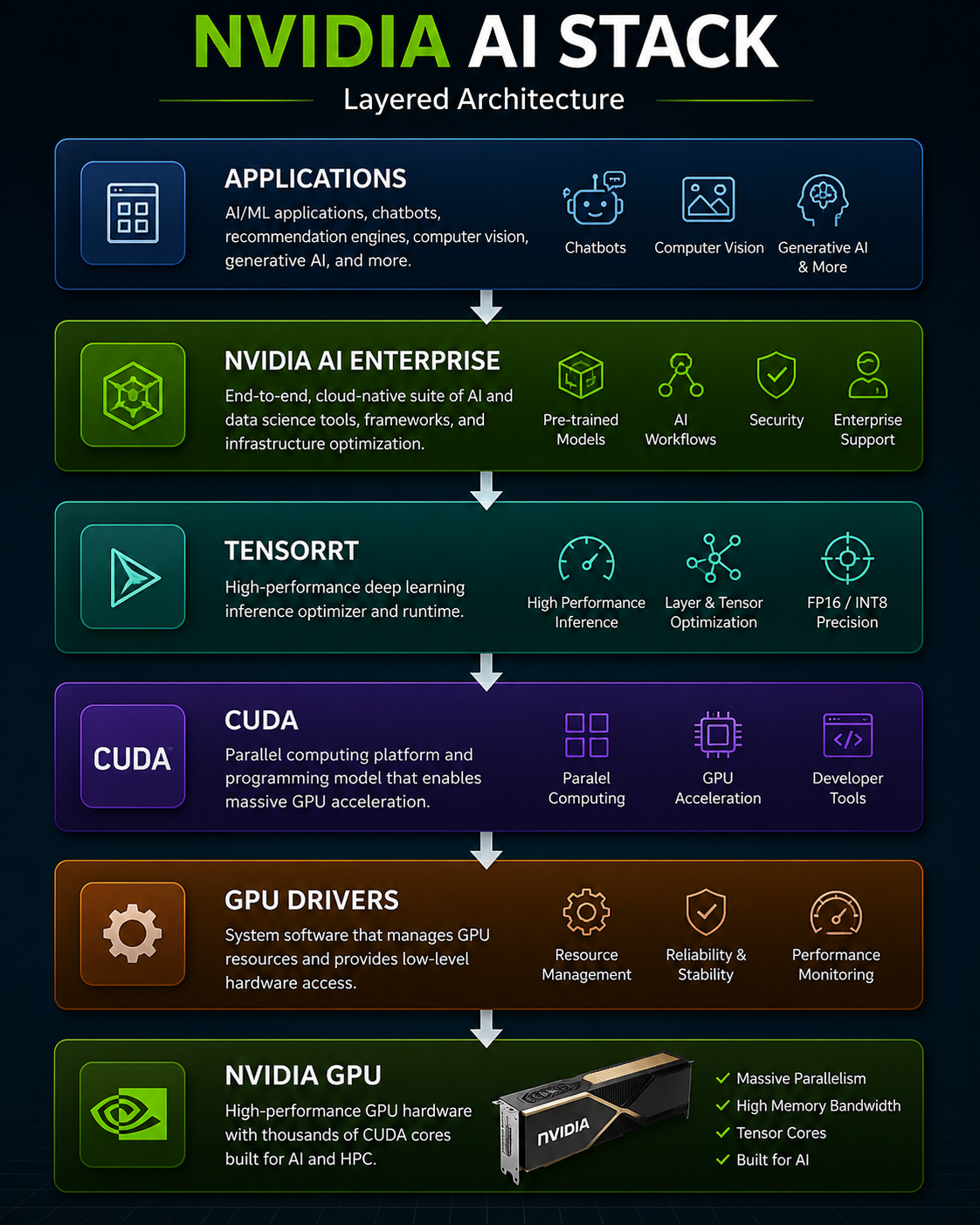
The NVIDIA AI Stack is a comprehensive collection of software platforms, SDKs, runtime engines, AI frameworks, cloud services, and deployment tools that work together to build, train, optimize, and deploy Artificial Intelligence applications at enterprise scale.
Rather than functioning as isolated products, every component of the stack is tightly integrated. CUDA provides GPU acceleration, TensorRT optimizes inference, Triton manages deployment, NeMo supports Generative AI development, while NVIDIA AI Enterprise delivers governance, licensing, and enterprise support. Together they create a unified ecosystem that maximizes both performance and developer productivity.
- Unified AI software ecosystem from development to deployment
- Optimized GPU utilization with minimal configuration effort
- Production-ready deployment across cloud, Kubernetes, and on-premises infrastructure
- Integrated support for Generative AI, LLMs, AI Agents, Computer Vision, Speech AI, and RAG
- Enterprise-grade security, lifecycle management, and monitoring
The NVIDIA AI Stack is organized into four tightly integrated layers. In the next section, we’ll explore how these layers work together—from physical GPU infrastructure to enterprise AI services and autonomous AI agents.
The Four Layers of the NVIDIA AI Stack
The NVIDIA AI Stack is built as a layered ecosystem where each component builds upon the layer below it. This architecture allows enterprises to develop, deploy, and manage AI applications efficiently while ensuring maximum GPU utilization, scalability, and operational consistency.
Why the NVIDIA AI Stack Matters
Modern AI projects involve much more than training models. Organizations must manage massive datasets, optimize GPU utilization, deploy inference services, monitor performance, and continuously scale workloads. The NVIDIA AI Stack provides an integrated software foundation that addresses these challenges through tightly connected tools and optimized workflows.
|
🚀
Faster AI TrainingNeMo Framework and Megatron-Core enable efficient distributed training using tensor, data, pipeline, and expert parallelism across hundreds or thousands of GPUs. |
⚡
Optimized InferenceTensorRT and TensorRT-LLM dramatically improve inference speed while reducing latency and infrastructure costs for production AI applications. |
|
🏢
Enterprise ScalabilityNVIDIA AI Enterprise delivers certified software, lifecycle management, enterprise support, and seamless deployment across Kubernetes, VMware, AWS, Azure, and Google Cloud. |
👨💻
Developer ProductivityPre-built containers, optimized SDKs, AI frameworks, and the NGC Catalog significantly reduce development time while improving deployment consistency. |
Up Next
The next section explores each core component of the NVIDIA AI Stack—including CUDA, cuDNN, TensorRT, Triton Inference Server, RAPIDS, NVIDIA NeMo, NVIDIA NIM, BioNeMo, NVIDIA AI Enterprise, and the NGC Catalog—to understand how they work together in enterprise AI deployments.
Core Components of the NVIDIA AI Stack
The NVIDIA AI Stack is composed of several tightly integrated software components that work together to accelerate every phase of the AI lifecycle. From GPU programming and deep learning optimization to model deployment and enterprise management, each component plays a specialized role while seamlessly integrating with the rest of the ecosystem.
CUDA
CUDA (Compute Unified Device Architecture) is the foundation of the NVIDIA AI Stack. It enables developers to directly program NVIDIA GPUs using C, C++, Python, and other supported languages. CUDA exposes thousands of GPU cores for massively parallel computing, making AI model training and scientific computing dramatically faster than CPU-only execution.
cuDNN
The CUDA Deep Neural Network Library (cuDNN) provides highly optimized GPU primitives for deep learning operations such as convolutions, pooling, normalization, and activation functions. Popular frameworks like TensorFlow and PyTorch automatically leverage cuDNN to deliver significant performance improvements.
TensorRT & TensorRT-LLM
TensorRT is NVIDIA’s high-performance inference optimization engine that reduces latency while maximizing throughput. TensorRT-LLM extends these capabilities specifically for transformer-based Large Language Models by optimizing attention mechanisms, memory usage, and GPU execution.
- Generative AI
- Chatbots
- Large Language Models
- Real-time AI inference
Triton Inference Server
Triton Inference Server provides enterprise-grade deployment for AI models. It supports multiple AI frameworks including TensorFlow, PyTorch, ONNX Runtime, TensorRT, and Python backends while enabling dynamic batching, model versioning, concurrent execution, and GPU sharing.
How These Components Work Together
What’s Next?
Beyond these foundational technologies, the NVIDIA ecosystem also includes RAPIDS for GPU-accelerated data science, NeMo for Generative AI development, NIM microservices for deployment, BioNeMo for life sciences, NVIDIA AI Enterprise for production support, and the NGC Catalog for optimized containers and AI assets.
Advanced Components of the NVIDIA AI Stack
Beyond the foundational technologies like CUDA and TensorRT, NVIDIA provides several advanced platforms that accelerate data preparation, Generative AI development, enterprise deployment, and production AI management. These components work together to create a complete enterprise AI ecosystem.
RAPIDS
RAPIDS is NVIDIA’s GPU-accelerated data science platform that dramatically speeds up data preprocessing, feature engineering, machine learning, and analytics. Instead of waiting hours for CPU-based data processing, RAPIDS performs the same operations directly on GPUs, significantly reducing preparation time before model training.
NVIDIA NeMo
NeMo is NVIDIA’s end-to-end Generative AI framework that enables organizations to build, customize, fine-tune, and deploy Large Language Models, multimodal AI, speech AI, and conversational AI applications.
- Large Language Models (LLMs)
- Speech Recognition
- Chatbots
- Retrieval-Augmented Generation (RAG)
- Multimodal AI
NVIDIA NIM
NVIDIA NIM provides production-ready AI inference microservices that simplify model deployment. Instead of manually configuring inference environments, developers can deploy optimized APIs capable of serving Generative AI applications with enterprise-grade performance, security, and scalability.
BioNeMo
BioNeMo extends the NVIDIA AI ecosystem into healthcare and life sciences. It provides specialized AI models, libraries, and deployment tools for genomics, protein research, molecular simulations, drug discovery, and biomedical AI applications.
NVIDIA AI Enterprise
NVIDIA AI Enterprise is the commercial platform that provides enterprise licensing, long-term software support, security updates, certified containers, and lifecycle management across Kubernetes, VMware, AWS, Azure, Google Cloud, and on-premises infrastructure.
NGC Catalog
The NVIDIA GPU Cloud (NGC) Catalog provides GPU-optimized containers, pretrained AI models, Helm charts, SDKs, and deployment assets that allow developers to start projects quickly without configuring complex software environments from scratch.
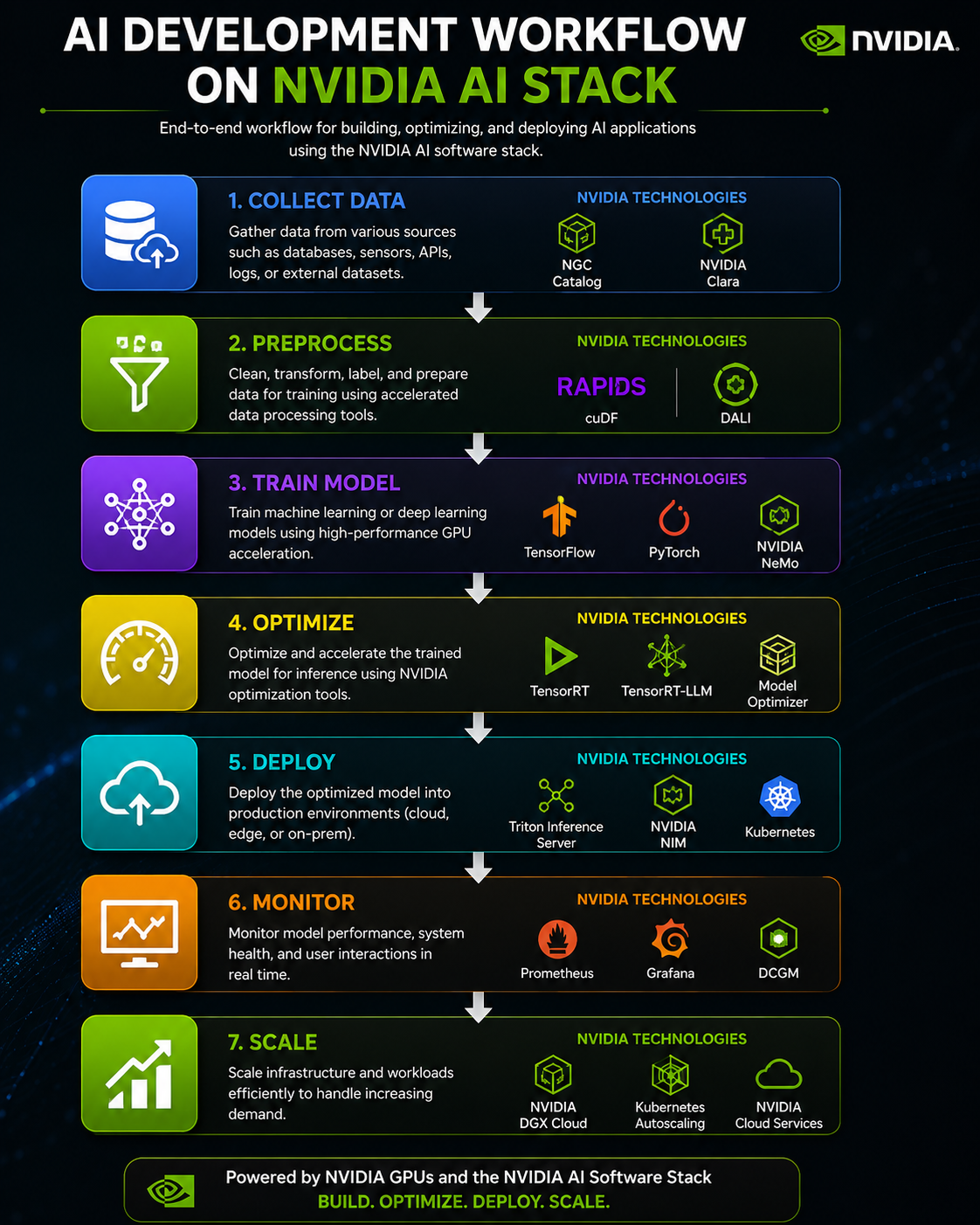
NVIDIA AI Development Lifecycle
RAPIDS
RAPIDS + DALI
NeMo + Megatron-Core
TensorRT
Triton + NIM
DCGM + Kubernetes + Prometheus
Enterprise Use Cases
The NVIDIA AI Stack supports a broad range of enterprise AI workloads—from training foundation models to deploying production-grade inference services. Its integrated software ecosystem enables organizations to accelerate innovation while maintaining scalability, reliability, and operational efficiency.
Large Language ModelsTrain and fine-tune foundation models using NeMo Framework with Megatron-Core across multi-GPU clusters for faster and more efficient model development. |
Enterprise AI InferenceDeploy optimized inference services using TensorRT, Triton Inference Server, and NVIDIA NIM for high-performance production AI applications. |
Generative AI & RAGBuild Retrieval-Augmented Generation applications using NeMo Retriever, NVIDIA NIM, and enterprise vector databases for intelligent search experiences. |
Healthcare & Computer VisionAccelerate medical imaging, genomics, speech AI, cybersecurity, robotics, and large-scale computer vision using specialized NVIDIA frameworks. |
Benefits of the NVIDIA AI Stack
| Benefit | Business Impact |
|---|---|
| Optimized Performance | Maximum GPU utilization through tightly integrated software. |
| Enterprise Ready | Certified software, enterprise support, and long-term stability. |
| Multi-Cloud Deployment | Runs across AWS, Azure, Google Cloud, VMware, and Kubernetes. |
| Security & Compliance | Enterprise-grade security, monitoring, and lifecycle management. |
Challenges
- Vendor lock-in due to tight integration with NVIDIA hardware and software.
- High infrastructure investment for enterprise GPU clusters.
- Steep learning curve because the ecosystem contains numerous interconnected technologies.
- Complex deployment across Kubernetes, cloud, and on-premises environments.
- Operational management including licensing, monitoring, and version consistency.
Best Practices
How MHTECHIN Supports NVIDIA AI Stack Deployments
Building enterprise AI infrastructure requires expertise in GPU orchestration, Kubernetes, distributed AI, and production deployment. MHTECHIN helps organizations implement and optimize NVIDIA-powered AI platforms through end-to-end consulting and engineering services.
- AI Model Development & Deployment
- TensorRT & Triton Optimization
- NeMo Framework Implementation
- RAG & Agentic AI Solutions
- GPU Infrastructure Optimization
- Training & Enterprise Upskilling
Key Takeaways
Conclusion
The NVIDIA AI Stack has evolved into one of the most comprehensive enterprise AI platforms available today. By combining optimized infrastructure software, AI frameworks, deployment services, and operational tooling, it enables organizations to accelerate every stage of the AI lifecycle—from model development and optimization to large-scale production deployment.
As Generative AI, AI agents, and enterprise machine learning continue to grow, organizations require more than powerful GPUs—they need an integrated software ecosystem capable of delivering performance, scalability, security, and operational simplicity. The NVIDIA AI Stack provides exactly that foundation for building the next generation of intelligent applications.

Leave a Reply