Introduction
As AI systems take on more consequential work, a single AI agent often isn’t enough. Different tasks call for different expertise, different tools, and different levels of oversight — asking one generalized agent to handle all of it tends to produce a system that’s slow, expensive, and hard to trust.
Instead of building one large agent that does everything, enterprises are increasingly designing systems where multiple specialized AI agents collaborate — each responsible for a narrower piece of the work, coordinated toward a shared objective. This isn’t simply “more agents.” It’s a different architectural approach, with its own design patterns, trade-offs, and failure modes. This guide focuses on how enterprises actually design, coordinate, and scale these systems in production.
What Are Multi-Agent Architectures?
A multi-agent architecture is a system in which multiple AI agents work toward a shared objective through defined communication, task delegation, collaboration, and coordination. Rather than one agent handling an entire workflow end to end, the work is distributed — each agent owns a specific role, tool set, or domain of expertise, and the system as a whole produces the final result.
The key architectural decisions aren’t about what any individual agent can do — that’s largely settled by the underlying model. The decisions that actually matter are about how the agents relate to each other: who directs whom, how they pass work along, and how disagreements or failures get resolved.
Why Single-Agent Systems Have Limitations
Single-agent systems work well for bounded, well-defined tasks. They start to strain as scope grows:
- Too many responsibilities — a single agent juggling many domains tends to perform worse at each one
- Context overload — long-running tasks accumulate context that degrades reasoning quality over time
- Tool limitations — a large tool set attached to one agent increases the chance of selecting the wrong tool
- Higher costs — routing every task, simple or complex, through one large capable model is inefficient
- Difficult debugging — when something goes wrong, it’s hard to isolate which part of a long, single-agent chain failed
- Scaling challenges — a single agent architecture doesn’t naturally parallelize as workload grows
These limitations are what push enterprises toward distributing work across specialized agents instead of scaling up one generalized agent.
How Multi-Agent Architectures Work
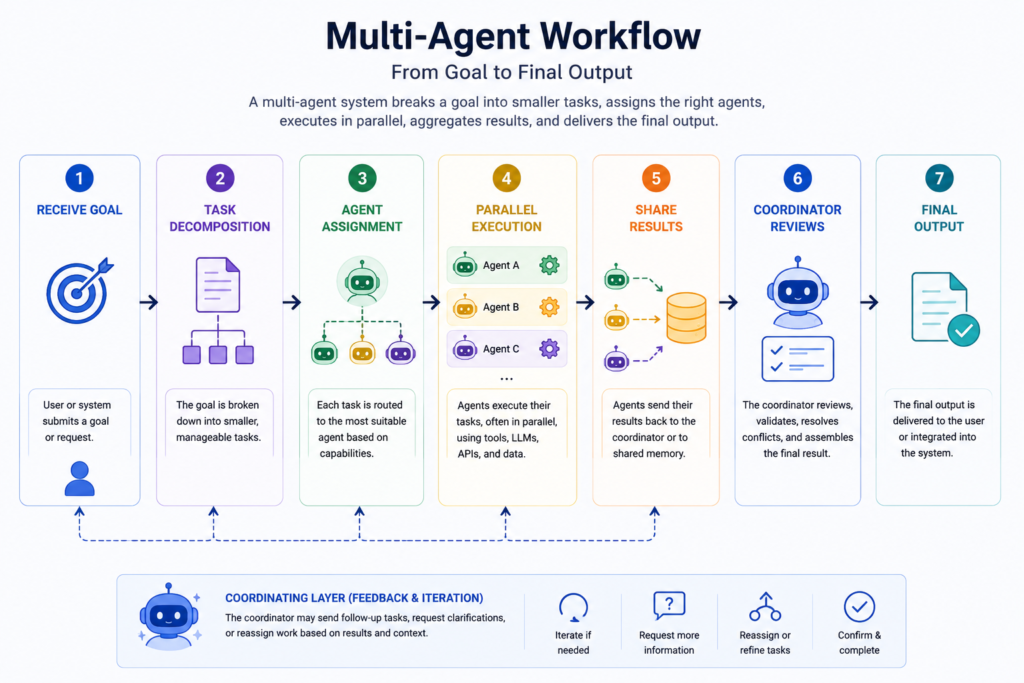
A typical multi-agent workflow follows a consistent shape, regardless of which coordination pattern it uses:
Receive goal → Task decomposition → Assign agents → Execute tasks → Share results → Coordinator reviews → Final output
The goal is broken into smaller pieces, each piece is routed to the agent best equipped to handle it, agents execute their pieces (often in parallel), results are shared back, and a coordinating layer reviews and assembles the final output before it’s delivered.
Types of Multi-Agent Architectures
Several coordination patterns have become standard in production systems, each with different trade-offs between control and flexibility:
Hierarchical (Supervisor) — A manager agent delegates tasks to worker agents and reviews their output. This is currently the most common starting pattern for cross-domain enterprise tasks, since it gives clear visibility into who did what.
Collaborative (Peer-to-Peer / Mesh) — Agents communicate directly with each other as peers rather than through a central coordinator, useful when tasks require ongoing negotiation between agents rather than one-directional delegation.
Pipeline (Sequential) — Agent A completes its task and passes the result to Agent B, and so on. Simple to reason about, but a failure anywhere in the chain blocks everything downstream.
Swarm — Many agents work on smaller pieces of a problem simultaneously with looser central control, well suited to exploratory tasks like broad research, but harder to trace when something goes wrong.
In practice, most production systems combine patterns rather than relying on a single one — a hierarchical structure at the top level, with sequential or parallel patterns inside each specialist’s own workflow.
| Pattern | Structure | Best suited for |
|---|---|---|
| Hierarchical | Manager → worker agents | Cross-domain tasks needing oversight |
| Collaborative | Peer-to-peer agents | Tasks requiring negotiation between agents |
| Pipeline | Agent A → Agent B → Agent C | Linear, well-defined multi-step processes |
| Swarm | Many agents, parallel, loosely coordinated | Broad exploration or research tasks |
Core Components
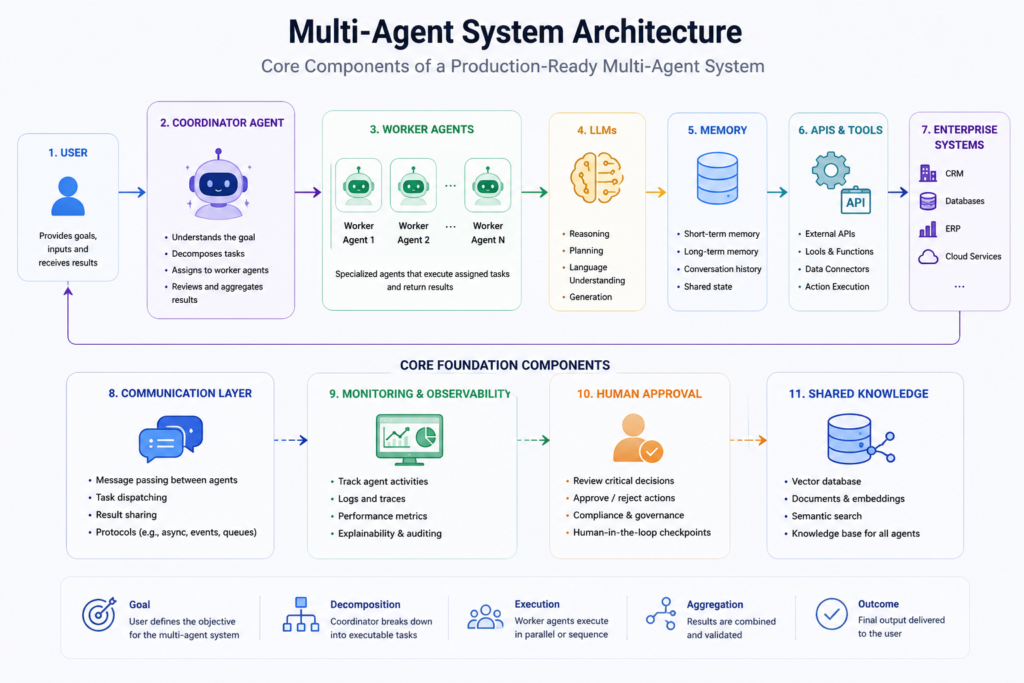
Beyond the individual agents, a production multi-agent system depends on several shared components:
- Coordinator agent — directs task assignment and reviews aggregated results
- Worker agents — specialized agents handling narrower, well-defined tasks
- Shared memory — context that needs to persist and be accessible across agents
- Vector database — supporting retrieval and semantic search across shared knowledge
- APIs — the mechanism individual agents use to take action
- Communication layer — the protocol agents use to pass tasks and results between each other
- Monitoring — visibility into which agent did what, and why
- Human approval — checkpoints for decisions that warrant oversight before they take effect
Enterprise Use Cases
Multi-agent designs are showing up in workflows that naturally split across distinct areas of expertise:
- Customer support — a routing agent triaging requests to specialized agents for billing, technical issues, or account changes
- Software development — separate agents for planning, coding, testing, and review working in sequence
- HR — coordinating onboarding tasks across documentation, provisioning, and scheduling agents
- Finance — one agent gathering data, another performing analysis, another assembling reports
- Supply chain — agents monitoring inventory, forecasting demand, and coordinating logistics in parallel
- Manufacturing — specialized agents for monitoring, diagnostics, and maintenance scheduling
- Cybersecurity — agents handling detection, triage, and response as distinct roles
- Healthcare — administrative and scheduling agents working alongside clinical decision support
Benefits
- Better scalability — new capabilities can be added as new agents rather than retraining one large system
- Modular design — individual agents can be updated or replaced without rebuilding the whole system
- Easier maintenance — issues can be isolated to a specific agent rather than debugged across one long process
- Higher accuracy — specialized agents tend to outperform a single generalist on narrow tasks
- Specialized expertise — different agents can be tuned, prompted, or even built on different models suited to their role
- Parallel execution — independent tasks can run simultaneously rather than sequentially
- Faster workflows — overall throughput improves when work is distributed rather than handled one step at a time
Challenges
Multi-agent systems solve some problems and introduce others:
- Agent communication — passing context and results between agents reliably is nontrivial engineering work
- Conflicting decisions — agents can reach different conclusions that need to be reconciled
- Latency — coordination overhead between agents can add up, especially in deeply hierarchical designs
- Cost — running multiple agents, particularly with cross-checking or debate patterns, multiplies token spend
- Monitoring — tracing a failure back to its source agent is harder than debugging a single-agent system
- Security — more agents means a larger surface area of tool and data access to secure
- Governance — accountability needs to be clear even when a decision passed through several agents
- Failure handling — a single agent’s error can cascade through the rest of the system if not contained
The core trade-off across every coordination pattern is between autonomy and control: looser patterns like swarms offer flexibility and speed, while tighter patterns like hierarchical supervision offer visibility and predictability at some cost to flexibility. Choosing the right pattern for the workflow — rather than defaulting to the most flexible or most controlled option — is itself one of the more consequential design decisions in a multi-agent system.
Technologies Behind Multi-Agent Systems
A common set of technologies underpins most multi-agent implementations today:
- Large language models — the reasoning engine behind each individual agent
- MCP (Model Context Protocol) — a standard for connecting agents to external tools and data sources
- RAG — grounding agent outputs in enterprise knowledge
- Vector databases — supporting semantic search and shared retrieval across agents
- LangGraph, AutoGen, and CrewAI — common orchestration frameworks for defining agent roles and coordination logic
- Kubernetes and Docker — running and scaling the underlying agent infrastructure
- APIs — the interface agents use to take action in connected systems
- Workflow engines — coordinating hand-offs and dependencies between agents
- Cloud platforms — providing the compute multi-agent systems run on
These are presented here as common industry technologies rather than a specific implementation — the right combination depends on the workflow, existing systems, and governance requirements of each organization.
Multi-Agent vs. Single-Agent
| Single Agent | Multi-Agent |
|---|---|
| One model | Multiple specialized agents |
| Sequential tasks | Parallel tasks |
| Limited scalability | Highly scalable |
| Single decision-maker | Collaborative decisions |
| Simpler architecture | More complex but modular |
Future Trends
A few directions are shaping how multi-agent systems are likely to evolve:
- AI agent teams — persistent groups of agents with defined roles, closer to a team structure than a single tool
- Autonomous enterprises — a growing share of internal processes running through coordinated agent systems with human oversight at key checkpoints
- Human-AI collaboration — clearer patterns for where multi-agent systems act independently and where people stay in the loop
- AI orchestration platforms — maturing tooling purpose-built for managing agent coordination, rather than general-purpose workflow engines adapted for the task
- Enterprise governance — stronger standards for auditability across systems where decisions pass through multiple agents
- Multi-agent reasoning — continued research into how agents negotiate, resolve disagreement, and improve collective decision quality
Why Businesses Are Exploring Multi-Agent Architectures
Organizations are exploring multi-agent architectures to improve scalability, distribute complex workloads, and build modular AI systems that can adapt to evolving business requirements. By assigning specialized responsibilities to different agents, enterprises can improve efficiency while maintaining flexibility and governance.
MHTECHIN focuses on AI integration and scalable enterprise solutions — helping organizations determine when a multi-agent approach is actually warranted, and designing the coordination, monitoring, and governance layers needed to make it work reliably.
Conclusion
Multi-agent architectures let organizations tackle problems that are genuinely difficult for a single AI agent to handle well — but the benefits depend entirely on thoughtful design. Choosing the right coordination pattern, building in monitoring and governance from the start, and containing failures before they cascade matter more than simply adding more agents to a system. Done well, multi-agent design turns a collection of narrow, specialized agents into something more capable than any one of them alone.
Frequently Asked Questions (FAQs)
1. What is a multi-agent architecture? A multi-agent architecture is a system in which multiple AI agents, each with a specialized role, coordinate through defined communication and delegation to accomplish a shared objective — rather than one agent handling the entire task alone.
2. How is it different from a single AI agent? A single agent handles a task end to end within one context. A multi-agent system distributes the task across several specialized agents that communicate, delegate, and combine their outputs into a final result.
3. What are the benefits of multi-agent systems? Better scalability, modular design that’s easier to maintain, higher accuracy from specialization, and the ability to execute independent tasks in parallel rather than sequentially.
4. What industries use multi-agent AI? Customer support, software development, HR, finance, supply chain, manufacturing, cybersecurity, and healthcare are among the areas where multi-agent designs are most established.
5. Are multi-agent systems secure? They can be, but security requires deliberate design — more agents means more tool and data access points to scope, monitor, and audit than a single-agent system.
6. What technologies power multi-agent architectures? Common components include large language models, the Model Context Protocol (MCP), RAG, vector databases, orchestration frameworks like LangGraph, AutoGen, and CrewAI, and standard infrastructure like Kubernetes and Docker.
7. What challenges should organizations consider? Reliable communication between agents, resolving conflicting outputs, coordination latency, rising costs at scale, harder debugging and monitoring, and containing failures before they cascade across agents.
8. How do multi-agent systems communicate? Through a defined communication layer — commonly a coordinator that routes tasks and aggregates results (hierarchical pattern), or direct peer-to-peer hand-offs between agents (collaborative or swarm patterns), depending on the architecture chosen.

Leave a Reply