Introduction
Artificial Intelligence is everywhere. From the moment you unlock your phone with facial recognition to the time you ask a chatbot for dinner recommendations, AI has quietly woven itself into the fabric of daily life. But what exactly is artificial intelligence? For beginners, the concept can feel overwhelming—a mix of science fiction fantasies and complex technical jargon.
This beginner’s guide cuts through the noise. Whether you are a student exploring career paths, a professional seeking to understand AI’s impact on your industry, or simply a curious mind, this article will give you a solid foundation. We will explore what AI truly is, how it works, the different types that exist, and—most importantly—how you can start using and even building AI tools today.
Throughout this guide, we will reference insights from industry leaders like Google, Microsoft, and OpenAI, and show you how MHTECHIN is helping businesses and individuals harness the power of AI through tailored solutions and expert training.
Section 1: What is Artificial Intelligence? A Clear Definition
1.1 Defining Artificial Intelligence
At its core, artificial intelligence refers to machines or software that display abilities we associate with human intelligence. One formal definition describes AI as “a broad branch of computer science concerned with creating machines that can learn, make decisions, and perform tasks to a human-like level.”
But intelligence is not a single thing—it is a collection of capabilities. AI systems can:
- Perceive patterns (like recognizing faces in photos)
- Make decisions (like recommending which movie to watch next)
- Generate content (like writing emails or creating images)
- Learn from experience (like improving at a game the more they play)
The key distinction is that traditional software follows fixed instructions, while AI systems can adapt and improve over time. They do not just execute commands; they learn from data.
1.2 AI is Not One Technology—It is an Umbrella Term
When people say “AI,” they are often referring to a collection of related technologies. Think of AI as an umbrella that covers:
| Subfield | What It Does | Example |
|---|---|---|
| Machine Learning (ML) | Algorithms that learn from data without being explicitly programmed | Spam filters that get better at detecting unwanted emails |
| Deep Learning | Multi-layered neural networks that learn complex patterns | Voice assistants understanding different accents |
| Natural Language Processing (NLP) | Understanding and generating human language | Chatbots like ChatGPT or Google’s Gemini |
| Computer Vision | Interpreting visual information from the world | Facial recognition on smartphones |
| Generative AI | Creating new content (text, images, music) | AI image generators like Midjourney |
As Microsoft AI notes in their vision for Humanist Superintelligence, the goal is not to replace human capability but to amplify it—expanding what people can imagine and achieve.
Section 2: A Brief History of AI—From Theory to Everyday Tool
Understanding where AI came from helps explain where it is going. The journey from academic concept to daily companion spans nearly a century.
2.1 The Early Foundations (1950s–1970s)
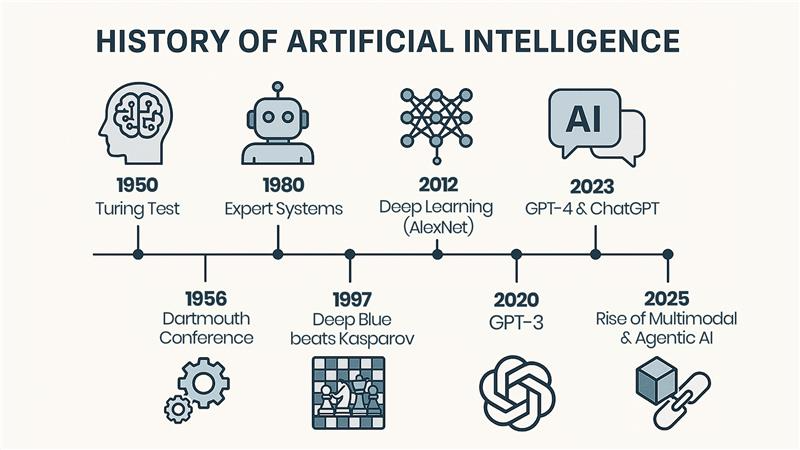
The field of AI was born in the 1950s. In 1950, Alan Turing published a paper asking, “Can machines think?” He proposed the Turing Test—if a machine could fool a human into thinking it was human, it had achieved intelligence. This became a foundational goal for early AI researchers.
The term “artificial intelligence” was coined in 1956 at the Dartmouth Conference, which many consider the birth of AI as a field. Early optimism led to predictions that human-level AI was just decades away—but progress proved slower than expected.
2.2 The AI Winters (1970s–1990s)
Overpromises led to disappointment. In the 1970s and again in the late 1980s, funding dried up as AI failed to deliver on its grand promises. These periods became known as “AI winters.” However, research continued quietly, laying groundwork for future breakthroughs.
2.3 The Rise of Machine Learning (1990s–2010s)
The 1990s saw a shift from trying to program intelligence directly to letting machines learn from data. In 1997, IBM’s Deep Blue made history by defeating world chess champion Garry Kasparov. Deep Blue was a reactive machine—it could analyze chess positions but had no memory of past games.
The 2010s brought deep learning into the mainstream. Neural networks with many layers (hence “deep”) began achieving superhuman performance in tasks like image recognition. In 2012, a deep learning model won the ImageNet competition, signaling a new era.
2.4 The Generative AI Revolution (2020–Present)
The launch of ChatGPT in late 2022 marked a turning point. For the first time, hundreds of millions of people could interact with a sophisticated AI through natural conversation. According to recent data, Google’s AI Overviews now serve 2 billion monthly users, while the Gemini app has grown to 450 million monthly active users.
As OpenAI’s chief scientist Jakub Pachocki recently shared, the industry is now focused on building autonomous AI researchers—systems that can tackle complex problems independently, potentially transforming how scientific discovery happens.
Section 3: The Four Types of AI (And Which Ones Exist Today)
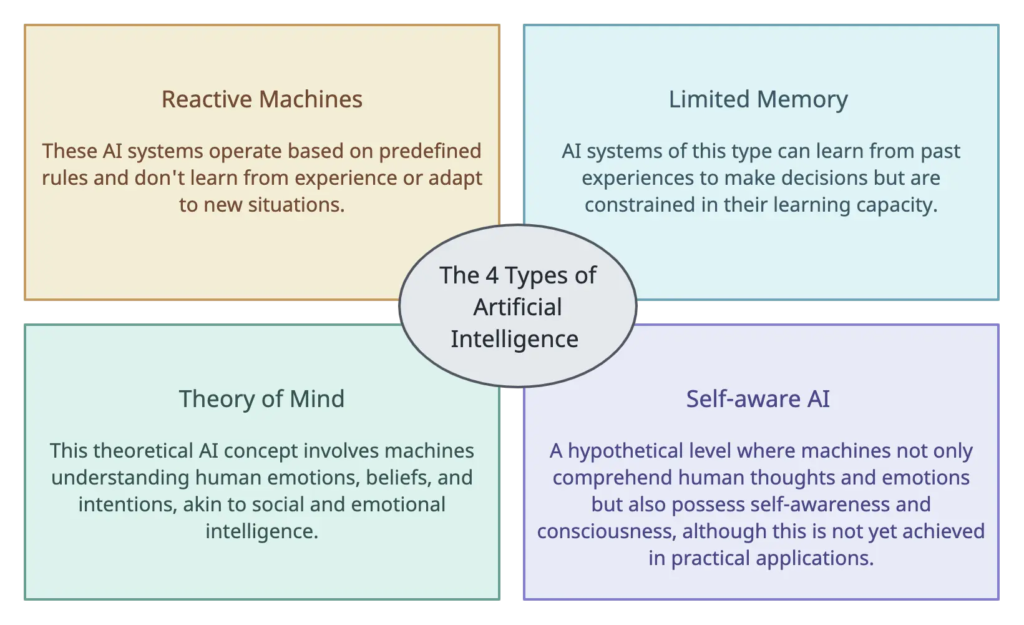
Researcher Arend Hintze of Michigan State University proposed a widely accepted framework for understanding AI types. This helps clarify what is currently possible versus what remains science fiction.
3.1 Reactive Machines
What they are: The simplest form of AI. Reactive machines respond to specific inputs with specific outputs. They have no memory and cannot learn from past experiences.
Examples:
- IBM Deep Blue: The chess supercomputer that beat Garry Kasparov. It evaluated millions of positions per second but had no concept of past games.
- Netflix recommendations: The algorithm analyzes your viewing history to suggest new content—but each recommendation is based on current data, not learning from previous recommendations in real-time.
Where they exist today: Widely deployed. Most traditional machine learning systems fall into this category.
3.2 Limited Memory AI
What they are: These systems can learn from historical data and improve over time. They build a temporary memory of past interactions to inform future decisions.
Examples:
- Self-driving cars: They monitor the speed, direction, and proximity of other vehicles, using this data to make real-time decisions about lane changes and braking.
- Chatbots like ChatGPT: They maintain context within a conversation, remembering what was said earlier to provide coherent responses.
Where they exist today: This is the dominant form of AI in use today. Most generative AI tools, recommendation engines, and autonomous systems are limited memory AI.
3.3 Theory of Mind AI
What they are: AI that understands that other beings have thoughts, emotions, and intentions—and can adjust its behavior accordingly.
Examples: None exist yet. This remains a future goal.
Why it matters: Theory of mind AI would represent a fundamental shift—machines that truly understand human psychology, enabling more natural and empathetic interaction.
3.4 Self-Aware AI
What they are: Systems with consciousness, self-awareness, and a sense of identity.
Examples: None exist. This is the stuff of science fiction.
Current status: Researchers debate whether self-aware AI is even possible or desirable. Companies like Microsoft AI emphasize keeping AI “controllable, aligned, and firmly in service to humanity.”
Section 4: How AI Actually Works—Core Concepts Explained Simply
You do not need a computer science degree to understand AI fundamentals. Here are the key concepts demystified.
4.1 Machine Learning: The Engine of Modern AI
Machine learning is how AI systems acquire intelligence. Instead of programming a computer with explicit rules for every scenario, we feed it examples and let it discover patterns.
How it works:
- Training data: The system learns from examples (e.g., thousands of labeled cat photos)
- Algorithm: A mathematical model finds patterns in the data
- Prediction: The trained model can then make predictions about new, unseen data
Real-world example: A spam filter does not follow rules like “emails with the word ‘viagra’ are spam.” Instead, it learns from millions of emails labeled “spam” or “not spam,” identifying subtle patterns humans might miss.
4.2 Neural Networks and Deep Learning
Neural networks are algorithms inspired by the human brain. They consist of layers of interconnected “neurons” that process information.
- Simple neural networks might have 3–5 layers
- Deep learning networks can have dozens or hundreds of layers, allowing them to learn extremely complex patterns
Deep learning powers today’s most impressive AI achievements—from voice assistants that understand speech to image generators that create photorealistic art.
4.3 Large Language Models (LLMs): The Brain Behind Chatbots
LLMs are a type of deep learning model trained on massive amounts of text—trillions of words from books, websites, and documents. They learn to predict what word comes next in a sequence, which turns out to be a surprisingly powerful way to generate coherent text, answer questions, and even write code.
Popular LLMs include:
- ChatGPT (OpenAI)
- Claude (Anthropic)
- Gemini (Google)
- Copilot (Microsoft)
These models have become so central to public conversation about AI that many people now equate “AI” with LLMs—though AI is actually much broader.
4.4 Generative AI: Creating Something New
Generative AI refers to systems that create new content rather than just analyzing existing data. This includes:
- Text generation: Writing essays, emails, code
- Image generation: Creating artwork from text descriptions
- Audio generation: Producing music or realistic voice synthesis
- Video generation: Creating short video clips from prompts
Microsoft’s MAI-Image-2 and MAI-Voice-1 represent the cutting edge of generative capabilities, designed to produce grounded, reliable outputs for real creative work.
4.5 Hallucinations: AI’s Achilles’ Heel
AI systems, particularly LLMs, sometimes generate information that sounds plausible but is completely false. This is called hallucination.
Why it happens: LLMs predict words based on patterns, not facts. They have no understanding of truth—they just know what words tend to follow other words.
What you can do: Always verify important information from AI tools against authoritative sources. Treat AI as a helpful assistant, not an infallible oracle.
Section 5: Real-World AI Applications—Where AI Is Making a Difference
AI is not a futuristic concept—it is transforming industries today.
5.1 In Business and Enterprise
| Application | How AI Helps | Example |
|---|---|---|
| Predictive Analytics | Forecasts customer behavior, sales trends, and risks | Retailers predicting inventory needs |
| Process Optimization | Automates workflows and identifies inefficiencies | MHTECHIN helps businesses implement AI to reduce redundancies and enhance workflows |
| Customer Service | Chatbots handle routine inquiries 24/7 | AI-powered support reducing wait times |
| Code Generation | AI assistants help developers write code faster | Tools like GitHub Copilot and OpenAI’s Codex |
OpenAI’s Codex is so effective that most technical staff at OpenAI now use it in their daily work. As Pachocki notes, “Our jobs are now totally different than they were even a year ago. Nobody really edits code all the time anymore. Instead, you manage a group of Codex agents.”
5.2 In Healthcare
- Early detection: AI analyzes medical images to spot abnormalities humans might miss
- Drug discovery: Models predict which molecular structures could become effective drugs
- Personalized medicine: AI helps tailor treatments to individual patients
5.3 In Education
AI is becoming a personalized tutor. According to the AI Launchpad course from the European Union’s Digital Skills and Jobs Platform, AI tools can help students learn at their own pace, with AI providing explanations, generating practice problems, and offering feedback.
5.4 In Creative Fields
- Writing: Drafting articles, marketing copy, and scripts
- Design: Generating logos, layouts, and visual concepts
- Music: Composing original pieces in various styles
5.5 In Daily Life
- Navigation: Google Maps predicts traffic and suggests optimal routes
- Shopping: Recommendation engines suggest products you might like
- Entertainment: Netflix, Spotify, and TikTok use AI to curate content
- Smart Homes: Voice assistants control lights, thermostats, and security
Section 6: How to Start Learning AI—A Beginner’s Roadmap
If you are excited to dive into AI, you are not alone. The field is more accessible than ever, with free resources available from industry leaders.
6.1 Step 1: Build Foundational Knowledge
Before writing code, understand the concepts. Microsoft offers an excellent free resource: the AI-900: Azure AI Fundamentals learning path. It covers:
- What machine learning is and how it works
- Computer vision and natural language processing
- Generative AI concepts
- Responsible AI principles
This path requires no technical background and provides “sandboxes”—free temporary environments where you can build real AI solutions without a credit card.
6.2 Step 2: Get Hands-On with Student Resources
If you are a student, take advantage of the Azure for Students offer. It provides free access to cloud resources for building AI projects. Start with a simple project like:
- A note summarizer
- A smart search tool for your syllabus
- A chatbot for a topic you care about
As one Microsoft Q&A expert advised, “This is your best resource. As a B.Tech student, you can sign up for the Azure for Students offer. This is how you’ll build your own projects.”
6.3 Step 3: Master Prompt Engineering
Prompt engineering is the art of crafting effective instructions for AI systems. It is a critical skill for getting good results from generative AI tools.
Basic principles:
- Be specific: “Write a summary” vs. “Write a 3-sentence summary suitable for a busy executive”
- Provide context: Tell the AI who it is helping and why
- Iterate: Refine your prompts based on what works
The AI Launchpad course includes a dedicated module on prompt engineering, recognizing it as a key skill for effective AI interaction.
6.4 Step 4: Explore Advanced Learning Paths
Once comfortable with fundamentals, pursue professional certifications:
- AI-102: Microsoft Azure AI Engineer Associate—the professional-level certification that validates your ability to implement AI solutions
6.5 Step 5: Stay Current
AI evolves rapidly. Follow authoritative sources:
- Google AI Blog
- Microsoft AI News
- OpenAI Research
- MIT Technology Review
Section 7: The Future of AI—What’s Coming Next
The AI landscape is shifting faster than ever. Here are the trends experts are watching.
7.1 Agentic AI: Systems That Take Action
Current AI responds to prompts. Agentic AI sets goals, plans sequences of steps, makes decisions, and carries out actions with minimal human supervision.
OpenAI’s roadmap:
- By September 2026: An “autonomous AI research intern” capable of tackling specific research problems independently
- By 2028: A fully automated multi-agent research system that can tackle problems too large or complex for humans
As Pachocki envisions, “I think we will get to a point where you kind of have a whole research lab in a data center.”
7.2 AI Mode and Conversational Search
Google’s AI Mode—now used by over 100 million people in the US and India—represents a shift from keyword search to conversation. Instead of typing fragmented queries, users can ask complex questions and have follow-up conversations.
As Google product VP Robby Stein explains, “We’re not building a chatbot to chat with you. We’re building a system that understands what you’re trying to accomplish.”
7.3 Responsible AI and Safety
As AI becomes more capable, safety becomes paramount. Microsoft AI’s Humanist Superintelligence framework emphasizes:
- Keeping humans in control
- Building alignment into the architecture
- Stress-testing safety at every stage
OpenAI is developing chain-of-thought monitoring—using AI to watch other AI’s “scratch pads” to catch unwanted behavior before it becomes a problem.
7.4 Specialized AI Architectures
Beyond general-purpose models, specialized architectures are emerging for specific use cases. Time-Delayed Neural Networks (TDNNs) , for example, excel at processing sequential data for applications like speech recognition, financial forecasting, and anomaly detection in industrial IoT.
Organizations like MHTECHIN are at the forefront of implementing these specialized solutions, tailoring AI architectures to meet specific business needs rather than applying one-size-fits-all approaches.
Section 8: AI Ethics and Responsible Use
As AI becomes more powerful, understanding its limitations and ethical implications is essential.
8.1 Bias in AI
AI systems learn from data—and if that data contains biases, the AI will too. This can lead to:
- Hiring algorithms that discriminate against certain groups
- Credit scoring systems that perpetuate historical inequalities
- Image recognition that performs worse on people with darker skin tones
What to do: Demand transparency from AI providers. Test AI systems for bias before deployment. Use diverse training data.
8.2 Privacy Concerns
AI systems often require large amounts of data. Questions to ask:
- Who owns the data used to train AI?
- What happens to your inputs when you use AI tools?
- How is your data protected?
8.3 Job Displacement vs. Job Transformation
AI will automate some tasks—but historically, technology creates new jobs even as it eliminates others. The key is adaptation. As Pachocki notes, “Our jobs are now totally different than they were even a year ago.” The challenge is ensuring workers have the skills to thrive in an AI-augmented workplace.
8.4 Environmental Impact
Training large AI models consumes enormous energy. The industry is increasingly focused on sustainability—an area where MHTECHIN emphasizes eco-friendly practices in its AI projects.
Section 9: How MHTECHIN Can Help You Navigate the AI Landscape
Whether you are an individual looking to build AI skills or a business seeking to implement AI solutions, MHTECHIN offers expertise tailored to your needs.
9.1 For Individuals: Training and Education
MHTECHIN provides practical, hands-on AI/ML workshops designed to prepare you for real-world challenges. Their approach emphasizes:
- Hands-on projects that simulate actual business scenarios
- Expert-led classes taught by professionals with years of industry experience
- Flexible schedules accommodating students, professionals, and enterprises
9.2 For Businesses: AI Implementation
MHTECHIN helps organizations harness AI through:
- Predictive analytics that enable data-driven decision-making
- Chatbot integration that automates customer service with intelligent systems
- Process optimization using AI to enhance workflows and reduce redundancies
9.3 Specialized Solutions
For businesses with unique data challenges, MHTECHIN offers specialized architectures like Time-Delayed Neural Networks for temporal data processing—ideal for financial forecasting, speech recognition, and industrial IoT applications.
9.4 The MHTECHIN-AWS Advantage
As an AWS-powered solution provider, MHTECHIN leverages cloud infrastructure to deliver scalable, reliable AI systems. This partnership ensures:
- Elastic Beanstalk simplifying app deployment
- RDS solutions for secure, scalable database management
- Monitoring tools ensuring 24/7 performance
Section 10: Frequently Asked Questions About Artificial Intelligence
10.1 Q: What is artificial intelligence in simple terms?
A: Artificial intelligence is technology that enables machines to perform tasks that normally require human intelligence—like understanding language, recognizing patterns, making decisions, and learning from experience. Think of it as teaching computers to think and learn rather than just follow step-by-step instructions.
10.2 Q: What are the 4 types of artificial intelligence?
A: The four types are: (1) Reactive Machines—AI that responds to inputs without memory, like IBM’s Deep Blue chess computer; (2) Limited Memory—AI that learns from historical data, like self-driving cars and chatbots; (3) Theory of Mind—AI that understands human emotions and intentions (not yet developed); and (4) Self-Aware AI—conscious systems with a sense of identity (theoretical only).
10.3 Q: How can a beginner start learning AI?
A: Start with free foundational courses like Microsoft’s AI-900 Azure AI Fundamentals, which requires no technical background. Then get hands-on experience through student programs like Azure for Students, which provides free cloud resources. Build simple projects like a note summarizer or chatbot. Finally, practice prompt engineering to effectively interact with generative AI tools.
10.4 Q: Is AI dangerous?
A: AI is a tool—its impact depends on how it is built and used. Current risks include bias in AI systems, privacy concerns, potential job displacement, and “hallucinations” where AI generates false information. Leading AI companies emphasize responsible development: Microsoft’s Humanist Superintelligence framework keeps humans in control, while OpenAI uses chain-of-thought monitoring to catch unwanted behavior.
10.5 Q: What is generative AI?
A: Generative AI refers to systems that create new content—text, images, audio, or video—rather than just analyzing existing data. Examples include ChatGPT for text, Midjourney for images, and Microsoft’s MAI-Voice-1 for speech. These tools learn patterns from training data and then generate novel outputs that follow those patterns.
10.6 Q: How is Google using AI in search?
A: Google has integrated AI across its search experience. AI Overviews provide AI-generated summaries at the top of search results, now serving 2 billion monthly users. AI Mode offers a conversational search experience where users can ask complex questions and have follow-up interactions, currently used by over 100 million people in the US and India.
10.7 Q: What is the difference between AI, machine learning, and deep learning?
A: AI is the broad umbrella term for machines that mimic human intelligence. Machine learning is a subset of AI where systems learn from data rather than being explicitly programmed. Deep learning is a subset of machine learning using multi-layered neural networks to learn complex patterns—it powers today’s most advanced AI like voice assistants and image generators.
10.8 Q: Will AI take my job?
A: AI will automate some tasks but also create new opportunities. History shows technology transforms jobs rather than eliminating them entirely. The key is developing skills to work alongside AI. As OpenAI’s chief scientist notes, roles are already changing—“Nobody really edits code all the time anymore. Instead, you manage a group of AI agents.”
Section 11: Conclusion—Your AI Journey Starts Here
Artificial intelligence is no longer a futuristic concept—it is a present-day reality transforming how we work, learn, and live. From the reactive machines of IBM’s Deep Blue to the sophisticated generative AI of today, the field has evolved dramatically. And with agentic AI and autonomous research systems on the horizon, the pace of change will only accelerate.
For beginners, the path forward is clearer than ever. Free resources from Microsoft, Google, and OpenAI make learning accessible. Practical projects let you build skills. And organizations like MHTECHIN stand ready to help you navigate the journey—whether you are an individual seeking training or a business looking to implement AI solutions.
The most important step is simply to start. AI literacy is becoming as fundamental as digital literacy. By understanding what AI is, how it works, and how to use it responsibly, you position yourself to thrive in an AI-augmented world.
Ready to take the next step? Explore MHTECHIN’s AI/ML workshops and training programs designed to build practical, job-ready skills. Visit www.mhtechin.com to learn how our expert team can help you harness the power of artificial intelligence—from foundational training to custom enterprise solutions.
The future of AI is not something that happens to you. It is something you help build.
This guide is brought to you by MHTECHIN—committed to empowering individuals and organizations with practical AI knowledge and enterprise-ready solutions. For personalized guidance on AI learning paths, hands-on training, or custom AI implementation, reach out to the MHTECHIN team today.

Leave a Reply