Introduction
When people talk about artificial intelligence, they often use the same term to describe vastly different things. A spam filter that learns to block unwanted emails is called AI. A chatbot that writes poetry is called AI. And the hypothetical machine that could outperform humans at every intellectual task is also called AI. These are not the same—and confusing them leads to misconceptions about what AI can and cannot do today.
Understanding the types of AI is essential for anyone who wants to navigate the AI landscape intelligently. It helps you separate science fiction from reality, set realistic expectations for AI investments, and understand the trajectory of technological development.
This article explains the three major categories of AI—Narrow AI, General AI, and Superintelligence—in simple terms. We will explore what each type means, which ones exist today, and how close we are to achieving the more advanced forms. Along the way, we will ground these concepts in real-world examples from industry leaders like Google, Microsoft, and OpenAI.
For a foundational introduction to AI concepts, you may find our Beginner’s Guide to AI helpful as a starting point.
Throughout, we will highlight how MHTECHIN helps individuals and organizations work with the AI that exists today—Narrow AI—while preparing for the capabilities emerging on the horizon.
Section 1: The Three-Tier Framework for Understanding AI Types
1.1 Why Categorizing AI Matters
Not all AI is created equal. The capabilities, limitations, and implications vary dramatically across different types of AI. Categorizing AI helps answer critical questions:
- What can AI actually do today?
- When will AI be able to do tasks that currently require human intelligence?
- Should we be concerned about AI surpassing human capabilities?
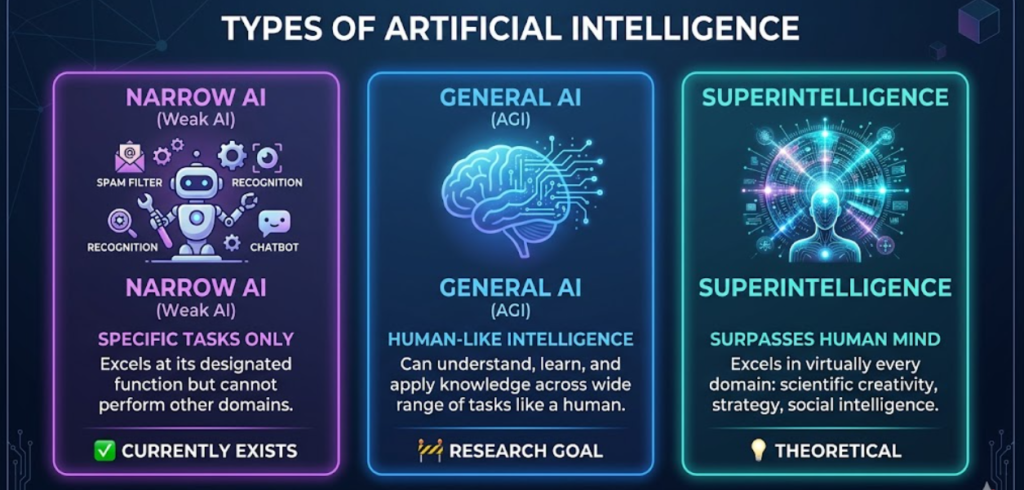
The most widely accepted framework categorizes AI into three levels based on capability and autonomy:
| Level | Name | Definition | Current Status |
|---|---|---|---|
| Level 1 | Narrow AI (Weak AI) | AI designed to perform a specific task or a narrow range of tasks. Excels at its designated function but cannot transfer skills to other domains. | Exists today. All current AI systems fall into this category. |
| Level 2 | General AI (AGI) | AI with human-like intelligence—can understand, learn, and apply knowledge across a wide range of tasks, just as a human can. | Does not exist. Research goal; timelines highly debated. |
| Level 3 | Superintelligence | AI that surpasses the best human minds in virtually every domain, including scientific creativity, strategic thinking, and social intelligence. | Theoretical. Not on any credible near-term roadmap; subject of philosophical debate. |
1.2 A Simple Analogy: Specialists vs. Generalists
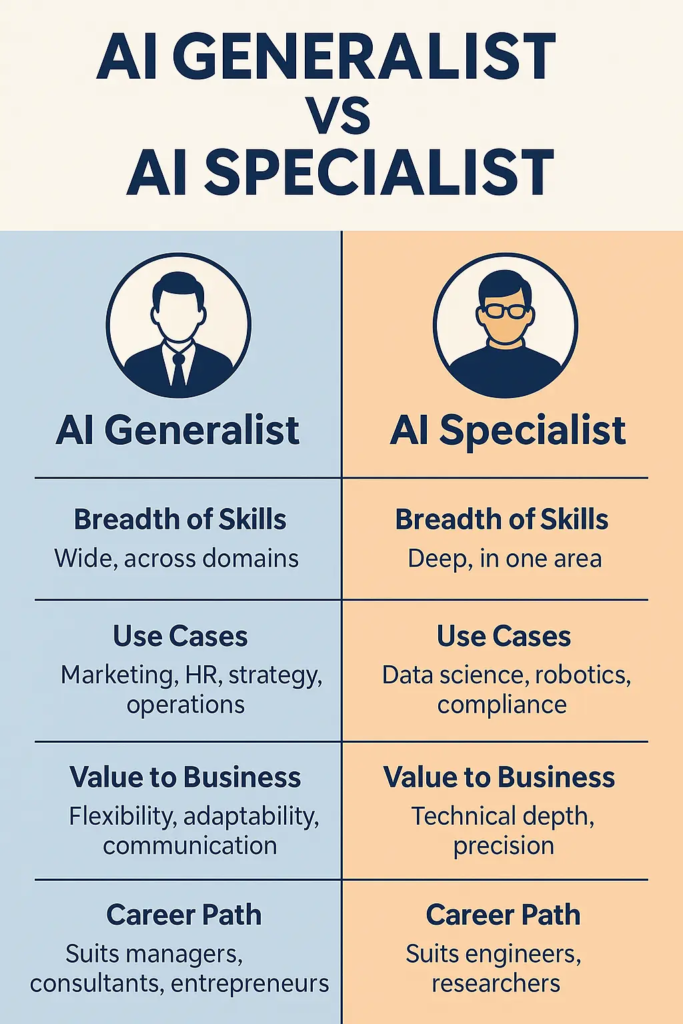
Think of Narrow AI as a specialist. A chess grandmaster is extraordinary at chess but may struggle to cook a meal or write a poem. Similarly, Narrow AI systems are brilliant at their designated tasks but cannot operate outside their domain.
General AI would be a generalist—like a well-educated human who can learn new skills, adapt to unfamiliar situations, and apply reasoning across diverse domains.
Superintelligence would be a generalist who is also smarter than any human who has ever lived, in every conceivable domain.
This distinction is crucial for understanding both the power and the limitations of AI today.
Section 2: Narrow AI (Weak AI)—The AI That Exists Today
2.1 Defining Narrow AI
Narrow AI, also called Weak AI, refers to artificial intelligence systems designed to perform a specific task or a narrow range of tasks. These systems excel at what they are trained to do but cannot transfer their knowledge to other domains. They do not possess general understanding or consciousness.
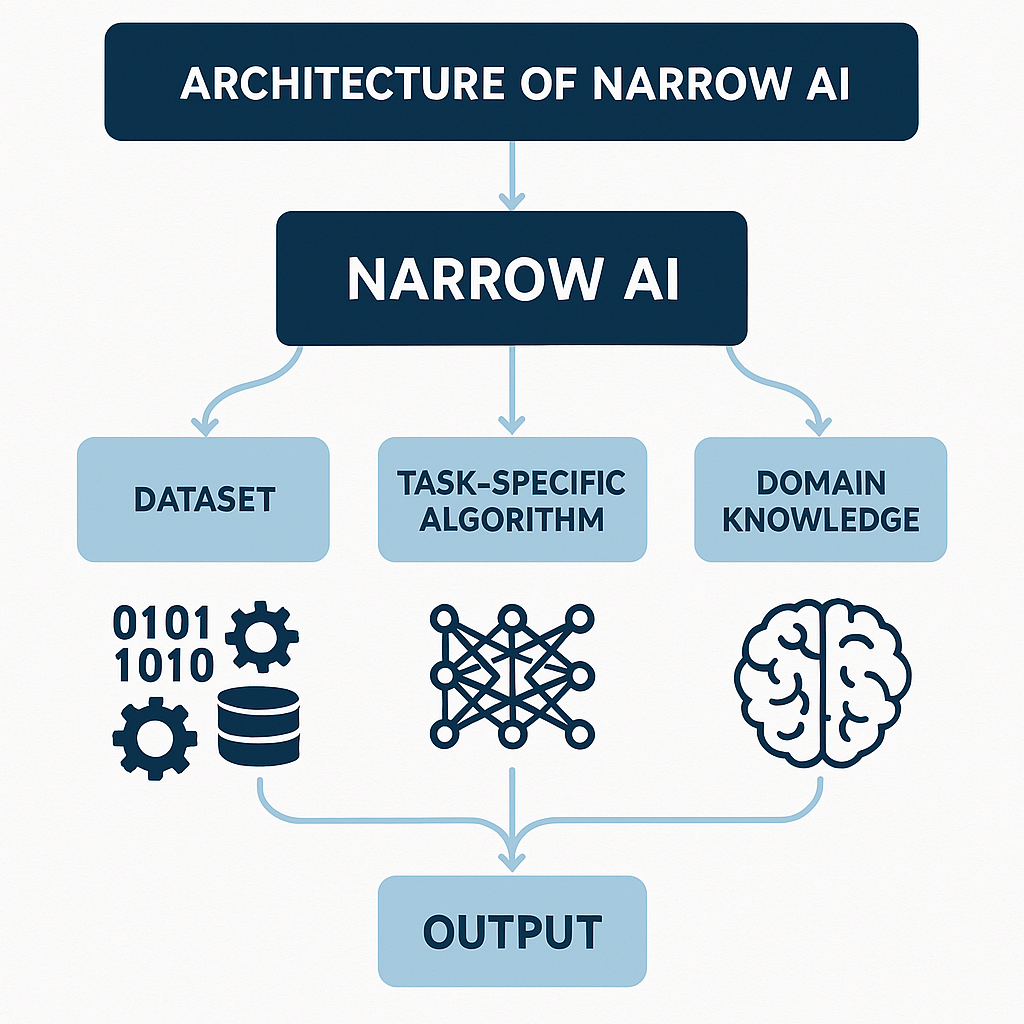
Every AI system deployed in the world today—from the most sophisticated large language model to the simplest spam filter—is Narrow AI.
2.2 Key Characteristics of Narrow AI
Task-specific. Narrow AI is designed for a particular purpose. A facial recognition system cannot drive a car. A recommendation engine cannot write legal contracts. Each system operates within its designated boundaries.
No general understanding. Narrow AI does not understand the world in any meaningful sense. It recognizes patterns in data but does not possess knowledge, beliefs, or intentions. When ChatGPT generates text, it is predicting likely word sequences—not “thinking” about the content.
Superhuman within its domain. In their specific tasks, Narrow AI systems often exceed human capabilities. AlphaGo beats world champions at Go. Medical imaging AI detects cancers with higher accuracy than human radiologists in specific screening tasks. But these systems cannot apply their “intelligence” outside their narrow domains.
2.3 Examples of Narrow AI in 2026
| Domain | Example | Capability |
|---|---|---|
| Conversational AI | ChatGPT, Gemini, Claude | Generate text, answer questions, write code—but cannot drive a car or diagnose a disease |
| Computer Vision | Facial recognition, medical imaging AI | Detect faces, identify objects, spot anomalies—but cannot hold a conversation |
| Recommendation Systems | Netflix, Amazon, TikTok algorithms | Suggest content based on user history—but cannot create new content from scratch |
| Autonomous Vehicles | Waymo, Tesla Autopilot | Navigate roads, detect obstacles—but cannot recommend movies or write poetry |
| Predictive Analytics | Deep Medical, fraud detection | Forecast outcomes based on patterns—but cannot understand why or explain in human terms |
| Generative AI | Midjourney, DALL·E | Create images from text—but cannot understand what they are creating |
2.4 The Power of Narrow AI: Real-World Impact
Despite being “narrow,” today’s AI systems deliver extraordinary value. Narrow AI has:
- Reduced missed appointments by 50% in NHS trusts through predictive analytics (Deep Medical)
- Saved 630 hours weekly in administrative work at UC San Diego Health through AI call handling
- Enabled 10,000+ healthcare professionals to focus on patients rather than documentation (Doctoralia Noa)
- Accelerated software development to the point where developers manage “groups of Codex agents” rather than editing code directly (OpenAI)
As OpenAI’s chief scientist Jakub Pachocki noted, even the most advanced systems today remain Narrow AI—they are specialized tools, not general intelligences. But their impact is profound.
2.5 Common Misconceptions About Narrow AI
Misconception: Narrow AI is “just” automation. Actually, Narrow AI goes far beyond traditional automation. Automation follows explicit rules; Narrow AI learns patterns from data, adapts to new inputs, and improves over time.
Misconception: Because it’s narrow, it’s not “real” AI. This is incorrect. Narrow AI is the only form of AI that exists. The term “Weak AI” can be misleading—these systems are extraordinarily powerful within their domains.
Misconception: Narrow AI will eventually become General AI on its own. Scaling up Narrow AI does not automatically produce General AI. A better spam filter does not become self-aware. The transition to AGI, if it happens, will require fundamental breakthroughs, not just more data and computing power.
Section 3: General AI (AGI)—The Holy Grail of AI Research
3.1 Defining General AI
General AI, also called Artificial General Intelligence (AGI) , refers to AI systems that possess human-like intelligence—the ability to understand, learn, and apply knowledge across a wide range of tasks, just as a human can.
An AGI system would not be confined to a single domain. It could learn to play chess, then write a poem, then diagnose a disease, then have a philosophical conversation—transferring knowledge and skills between domains as humans do.
3.2 Key Characteristics of AGI
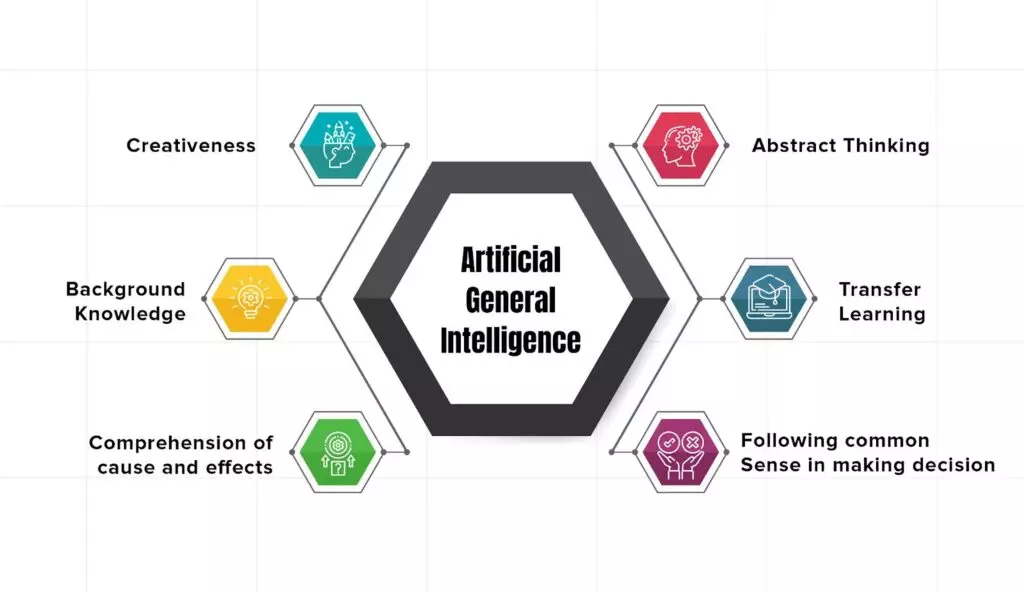
Cross-domain competence. AGI would perform capably across a broad range of cognitive tasks, not just one specialized area.
Transfer learning. It would apply knowledge learned in one domain to solve problems in another—something current AI struggles with.
Common sense reasoning. AGI would understand the world in ways that humans take for granted—cause and effect, physical intuition, social norms.
Autonomous learning. It would learn new tasks with minimal supervision, adapting to novel situations without requiring massive retraining.
Self-awareness (possibly). Some definitions include consciousness or self-awareness, though this remains controversial. Many researchers separate intelligence from consciousness.
3.3 Where AGI Stands in 2026
AGI does not exist today. Despite remarkable advances in large language models and agentic systems, no deployed AI meets the definition of general intelligence.
Current systems, including the most advanced LLMs, remain Narrow AI. They excel at language tasks but fail at tasks requiring genuine understanding, common sense reasoning, or physical interaction with the world.
3.4 The AGI Debate: How Close Are We?
The timeline for achieving AGI is one of the most hotly debated topics in AI.
Optimists believe AGI could arrive within years. Some researchers at OpenAI and other leading labs suggest that scaling current architectures—more data, more computing power, more sophisticated training—could lead to AGI by the end of the decade. OpenAI’s roadmap includes an “autonomous AI research intern” by September 2026 and a fully automated multi-agent research system by 2028, capabilities that begin to approach AGI-like performance in research domains.
Skeptics argue that fundamental breakthroughs are still needed. Current AI lacks genuine understanding, common sense, and the ability to reason causally. Scaling existing architectures, they contend, will not produce true general intelligence.
The mainstream view acknowledges that AGI is not imminent but also not science fiction. Most researchers believe AGI is possible within decades, though the exact timeline remains highly uncertain.
3.5 What Would AGI Enable?
If achieved, AGI would represent a paradigm shift. Potential applications include:
- Scientific discovery: AGI researchers could accelerate breakthroughs in medicine, materials science, and physics
- Automated problem-solving: Complex challenges—climate change, disease, energy—could be tackled by systems that reason across domains
- Personal AI assistants: Truly intelligent agents that understand context, anticipate needs, and execute complex multi-step tasks
- Economic transformation: Many knowledge work tasks could be automated, reshaping industries and employment
3.6 Leading Voices on AGI
OpenAI has stated that its mission is to ensure that AGI benefits all of humanity. The organization’s recent roadmap includes increasingly autonomous systems that approach AGI-like capabilities.
Microsoft AI’s Humanist Superintelligence framework emphasizes keeping AGI “controllable, aligned, and firmly in service to humanity”—acknowledging that AGI development is a goal while emphasizing safety.
Google DeepMind continues to pursue AGI research while publishing frameworks for responsible development.
Section 4: Superintelligence—Beyond Human Capability
4.1 Defining Superintelligence
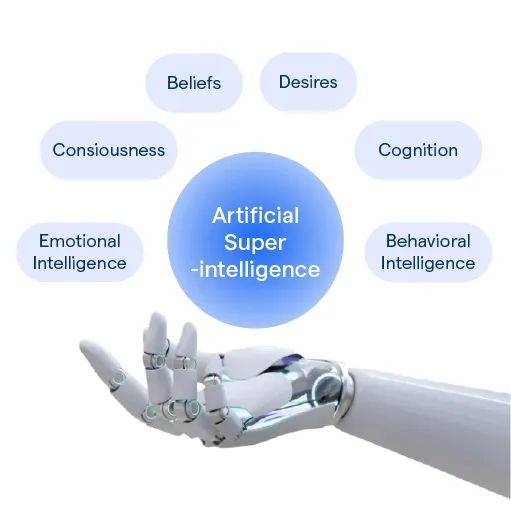
Superintelligence refers to an intellect that is vastly smarter than the best human minds in virtually every domain—including scientific creativity, strategic thinking, social intelligence, and general wisdom.
The term was popularized by philosopher Nick Bostrom in his book Superintelligence: Paths, Dangers, Strategies. Superintelligence would not just be slightly smarter than humans; it would surpass us as dramatically as humans surpass ants.
4.2 Key Characteristics of Superintelligence
Superhuman in every domain. Unlike Narrow AI, which is superhuman in specific tasks, superintelligence would exceed human capabilities across all cognitive domains.
Recursive self-improvement. A superintelligence could potentially improve its own capabilities, leading to rapid, exponential growth in intelligence—the so-called “intelligence explosion.”
Strategic superiority. It would outthink humans in planning, strategy, and long-term reasoning.
Value alignment challenge. The central concern around superintelligence is ensuring its goals align with human values—a problem that becomes critical if the system is vastly smarter than its creators.
4.3 Where Superintelligence Stands in 2026
Superintelligence does not exist and is not on any credible short-term roadmap. Even the most optimistic AGI timelines place superintelligence further out, often decades beyond AGI.
Most researchers view superintelligence as a theoretical possibility rather than an imminent reality. The focus today is on developing safe and aligned Narrow AI and, eventually, AGI—with superintelligence remaining a long-term consideration.
4.4 The Superintelligence Debate
Concerns. Many researchers, including the late Stephen Hawking and AI pioneers like Geoffrey Hinton, have expressed concerns about superintelligence. If created without proper safeguards, a superintelligence could pose existential risks. The alignment problem—ensuring that a superintelligence’s goals align with human values—is considered one of the most important unsolved problems in AI.
Skepticism. Others argue that superintelligence is overhyped. They contend that intelligence is not a single dimension that can be scaled indefinitely, or that the concerns are too speculative to drive policy.
The mainstream position. Leading AI companies acknowledge the importance of safety research while pursuing AGI. Microsoft AI’s framework explicitly emphasizes keeping AI “controllable, aligned, and firmly in service to humanity.” OpenAI invests heavily in alignment research, including chain-of-thought monitoring to catch unwanted behavior.
4.5 Superintelligence in Popular Culture vs. Reality
Science fiction often portrays superintelligence as malevolent AI seeking to dominate humanity. The reality is likely more nuanced—and the risks more subtle. The concern is not necessarily that a superintelligence would be evil, but that a highly capable system pursuing poorly specified goals could cause unintended harm. As the saying goes, “The AI does not hate you, but it does not love you either—and you are made of atoms it could use for something else.”
Section 5: Comparing Narrow AI, AGI, and Superintelligence
5.1 Side-by-Side Comparison
| Dimension | Narrow AI (Today) | General AI (Future) | Superintelligence (Theoretical) |
|---|---|---|---|
| Scope | Single task or narrow domain | Broad, human-like range of tasks | All cognitive domains |
| Transfer learning | Minimal; requires retraining | Can apply knowledge across domains | Superior transfer capabilities |
| Understanding | Pattern recognition; no genuine understanding | Genuine comprehension and reasoning | Deep understanding beyond human |
| Autonomy | Follows training; limited adaptation | Autonomous learning and adaptation | Recursive self-improvement |
| Current status | Widely deployed | Research goal; does not exist | Theoretical; no roadmap |
| Timeline | Here now | Debated: years to decades | Unclear; likely decades after AGI |
5.2 Why the Distinctions Matter
Understanding these distinctions is essential for:
Setting realistic expectations. When businesses evaluate AI investments, they are working with Narrow AI. Expecting general intelligence capabilities leads to disappointment. Narrow AI is powerful—but it has limits.
Evaluating risks. The risks of Narrow AI are real but manageable: bias, hallucination, privacy concerns. AGI and superintelligence raise different orders of risk that require different mitigation strategies.
Following the conversation. When experts debate AI timelines, safety, and regulation, they are often discussing AGI and superintelligence. Understanding the terms helps you engage with these discussions meaningfully.
Making informed decisions. Whether you are a student choosing a career path, a professional adapting to AI tools, or a leader setting strategy, understanding where AI is now (Narrow) and where it is going (AGI) helps you position yourself for the future.
Section 6: Real-World Trajectory—From Narrow to General AI
6.1 How Close Are We to AGI?
The answer depends on who you ask—and how you define AGI.
By capability measures. Some argue that large language models already demonstrate aspects of general intelligence. They can converse, reason, write code, and answer questions across domains. However, they also fail at tasks requiring genuine understanding, common sense, or physical interaction.
By architectural limits. Others contend that current architectures—transformers trained on next-word prediction—will never achieve true AGI. They argue that fundamental breakthroughs in architecture, training, and understanding of intelligence are required.
By observed progress. The rapid progress from GPT-3 in 2020 to GPT-4 in 2023 to the systems of 2026 suggests that scaling continues to yield new capabilities. Whether scaling alone leads to AGI remains an open question.
6.2 The Agentic AI Bridge
Agentic AI—systems that set goals, plan sequences of steps, and execute actions with minimal supervision—represents a step toward AGI. These systems are still Narrow AI (they operate within defined domains), but they demonstrate capabilities—planning, tool use, multi-step reasoning—that were previously associated with general intelligence.
OpenAI’s roadmap illustrates this progression: from chatbots to autonomous research interns to multi-agent research systems. Each step brings capabilities closer to AGI, even if the underlying systems remain specialized.
6.3 What Industry Leaders Are Saying
OpenAI: Focused on building safe AGI; roadmap includes autonomous research agents by 2026 and multi-agent research systems by 2028.
Microsoft AI: Emphasizes “Humanist Superintelligence”—keeping future systems aligned and in service to humanity.
Google DeepMind: Continues foundational AGI research while publishing safety frameworks.
Anthropic: Focuses on “constitutional AI” and alignment research to ensure safe deployment of increasingly capable systems.
Section 7: How MHTECHIN Helps You Navigate AI Types
Understanding the types of AI is not just an academic exercise—it informs practical decisions. MHTECHIN helps individuals and organizations work effectively with the AI that exists today while preparing for emerging capabilities.
7.1 For Beginners: Building Literacy Across AI Types
MHTECHIN’s AI/ML workshops ensure that learners understand not just how to use AI, but what AI is and is not. The curriculum covers:
- The distinction between Narrow AI, AGI, and superintelligence
- Realistic expectations for what AI can and cannot do today
- How to evaluate AI claims and separate hype from reality
- Practical skills for working with Narrow AI systems
For those new to AI, these workshops provide the hands-on experience to complement conceptual understanding.
7.2 For Businesses: Deploying Narrow AI Effectively
For organizations, the focus is on Narrow AI—and there is enormous value to capture. MHTECHIN helps businesses:
Identify high-impact use cases. Where can Narrow AI deliver measurable ROI? Predictive analytics? Customer service automation? Process optimization?
Select appropriate technologies. Different Narrow AI tools serve different purposes. MHTECHIN guides clients through platform choices—AWS, Azure, Google Cloud—and specialized vendors.
Deploy with realistic expectations. Narrow AI is powerful but not magical. MHTECHIN helps organizations understand limitations, manage risks, and build human-in-the-loop systems.
Prepare for emerging capabilities. As agentic AI and eventually AGI capabilities emerge, MHTECHIN helps organizations stay ahead—evaluating new tools, updating strategies, and ensuring responsible adoption.
7.3 The MHTECHIN Approach
MHTECHIN’s expertise spans the AI landscape: from foundational literacy through enterprise deployment to strategic planning for emerging capabilities. The team understands that different types of AI require different approaches—and that the most effective strategies are grounded in clear understanding of what AI can and cannot do.
For individuals and organizations alike, MHTECHIN provides the guidance to navigate the AI landscape intelligently—distinguishing between what exists today, what is coming tomorrow, and what remains science fiction.
Section 8: Frequently Asked Questions About Types of AI
8.1 Q: What are the 3 types of AI?
A: The three main types are Narrow AI (Weak AI)—systems designed for specific tasks, which is all AI that exists today; General AI (AGI)—human-like intelligence across domains, which does not yet exist; and Superintelligence—AI that surpasses human capabilities in every domain, which is theoretical.
8.2 Q: What is Narrow AI with example?
A: Narrow AI refers to AI systems designed for a specific task or narrow range of tasks. Examples include ChatGPT (text generation), facial recognition systems, Netflix recommendation engines, self-driving car systems, and medical imaging AI. All of these excel at their designated tasks but cannot operate outside their domains.
8.3 Q: Does General AI exist in 2026?
A: No. General AI (AGI) does not exist in 2026. Every AI system deployed today is Narrow AI. While large language models and agentic systems demonstrate impressive capabilities, they lack genuine understanding, common sense reasoning, and the ability to transfer knowledge across domains as humans do.
8.4 Q: How close are we to AGI?
A: Timelines vary widely. Optimists suggest AGI could arrive within years; skeptics argue fundamental breakthroughs are still needed and AGI may be decades away. Most researchers agree that AGI is not imminent but also not science fiction. OpenAI’s roadmap includes increasingly autonomous systems that approach AGI-like capabilities by 2028.
8.5 Q: What is superintelligence in AI?
A: Superintelligence refers to an intellect that is vastly smarter than the best human minds in virtually every domain—scientific creativity, strategic thinking, social intelligence, and general wisdom. It does not exist and is not on any credible near-term roadmap. The concept is primarily discussed in the context of long-term AI safety and alignment.
8.6 Q: Is superintelligence dangerous?
A: The potential risks of superintelligence are a subject of serious debate. The central concern is the alignment problem: ensuring that a superintelligence’s goals align with human values. Leading AI companies, including Microsoft and OpenAI, invest in alignment research to ensure that if AGI or superintelligence is achieved, it remains controllable and beneficial to humanity.
8.7 Q: Will Narrow AI become General AI automatically?
A: No. Scaling up Narrow AI—more data, more computing power—does not automatically produce General AI. The transition to AGI, if it happens, will likely require fundamental breakthroughs in architecture, learning algorithms, and understanding of intelligence.
8.8 Q: Why does understanding AI types matter for business?
A: Understanding AI types helps set realistic expectations. Narrow AI is powerful and delivers measurable ROI today—but it has limits. Expecting general intelligence capabilities leads to disappointment. Knowing the distinction helps businesses evaluate AI investments, manage risks, and plan for emerging capabilities.
8.9 Q: What is the difference between AI and AGI?
A: AI (artificial intelligence) is the broad term for machines that mimic human intelligence. AGI (artificial general intelligence) is a specific type of AI with human-like intelligence across a wide range of domains. All AGI would be AI, but most AI (including all AI that exists today) is Narrow AI—not AGI.
8.10 Q: How can I learn more about AI types?
A: Start with foundational resources like our Beginner’s Guide to AI . For structured learning, MHTECHIN offers workshops that build practical skills while grounding them in clear understanding of AI capabilities and limitations.
Section 9: Conclusion—Understanding AI Types for an AI-Powered World
The distinctions between Narrow AI, General AI, and Superintelligence are not merely academic. They shape how we understand what AI can do today, what it might do tomorrow, and how we should prepare.
Today, we live in a world of Narrow AI. These systems are extraordinarily powerful within their domains—predicting no-shows, generating clinical notes, recommending content, driving cars. They deliver measurable ROI and transform industries. But they are tools, not minds. They do not understand, cannot generalize beyond their training, and have no consciousness or intent.
General AI—if and when it arrives—will represent a fundamental shift. Systems that can reason across domains, learn autonomously, and genuinely understand the world could accelerate scientific discovery, solve complex problems, and reshape the economy. But they also raise profound questions about control, alignment, and the future of human work.
Superintelligence remains a theoretical consideration—important for long-term safety research but not a near-term concern for most individuals and organizations.
For individuals, the path forward is to build literacy and practical skills with Narrow AI—the technology that exists today. For organizations, the opportunity is to deploy Narrow AI systems that deliver measurable value while preparing for emerging capabilities. And for everyone, understanding the types of AI helps separate hype from reality, enabling informed decisions in an AI-powered world.
Ready to navigate the AI landscape with confidence? Explore MHTECHIN’s AI/ML workshops and enterprise implementation services at www.mhtechin.com. From foundational literacy to strategic deployment, our team helps you understand what AI is—and what it can do for you.
This guide is brought to you by MHTECHIN—helping individuals and organizations understand and work with AI, from Narrow to General and beyond. For personalized guidance on AI learning paths or business AI strategy, reach out to the MHTECHIN team today.

Leave a Reply