Introduction
Every day, you interact with technology that understands human language—even if you do not realize it. When you ask Siri for the weather, when your email client suggests a quick reply, when your phone corrects your typing, when your bank’s chatbot helps you reset a password—these are all examples of Natural Language Processing, or NLP.
NLP is the branch of artificial intelligence that enables machines to understand, interpret, and generate human language. It is one of the most transformative AI technologies because language is central to how humans communicate, work, and share knowledge. In 2026, NLP is embedded in everything from enterprise software to consumer apps, often working so seamlessly that we forget it is there.
This article explains what NLP is, how it works in simple terms, and—most importantly—how it shows up in applications you use every day. Whether you are a business professional evaluating AI tools, a non-technical user curious about the technology behind your favorite apps, or someone building foundational AI literacy, this guide will help you recognize and understand NLP in the wild.
For a foundational understanding of how AI systems learn and process information, you may find our guide on Neural Networks Explained for Non-Technical Professionals helpful as a starting point.
Throughout, we will highlight how MHTECHIN helps organizations leverage NLP—from customer service automation to document processing—to deliver measurable business value.
Section 1: What Is Natural Language Processing (NLP)?
1.1 A Simple Definition
Natural Language Processing is the technology that allows computers to understand, interpret, and generate human language. It sits at the intersection of computer science, artificial intelligence, and linguistics.
The challenge is immense. Human language is messy. We use slang, sarcasm, ambiguity, context, and cultural references. We misspell words, use fragmented sentences, and rely on shared knowledge. For a computer, which prefers structured data like numbers and clear rules, understanding language is extraordinarily difficult.
NLP solves this by combining linguistic rules with machine learning. Systems are trained on massive amounts of text—books, websites, conversations—learning the patterns that make language work.
1.2 What NLP Does: The Core Capabilities
NLP enables machines to perform several distinct tasks with language:
| Capability | What It Means | Everyday Example |
|---|---|---|
| Understanding | Extracting meaning from text or speech | Your email client recognizing that “Can we reschedule?” is a request |
| Generation | Producing human-like language | ChatGPT writing an email draft for you |
| Translation | Converting between languages | Google Translate rendering a menu in your language |
| Summarization | Condensing long text to key points | AI generating a summary of a long article |
| Classification | Categorizing text | Your spam filter deciding whether an email is junk |
| Sentiment Analysis | Detecting emotion or opinion | A brand monitoring whether social media mentions are positive or negative |
| Entity Recognition | Identifying people, places, dates, and things | Calendar apps automatically adding events from emails |
1.3 Why NLP Matters in 2026
In 2026, NLP is everywhere. The shift from typing to conversation has accelerated. Google’s AI Mode now serves over 100 million users who ask complex questions in natural language rather than typing keyword fragments. Voice assistants are embedded in cars, homes, and offices. Enterprise software increasingly offers natural language interfaces—you can ask your company’s data system “What were sales in Q3?” and get an answer.
NLP is not just about convenience. It unlocks value from unstructured data—the vast majority of business information that lives in emails, documents, chat logs, and customer interactions. Organizations that harness NLP can automate processes, gain insights, and improve customer experiences at scale.
Section 2: How NLP Works—The Simple Version
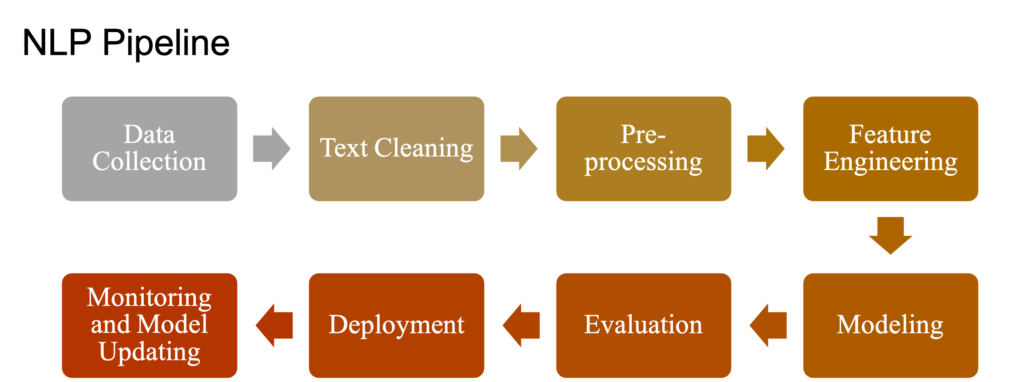
2.1 From Human Language to Machine Understanding
Before a computer can understand language, it must convert text into numbers. NLP systems break language down into smaller pieces and represent them mathematically.
Tokenization. The first step is splitting text into tokens—words, parts of words, or punctuation marks. “I love AI” becomes [“I”, “love”, “AI”].
Vectorization. Each token is converted into a vector—a list of numbers that represents its meaning in a high-dimensional space. Words with similar meanings have similar vectors. For example, “king” and “queen” are mathematically close, as are “car” and “automobile.”
Context. Modern NLP uses attention mechanisms (like those in transformer models) to understand how words relate to each other. In “She gave her dog a treat because it was hungry,” attention helps the model understand that “it” refers to “dog,” not “she.”
2.2 The Breakthrough: Transformers
The field of NLP was transformed in 2017 when Google researchers introduced the transformer architecture. Transformers introduced the attention mechanism, which allows models to weigh the importance of different words when making predictions.
Before transformers, language models struggled with long-range context. They would lose track of what was said earlier in a paragraph. Transformers solved this, enabling models to track relationships across hundreds or thousands of words.
Today, all major language models—ChatGPT, Gemini, Claude—are built on transformers. They are the foundation of modern NLP.
2.3 Large Language Models (LLMs)
Large Language Models are a specific type of NLP system trained on massive amounts of text—trillions of words from books, websites, and documents. Through predicting the next word in a sequence, they learn grammar, facts, reasoning patterns, and style.
LLMs like ChatGPT are not just language models; they are foundation models that can be adapted to countless tasks—writing, summarizing, coding, translating, even reasoning. They represent the most advanced form of NLP available today.
Section 3: Everyday NLP Applications You Use (Probably Without Realizing)
3.1 Smartphone Keyboards and Autocorrect
When you type on your phone and it suggests the next word or corrects a misspelling, that is NLP. The keyboard has learned from millions of typing examples—what words commonly follow others, which sequences are likely typos, and even your personal typing patterns.
This is a form of language modeling—predicting what comes next. The same technology, scaled up massively, powers ChatGPT.
3.2 Voice Assistants
Siri, Google Assistant, Alexa, and other voice assistants combine NLP with speech recognition. They convert your spoken words to text, interpret the intent, and generate a response.
When you say “Set a timer for 10 minutes,” the assistant must:
- Recognize the words despite your accent and background noise
- Understand that “set a timer” is a command, not a question
- Extract “10 minutes” as the duration
- Execute the action and confirm
Modern voice assistants use transformer-based models for both speech recognition and language understanding, making them far more accurate than early versions.
3.3 Email Spam Filters
Every time an email lands in your spam folder, NLP made that decision. Spam filters analyze the content of emails, looking for patterns—not just obvious keywords like “viagra,” but subtle combinations: sender reputation, email structure, link patterns, language style.
The filter is a text classifier. It has been trained on millions of emails labeled “spam” or “not spam.” When a new email arrives, it calculates a probability and routes accordingly.
3.4 Smart Replies and Predictive Text
When Gmail suggests “Yes, that works” or “Let me check” as a quick reply, that is NLP. The system analyzes the email you received, identifies common response patterns, and generates short, contextually appropriate options.
These suggestions are generated by language models trained on millions of email exchanges. They learn the types of responses people commonly use in different contexts.
3.5 Translation Services
Google Translate, Microsoft Translator, and similar services use NLP to convert text between languages. Modern translation uses transformer models trained on parallel texts—the same content in multiple languages.
The results are far better than earlier phrase-based translation. Systems understand context, handle idioms more naturally, and can translate entire documents while maintaining consistent terminology.
3.6 Search Engines
When you type a query into Google, NLP helps understand what you mean—not just what you typed. Google processes billions of searches daily, using language models to interpret intent, handle misspellings, and understand conversational queries.
In 2026, Google’s AI Overviews and AI Mode represent the evolution of search into a conversational experience. You can ask complex questions and have follow-up conversations, with NLP understanding the context across turns.
3.7 Banking and Customer Service Chatbots
When you message your bank’s chatbot to “dispute a charge,” NLP identifies your intent, extracts the relevant details (the charge amount, date, merchant), and either resolves the issue or routes you to a human agent.
Modern chatbots use intent classification to categorize what you want and entity extraction to pull out key details. They can handle routine requests—password resets, balance checks, transaction history—without human intervention, resolving 50–70% of inquiries.
3.8 Calendar and Email Assistants
When your calendar app automatically adds an event from an email that says “Let’s meet Thursday at 3 PM,” NLP is at work. The system:
- Detects that the email contains a meeting invitation
- Extracts the date and time
- Identifies the location if mentioned
- Offers to add it to your calendar
Similarly, when your email suggests a reminder to follow up on a message you haven’t replied to, that is NLP understanding conversational context.
3.9 Document Summarization
Tools like Microsoft Copilot, Google’s AI in Workspace, and specialized summarization apps can take a long document—a contract, a research paper, a meeting transcript—and generate a concise summary.
These systems use extractive summarization (pulling key sentences) or abstractive summarization (generating new text that captures the essence). The latter is more advanced and uses language models similar to ChatGPT.
3.10 Social Media Moderation
When social media platforms automatically flag hate speech, harassment, or misinformation, they use NLP. Models are trained to classify text into categories—safe, potentially harmful, clearly violating policies.
This is a challenging application because language is subtle, and context matters. Systems continue to improve but still require human review for complex cases.
3.11 Medical Documentation and Clinical Notes
In healthcare, NLP is transforming documentation. Systems like Amazon Connect Health can transcribe patient-clinician conversations and automatically format notes into electronic health records.
NLP extracts medical entities—diagnoses, medications, procedures—and structures them, saving clinicians 5–20% of their EHR workflow time. At UC San Diego Health, this has freed 630 hours weekly for patient care.
3.12 Recruitment and HR
Recruitment platforms use NLP to screen resumes, matching candidates’ skills and experience to job descriptions. NLP can identify relevant experience even when phrasing differs—recognizing that “managed a team of five” and “supervised five direct reports” mean similar things.
These systems help reduce manual screening time, though they must be carefully monitored for bias.
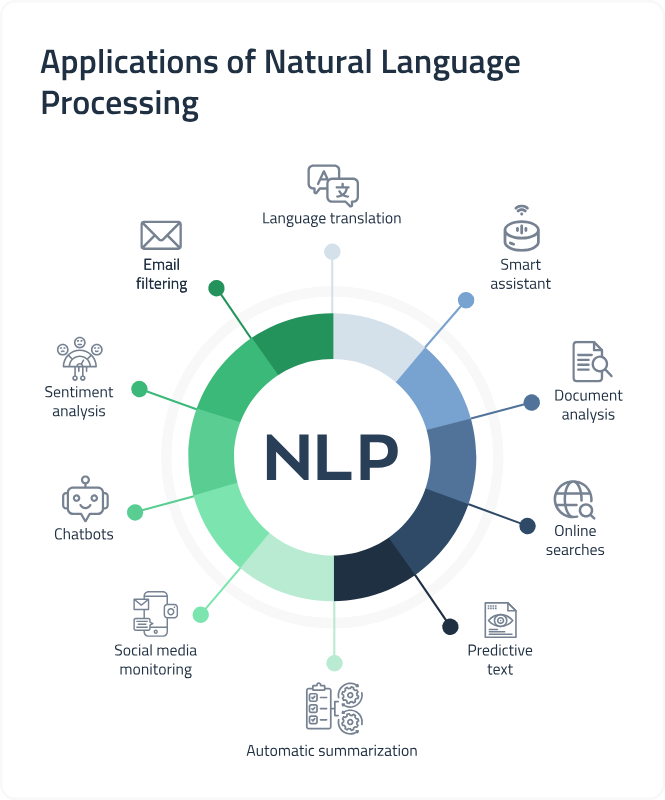
Section 4: How NLP Is Used Across Industries
4.1 Healthcare
| Application | How NLP Helps | Example |
|---|---|---|
| Clinical documentation | Transcribes and structures conversations | Amazon Connect Health, Nuance DAX |
| Medical coding | Extracts diagnoses and procedures from notes | Automates billing code assignment |
| Drug discovery | Analyzes research papers and clinical trial data | Identifies potential drug candidates |
| Patient communication | Interprets patient messages and routes appropriately | Triage systems in patient portals |
4.2 Financial Services
| Application | How NLP Helps | Example |
|---|---|---|
| Fraud detection | Analyzes transaction descriptions and communications | Identifies suspicious patterns |
| Regulatory compliance | Scans communications for prohibited language | Banks monitoring trader communications |
| Customer service | Handles routine inquiries via chatbots | Account balance, transaction history |
| Document processing | Extracts data from loan applications, contracts | Automates underwriting workflows |
4.3 Legal
| Application | How NLP Helps | Example |
|---|---|---|
| Contract analysis | Extracts obligations, deadlines, and risks | Tools like Ironclad, LawGeex |
| E-discovery | Searches millions of documents for relevant content | Litigation support |
| Legal research | Summarizes case law and identifies precedents | AI-assisted research platforms |
4.4 Education
| Application | How NLP Helps | Example |
|---|---|---|
| Essay grading | Provides feedback on structure and grammar | Automated writing evaluation |
| Personalized tutoring | Adapts explanations to student level | AI tutors that answer questions |
| Content summarization | Condenses textbook chapters | Study aid tools |
4.5 Retail and E-commerce
| Application | How NLP Helps | Example |
|---|---|---|
| Product search | Understands natural language queries | “Running shoes for wide feet” |
| Customer reviews | Summarizes sentiment and common themes | Automated review analysis |
| Chat support | Handles returns, order tracking | AI customer service agents |
Section 5: The Technology Behind NLP—Simplified
5.1 Key NLP Tasks
| Task | What It Does | Everyday Example |
|---|---|---|
| Tokenization | Splits text into pieces | Breaking a sentence into words |
| Part-of-Speech Tagging | Identifies nouns, verbs, adjectives | Understanding that “run” is a verb in context |
| Named Entity Recognition | Identifies people, places, dates | Extracting “March 15” and “New York” from text |
| Sentiment Analysis | Determines emotional tone | Detecting whether a review is positive or negative |
| Intent Classification | Determines what the user wants | Recognizing “book a flight” as an intent |
| Language Modeling | Predicts what word comes next | Autocomplete suggestions |
5.2 How Language Models Learn
Language models like those behind ChatGPT learn through a simple but powerful process: predicting the next word.
During training, the model processes trillions of words. For each sequence, it tries to predict the next word. When it is wrong, it adjusts its internal parameters (billions of them) to get closer to the correct prediction.
Through this process, the model implicitly learns:
- Grammar and syntax
- Facts and knowledge
- Reasoning patterns
- Style and tone
- Context and nuance
This is why the same model can write code, answer medical questions, and compose poetry—it has learned the patterns that underlie all these forms of language.
5.3 Fine-Tuning for Specific Applications
While large language models are generalists, they can be fine-tuned for specific tasks with relatively little additional training. A general model can be adapted to:
- Answer customer support questions for a specific company
- Extract structured data from legal contracts
- Translate medical terminology accurately
- Detect fraud in financial communications
This fine-tuning makes NLP practical for business applications without requiring companies to build models from scratch.
Section 6: How MHTECHIN Helps Organizations Leverage NLP
NLP is powerful, but deploying it effectively requires understanding the technology, the data, and the use case. MHTECHIN helps organizations across industries harness NLP for real business outcomes.
6.1 For Customer Service and Support
MHTECHIN helps organizations deploy NLP-powered chatbots and virtual agents that:
- Handle 50–70% of routine inquiries without human intervention
- Classify intent accurately—billing question, technical support, account issue
- Extract entities—order numbers, dates, account details—to resolve requests faster
- Escalate seamlessly to human agents when needed
The result is faster response times, reduced operational costs, and improved customer satisfaction.
6.2 For Document Processing and Automation
Many organizations are buried in documents—contracts, invoices, forms, reports. MHTECHIN helps deploy NLP systems that:
- Extract key fields from unstructured documents
- Classify documents by type and priority
- Summarize lengthy reports and contracts
- Flag anomalies or risks for human review
6.3 For Unlocking Insights from Unstructured Data
The majority of business data is unstructured—emails, chat logs, customer feedback, social media posts. MHTECHIN helps organizations:
- Analyze sentiment across customer interactions
- Identify emerging trends and issues
- Automate categorization and tagging
- Surface insights that drive decision-making
6.4 The MHTECHIN Approach
MHTECHIN’s NLP practice combines:
- Business understanding. What problem are you solving? What outcomes matter?
- Data readiness. Do you have enough data? Is it labeled? What quality?
- Model selection. Is a pre-trained LLM sufficient, or do you need custom fine-tuning?
- Deployment and integration. How does NLP fit into existing workflows?
- Monitoring and improvement. How do you measure success and iterate?
For organizations exploring NLP, MHTECHIN provides the expertise to move from concept to production—delivering measurable value without unnecessary complexity.
Section 7: Frequently Asked Questions About NLP
7.1 Q: What is natural language processing in simple terms?
A: Natural language processing (NLP) is the technology that allows computers to understand, interpret, and generate human language. It powers everything from autocorrect on your phone to chatbots that answer customer service questions to voice assistants like Siri.
7.2 Q: What are some everyday examples of NLP?
A: Common examples include: your email spam filter, autocorrect and predictive text on your phone, voice assistants (Siri, Alexa), smart replies in Gmail, Google Translate, customer service chatbots, and search engines understanding conversational queries.
7.3 Q: How does NLP differ from large language models like ChatGPT?
A: NLP is the broader field. Large language models (LLMs) like ChatGPT are a specific type of NLP system—they are trained on massive amounts of text and can perform many language tasks. LLMs represent the most advanced form of NLP currently available.
7.4 Q: How does NLP understand context and ambiguity?
A: Modern NLP uses transformer models with attention mechanisms. Attention allows the model to weigh the importance of different words when making predictions. For example, in “She gave her dog a treat because it was hungry,” attention helps the model understand that “it” refers to “dog,” not “she.”
7.5 Q: Can NLP understand sarcasm and tone?
A: With difficulty. Advanced language models can detect sarcasm when there is enough context, but it remains challenging. Sentiment analysis has improved, but subtlety, cultural references, and irony still trip up NLP systems. Human oversight remains important for nuanced communication.
7.6 Q: What languages does NLP support?
A: Major NLP systems support dozens of languages. English has the most robust support, but Chinese, Spanish, Arabic, Hindi, and many others are well-supported. Lower-resource languages have less training data and therefore lower accuracy.
7.7 Q: How do chatbots understand what I want?
A: Chatbots use two key NLP techniques: intent classification (determining what you want—e.g., “reset password”) and entity extraction (identifying key details—e.g., account number, date). Together, these allow the chatbot to understand your request and take action.
7.8 Q: How accurate is NLP translation?
A: Modern neural machine translation is highly accurate for common language pairs, especially when translating formal text. Translation quality degrades with slang, idioms, or complex technical language. For many business and travel purposes, NLP translation is sufficient for understanding, though human review is recommended for critical content.
7.9 Q: Can NLP handle different accents in speech?
A: Yes, modern voice assistants use speech recognition models trained on diverse accents and dialects. They are far better than early systems, but accuracy still varies. Background noise, strong accents, and rapid speech can reduce performance.
7.10 Q: How can my business start using NLP?
A: Start by identifying a specific use case—customer service automation, document processing, sentiment analysis. Assess your data: do you have enough examples to train or fine-tune a model? Consider whether a pre-built API (like those from Google, Microsoft, or AWS) meets your needs, or whether you need custom development. MHTECHIN can help you navigate these decisions and deploy NLP solutions that deliver measurable ROI.
Section 8: Conclusion—NLP as the New User Interface
Natural language processing has transformed how we interact with technology. The keyboard and mouse are giving way to conversation. We ask questions, issue commands, and have back-and-forth exchanges with systems that understand our intent.
In 2026, NLP is embedded in the tools we use every day—often so seamlessly that we do not notice. Email spam filters, autocorrect, voice assistants, translation tools, customer service chatbots—all rely on machines that have learned to understand human language.
For organizations, NLP represents a massive opportunity. It unlocks value from unstructured data, automates routine interactions, and creates more natural experiences for customers and employees. The barrier to entry has fallen dramatically. Pre-trained models and APIs mean that organizations can deploy sophisticated NLP without building systems from scratch.
The key is to start with a clear use case, understand your data, and match the technology to the problem. Whether you are automating customer support, extracting insights from documents, or building a conversational interface, NLP can deliver real business value.
Ready to harness the power of language in your organization? Explore MHTECHIN’s NLP solutions and advisory services at www.mhtechin.com. From strategy through deployment, our team helps you turn natural language into business advantage.
This guide is brought to you by MHTECHIN—helping organizations understand and deploy natural language processing for real-world impact. For personalized guidance on NLP strategy or implementation, reach out to the MHTECHIN team today.

Leave a Reply