Introduction
Artificial intelligence. Machine learning. Deep learning. These terms are often used interchangeably—in news headlines, product marketing, and even casual conversation. But they are not the same. Understanding the distinctions is not just an academic exercise; it is essential for anyone who wants to evaluate AI tools, build AI skills, or make informed technology investments.
Think of it this way: if AI is the universe, machine learning is a galaxy within it, and deep learning is a star system within that galaxy. Each is contained within the broader category, but each has distinct characteristics, capabilities, and applications.
This article breaks down the differences between AI, machine learning, and deep learning in simple terms. We will explore how they relate to one another, what makes each unique, and when you would use one over the other. Along the way, we will use real-world examples from industry leaders like Google, Microsoft, and OpenAI to ground the concepts.
For a foundational understanding of AI types, you may find our guide on Types of AI: Narrow, General, and Superintelligence Explained helpful as a starting point.
Throughout, we will highlight how MHTECHIN helps individuals and organizations navigate these distinctions—building practical skills and deploying the right technology for the right job.
Section 1: The Big Picture—How They Relate
1.1 A Simple Hierarchy
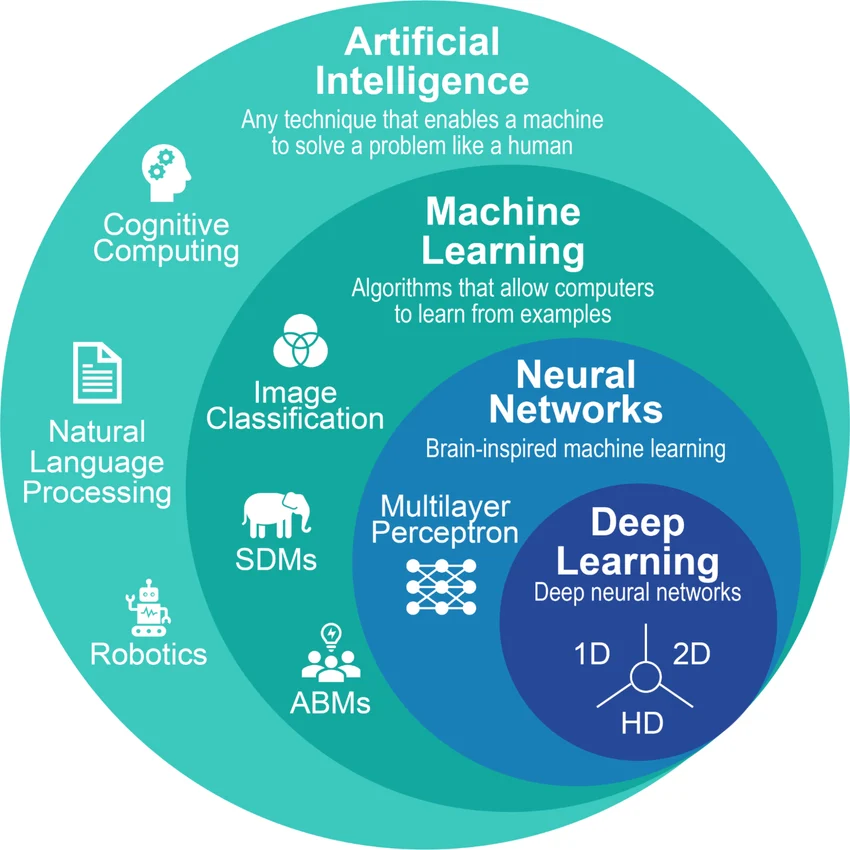
The relationship between AI, machine learning, and deep learning is hierarchical:
Artificial Intelligence (AI) is the broadest category. It encompasses any technique that enables machines to mimic human intelligence—whether through rule-based systems, search algorithms, or learning from data.
Machine Learning (ML) is a subset of AI. It refers specifically to systems that learn from data rather than following explicit programming. All machine learning is AI, but not all AI is machine learning.
Deep Learning (DL) is a subset of machine learning. It uses multi-layered neural networks to learn complex patterns from large amounts of data. All deep learning is machine learning, but not all machine learning is deep learning.
Think of it as a set of Russian nesting dolls: AI contains ML, which contains DL.
1.2 A Visual Representation
Imagine a circle labeled “Artificial Intelligence.” Inside it, a smaller circle labeled “Machine Learning.” Inside that, an even smaller circle labeled “Deep Learning.”
Artificial Intelligence includes everything from simple if-then rules in a chess program to advanced neural networks. Machine Learning includes algorithms that learn from data—linear regression, decision trees, support vector machines, and neural networks. Deep Learning includes only neural networks with multiple hidden layers—the technology behind today’s most advanced AI systems.
1.3 Why the Distinction Matters
Understanding these distinctions helps you:
- Set realistic expectations. Deep learning is powerful but requires massive data and computing power. Traditional machine learning can be more efficient for simpler problems.
- Choose the right tool. Not every AI problem requires deep learning. Sometimes a simpler algorithm works better, faster, and with less data.
- Evaluate claims. When a product says it uses “AI,” that could mean anything from a simple decision tree to a massive neural network. Knowing the difference helps you ask the right questions.
- Build skills strategically. If you are learning AI, understanding the hierarchy helps you decide where to start and what to specialize in.
Section 2: Artificial Intelligence—The Broad Umbrella
2.1 What Is Artificial Intelligence?
Artificial intelligence is the broad field of creating machines that can perform tasks requiring human-like intelligence. This includes reasoning, learning, perception, problem-solving, and language understanding.
The term was coined in 1956 at the Dartmouth Conference, and the field has evolved through several phases—from early symbolic AI (which used explicit rules) to today’s data-driven approaches.
2.2 What Falls Under AI?
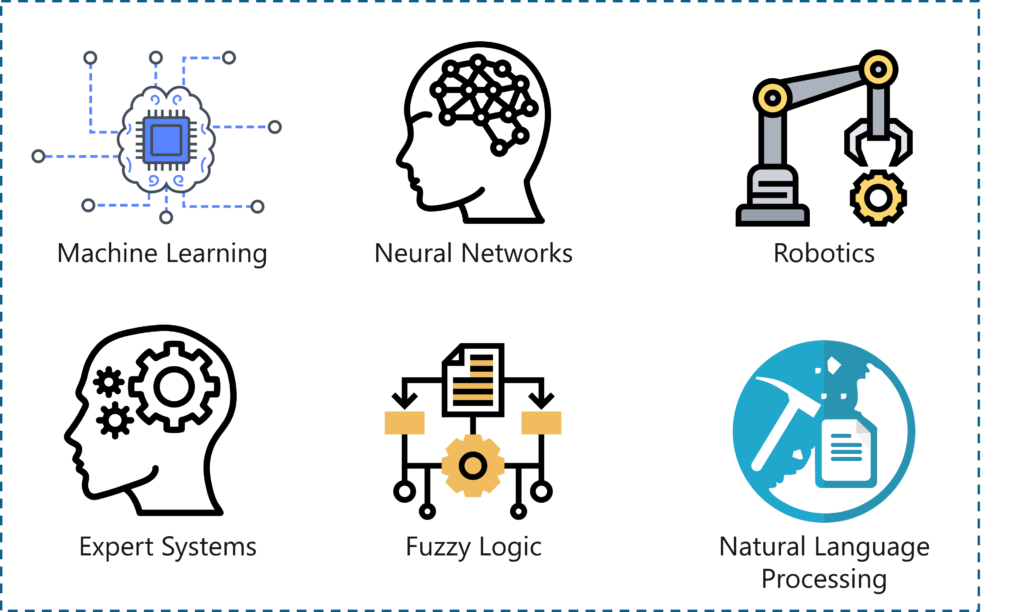
AI encompasses a wide range of approaches:
Symbolic AI (Good Old-Fashioned AI). Early AI systems used explicit rules and logic. An expert system for medical diagnosis, for example, would contain thousands of if-then rules written by human experts. These systems do not learn from data—they follow programmed logic.
Search Algorithms. Systems that explore possible solutions to find optimal outcomes. IBM’s Deep Blue, which beat Garry Kasparov at chess in 1997, used search algorithms to evaluate millions of possible moves.
Machine Learning. Systems that learn patterns from data. This is the dominant approach in AI today.
Robotics. The combination of AI with physical systems—from industrial arms to autonomous drones.
Natural Language Processing. Systems that understand and generate human language, whether through rules or learning.
Computer Vision. Systems that interpret visual information.
2.3 Examples of AI (That Are Not ML or DL)
Not all AI uses machine learning. Examples include:
- Rule-based chatbots. Early customer service bots that followed decision trees—if the user says “billing,” go to billing flow.
- Chess engines. Some chess programs use search algorithms without learning.
- Expert systems. Medical diagnosis systems with explicit rules written by doctors.
- Automated teller machines. The logic that processes transactions follows explicit programming.
These systems are AI because they perform tasks that normally require human intelligence. But they do not learn from data.
2.4 AI Today
In 2026, most cutting-edge AI uses machine learning—and increasingly, deep learning. But the broader field still includes many approaches. When people say “AI” in business contexts, they usually mean machine learning. But technically, AI is the larger discipline.
Section 3: Machine Learning—The Engine of Modern AI
3.1 What Is Machine Learning?
Machine learning is a subset of AI that focuses on systems that learn from data. Instead of being explicitly programmed with rules, a machine learning algorithm is fed examples and discovers patterns on its own.
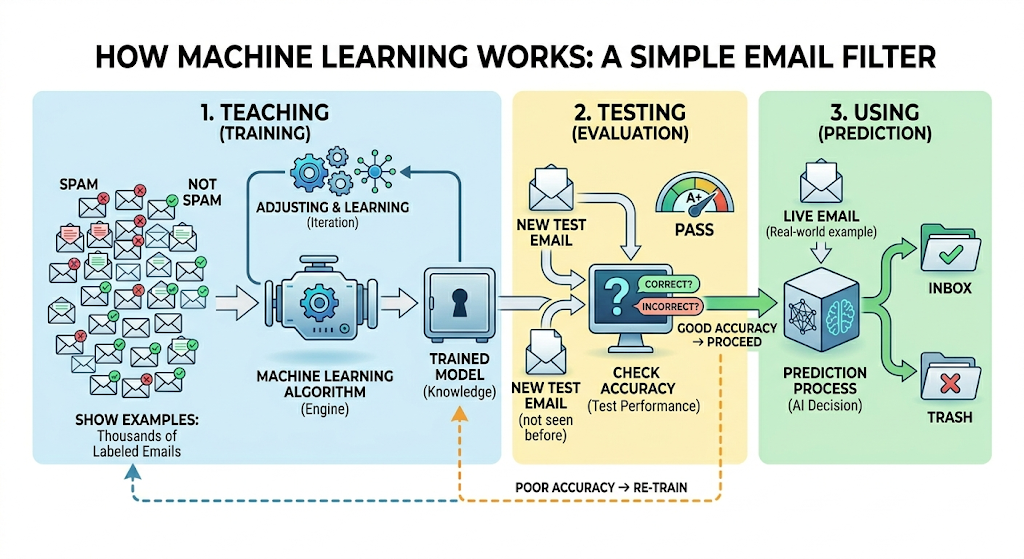
The core idea is simple: show the system thousands or millions of examples, let it find patterns, and then use those patterns to make predictions on new data.
3.2 How Machine Learning Works
Every machine learning system follows a similar process:
Training. The algorithm processes labeled or unlabeled data, adjusting internal parameters to improve performance. For a spam filter, training data consists of millions of emails labeled “spam” or “not spam.”
Evaluation. The trained model is tested on data it has not seen before to measure accuracy.
Prediction (Inference). The deployed model makes predictions on new, unseen data—like classifying a new email as spam or not.
3.3 Types of Machine Learning
| Type | How It Works | Example |
|---|---|---|
| Supervised Learning | Learns from labeled data (input-output pairs) | Spam detection, house price prediction, image classification |
| Unsupervised Learning | Finds patterns in unlabeled data | Customer segmentation, anomaly detection |
| Reinforcement Learning | Learns through trial and error, maximizing rewards | Game-playing AI (AlphaGo), robotics control |
3.4 Machine Learning Algorithms
Machine learning includes a wide range of algorithms, from simple to complex:
- Linear regression. Predicts a continuous value (e.g., house prices)
- Logistic regression. Classifies into categories (e.g., spam or not)
- Decision trees. Makes decisions through a series of if-then rules learned from data
- Random forests. Combines many decision trees for better accuracy
- Support vector machines. Finds boundaries that separate categories
- K-means clustering. Groups similar data points together
- Neural networks. Models inspired by the brain (the foundation of deep learning)
3.5 Examples of Machine Learning (That Are Not Deep Learning)
Many machine learning applications do not use deep learning:
- Spam filters. Often use simpler algorithms like logistic regression or naive Bayes
- Credit scoring. Uses decision trees or random forests
- Customer segmentation. Uses clustering algorithms like k-means
- Fraud detection. Often combines multiple algorithms including random forests
- Recommendation engines. Many use collaborative filtering, not deep learning
These systems learn from data but do not require the massive neural networks associated with deep learning.
Section 4: Deep Learning—The Cutting Edge
4.1 What Is Deep Learning?
Deep learning is a subset of machine learning that uses neural networks with many layers (hence “deep”) to learn complex patterns from large amounts of data.
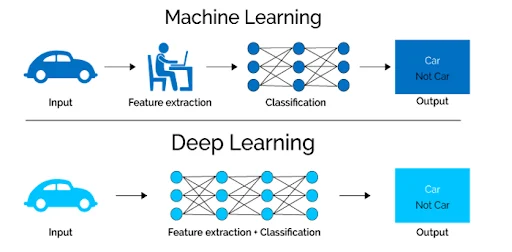
While traditional machine learning often requires human experts to identify relevant features (a process called feature engineering), deep learning learns features automatically from raw data.
4.2 How Deep Learning Works
Deep learning uses artificial neural networks loosely inspired by the human brain. These networks consist of:
Input layer. Receives raw data—pixels of an image, words in a sentence, numbers in a spreadsheet.
Hidden layers. Multiple layers (sometimes dozens or hundreds) that process the information. Each layer learns increasingly abstract patterns. In image recognition, early layers detect edges, middle layers detect shapes, and later layers detect complete objects.
Output layer. Produces the final result—a classification, prediction, or generated content.
The network learns through backpropagation: the error at the output is calculated, then propagated backward through the network, adjusting each neuron’s parameters to reduce future errors.
4.3 Why “Deep” Matters
The depth of the network—the number of hidden layers—is what makes deep learning powerful. With many layers, the network can learn hierarchical representations. This is why deep learning excels at:
- Image recognition. Learning from raw pixels to high-level concepts
- Speech recognition. Learning from raw audio to words and meaning
- Natural language processing. Learning from raw text to grammar and semantics
- Generative AI. Creating new content that follows learned patterns
4.4 Types of Deep Learning Architectures
| Architecture | Best For | Example |
|---|---|---|
| Convolutional Neural Networks (CNNs) | Grid-like data (images, video) | Facial recognition, medical imaging |
| Recurrent Neural Networks (RNNs) / LSTMs | Sequences (time series, text) | Speech recognition, stock prediction |
| Transformers | Long-range dependencies in sequences | Large language models (ChatGPT, Gemini) |
| Diffusion Models | Generating content from noise | Image generation (Midjourney, DALL·E) |
4.5 Examples of Deep Learning
Deep learning powers today’s most advanced AI applications:
- Large language models. ChatGPT, Gemini, Claude—all use transformer-based deep learning
- Image generation. Midjourney, DALL·E—use diffusion models (a deep learning architecture)
- Self-driving cars. Use CNNs and other deep learning networks for perception
- Voice assistants. Use deep learning for speech recognition and natural language understanding
- Medical imaging AI. Uses CNNs to detect cancers, fractures, and anomalies
- AlphaFold. Uses deep learning to predict protein structures
Section 5: Side-by-Side Comparison
5.1 Key Differences at a Glance
| Dimension | Artificial Intelligence (AI) | Machine Learning (ML) | Deep Learning (DL) |
|---|---|---|---|
| Definition | Machines mimicking human intelligence | Systems that learn from data | Neural networks with many layers |
| Scope | Broadest | Subset of AI | Subset of ML |
| Approach | Rules, search, learning, logic | Learning from examples | Learning hierarchical patterns |
| Data Requirements | Varies by approach | Moderate to large | Very large (millions of examples) |
| Hardware | Any | Any (can run on CPUs) | Specialized (GPUs, TPUs required) |
| Feature Engineering | Human-defined | Often requires feature engineering | Automatic feature learning |
| Interpretability | High (rule-based) | Moderate | Low (black box problem) |
| Examples | Expert systems, chess engines | Spam filters, credit scoring | LLMs, image generators, self-driving cars |
5.2 When to Use Each
Choose Traditional AI (Rule-Based) when:
- The problem is well-understood and rules can be defined explicitly
- You have little or no data
- Explainability is critical (e.g., regulated industries)
- The problem is simple and does not require learning
Choose Machine Learning when:
- You have data but not too much (thousands to hundreds of thousands of examples)
- The problem is too complex for explicit rules
- You need reasonable accuracy without massive computing resources
- Interpretability matters (simpler ML models are more explainable)
Choose Deep Learning when:
- You have massive amounts of data (millions of examples)
- The problem involves unstructured data—images, audio, text
- You can access specialized hardware (GPUs/TPUs)
- State-of-the-art accuracy is required
- The problem is complex enough to justify the investment
Section 6: Real-World Examples to Illustrate the Differences
6.1 Example 1: Spam Detection
Traditional AI Approach. A rule-based spam filter uses explicit rules: if the email contains “viagra,” mark as spam; if the sender is not in contacts, mark as spam. This works but misses subtle patterns.
Machine Learning Approach. A logistic regression or random forest model trained on millions of emails learns patterns: combinations of words, sender reputation, email structure. This is more accurate and adapts to new spam tactics.
Deep Learning Approach. A transformer-based model could analyze email content with deeper understanding of context, but this would be overkill. Spam detection works well with simpler ML.
Verdict: Machine learning (not deep learning) is the right choice.
6.2 Example 2: Image Recognition
Traditional AI Approach. Hard to even define rules. What are the explicit rules for recognizing a cat? Not feasible.
Machine Learning Approach. A support vector machine or random forest could work with hand-crafted features (e.g., edges, colors). But performance is limited.
Deep Learning Approach. A convolutional neural network (CNN) learns features automatically from raw pixels. This achieves state-of-the-art accuracy and is the standard approach.
Verdict: Deep learning is the right choice.
6.3 Example 3: Credit Scoring
Traditional AI Approach. Simple if-then rules: if income > X and debt < Y, approve. Works but misses nuance.
Machine Learning Approach. A random forest or gradient boosting model trained on historical loan data learns complex relationships between dozens of factors. This is highly accurate and more fair than simple rules.
Deep Learning Approach. A deep neural network could potentially capture even more complex interactions, but interpretability suffers. Regulators often require explainability in lending.
Verdict: Machine learning (not deep learning) is often the right choice due to interpretability requirements.
6.4 Example 4: Large Language Model (ChatGPT)
Traditional AI Approach. Not feasible. No rule-based system can generate coherent, context-aware text across all domains.
Machine Learning Approach. Earlier language models (like n-gram models) used simpler ML but produced stiff, ungrammatical text.
Deep Learning Approach. Transformer-based deep learning, trained on trillions of words, enables the fluency, reasoning, and adaptability of modern LLMs.
Verdict: Deep learning is essential.
Section 7: How MHTECHIN Helps You Navigate AI, ML, and DL
Understanding the differences between AI, machine learning, and deep learning is essential for making smart decisions—whether you are learning the field or deploying technology. MHTECHIN helps individuals and organizations navigate these distinctions.
7.1 For Beginners: Building Foundational Knowledge
MHTECHIN’s AI/ML workshops start with the fundamentals—ensuring learners understand the landscape before diving into tools. The curriculum covers:
- The relationship between AI, ML, and deep learning
- When to use each approach
- Practical skills in traditional ML algorithms (regression, classification, clustering)
- Introduction to deep learning with hands-on projects
- How to evaluate which technology fits a given problem
For those starting their AI journey, this foundation is essential.
7.2 For Businesses: Choosing the Right Technology
Organizations often face the question: do we need AI, ML, or deep learning? MHTECHIN helps clients answer this through:
AI readiness assessments. Evaluate your data, infrastructure, and use cases to determine the appropriate approach.
Proof-of-concept development. Test simple ML models before committing to deep learning. Often, simpler approaches deliver 80% of the value with 20% of the complexity.
Deep learning for complex problems. When the use case demands it—computer vision, natural language processing, generative AI—MHTECHIN builds and deploys deep learning solutions.
Interpretability considerations. For regulated industries (finance, healthcare), MHTECHIN ensures that chosen approaches meet explainability requirements.
7.3 The MHTECHIN Approach
MHTECHIN’s expertise spans the full spectrum—from traditional rule-based systems through machine learning to cutting-edge deep learning. The team understands that the most sophisticated technology is not always the right solution. The goal is to match the approach to the problem, ensuring that investments deliver measurable results without unnecessary complexity.
For individuals and organizations alike, MHTECHIN provides the guidance to navigate the AI landscape—choosing the right tool for the right job.
Section 8: Frequently Asked Questions
8.1 Q: What is the difference between AI and machine learning?
A: AI is the broad field of creating machines that mimic human intelligence. Machine learning is a subset of AI that focuses on systems that learn from data rather than following explicit rules. All machine learning is AI, but not all AI is machine learning—for example, rule-based expert systems are AI but not ML.
8.2 Q: Is deep learning the same as machine learning?
A: No. Deep learning is a subset of machine learning. Deep learning uses neural networks with many layers to learn complex patterns. Traditional machine learning includes many other algorithms—linear regression, decision trees, random forests, support vector machines—that are not deep learning.
8.3 Q: Which is better: machine learning or deep learning?
A: Neither is universally “better.” The right choice depends on the problem. Deep learning excels at complex tasks with massive data—image recognition, natural language processing, generative AI. Traditional machine learning is often more efficient, more interpretable, and requires less data for simpler problems like spam detection, credit scoring, or customer segmentation.
8.4 Q: Can I do AI without machine learning?
A: Yes. Early AI systems used symbolic AI—explicit rules and logic—without learning from data. Chess engines, expert systems, and rule-based chatbots are examples. However, most cutting-edge AI today uses machine learning.
8.5 Q: Do I need deep learning for my business problem?
A: Probably not unless your problem involves unstructured data (images, audio, text) at massive scale. Start with simpler machine learning. Often, a random forest or gradient boosting model delivers excellent results with less complexity, less data, and better interpretability.
8.6 Q: How much data do I need for machine learning vs deep learning?
A: Traditional machine learning can work with thousands of examples. Deep learning typically requires millions of examples to achieve state-of-the-art performance, along with specialized hardware (GPUs/TPUs). If you have limited data, start with simpler ML.
8.7 Q: Which should I learn first: AI, ML, or deep learning?
A: Start with AI fundamentals—understanding what AI is and its history. Then learn machine learning basics—supervised and unsupervised learning, common algorithms. Deep learning should come after you understand ML fundamentals. Rushing to deep learning without ML foundations leads to gaps in understanding.
8.8 Q: What are examples of AI that are not machine learning?
A: Rule-based chatbots, expert systems (like early medical diagnosis systems), chess engines using search algorithms, and traditional automation systems are AI without machine learning. These systems follow explicit rules rather than learning from data.
8.9 Q: What are examples of machine learning that are not deep learning?
A: Spam filters (using logistic regression), credit scoring (using random forests), customer segmentation (using k-means clustering), fraud detection (using gradient boosting), and house price prediction (using linear regression) are all machine learning without deep learning.
8.10 Q: What are examples of deep learning?
A: Large language models (ChatGPT, Gemini), image generators (Midjourney, DALL·E), self-driving car perception systems, medical imaging AI, voice assistants (speech recognition), and AlphaFold (protein folding) are all deep learning applications.
Section 9: Conclusion—Choosing the Right Tool for the Right Job
Artificial intelligence, machine learning, and deep learning are not interchangeable terms—they represent a hierarchy of approaches, each with distinct characteristics, strengths, and trade-offs.
AI is the broad vision: machines that mimic human intelligence. Machine learning is the dominant approach today: systems that learn from data. Deep learning is the cutting edge: multi-layered neural networks that achieve remarkable results on complex problems.
The key is not to ask which is “best,” but which is right for your problem. A simple rule-based system may be perfect for straightforward automation. A random forest model may deliver excellent results with less data and better interpretability. Deep learning is essential for image recognition, natural language understanding, and generative AI—but it requires massive data, specialized hardware, and careful tuning.
For individuals building skills, the path forward is to understand the landscape—start with AI fundamentals, then machine learning, then deep learning. For organizations deploying solutions, the strategy is to match the approach to the problem—avoiding unnecessary complexity while capturing the power of advanced techniques where they matter.
Ready to navigate AI, ML, and deep learning with confidence? Explore MHTECHIN’s workshops and enterprise services at www.mhtechin.com. From foundational training to strategic deployment, our team helps you choose the right technology for your goals.
This guide is brought to you by MHTECHIN—helping individuals and organizations understand and apply AI, from fundamentals to cutting edge. For personalized guidance on AI learning paths or technology strategy, reach out to the MHTECHIN team today.

Leave a Reply