Introduction
Two types of artificial intelligence dominate business conversations in 2026: Generative AI and Predictive AI. Both are powerful. Both are transforming industries. But they do fundamentally different things—and choosing the wrong one for your problem can lead to wasted investment and disappointing results.
Generative AI creates. It writes emails, designs logos, generates code, and produces realistic images. Predictive AI forecasts. It predicts which customers are likely to churn, which transactions are fraudulent, which patients will miss appointments, and which products will sell.
Understanding the difference is not just technical trivia—it is essential for making smart technology investments. A company that needs to forecast inventory demand does not need a creative writing tool. A marketing team that needs personalized ad copy does not need a churn prediction model.
This article explains what generative AI and predictive AI are, how they work, where each excels, and—most importantly—how to decide which one you need. Whether you are a business leader evaluating AI investments, a professional working with AI teams, or someone building foundational AI literacy, this guide will help you make informed choices.
For a foundational understanding of how AI systems learn and process information, you may find our guide on Neural Networks Explained for Non-Technical Professionals helpful as a starting point.
Throughout, we will highlight how MHTECHIN helps organizations navigate the generative vs. predictive landscape—choosing the right technology for the right problem.
Section 1: What Is Generative AI?
1.1 A Simple Definition
Generative AI refers to artificial intelligence systems that create new content—text, images, audio, video, code, or other media—rather than just analyzing or classifying existing data.
The word “generative” is key. These systems do not simply retrieve or rearrange existing content. They generate novel outputs that have never existed before, following the patterns they learned during training.
1.2 How Generative AI Works
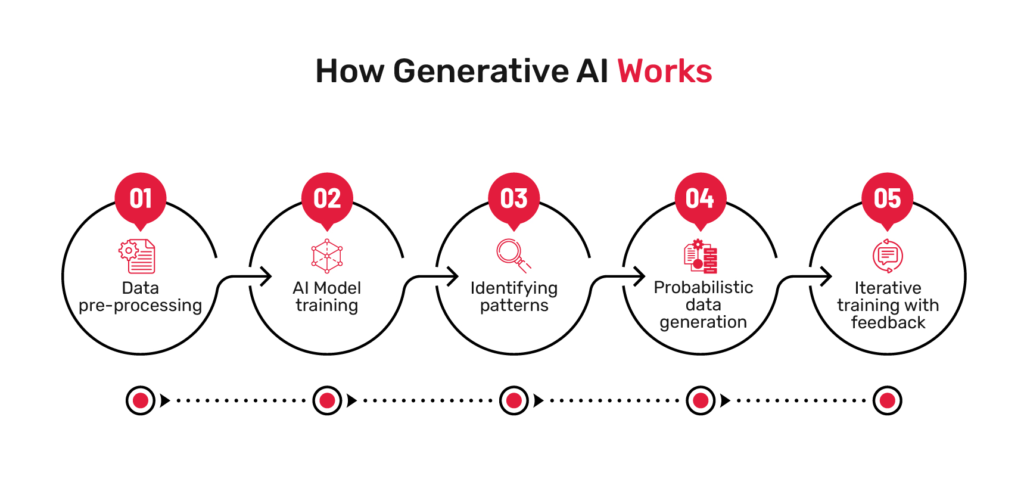
Generative AI models are trained on massive datasets—billions of images, trillions of words, millions of songs. Through this training, they learn the underlying patterns of the data: what makes a sentence grammatical, what makes a face look realistic, what makes a melody pleasing.
Once trained, they can generate new content by sampling from these learned patterns. When you ask ChatGPT to write a poem, it is not retrieving a poem from a database. It is generating new words, one at a time, based on patterns learned from millions of existing poems.
1.3 Common Types of Generative AI
| Type | What It Creates | Examples |
|---|---|---|
| Large Language Models (LLMs) | Text, code, summaries, conversations | ChatGPT, Gemini, Claude, Copilot |
| Image Generators | Realistic images, art, designs | Midjourney, DALL·E, Adobe Firefly |
| Audio Generators | Speech, music, sound effects | Microsoft MAI-Voice-1, ElevenLabs |
| Video Generators | Short videos, animations | Runway, advanced versions of Sora |
| Code Generators | Working code, tests, documentation | GitHub Copilot, Cursor, Codex |
1.4 What Generative AI Is Good For
Generative AI excels at tasks that require creation:
- Content creation. Drafting emails, articles, marketing copy, social media posts
- Design and creativity. Generating logos, product concepts, architectural renderings
- Code development. Writing functions, unit tests, documentation
- Customer communication. Personalizing outreach, crafting responses
- Summarization. Condensing long documents, meeting transcripts, research papers
- Translation. Converting content between languages while preserving tone and meaning
- Brainstorming. Generating ideas, variations, alternatives
1.5 Examples of Generative AI in Action
Marketing. A marketing team uses ChatGPT to generate 50 variations of ad copy, then tests which performs best. Instead of writing each variation manually, the team focuses on strategy and refinement.
Software Development. A developer uses GitHub Copilot to generate boilerplate code, API integrations, and unit tests. Development speed increases significantly, and the developer focuses on architecture and complex logic.
Customer Service. A support team uses generative AI to draft personalized responses to customer inquiries. Agents review and refine rather than writing from scratch, reducing response time.
Design. A product designer uses Midjourney to generate concept images for a new product line. The team explores dozens of directions in hours rather than weeks.
Section 2: What Is Predictive AI?
2.1 A Simple Definition
Predictive AI refers to artificial intelligence systems that analyze historical data to make predictions about future events, behaviors, or outcomes.
These systems do not create new content. They forecast. They answer questions like: Will this customer churn? Is this transaction fraudulent? Will this patient miss their appointment? Which product will sell best next quarter?
2.2 How Predictive AI Works
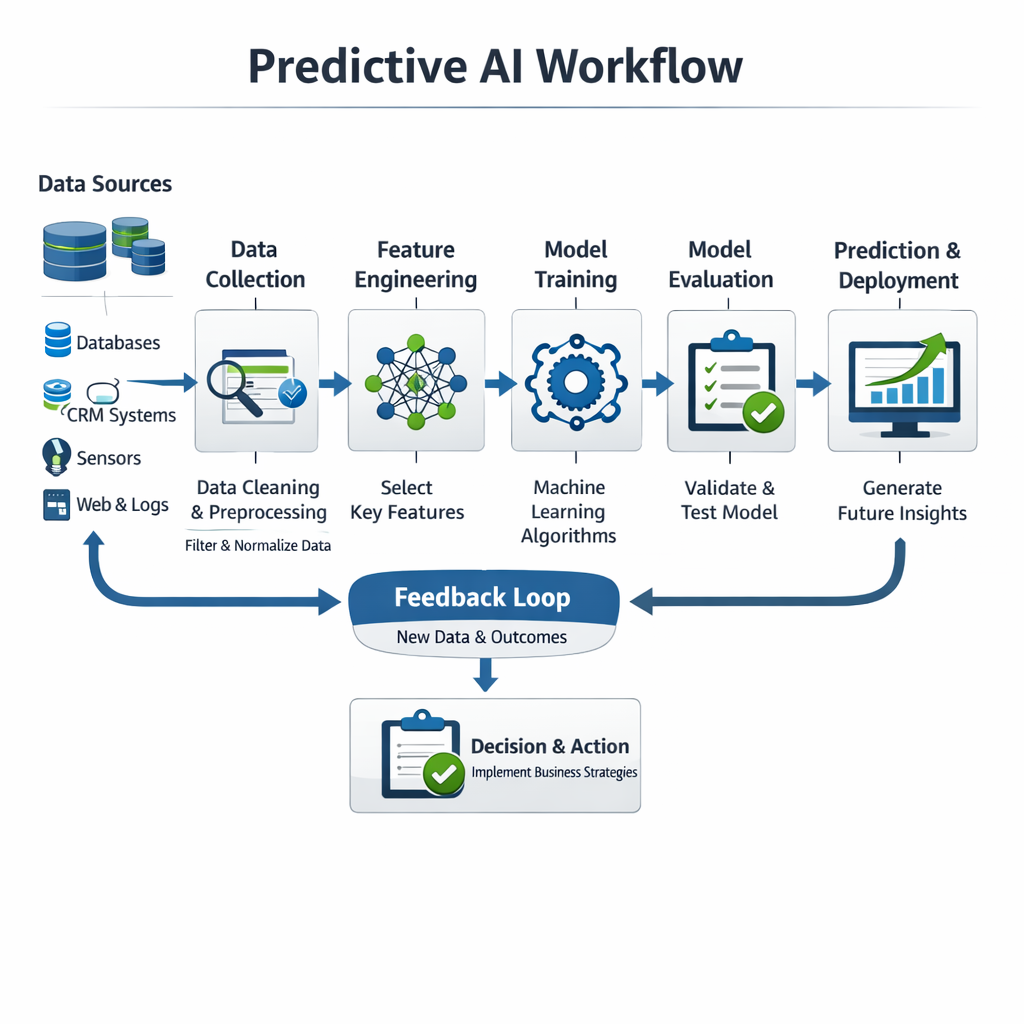
Predictive AI models are trained on historical data where the outcome is known. A churn prediction model is trained on customer data where the model knows which customers ultimately left and which stayed. It learns patterns—combinations of behaviors, usage patterns, demographics—that correlate with churn.
Once trained, the model can score new customers, predicting their likelihood of churning. The output is typically a probability or risk score, not a creative output.
2.3 Common Types of Predictive AI
| Type | What It Predicts | Examples |
|---|---|---|
| Classification Models | Which category something belongs to | Spam or not, fraud or not, churn or not |
| Regression Models | A numerical value | Sales forecast, price prediction, demand estimate |
| Time Series Models | Future values based on historical patterns | Stock prices, traffic volume, energy demand |
| Risk Scoring Models | Likelihood of an event | Credit risk, no-show risk, disease risk |
2.4 What Predictive AI Is Good For
Predictive AI excels at tasks that require forecasting:
- Customer churn. Identifying which customers are likely to leave so you can intervene
- Fraud detection. Flagging transactions that are likely fraudulent
- Demand forecasting. Predicting how much inventory you will need
- Risk assessment. Evaluating credit risk, insurance risk, operational risk
- Maintenance scheduling. Predicting when equipment will fail
- Healthcare outcomes. Predicting which patients are at risk of readmission or no-show
- Pricing optimization. Determining the optimal price to maximize revenue
2.5 Examples of Predictive AI in Action
Healthcare. Deep Medical uses predictive AI to forecast which patients are likely to miss appointments. The system analyzes historical attendance patterns, appointment characteristics, and patient-specific factors. High-risk patients receive proactive outreach. Results: 50% reduction in missed appointments, unlocking 110,000 additional slots annually.
Financial Services. A bank uses predictive AI to score credit applications. The model analyzes thousands of factors—income, debt, payment history, employment—to predict the likelihood of default. Decisions are faster, more consistent, and more accurate than manual underwriting.
Retail. A retailer uses predictive AI to forecast demand for thousands of products across hundreds of stores. The model considers historical sales, seasonality, promotions, and even weather forecasts. Inventory is optimized, reducing both stockouts and overstock.
Manufacturing. A factory uses predictive AI to forecast equipment failure. Sensors collect data on vibration, temperature, and performance. The model predicts failures days or weeks in advance, enabling scheduled maintenance rather than costly unplanned downtime.
Section 3: Key Differences Between Generative AI and Predictive AI
3.1 Side-by-Side Comparison
| Dimension | Generative AI | Predictive AI |
|---|---|---|
| What It Does | Creates new content | Forecasts future outcomes |
| Output | Text, images, code, audio, video | Probability, risk score, numerical forecast, category |
| Training Data | Unstructured content (text, images, audio) | Structured historical data with known outcomes |
| Key Question It Answers | “What can I create?” | “What will happen?” |
| Examples | ChatGPT writing an email | Churn prediction model flagging at-risk customers |
| Common Architectures | Transformers, diffusion models, GANs | Gradient boosting, random forests, neural networks |
| Success Metric | Quality, relevance, creativity, coherence | Accuracy, precision, recall, AUC |
3.2 The Core Distinction
The simplest way to understand the difference:
Generative AI asks: What can I make?
Predictive AI asks: What will happen?
If you need to create something—content, code, designs—you need generative AI. If you need to forecast something—risk, demand, behavior—you need predictive AI.
3.3 When to Use Each
Use Generative AI when:
- You need to create content at scale (emails, articles, marketing copy)
- You need to generate code, tests, or documentation
- You need design concepts, variations, or creative assets
- You need to summarize or translate content
- You need to personalize communication
Use Predictive AI when:
- You need to identify which customers are at risk
- You need to forecast demand, sales, or inventory
- You need to detect fraud, anomalies, or risks
- You need to optimize pricing, staffing, or maintenance schedules
- You need to predict healthcare outcomes
3.4 Overlap and Combined Use
In many real-world applications, generative AI and predictive AI work together. They are not mutually exclusive—they are complementary.
Example: Personalized Marketing. Predictive AI identifies which customers are most likely to respond to an offer. Generative AI creates personalized email content for those customers. Together, they deliver targeted, relevant outreach at scale.
Example: Healthcare Outreach. Predictive AI flags patients at high risk of missing appointments. Generative AI crafts personalized reminder messages—adjusting tone, language, and format for each patient. The combination reduces no-shows more effectively than either technology alone.
Example: Customer Support. Predictive AI predicts which support tickets are urgent or likely to escalate. Generative AI drafts response drafts for agents, accelerating resolution. The combination improves efficiency and customer satisfaction.
Section 4: Choosing the Right Technology for Your Problem
4.1 A Decision Framework
When evaluating whether you need generative AI, predictive AI, or both, ask these questions:
Question 1: What is the core business problem?
- If you need to create something—content, code, designs—lean toward generative AI.
- If you need to forecast something—risk, demand, behavior—lean toward predictive AI.
Question 2: What data do you have?
- Do you have large amounts of unstructured data (text, images) that you want to learn patterns from? Generative AI may be appropriate.
- Do you have historical structured data with known outcomes (transactions, customer records, equipment logs)? Predictive AI may be appropriate.
Question 3: What is the output?
- If the output is text, images, code, or other content → generative AI.
- If the output is a probability, score, forecast, or category → predictive AI.
Question 4: What is your tolerance for error?
- Generative AI can produce creative, useful outputs even with some inaccuracy—the cost of a slightly off email draft is low.
- Predictive AI in high-stakes applications (fraud detection, credit scoring) requires high accuracy and explainability.
Question 5: What is your infrastructure?
- Generative AI (especially large models) requires significant computing resources.
- Predictive AI can often run on modest infrastructure, especially with simpler models like random forests.
4.2 Common Use Cases by Business Function
| Function | Generative AI Use Cases | Predictive AI Use Cases |
|---|---|---|
| Marketing | Ad copy, email drafts, social content | Campaign response prediction, customer segmentation |
| Sales | Proposal drafts, follow-up emails | Lead scoring, win probability, churn prediction |
| Customer Support | Response drafts, knowledge base articles | Ticket priority, escalation prediction |
| Product | Feature descriptions, user documentation | Adoption forecasting, usage prediction |
| Operations | Process documentation, training materials | Demand forecasting, maintenance scheduling |
| Finance | Report summaries, investor communications | Fraud detection, credit risk, revenue forecasting |
| HR | Job descriptions, offer letters | Attrition risk, candidate screening |
| Engineering | Code generation, test creation, documentation | Bug prediction, deployment risk |
4.3 Cost Considerations
Generative AI costs:
- Model usage: API costs per token or per image
- For custom models: significant training costs, GPU infrastructure
- Generally higher per-unit cost (each generation consumes compute)
Predictive AI costs:
- Model development: data preparation, feature engineering, model training
- Inference: generally lower cost per prediction
- Ongoing monitoring: models need retraining as data patterns change
4.4 Common Mistakes to Avoid
Mistake 1: Using generative AI for predictive problems. Asking ChatGPT to predict which customers will churn is the wrong tool. It will generate plausible-sounding text but will not produce reliable forecasts based on your data.
Mistake 2: Using predictive AI for generative problems. A predictive model cannot write marketing copy or generate design concepts. It is not designed for creation.
Mistake 3: Underestimating data requirements. Generative AI requires massive training data. If you do not have millions of examples, a pre-trained model (like ChatGPT) may work, but fine-tuning requires significant data.
Mistake 4: Overlooking interpretability needs. In regulated industries, you may need to explain why a decision was made. Predictive models like decision trees or random forests are more interpretable than deep learning models. Generative AI offers little interpretability.
Section 5: Real-World Examples of Generative vs Predictive AI
5.1 Healthcare: Two Problems, Two Solutions
Predictive AI in Healthcare. Deep Medical uses predictive AI to forecast which patients will miss appointments. The model analyzes historical attendance patterns, distance to clinic, appointment type, and other factors. High-risk patients receive proactive outreach. Result: 50% reduction in missed appointments.
Generative AI in Healthcare. Doctoralia Noa uses generative AI to transcribe and structure clinical notes. The system listens to patient-clinician conversations and generates formatted notes for electronic health records. Result: 5–20% reduction in documentation time, freeing clinicians for patient care.
The combination. These are different problems requiring different technologies. Both deliver value. Neither can do the other’s job.
5.2 Retail: Two Problems, Two Solutions
Predictive AI in Retail. A retailer uses predictive AI to forecast demand for thousands of products. The model analyzes historical sales, seasonality, promotions, and local events. Accurate forecasts reduce both stockouts and overstock.
Generative AI in Retail. The same retailer uses generative AI to write product descriptions for thousands of items. The system generates unique, SEO-optimized descriptions in minutes—work that would take a human copywriter months.
The combination. Predictive AI ensures the right products are in stock. Generative AI ensures they are presented effectively. Together, they drive sales.
5.3 Financial Services: Two Problems, Two Solutions
Predictive AI in Finance. A bank uses predictive AI to detect fraudulent transactions. The model scores each transaction in milliseconds, flagging those with high fraud probability. Result: reduced fraud losses without blocking legitimate transactions.
Generative AI in Finance. The same bank uses generative AI to draft personalized financial advice for customers. The system generates plain-language explanations of complex products, tailored to each customer’s situation.
The combination. Predictive AI protects assets; generative AI communicates value.
Section 6: How MHTECHIN Helps You Choose and Deploy
Choosing between generative AI and predictive AI—or deciding to combine them—requires expertise in both technologies and a clear understanding of your business goals. MHTECHIN helps organizations navigate this landscape.
6.1 For Strategy and Planning
MHTECHIN helps organizations:
- Assess your use case. Is your problem best solved by generative AI, predictive AI, or both?
- Evaluate data readiness. Do you have the right data for the approach?
- Estimate costs and ROI. What investment is required? What returns are realistic?
- Plan for integration. How will AI outputs fit into existing workflows?
6.2 For Predictive AI Deployment
MHTECHIN builds and deploys predictive AI systems for:
- Customer churn prediction. Identify at-risk customers before they leave
- Demand forecasting. Optimize inventory, staffing, and supply chains
- Fraud and risk detection. Flag anomalies in real time
- Maintenance scheduling. Predict equipment failure before it occurs
- Healthcare outcomes. Forecast no-show risk, readmission risk
6.3 For Generative AI Deployment
MHTECHIN helps organizations leverage generative AI for:
- Content creation. Marketing copy, email campaigns, product descriptions
- Code generation. Accelerating software development
- Personalized communication. Tailored outreach at scale
- Document summarization. Extracting insights from reports and contracts
- Translation and localization. Adapting content for global audiences
6.4 The MHTECHIN Approach
MHTECHIN’s approach is grounded in matching technology to problem—not chasing trends. The team:
- Understands your business. What are you trying to achieve?
- Evaluates your data. Do you have the right foundation?
- Recommends the appropriate approach. Generative, predictive, or combined.
- Deploys and monitors. Ensuring systems deliver value over time.
For organizations exploring AI, MHTECHIN provides the expertise to make informed choices—avoiding the trap of using the wrong tool for the job.
Section 7: Frequently Asked Questions
7.1 Q: What is the difference between generative AI and predictive AI?
A: Generative AI creates new content—text, images, code, audio. Predictive AI forecasts future outcomes—risk, demand, behavior. Think of generative AI as “what can I make?” and predictive AI as “what will happen?”
7.2 Q: Which is more useful for business?
A: Both are highly valuable—for different problems. Predictive AI is essential for forecasting, risk management, and optimization. Generative AI is essential for content creation, personalization, and communication. The right choice depends on your specific business problem.
7.3 Q: Can generative AI make predictions?
A: Not reliably. While large language models can generate plausible-sounding predictions, they are not designed for forecasting based on structured data. For accurate predictions, use predictive AI trained on your historical data.
7.4 Q: Can predictive AI create content?
A: No. Predictive AI outputs probabilities, scores, or categories—not creative content. If you need to generate text, images, or code, use generative AI.
7.5 Q: Can I use both together?
A: Yes—and many successful applications combine both. Predictive AI identifies which customers or situations need attention; generative AI creates personalized content for those customers. Together, they deliver more value than either alone.
7.6 Q: Which requires more data?
A: Generative AI generally requires massive datasets—trillions of words for LLMs, millions of images for image generators. However, you can use pre-trained models (like ChatGPT) without your own training data. Predictive AI requires your own historical data with known outcomes, but the volume needed is often smaller—thousands to hundreds of thousands of examples.
7.7 Q: Which is more expensive?
A: It depends. Generative AI has higher per-unit costs (each generation consumes compute). Predictive AI has higher upfront costs for data preparation and model development but lower per-prediction costs. Both require ongoing monitoring and maintenance.
7.8 Q: Which is easier to implement?
A: Generative AI is often easier to start with because pre-trained models (ChatGPT, Gemini, Claude) are available via API. You can build applications without training your own models. Predictive AI typically requires custom development using your own data, which takes more time and expertise.
7.9 Q: How do I know which one I need?
A: Start by defining your core business problem. Ask: Do I need to create something (content, code, designs) or forecast something (risk, demand, behavior)? If you are unsure, MHTECHIN offers AI readiness assessments to help you evaluate use cases and choose the right approach.
7.10 Q: Can I switch from one to the other later?
A: Yes. Many organizations start with one type of AI and add the other as their capabilities mature. The infrastructure, data, and expertise developed for one often support the other. MHTECHIN helps clients build flexible AI strategies that can evolve over time.
Section 8: Conclusion—The Right Tool for the Right Job
Generative AI and predictive AI are both powerful. Both are transforming how businesses operate. But they are not interchangeable. Using generative AI for a predictive problem—or predictive AI for a generative problem—leads to disappointing results.
The key is to match the technology to the problem. If you need to create content, code, or designs, generative AI is your answer. If you need to forecast risk, demand, or behavior, predictive AI is your answer. And in many cases, the most powerful solutions combine both—predictive AI identifies what matters, and generative AI communicates it effectively.
For organizations investing in AI, the question is not “which is better?” but “which is right for my problem?” With clear use cases, quality data, and the right expertise, both generative and predictive AI can deliver measurable ROI.
Ready to choose the right AI for your business? Explore MHTECHIN’s AI advisory and deployment services at www.mhtechin.com. From strategy through implementation, our team helps you match technology to problem—and deliver results.
This guide is brought to you by MHTECHIN—helping organizations navigate the AI landscape, from generative to predictive and beyond. For personalized guidance on AI strategy or implementation, reach out to the MHTECHIN team today.

Leave a Reply