Introduction
The insurance industry is undergoing a digital transformation driven by Artificial Intelligence. Among all use cases, claims processing is one of the most critical and complex operations—often involving manual verification, long processing times, and high operational costs.
With the rise of autonomous (agentic) AI, insurers can now automate end-to-end claims workflows, improving speed, accuracy, and customer satisfaction.
Leading technology innovators such as Google, Microsoft, and OpenAI are enabling intelligent systems that can analyze claims, detect fraud, and interact with customers in real time.
This guide by MHTECHIN explores how AI-powered autonomous agents are transforming insurance claims processing.
Role of AI in the Insurance Industry
What is AI in Insurance?
AI in insurance refers to the use of machine learning, natural language processing, and automation to:
- Analyze policy and claims data
- Detect fraud and anomalies
- Automate workflows
- Improve customer service
Why Claims Processing Needs Transformation
Traditional claims processing faces several challenges:
- Manual and time-consuming workflows
- High error rates
- Fraud risks
- Poor customer experience
Autonomous AI agents address these issues by enabling intelligent, real-time decision-making.
What Are Autonomous Agents in Insurance?
Definition
Autonomous agents are AI systems that can:
- Understand tasks
- Make decisions
- Execute actions
- Learn from outcomes
In insurance, they act as digital claims processors, handling tasks independently or with minimal human intervention.
Key Capabilities
- Document analysis
- Fraud detection
- Decision-making
- Customer interaction
AI-Driven Claims Processing Workflow

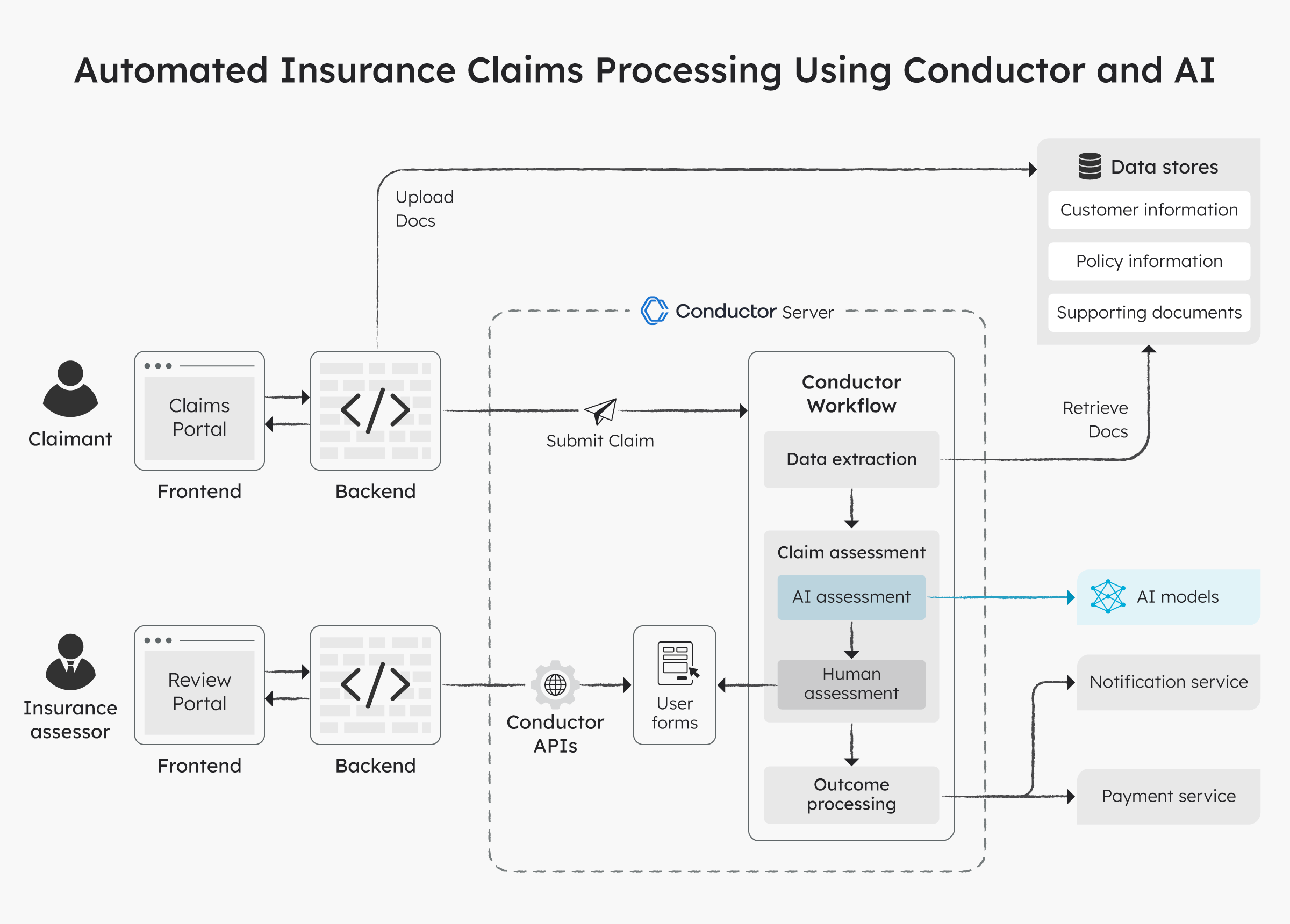
How AI Agents Transform Claims Processing
Claim Submission and Intake
Automated Data Collection
AI agents collect claim data from:
- Online forms
- Mobile apps
- Chatbots
Document Understanding
AI uses NLP and computer vision to:
- Extract information from documents
- Validate claim details
Claim Evaluation and Verification
Policy Validation
AI checks:
- Policy coverage
- Eligibility criteria
- Claim conditions
Damage Assessment
For cases like vehicle or property insurance:
- AI analyzes images and videos
- Estimates damage and repair costs
Fraud Detection
Anomaly Detection
AI identifies suspicious patterns such as:
- Repeated claims
- Inconsistent information
Behavioral Analysis
AI evaluates claimant behavior to detect potential fraud.
Decision-Making and Approval
Automated Decision Systems
AI agents:
- Approve valid claims
- Flag risky cases for human review
Risk Scoring
Each claim is assigned a risk score based on:
- Historical data
- Claim complexity
Payment and Settlement
Automated Payouts
Once approved, AI systems:
- Initiate payments
- Notify customers
Real-Time Updates
Customers receive:
- Status updates
- Notifications
Benefits of AI in Claims Processing
Faster Processing
- Claims processed in minutes instead of days
Cost Reduction
- Reduced manual labor
- Lower operational expenses
Improved Accuracy
- Reduced human errors
- Consistent decision-making
Enhanced Customer Experience
- Faster claim resolution
- Transparent communication
Fraud Prevention
- Early detection of fraudulent claims
- Reduced financial losses
Challenges in AI-Based Claims Processing
Data Quality Issues
AI requires high-quality data for accurate decisions.
Regulatory Compliance
Insurance is heavily regulated, requiring strict adherence to laws.
Model Transparency
Decisions must be explainable to customers and regulators.
Integration with Legacy Systems
Existing systems may not support modern AI technologies.
Ethical Considerations
Fairness
AI systems must avoid biased decisions.
Transparency
Customers should understand how decisions are made.
Accountability
Insurance companies must remain responsible for AI-driven outcomes.
Future of AI in Insurance
The future of AI in insurance includes:
- Fully autonomous claims processing
- Real-time fraud detection systems
- Personalized insurance products
- Integration with IoT devices (e.g., smart vehicles, wearables)
AI will enable a shift toward proactive and predictive insurance models.
MHTECHIN Perspective
MHTECHIN recommends a strategic approach to implementing AI in insurance:
- Start with high-impact use cases like claims processing
- Ensure data security and compliance
- Combine AI automation with human oversight
- Continuously monitor and improve models
This ensures efficient, scalable, and trustworthy AI systems.
Conclusion
AI is transforming insurance claims processing through autonomous agents that can handle complex workflows with speed and accuracy. From claim intake to settlement, AI improves efficiency, reduces costs, and enhances customer satisfaction.
While challenges exist, responsible implementation of AI can unlock significant value for insurers and customers alike.
MHTECHIN highlights that the future of insurance lies in intelligent, automated systems that deliver fast, fair, and transparent claim experiences.
FAQ
How is AI used in insurance claims processing?
AI automates claim submission, evaluation, fraud detection, and payment processes.
What are autonomous agents in insurance?
They are AI systems that can independently manage claims workflows and make decisions.
How does AI detect fraud in insurance?
AI uses anomaly detection and behavioral analysis to identify suspicious claims.
What are the benefits of AI in claims processing?
Faster processing, reduced costs, improved accuracy, and better customer experience.
What are the challenges of AI in insurance?
Challenges include data quality, regulatory compliance, and model transparency.

Leave a Reply