Introduction:
Artificial intelligence has moved well beyond the experimental phase. Across healthcare, manufacturing, banking, retail, logistics, and IT services, enterprises are investing heavily in AI to automate workflows, improve decision-making, and unlock new business opportunities.
Yet one challenge continues to hold organizations back: enterprise AI deployment. Building an AI prototype is relatively easy. Deploying it at scale—securely, reliably, and cost-effectively—is where most initiatives stall. While many organizations successfully develop AI prototypes, transitioning those solutions into production remains a significant challenge due to integration complexity, governance requirements, infrastructure readiness, and ongoing maintenance. As a result, many organizations remain stuck in what is often referred to as “pilot purgatory.“
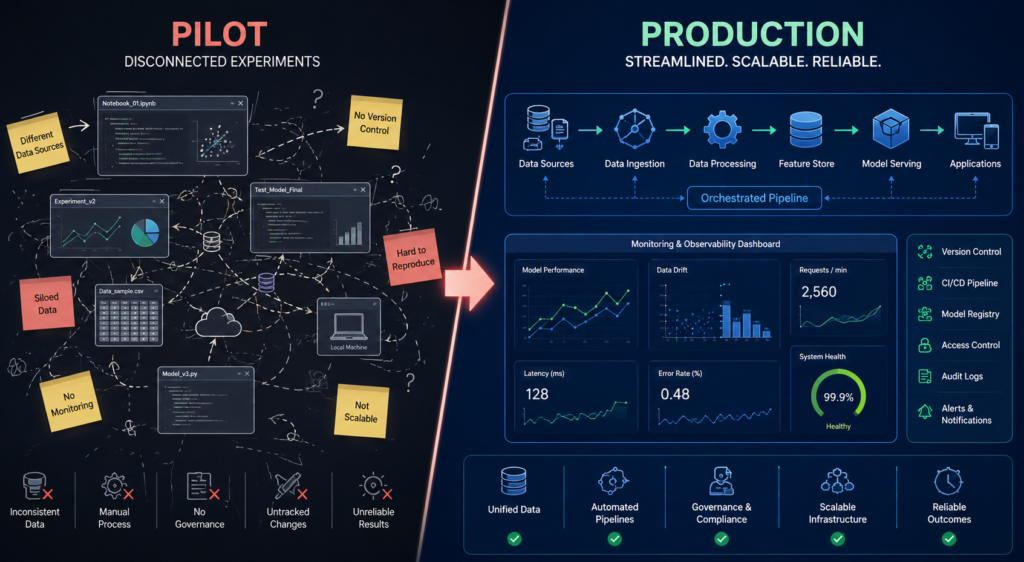
Why Enterprise AI Deployment is More Than Building a Model
Developing a model is only the beginning. Real-world enterprise environments require AI systems to integrate seamlessly with existing applications, process live data securely, comply with industry regulations, and perform reliably around the clock.
Successful deployment depends on:
- Data engineering — clean, connected, and governed data pipelines
- AI infrastructure — compute, storage, and orchestration built for scale
- Cloud integration — connecting AI systems to existing enterprise tools
- Security — protecting sensitive data at every stage
- Governance — auditability, explainability, and accountability
- Continuous monitoring — tracking performance and drift over time
- Performance optimization — meeting latency and cost targets
- MLOps automation — repeatable, reliable deployment pipelines
Without these components, even a highly accurate model can fail once it meets production traffic, messy data, or regulatory scrutiny.
Common Challenges Organizations Face When Scaling AI
Organizations often encounter similar obstacles while scaling AI.
1. Data Silos
Enterprise data is rarely centralized.
Information is distributed across:
- ERP Systems
- CRM Platforms
- Legacy Applications
- Cloud Storage
- Internal Databases
- Third-party APIs
2. Lack of AI Governance
As AI influences business decisions, organizations need complete transparency.
Key governance requirements include:
- Audit trails
- Explainable AI
- Bias detection
- Compliance reporting
- Access control
- Version management
3. Security & Compliance Risks
Enterprise AI processes sensitive information including:
- Customer records
- Financial data
- Healthcare information
- Intellectual property
A secure AI architecture protects both data and business reputation.
4. Infrastructure Scalability
An AI proof of concept serving 100 users is vastly different from an enterprise application supporting millions of requests.
Production deployments require:
- Load balancing
- GPU optimization
- Autoscaling
- Containerization
- High availability
- Disaster recovery
Without scalable infrastructure, performance quickly deteriorates.
Building a Production-Ready AI Foundation
1. Define a Clear Production Contract
Before any deployment begins, MHTECHIN works with clients to set measurable targets — latency (e.g., p95 response time), uptime, cost per request, and acceptable error rates. This “production contract” shapes every architecture and model decision that follows, preventing expensive surprises once the system is live.
2. Make Governance a Prerequisite, Not an Afterthought
As AI becomes embedded in business processes, establishing a formal AI governance framework is becoming increasingly important. Governance helps organizations improve transparency, manage risk, support regulatory compliance, and build trust in AI-driven decisions.
- Auditable — full traceability of model decisions
- Explainable — using techniques like SHAP and LIME to open up “black-box” outputs
- Compliant — built with regulations like the EU AI Act and GDPR in mind (the EU AI Act alone now affects an estimated 42% of enterprise deployments involving high-risk use cases like hiring, credit scoring, and healthcare diagnosis)
- Fair — continuously tested for bias
3. Adopt a Multi-Model Strategy
Relying on a single AI model for every task is no longer considered the most effective approach. Many organizations now adopt a multi-model strategy, selecting different models based on the specific task, performance requirements, and cost considerations. This approach improves efficiency, optimizes resource utilization, and helps deliver better business outcomes. MHTECHIN focuses on designing fit-for-purpose AI architectures that align model selection with enterprise objectives while balancing performance and operational costs.
4. Optimize Infrastructure and Cost Continuously
At scale, compute and token costs add up fast. Enterprises that have shifted from routing everything through premium models to intelligent, task-based routing can significantly reduce infrastructure costs. MHTECHIN builds this discipline in from the start: routing rules, caching for frequent queries, and model compression to keep AI sustainable without blowing the budget.
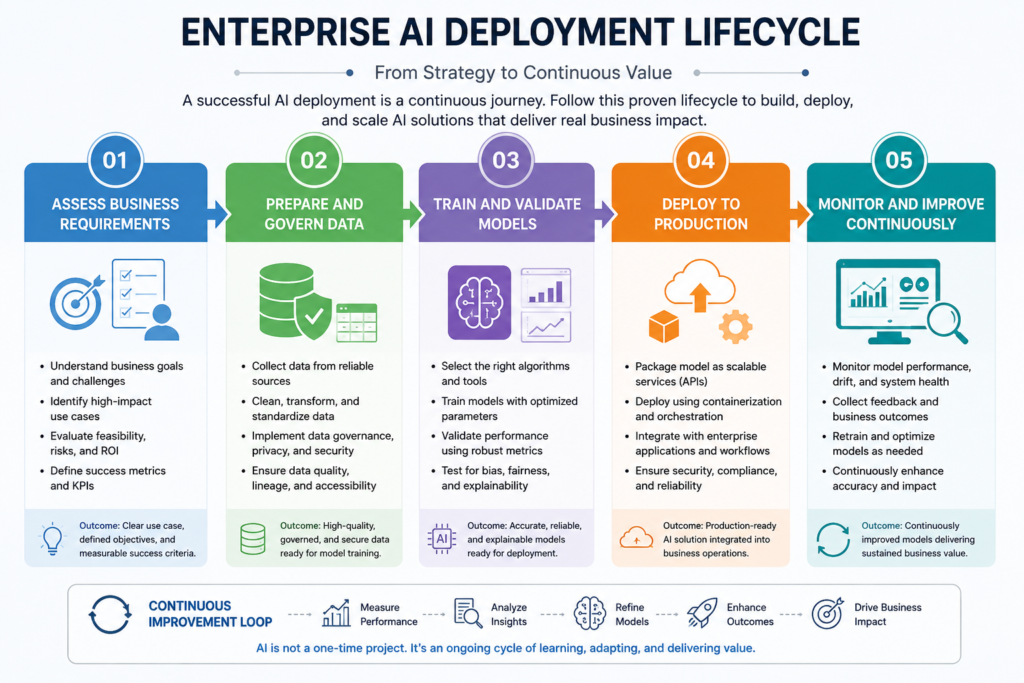
Enterprise AI Deployment in Action
Imagine a manufacturing company deploying an AI-powered predictive maintenance solution. During development, the model is trained using historical sensor data. Once deployed, it integrates with live IoT devices, maintenance management software, and real-time dashboards to detect anomalies before equipment failures occur. Continuous monitoring ensures the model adapts as operating conditions change, demonstrating why successful enterprise AI deployment extends well beyond model development.
Technologies Used in Enterprise AI Deployment
Building an AI model is only one part of a successful deployment. To run AI applications reliably in production, organizations typically rely on a combination of modern infrastructure, automation, and monitoring technologies. The choice of tools depends on business requirements, existing systems, scalability needs, and compliance requirements.
1. Docker
Docker enables AI applications to be packaged with all their dependencies into portable containers. This ensures that models behave consistently across development, testing, and production environments while simplifying deployment and reducing environment-related issues.
2. Kubernetes
As AI applications scale, managing multiple containers manually becomes impractical. Kubernetes automates container orchestration by handling deployment, scaling, load balancing, and recovery. It helps organizations maintain high availability and efficiently manage AI workloads in production.
3. MLOps Platforms
MLOps platforms streamline the lifecycle of machine learning models by automating tasks such as model versioning, deployment, monitoring, retraining, and performance tracking. These platforms help organizations maintain reliable AI systems while reducing manual effort.
4. Vector Databases
With the growing adoption of Generative AI and Retrieval-Augmented Generation (RAG), vector databases have become increasingly important. They store and retrieve vector embeddings, allowing AI applications to perform semantic search and deliver context-aware responses from large knowledge bases.
5. API Gateways
Enterprise AI models often need to communicate with web applications, mobile apps, ERP systems, and other enterprise software. API gateways securely manage these interactions by handling authentication, traffic management, rate limiting, and request routing.
6. CI/CD Pipelines
Continuous Integration and Continuous Deployment (CI/CD) pipelines automate the testing, validation, and deployment of AI applications. By reducing manual intervention, they enable faster releases while improving software quality and deployment consistency.
7. Cloud Platforms
Cloud platforms provide the computing resources, storage, networking, and AI services required to build and scale enterprise applications. Many organizations choose cloud-based deployments because they offer flexibility, scalability, and easier infrastructure management compared to traditional on-premises environments.
Best Practices for Successful Enterprise AI Deployment
Organizations achieving the highest AI ROI consistently follow these principles:
1. Build with Business Objectives First
Every AI initiative should solve a measurable business problem rather than simply adopting the latest technology.
2. Prioritize High-Quality Data
Clean, structured, and governed data remains the foundation of every successful AI system.
3. Adopt Responsible AI
Transparency, fairness, and explainability build trust among customers, regulators, and stakeholders.
4. Monitor Models Continuously
AI performance naturally declines over time due to changing business conditions and evolving datasets. Continuous monitoring helps maintain accuracy.
5. Optimize Infrastructure Costs
Selecting the right model for each workload, implementing caching, and optimizing compute resources significantly reduce operational expenses without sacrificing performance.
Emerging Trends in Enterprise AI Deployment
Enterprise AI is evolving rapidly. Several technologies are reshaping the future:
1. Generative AI Integration
Organizations are integrating Large Language Models (LLMs) into customer support, internal knowledge systems, document automation, and software development.
2. AI Agents
Agentic AI systems can independently plan, reason, and execute multi-step workflows, enabling higher levels of automation across enterprise operations.
3. Multi-Model Architecture
Instead of relying on a single model, enterprises increasingly use specialized models optimized for different tasks to improve accuracy and cost efficiency.
4. Edge AI
Running AI closer to where data is generated reduces latency, improves privacy, and supports real-time decision-making in manufacturing, healthcare, and IoT environments.
5. Responsible AI Compliance
As AI regulations mature worldwide, governance, transparency, and accountability will become standard requirements for enterprise deployments.
Why Businesses Choose MHTECHIN
MHTECHIN delivers end-to-end enterprise AI services that combine technical excellence with business-focused execution.
Our capabilities include:
- AI Solution Development
- Cloud AI Deployment
- Generative AI Solutions
- Custom AI Applications
- AI Security & Compliance
- Enterprise Automation
Every organization has unique operational requirements, existing technology stacks, and business goals. MHTECHIN focuses on delivering AI solutions tailored to these needs by combining cloud technologies, AI development, and enterprise integration practices. This approach helps businesses move from experimentation to scalable AI adoption while prioritizing performance, security, and long-term maintainability.
Conclusion
The true value of AI isn’t demonstrated in a proof of concept—it’s realized when AI consistently delivers business outcomes in production.
Enterprise AI Deployment requires more than advanced algorithms. It demands secure infrastructure, reliable data pipelines, governance, continuous monitoring, and scalable engineering practices.
MHTECHIN’s approach emphasizes helping organizations move beyond experimentation by building production-ready AI solutions that are secure, compliant, and optimized for enterprise success.
Whether you’re launching your first AI initiative or expanding AI across multiple business units, MHTECHIN provides the expertise to transform innovation into measurable business value.
Frequently Asked Questions (FAQs)
1. What is Enterprise AI Deployment?
Enterprise AI Deployment is the process of integrating AI models into real-world business environments where they can securely process live data, interact with enterprise applications, and deliver reliable outcomes at scale. It involves much more than model development, including infrastructure, security, governance, monitoring, and maintenance.
2. How long does Enterprise AI Deployment take?
The deployment timeline varies depending on factors such as project complexity, data readiness, integration requirements, and regulatory considerations. While some projects can be deployed within a few weeks, large enterprise implementations may take several months to complete.
3. Why do AI projects fail after the pilot phase?
Many AI initiatives fail because organizations underestimate the challenges of production deployment. Common reasons include poor data quality, lack of governance, inadequate infrastructure, integration difficulties, security concerns, and the absence of continuous monitoring after deployment.
4. What is MLOps?
MLOps (Machine Learning Operations) is a set of practices that combines machine learning, software engineering, and DevOps principles to manage the complete lifecycle of AI models. It focuses on automating model deployment, monitoring, version control, retraining, and maintenance to ensure AI systems remain reliable over time.
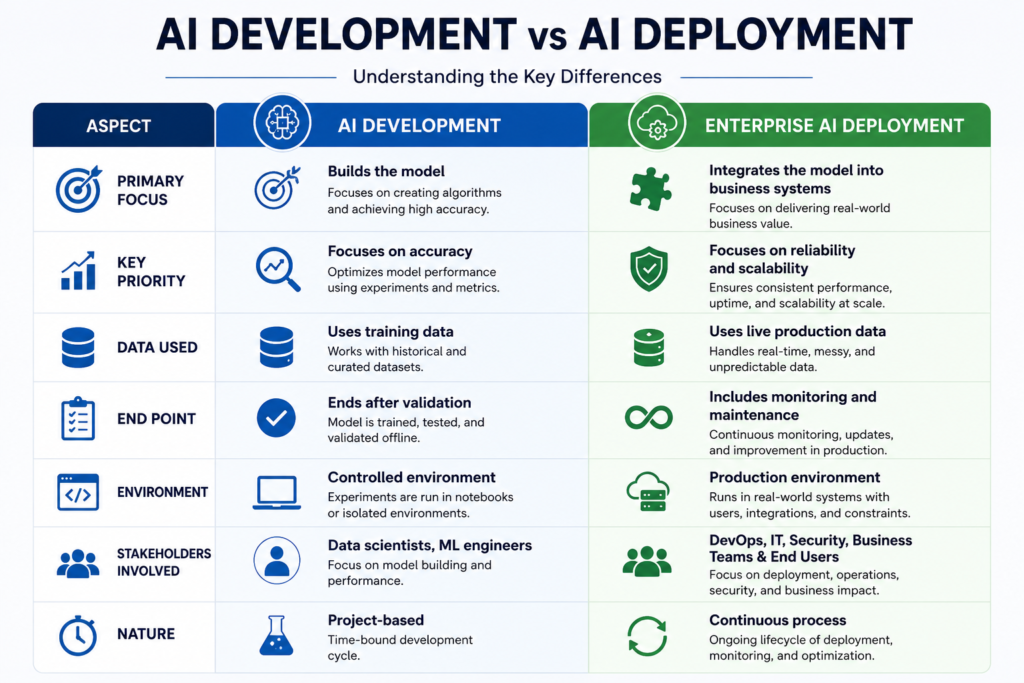
5. How is Enterprise AI Deployment different from AI Development?
AI development focuses on designing, training, and validating machine learning models. Enterprise AI deployment focuses on integrating those models into production environments where they can securely serve business applications, process live data, and operate reliably while being continuously monitored and maintained.

Leave a Reply