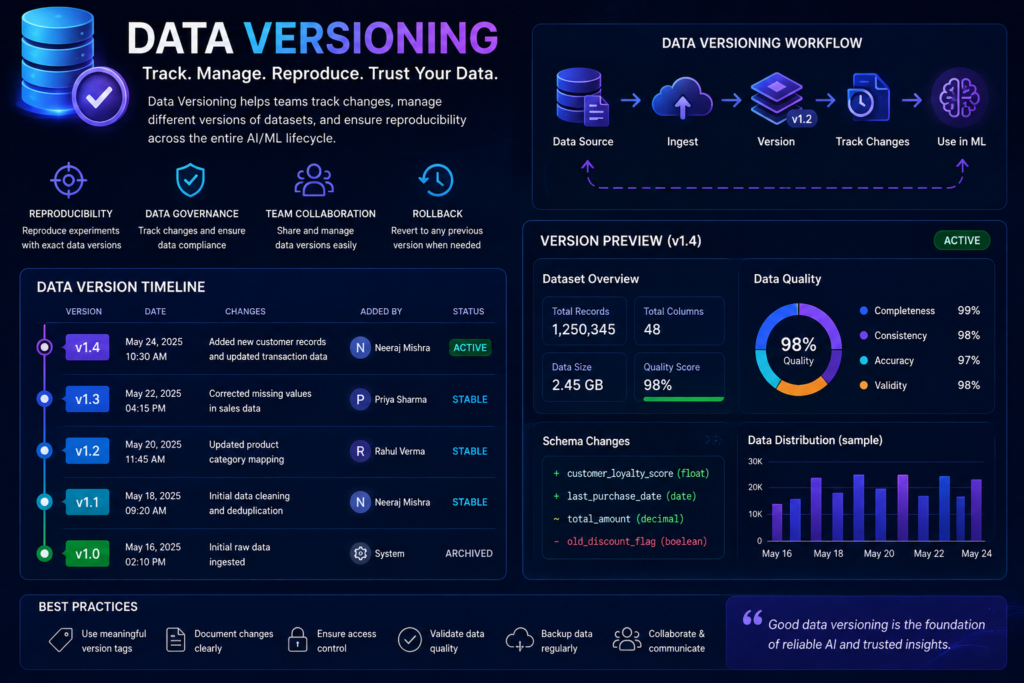
Data Versioning: The Complete Enterprise Guide to Managing AI Data Across the Machine Learning Lifecycle
The Silent Regression That Wasted Two Weeks
It’s a Wednesday morning. A machine learning engineer is frantically debugging why their production model’s accuracy dropped by 8% overnight. The code hasn’t changed. The model architecture is identical. The hyperparameters are the same. But something is different. After two days of investigation, the team discovers the root cause: the training dataset was silently updated. A column in the source database was repurposed, labels were corrected, and the schema drifted—all without anyone noticing.
This scenario plays out in enterprises every single day. As one industry expert put it, “The most dangerous MLOps failures don’t come from the model. They come from the silent, untracked changes in the data universe the model lives in” . We obsess over code versioning in Git, but we ignore the far more chaotic variable: the data itself . This guide is the complete playbook for data versioning—the practice of treating data with the same rigor as application code—across the entire machine learning lifecycle.
What Is Data Versioning?
Data versioning is the systematic practice of creating immutable, traceable snapshots of every dataset used to train, validate, test, or deploy a machine learning model . It tracks changes to datasets over time, preserving a complete history of when, how, and why data changed .
Think of it as Git for datasets—but with important differences. While Git tracks changes to source code files, data versioning handles the unique challenges of large-scale data:
- Petabyte-scale storage: Data versioning tools use copy-on-write mechanics that only store the delta between versions, rather than duplicating entire datasets
- Binary and unstructured data: Images, video, audio, and other non-text formats require specialized handling
- Data lineage: Understanding the relationship between raw data, transformed data, features, and model outputs
- Schema evolution: Tracking structural changes to data over time
Data Versioning vs. File Backup
The distinction is critical. A backup is a point-in-time copy of files. Versioning is a structured system that:
- Tracks changes incrementally rather than duplicating entire datasets
- Stores metadata including author, timestamp, change description, and dependencies
- Enables time travel—querying or reverting to any historical state
- Integrates with CI/CD pipelines for automated testing and validation
Why Data Versioning Is Critical for Enterprise AI
1. Reproducibility
“Reproducibility is essential in machine learning and data research. Reproducing results is virtually impossible without an exact snapshot of the data that went into a specific model or analysis” . A 2022 study from Princeton and Stanford found that only 4 out of 50 surveyed ML papers provided sufficient artifacts to reproduce their results .
Without data versioning, teams cannot:
- Recreate past experiments to validate findings
- Debug why a model’s behavior changed between training runs
- Answer regulatory questions about what data was used to train a model
2. Debugging Model Regressions
“When an LLM starts generating lower-quality outputs after retraining, teams need to determine whether the cause is a code change, a hyperparameter adjustment, or a data shift. Dataset versioning isolates the data variable by providing an exact diff between the training data used in the working version and the current version” .
📷 Diagram Here: Versioning isolates the data variable for root-cause analysis.
3. Regulatory Compliance
The EU AI Act requires organizations deploying high-risk AI systems to maintain auditable records of training data, including “dataset version IDs, data sources, and quality documentation” . By August 2026, this becomes a legal requirement for many organizations . An EY AI Pulse Survey found that 83% of executives say AI adoption would accelerate with stronger data infrastructure .
4. Safe Collaboration
“Multiple teams often work on the same LLM simultaneously. One team might refine instruction-tuning data while another adjusts safety filters. Without versioned datasets, concurrent modifications create conflicts that are difficult to detect and even harder to resolve” . Branching and merging strategies borrowed from software version control give each team isolated environments to experiment without corrupting shared training pipelines .
5. Cost Optimization
“Full LLM retraining costs millions of dollars in compute. Versioning enables teams to identify exactly which portions of training data changed, making targeted fine-tuning or LoRA adapter updates possible instead of full retraining” . This approach reduces both compute costs and storage overhead.
6. Governance and Auditability
“Every model version should be immutable once registered. Overwriting artifacts in place destroys the audit trail and makes rollback impossible” . Immutability supports regulatory requirements and creates a verifiable chain of custody.
How Data Versioning Works: The Production-Grade Workflow
The complete data versioning workflow follows the data’s journey through the ML lifecycle:
text
┌─────────────────┐
│   RAW DATA      │ - Source databases, APIs, external feeds
└────────┬────────┘
         ▼
┌─────────────────┐
│ DATA COLLECTION │ - Extract, validate, and organize source data
└────────┬────────┘
         ▼
┌─────────────────┐
│    CLEANING     │ - Handle missing values, duplicates, outliers
└────────┬────────┘
         ▼
┌─────────────────┐
│   VALIDATION    │ - Schema checks, quality gates, and tests
└────────┬────────┘
         ▼
┌─────────────────┐
│  VERSION CREATE │ - Immutable snapshot with metadata and hash
└────────┬────────┘
         ▼
┌─────────────────┐
│    STORAGE      │ - Cloud object store or data lake with versioning
└────────┬────────┘
         ▼
┌─────────────────┐
│    TRAINING     │ - Model training with dataset version reference
└────────┬────────┘
         ▼
┌─────────────────┐
│     TESTING     │ - Evaluation against versioned test datasets
└────────┬────────┘
         ▼
┌─────────────────┐
│   DEPLOYMENT    │ - Model version linked to dataset version
└────────┬────────┘
         ▼
┌─────────────────┐
│    MONITORING   │ - Detect data drift, performance degradation
└────────┬────────┘
         ▼
┌─────────────────┐
│ NEXT VERSION    │ - Updated dataset with new version ID
└─────────────────┘
The SCD Type 2 Pattern for Time-Travel
One of the most powerful patterns for data versioning comes from data warehousing: Slowly Changing Dimension (SCD) Type 2. Instead of overwriting data, you:
- Expire the old row: Set an
effective_end_dateto today - Append the new row: Add the new record with a new
effective_start_date
This creates a perfect, auditable history. “You can ask, ‘What did the universe of data look like at this exact point in time?’ and get a consistent answer” . The SCD Type 2 pattern solves the temporal paradox that silently breaks model reproducibility.
Core Components of Data Versioning
A complete data version record includes:
🟢 Dataset: The actual data files, stored as immutable snapshots
🟢 Version ID: Sequential version number or hash-based identifier
🟢 Metadata: Author, change description, creation timestamp, and related context
🟢 Schema: Data structure definition and column specifications
🟢 Labels: Ground truth labels or annotations for supervised learning
🟢 Data Source: Origin of the data (database, API, file, etc.)
🟢 Storage Location: Where the versioned data is physically stored
🟢 Hash: Cryptographic hash for integrity verification
🟢 Change History: What changed from the previous version, with detailed diffs
🟢 Validation Status: Quality checks passed or failed
🟢 Dependencies: Code, processing steps, and extracted features required to reproduce the dataset
The 4-Stage AI Asset Lifecycle
The enterprise approach to data versioning fits into a broader 4-stage lifecycle that applies to datasets, models, and label schemas :
Stage 1: Create
What happens: A new dataset is labeled, a model is trained, or a label schema is defined.
The common failure: The asset is created with no metadata attached. The engineer who built it knows the context. Nobody else does.
What good looks like: Every asset gets a creation record that includes:
- Origin metadata: Source data location, labeling tool, annotator, annotation guideline version
- Configuration snapshot: Labeling schema version, number of annotated samples, class distribution
- Quality baseline: Inter-annotator agreement scores, auto-label accuracy rates
Stage 2: Version
What happens: The asset changes—labels get corrected, new training data is added, a schema adds a new class.
The common failure: The new version overwrites the old one, or it gets saved as dataset_v2_final_FINAL.parquet.
What good looks like: Dataset versioning tracks three distinct change types :
- Additive changes: New samples added, with records of how many, from what source, and with what label distribution
- Corrective changes: Existing labels modified, with original label preserved alongside the correction
- Schema changes: A new label class added or existing class redefined (this retroactively affects the meaning of every previously labeled sample)
For models, versioning means storing the full training artifact alongside a pointer to the exact dataset version used. The model and dataset versions must be linked bidirectionally .
📷 Prompt Lifecycle Graphic: Visual representation of the 4-stage lifecycle.
Stage 3: Deploy
What happens: A model moves from development to production.
The common failure: The model is deployed without a record of which dataset version it was trained on, which evaluation thresholds it passed, or what its known failure modes are.
What good looks like: A deployment record ties together:
- Model version: The exact artifact running in production
- Training data lineage: Which dataset version, label schema version, and preprocessing pipeline were used
- Evaluation gate results: Metrics achieved and minimum thresholds required for deployment approval
- Known limitations: Documented failure modes and edge cases
- Rollback pointer: Previous production model version and rollback procedure
Stage 4: Retire
What happens: A model is removed from production. A dataset is superseded by a newer version.
The common failure: Retired assets are deleted without any record, leaving no ability to understand historical predictions.
What good looks like: Retirement is not deletion—it is archival with context:
- Reason for retirement: Replaced by better version, stale data, schema change
- Date range of active service: When deployed and when removed
- Successor pointer: What replaced it, creating a chain of custody
- Archival location: Where artifacts are stored for future reference
Enterprise Use Cases
🏦 Banking: Fraud Detection
Fraud detection models require strict reproducibility and audit trails. A bank maintaining a loan approval model must be able to answer regulatory questions about what data was used to train each model version. The “time-travel problem” is critical: product categories in a master database can change, breaking models trained on historical snapshots .
🏥 Healthcare: Clinical Decision Support
Healthcare applications require HIPAA compliance and auditability. Every version change is recorded with author, approval workflow, and validation against medical benchmark datasets. Teams must be able to reproduce predictions from any model version on demand .
🛒 E-commerce: Recommendation Systems
Product recommendation models retrain weekly based on inventory, seasonality, and customer behavior. Marketing teams refine data through a UI while maintaining version history and rollback capability. The high cost of full retraining makes selective retraining essential .
🚗 Automotive: Autonomous Vehicle Training
Self-driving car datasets are massive (petabytes of sensor data). Data versioning enables teams to:
- Track which sensor data versions were used for each model
- Isolate experiments to specific vehicle fleets or weather conditions
- Reproduce driving scenarios for safety validation
- Comply with automotive safety regulations
🏭 Manufacturing: Predictive Maintenance
Factory sensor data drifts as equipment ages. Data versioning tracks changes in sensor behavior over time, enabling:
- Detection of data drift that could impact model accuracy
- Comparison of models trained on different time periods
- Audit trail for quality and safety investigations
- Cost optimization by identifying when retraining is necessary
Data Versioning vs Model Versioning vs Prompt Versioning
25+ Best Practices for Enterprise Data Versioning
Naming and Organization
- Use clear, descriptive naming conventions reflecting dataset content, version, and update date
- Define the scope and granularity of versioning—identify which datasets need versioning and focus on the most critical parts of your ML workflow
- Version the template, not just the data—variable schemas and transformations belong in the version record
- Structure repositories with clear directory hierarchies to reflect dataset versions, sources, and processing stages
Metadata and Documentation
- Always record metadata alongside data versions: dates, sources, transformations, purpose, and owners
- Use descriptive commit messages documenting what changed and why
- Document naming conventions and metadata standards to maintain consistency across teams
- Maintain a CHANGELOG.md alongside each dataset version that records what changed (additions, corrections, etc.)
Automation and Integration
- Automate the versioning process using CI/CD or data pipeline orchestration tools (e.g., Airflow, Prefect)
- Use Git hooks or equivalent automation for validation checks before merging branches
- Integrate versioning with experiment tracking systems like MLflow or Weights & Biases
- Ensure code and data are tracked together—any version of your project should be fully reproducible
- Link data versions directly to ML pipelines so each experiment automatically associates with its dataset
Versioning Strategy
- Create immutable snapshots for every dataset used in training, validation, and testing
- Use SCD Type 2 for master data to maintain temporal consistency
- Implement branching and merging for parallel experimentation without data duplication
- Adopt semantic versioning for datasets:
- Major version: Structural changes (new columns, schema modifications)
- Minor version: New data additions maintaining existing structure
- Patch version: Corrections to existing records, label fixes
- Store only the delta between versions using copy-on-write mechanics to save storage costs
Validation and Quality
- Define automated validation checks before and after version creation—schema drift, null values, duplicates, feature inconsistencies
- Establish quality gates for promotion between dev, staging, and production
- Connect data versions to evaluation results—each version should accumulate quality scores over time
- Use data observability tools to detect silent data failures early
Security and Compliance
- Implement strict access controls using role-based permissions
- Use encryption for data at rest and in transit to protect sensitive information
- Regularly audit data versions to ensure they meet privacy regulations and security policies
- Define data disposal policies specifying retention periods and automated deletion of obsolete versions
Common Mistakes to Avoid
❌ Overwriting datasets in place
No diff, no audit trail, no rollback capability. The classic anti-pattern that destroys reproducibility .
❌ Missing metadata
“Without metadata, each dataset version is just a folder with files. You can’t answer why it was created or whether it can be trusted” .
❌ No rollback strategy
When a dataset corruption is detected, teams have no way to revert to a known-good version.
❌ Duplicate datasets without tracking
Teams create multiple copies “just to be safe” and lose the ability to know which is authoritative.
❌ Poor naming conventions
data_final_v2_FINAL_really.parquet signals an organization that has already lost control.
❌ Lack of validation
Data errors flow silently into training pipelines and cause model degradation that’s difficult to trace .
❌ Ignoring governance
Regulatory requirements (EU AI Act) catch up with organizations that deferred governance .
❌ No documentation
Team members leave and their undocumented data decisions leave with them .
❌ Versioning data without versioning code
Code changes make data versions unreproducible—the two must be linked .
❌ No connection to experiments
Each data version should accumulate evaluation results so teams can see which versions performed best.
❌ Refreshing data on every pipeline run
Without version pinning, experiments become unreproducible .
Popular Data Versioning Tools
🔹 DVC (Data Version Control)
Best for: Individual data scientists and small teams. Feature: DVC extends Git to handle large files and ML pipelines . It stores lightweight pointer files in Git while storing data in cloud object stores (S3, GCS, Azure). In November 2025, lakeFS acquired DVC, consolidating the two most prominent open-source projects .
Key capabilities:
- Git-like semantics: branch, merge, commit, diff
- Remote storage backends
- Experiment tracking and pipeline definition
🔹 lakeFS
Best for: Petabyte-scale production data lakes. Feature: Provides Git-like operations over object storage with copy-on-write mechanics .
Key capabilities:
- Instant branching (branch a 10 TB dataset in seconds)
- Real-time rollback and commit for datasets
- Integration with Spark, Hive, Presto
- Organizations including Arm, Bosch, and NASA use lakeFS
🔹 Delta Lake
Best for: Teams using Apache Spark. Feature: Open-source storage layer providing ACID transactions and versioning .
Key capabilities:
- Time travel (query past versions with
VERSION AS OF) - Schema evolution support
- Native support for large-scale analytics
🔹 MLflow
Best for: Experiment tracking and model registry. Feature: Comprehensive ML lifecycle platform with dataset versioning integration .
Key capabilities:
- Tracks parameters, metrics, and artifacts for every training run
- Model Registry for stage transitions (Staging, Production, Archived)
- MLflow 3.0 supports generative AI applications
🔹 Weights & Biases (W&B)
Best for: Collaborative experiment tracking. Feature: Artifacts feature logs dataset versions alongside model checkpoints .
Key capabilities:
- Complete lineage from data to trained model
- Comparison tools for visualizing dataset version impacts
- Built-in experiment tracking
🔹 Apache Iceberg
Best for: Large-scale data lakes with complex schemas. Feature: Table format with versioning, schema evolution, and time travel.
🔹 Quilt
Best for: Data packaging and cataloging. Feature: Emphasizes data catalogs and S3 with versioning.
🔹 Pachyderm
Best for: Data science workflows. Feature: Integrated data versioning and reproducibility.
Data Versioning in Cloud Platforms
AWS
- Amazon S3 Versioning: Object-level versioning for data lakes
- AWS Lake Formation: Data lake governance with version-aware access controls
- SageMaker Model Registry: Links models to dataset versions
Microsoft Azure
- Azure Data Lake Storage Gen2: Hierarchical namespace with versioning
- Azure ML Model Registry: Integrated dataset and model versioning
- Azure Purview: Data lineage and governance
Google Cloud Platform
- Vertex AI Model Registry: End-to-end versioning with BigQuery integration
- Cloud Storage Object Versioning: Baseline versioning for data files
- Data Catalog: Data lineage and discovery
Databricks
- Delta Lake: Native versioning and time travel
- Databricks Feature Store: Versioned feature definitions
- MLflow Integration: Full experiment tracking
Snowflake
- Time Travel: Query historical data states (up to 90 days)
- Data Governance: Complete lineage and access controls
- Zero-Copy Cloning: Instant dataset branching
Hybrid and Multi-Cloud
- lakeFS: Versioning across multiple object storage backends
- DVC: Remote storage across cloud providers
- Apache Iceberg: Cross-platform table format with versioning
Security and Compliance Considerations
🔒 Data Encryption
Versioned datasets must be encrypted at rest and in transit. Object storage encryption (S3 SSE, Azure Storage encryption) is essential.
🔒 Role-Based Access Control (RBAC)
Use granular permissions to control who can view, edit, and deploy dataset versions. “Implement strict access controls using role-based permissions” .
🔒 Audit Logs
Every change must be logged with author, timestamp, and description. CloudTrail or equivalent auditing is essential. “Overwriting artifacts in place destroys the audit trail and makes rollback impossible” .
🔒 Data Privacy
“Ensure data privacy is crucial to preventing security breaches when handling sensitive information. Use encryption methods to protect data at rest and in transit. Apply data anonymization or de-identification techniques when needed” .
🔒 Regulatory Compliance
The EU AI Act requires “auditable training data records” by August 2026 . Organizations must:
- Maintain dataset version IDs, data sources, and quality documentation
- Support “traceability of results” and “documentation of the datasets used for training, validation and testing”
- Implement controlled promotion of data between environments
🔒 Data Integrity
Use cryptographic hashes to verify data integrity. DVC creates a hash of each data version and stores it in the pointer file .
🔒 Secure Backups
Backups must be encrypted and versioned. “Data versioning is like a time machine, and users can roll back to an earlier dataset version if necessary” .
The Enterprise Data Versioning Workflow in Production
Step 1: Data Ingestion and Validation
- Raw data collected from source systems
- Automated validation: schema checks, null detection, duplicate detection
- Quality gates prevent bad data from entering the pipeline
Step 2: ETL/ELT Processing
- Cleaning, transformation, feature engineering
- SCD Type 2 for master data to preserve history
- Each transformation step versions its output
Step 3: Feature Store Registration
- Features extracted and stored in a centralized repository
- Feature definitions versioned with the data
- Models trained on specific feature versions
Step 4: Dataset Version Creation
- Immutable snapshot with version ID, metadata, hash
- Linked to source code version, preprocessing scripts, labels
- Stored in versioned data lake or object storage
Step 5: Validation and Quality Gates
- Automated data quality checks pass before promotion
- Schema validation, data freshness tests, leakage detection
- Promotion to staging requires passing all gates
Step 6: Training Pipeline Execution
- Pipeline fetches exact dataset version by ID
- Model version linked to dataset version
- Evaluation metrics stored with the model
Step 7: Production Deployment
- Model version promoted to production with deployment record
- Deployment record includes dataset version, code commit, configs
- Rollback pointer stored for rapid response
Step 8: Monitoring and Drift Detection
- Data drift monitored in production
- Model performance tracked against baseline
- Alerts trigger investigation or retraining
Step 9: Continuous Improvement
- Production traces feed into next version iteration
- Edge cases added to test datasets
- Process repeats with new version
Real-World Case Studies
Google: Foundation Model Training
Google’s approach to versioning the trillion-token corpora used for Gemini includes:
- Full provenance of every pre-training, instruction-tuning, and fine-tuning dataset
- Automated lineage from raw data to model outputs
- Audit trails for regulatory compliance
Netflix: Personalization at Scale
Netflix versioning of recommendation training data enables:
- A/B testing different dataset versions on live traffic
- Rapid rollback of problematic data versions
- Collaboration across multiple data science teams
Uber: Michelangelo Platform
Uber’s ML platform uses “feature stores where the definition, access, and storage of the features is standardized” . This avoids repeatedly extracting feature sets where similar features may have different definitions.
Tesla: Autonomous Vehicle Training
Tesla versioning of sensor data (petabytes of driving footage) enables:
- Tracking which sensor data versions were used for each model
- Isolating experiments to specific vehicle fleets or weather conditions
- Reproducing driving scenarios for safety validation
Airbnb: Home Recommendations
Airbnb’s data versioning supports:
- Multi-team collaboration on training data
- Experiment tracking across different data versions
- Compliance with travel industry regulations
Spotify: Music Discovery
Spotify versioning of user interaction data enables:
- Reproducible A/B tests on recommendation algorithms
- Debugging regressions by comparing data versions
- Cost optimization through selective retraining
SEO FAQ Section
1. What is data versioning?
Data versioning is the practice of creating immutable, traceable snapshots of datasets used in machine learning and analytics . It tracks changes over time, preserving a complete history of when, how, and why data changed.
2. Why is data versioning important for machine learning?
It enables reproducibility, debugging of model regressions, regulatory compliance (especially under EU AI Act), team collaboration, and cost optimization through selective retraining .
3. How does data versioning differ from Git?
Git is for code; data versioning handles large datasets, binary files, schema evolution, and data lineage. Tools like DVC extend Git workflows for datasets, while lakeFS provides Git-like operations over object storage at petabyte scale .
4. What is the SCD Type 2 pattern?
Slowly Changing Dimension Type 2 is a data warehousing pattern that preserves history by expiring old rows (setting effective_end_date) and appending new rows with new effective_start_date. This enables “time-travel” to answer what data looked like at any point in time .
5. What is the 4-stage AI asset lifecycle?
The 4 stages are: Create (dataset creation with provenance), Version (immutable snapshots with metadata), Deploy (models linked to dataset versions with deployment records), Retire (archival with context, not deletion) .
6. What tools support data versioning?
DVC, lakeFS, Delta Lake, MLflow, Weights & Biases, Apache Iceberg, Quilt, and Pachyderm .
7. What is time travel in data versioning?
Time travel refers to querying or reverting to earlier versions of a dataset . Delta Lake’s VERSION AS OF and lakeFS’s branching provide this capability .
8. How does the EU AI Act affect data versioning?
The EU AI Act requires auditable training data records including dataset version IDs, data sources, and quality documentation by August 2026 . High-risk AI systems must have “traceability of results” and documentation of training, validation, and testing datasets .
9. What should be versioned beyond dataset files?
Feature definitions, preprocessing code, label schemas, transformation scripts, data lineage, and the relationship between datasets and model versions .
10. How do you roll back a data version?
If using lakeFS or Delta Lake, you can revert to a previous version with a simple command. With DVC, git checkout and dvc checkout restores the exact data from that code commit .
11. What is semantic versioning for datasets?
Adapting semantic versioning from software: major version for structural changes (schema modifications), minor for new data additions, patch for corrections to existing records .
12. How does data versioning help with model debugging?
Data versioning isolates the data variable, providing an exact diff between training data used in working and current versions. Combined with lineage tracking, this accelerates root-cause analysis from days to minutes .
13. Can you version data without using specialized tools?
For very small projects, manual versioned filenames (data_v1.parquet, data_v2.parquet) can work but lack automation, audit trails, and the ability to handle large datasets efficiently .
14. What is a feature store and how does it relate to data versioning?
A feature store is a centralized repository where feature definitions, access, and storage are standardized . It extends data versioning to the feature level—models trained on different feature versions are fundamentally different models .
15. What are common data versioning mistakes?
Overwriting datasets, missing metadata, no rollback strategy, poor naming conventions, lack of validation, ignoring governance, no documentation, and not linking data versions to experiments .
16. How do you implement data versioning with cloud storage?
Use object storage versioning (S3, GCS, Azure) combined with tools like lakeFS, Delta Lake, or DVC for structured versioning beyond simple file snapshots .
17. What is the relationship between data and model versioning?
Models are the product of data plus code plus config. Bidirectional linking is essential—every model version should reference the exact dataset version used, and every dataset version should track which models were trained on it .
18. How does data versioning support team collaboration?
Branching and merging enable parallel experimentation without data duplication. Teams can experiment in isolated environments without corrupting shared training pipelines .
19. What are the storage implications of data versioning?
Modern tools use copy-on-write mechanics that only store the delta between versions. Branching a 10 TB dataset is near-instantaneous and costs negligible additional storage .
20. Why do 85% of AI projects fail?
Industry research shows that up to 85% of AI projects fail to deliver expected business value, often because teams lack operational discipline to track what they ship. Weak versioning and missing governance are major contributors .
Future Trends in Data Versioning
🤖 AI Agents
As autonomous systems emerge, data versioning extends to agent experiences, tool usage, and decision histories. Version control becomes critical for understanding why an agent made a particular decision.
🧠 Foundation Models
Large language and vision models require versioning at unprecedented scales—trillion-token corpora across multiple data sources and preprocessing pipelines .
📦 Data Lakehouse
The convergence of data lakes and warehouses requires unified versioning across structured and unstructured data. Delta Lake and Apache Iceberg are leading this pattern .
⚡ Real-Time Data Versioning
Streaming data introduces new challenges. Real-time versioning systems must handle continuous updates while maintaining reproducibility.
☁ Multi-Cloud AI
Organizations need versioning that spans AWS, Azure, GCP, and on-premises. Tools like lakeFS and DVC are designed for this multi-cloud reality .
📊 Data Observability
Data quality and health monitoring integrated with versioning. Teams can detect silent failures before they impact model performance .
🔗 Data Lineage
End-to-end lineage from raw data to model output becomes the norm. Organizations need to trace any prediction back to its training data .
🛡 AI Governance
Governance platforms connect versioned training data to end-to-end lineage for full model provenance. Compliance becomes automated rather than manual .
🔍 Explainable AI
Understanding why a model made a decision requires knowing what data it was trained on. Data versioning provides the link between predictions and training data .
🚀 Autonomous AI Systems
Self-improving systems that iterate on their own data will need robust versioning to audit and understand changes made by the AI itself.
Conclusion: The Foundation of Enterprise AI
Data versioning is not a nice-to-have. It is a foundational capability for any organization shipping AI to users . The cost is modest—a versioning tool, metadata tracking, and integration with existing pipelines. The return is immediate.
The first time you have to roll back a dataset corruption in minutes instead of days, you will never go back. The first time a data scientist can reproduce a six-month-old experiment in hours instead of weeks, you will see how data versioning unlocks team productivity.
Three Steps to Get Started
- Choose a versioning tool that fits your scale. DVC for small teams, lakeFS for petabyte-scale data lakes, Delta Lake for Spark workflows .
- Create immutable snapshots of every dataset used in training, validation, and testing. Link them to code commits and model artifacts .
- Implement automated validation before promoting data versions between environments. Quality gates prevent bad data from reaching production .
The teams that do this ship better AI products faster. The teams that don’t spend their weekends debugging data incidents. The choice is clear.
This article draws on production experience from teams deploying ML applications at enterprise scale, with insights from lakeFS, DVC, MLflow, Atlan, and leading cloud providers .

Leave a Reply