Imagine this: You tell your AI, “Plan my weekend trip to Goa, book a hotel under ₹5,000 per night, create a 2-day itinerary, check the weather, and remind me to pack an umbrella.”
A chatbot would give you a list of suggestions—hotel names, weather forecasts, and a sample itinerary. You would then visit five different websites, compare prices, make the bookings, set the reminders, and piece it all together.
An AI agent, on the other hand, would simply do it—book the hotel, add events to your calendar, send the itinerary to your phone, and set the reminder—all without you lifting a finger.
That is the shift we are witnessing: from conversation to autonomous action. And it is why AI agents are being called the next big leap in artificial intelligence.
Most people today think AI equals ChatGPT. Ask anyone on the street, and they will describe a chatbot that answers questions, writes poems, or fixes code. But the industry has already moved on.
In 2024–2026, every major tech company—OpenAI, Google, Microsoft, Anthropic—has pivoted toward agentic AI. These are systems that do not just talk; they plan, reason, use tools, and execute tasks with minimal human supervision.
For students, this means new career paths. For developers, it means building with new frameworks like LangChain, AutoGen, and CrewAI. For recruiters, it means hiring for skills that did not exist two years ago. Understanding AI agents is no longer optional—it is becoming essential.
1. What Exactly Is an AI Agent?
An AI agent is a system that perceives its environment, makes decisions, and takes actions to achieve a specific goal—often using external tools like APIs, databases, browsers, or files.
Real-World Analogy:
Think of a chatbot as a library reference desk. You ask a question, and the librarian gives you an answer from a book.
Now think of an AI agent as a personal executive assistant. You give them a goal—say, “organise a client dinner next Thursday”—and they:
- Check your calendar for availability
- Call three restaurants for reservations
- Compare menus and prices
- Send calendar invites
- Order a cab for the evening
The assistant does not just talk about the task—they complete it.
2. AI Agent vs Chatbot – The Core Differences
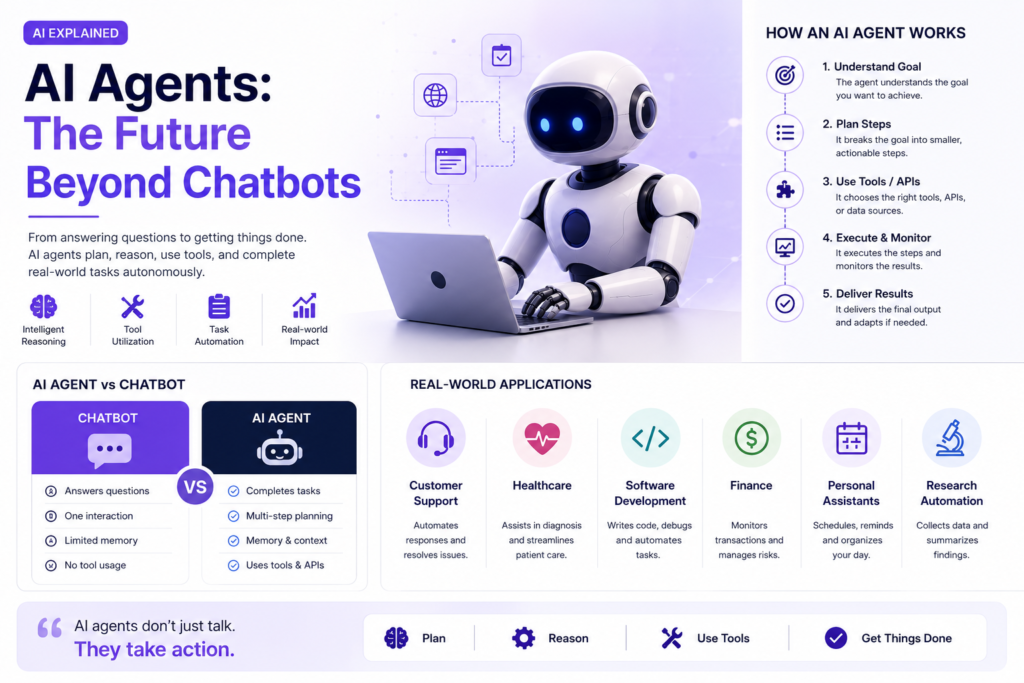
| Feature | Chatbot | AI Agent |
|---|---|---|
| Primary function | Answers questions | Completes tasks |
| Interaction style | Single-turn or short conversations | Multi-step planning and execution |
| Memory | Limited or session-based | Maintains long-term context and memory |
| Tool usage | None or minimal | Can use APIs, databases, browsers, code interpreters, and files |
| Decision-making | Reactive (responds to prompts) | Proactive (plans and iterates) |
| Autonomy | Low – needs constant user input | High – can work independently toward a goal |
3. How an AI Agent Actually Works
Here is a simplified flow of how a typical AI agent processes a request:
User gives a goal
↓
Agent plans the steps
↓
Agent reasons about tools needed
↓
Agent calls APIs / databases / browsers
↓
Agent checks intermediate results
↓
Agent iterates if needed
↓
Agent delivers final output
For example, if you ask an agent to “find the cheapest flight from Delhi to Bangalore this Friday and book it if under ₹6,000”, it will:
- Query multiple airline APIs.
- Compare prices.
- Check your payment method.
- Book the ticket.
- Email you the confirmation.
- Update your calendar.
All of this happens in the background, often in seconds.
4. Real-World Applications – Where Agents Are Being Used Today
| Industry | Application | Example |
|---|---|---|
| Customer Support | Automated ticket resolution | Zendesk’s AI agents resolve support tickets without human intervention |
| Healthcare | Patient triage and appointment scheduling | Agents help hospitals prioritise emergency cases |
| Software Development | Code reviews, bug fixes, and deployment | GitHub Copilot Workspace acts as an agentic coding assistant |
| Finance | Fraud detection and portfolio management | AI agents monitor transactions and rebalance investment portfolios |
| Personal Assistants | Scheduling, travel, shopping | Google Assistant’s new agentic features book restaurants and manage to-do lists |
| Research Automation | Literature reviews and data extraction | Elicit and Scite use agents to summarise research papers |
5. The Strengths and Limitations of AI Agents
- Strengths:
- Massive productivity boost – Tasks that took hours now take minutes.
- 24/7 availability – Agents do not sleep or take breaks.
- Consistency – They follow rules without fatigue or bias (if trained well).
- Scalability – One agent can serve thousands of users simultaneously.
- Limitations:
- Hallucinations – Agents can confidently produce incorrect information.
- High cost – Running agentic workflows consumes significant compute power.
- Privacy risks – Agents often need access to sensitive data.
- Security vulnerabilities – Poorly designed agents can be exploited.
- Over-reliance – Humans may blindly trust agent decisions without verification.
6.The Future – What Comes Next?
By 2028–2030, we are likely to see:
- Multi-agent systems – Teams of AI agents collaborating on complex projects, like building an entire app or managing a supply chain.
- Autonomous businesses – Small companies run almost entirely by agents, with humans only supervising.
- AI coworkers – Agents that integrate seamlessly into human teams, attending meetings and contributing ideas.
- Personal AI assistants – Always-on agents that know your preferences, habits, and goals better than you do.
- But even in this future, one thing remains clear: human oversight is not optional. Agents will augment us, not replace us.
- 7. Key Takeaways
- Chatbots answer questions; AI agents complete tasks – this is the core distinction.
- AI agents use planning, reasoning, memory, and tool-calling to achieve goals autonomously.
- Real-world adoption is already happening in support, healthcare, finance, and software development.
- While powerful, agents have limitations – cost, hallucinations, privacy, and security concerns remain.
- The future is multi-agent systems, autonomous workflows, and AI coworkers – but human oversight stays essential. Companies like MHTECHIN are bridging the gap between AI research and practical, enterprise-ready agent deployment.
AI Agents Explained: How They Are Different from Chatbots and Why They Matter– developed by Shreya Rathi

Leave a Reply