Introduction
Imagine two customer service systems handling the same issue. A traditional AI system transcribes the customer call, flags a budget concern, and generates a summary—then waits for a human representative to read the summary, update the CRM, and draft a follow-up email. Days pass. The customer moves to a competitor .
Now imagine an agentic AI system handling the same scenario. It captures the conversation, identifies the budget constraint, automatically updates the CRM, drafts a personalized follow-up with pricing options, and escalates to a manager only if the proposed discount exceeds approval thresholds—all within minutes of the call ending .
This difference—between reactive assistance and proactive execution—is the fundamental distinction between traditional AI and agentic AI. And it’s why 2026 is being called the year autonomy becomes the defining battleground for enterprise AI adoption .
As organizations move beyond experimentation, the question is no longer whether AI can generate insights. It’s whether AI can act on them—autonomously, reliably, and within guardrails.
This comprehensive guide explores the critical differences between agentic AI and traditional AI, why autonomy matters for business outcomes, and how organizations can navigate the transition. We’ll examine architectural distinctions, governance implications, real-world applications, and practical implementation pathways.
Part 1: Defining the Two Paradigms
What Is Traditional AI?
Traditional AI encompasses systems designed for pattern recognition, prediction, and content generation in response to human prompts. These systems excel at specific tasks but lack the ability to initiate action independently.
Categories of Traditional AI:
| Category | Function | Examples |
|---|---|---|
| Predictive AI/ML | Pattern recognition, forecasting | Fraud detection, demand forecasting, risk scoring |
| Generative AI | Content creation, summarization | ChatGPT, image generators, code assistants |
| Reactive AI | Rule-based responses | Chatbots, recommendation engines |
The common thread across traditional AI is reactivity. These tools await human input, process it, and return output—but they don’t close the loop by taking action on that output .
What Is Agentic AI?
Agentic AI refers to systems designed for goal-directed autonomy—the ability to perceive environments, reason about objectives, plan multi-step actions, execute tasks, and adapt based on outcomes—all without continuous human intervention .
According to a comprehensive 2026 arXiv study on agentic architectures, these systems integrate six core components: perception, brain (reasoning), planning, action, tool use, and collaboration . Unlike traditional AI, agentic systems don’t just answer questions—they pursue goals.
The Fundamental Distinction: Reactive vs. Proactive
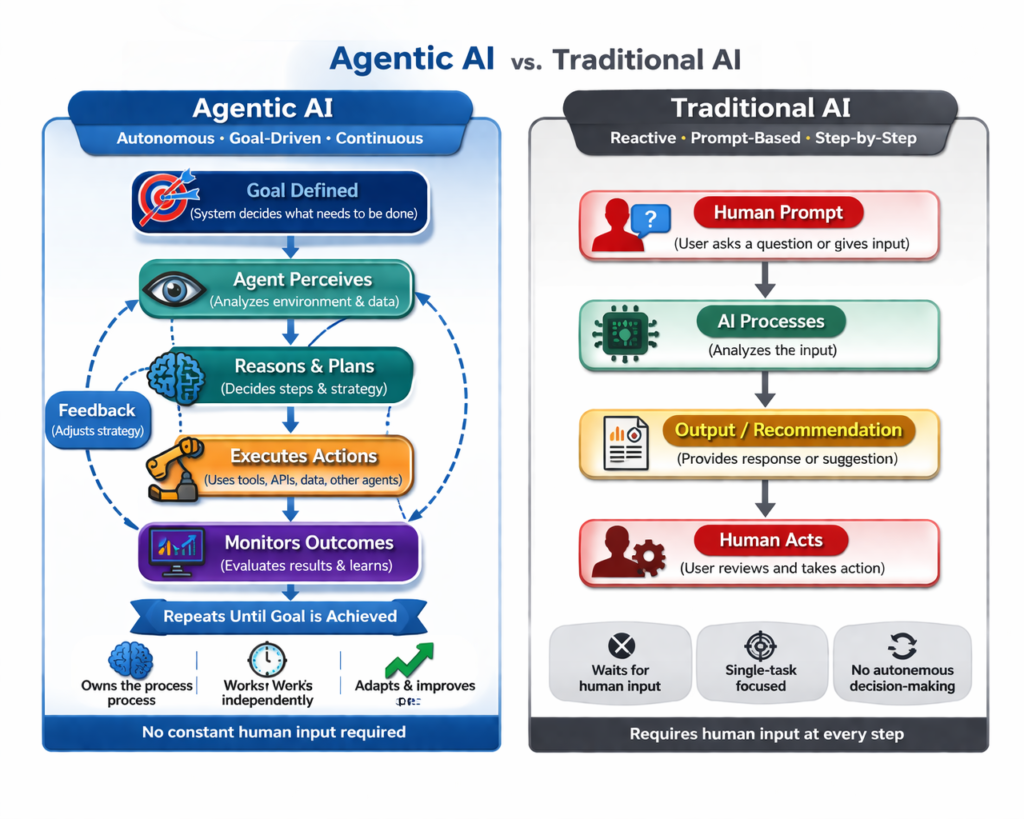
*Figure 1: Agentic AI operates in continuous perception-action loops.Traditional AI follows a linear, human-dependent flow.*
Part 2: The Core Differences—A Comprehensive Comparison
2.1 Execution: Single-Task vs. Multi-Step Workflows
Traditional AI excels at isolated tasks. A predictive model forecasts demand; a chatbot answers a question; a summarization tool condenses a document. Each requires a distinct prompt or input .
Agentic AI, by contrast, manages end-to-end workflows. When given a high-level goal like “reduce procurement cycle time,” an agentic system might:
- Analyze historical procurement data
- Identify bottleneck patterns
- Research alternative vendors
- Generate recommendations
- Initiate approval workflows
- Monitor implementation outcomes
This shift from task completion to goal achievement represents a fundamental change in how AI interacts with business processes.
2.2 Autonomy: Low vs. Moderate to High
Traditional AI tools have minimal autonomy. They respond to prompts but cannot initiate actions. As TechRadar notes, “73% of insights captured by legacy AI tools never translate into executed actions” . The missing link is autonomy.
Agentic AI systems operate with defined autonomy boundaries. Within those guardrails, they:
- Initiate actions without prompting
- Select appropriate tools for each subtask
- Adapt plans when conditions change
- Escalate only when thresholds are exceeded
2.3 Integration: Isolated vs. Cross-System
Traditional AI often operates in silos. A sales tool generates insights; a separate system handles CRM updates; another manages follow-ups. Humans bridge the gaps .
Agentic AI integrates across enterprise systems through dynamic tool calling. Using protocols like the Model Context Protocol (MCP), agents can invoke APIs, query databases, update CRMs, and coordinate across platforms—all within a single workflow .
2.4 Governance: Model-Focused vs. Workflow-Focused
Traditional AI governance focuses on model outputs: Is the prediction accurate? Is the generated content appropriate?
Agentic AI governance must address action risks. As highlighted in enterprise AI research, governance must extend to:
- Autonomy boundaries
- Action approval thresholds
- Financial exposure limits
- Compliance verification before execution
This shift from monitoring outputs to controlling actions introduces new complexity—and new accountability requirements.
2.5 Feedback: Periodic Retraining vs. Continuous Evaluation
Traditional AI models typically improve through periodic retraining cycles—monthly, quarterly, or annually.
Agentic systems incorporate continuous feedback loops. After each action, they evaluate outcomes and refine future decisions. This creates a perception-reasoning-action-feedback cycle that enables real-time adaptation .
Comparison Table: Agentic AI vs Traditional AI
| Dimension | Traditional AI | Agentic AI | Business Impact |
|---|---|---|---|
| Execution | Single-task | Multi-step workflows | 30-50% faster process completion |
| Autonomy | Requires human prompts | Goal-directed action | Reduced administrative overhead (up to 45% time savings) |
| Integration | Isolated outputs | Cross-system orchestration | Elimination of manual data transfer |
| Governance | Model accuracy focus | Workflow + policy focus | Higher accountability requirements |
| Feedback | Periodic retraining | Continuous evaluation | Real-time adaptation |
| Risk Surface | Predictive errors | Autonomous action risks | Need for guardrails |
| Human Role | Operator | Director/Strategist | Shift from execution to oversight |
Part 3: The Autonomy Advantage—Why It Matters
3.1 Closing the Execution Gap
The most compelling argument for agentic AI is simple: insights without action have no value.
Research from Gartner cited by TechRadar shows that 73% of insights captured by traditional AI tools never translate into executed actions . This “execution gap” costs companies time, revenue, and competitive positioning.
Consider a sales organization. Boston Consulting Group reports that sales representatives spend up to 45% of their time on administrative tasks—CRM updates, manual follow-ups, data entry . Traditional AI might flag a high-value opportunity, but it still requires manual action. Agentic AI can trigger the follow-up, update the CRM, and schedule the next meeting—automatically.
3.2 Speed and Operational Agility
In fast-moving markets, execution speed directly correlates with revenue performance. Delays in responding to customer signals, competitive moves, or market shifts lead to missed opportunities .
Agentic AI compresses decision-to-action timelines by:
- Eliminating handoffs between systems and people
- Automating routine operational tasks
- Enabling real-time responses to changing conditions
A procurement agent, for example, can identify pricing anomalies and initiate renegotiation workflows within hours—not weeks .
3.3 Consistency and Scale
Human-dependent workflows introduce variability. Different people handle similar situations differently, leading to inconsistent outcomes.
Agentic AI executes tasks consistently, following defined policies and guardrails. This consistency scales effortlessly—the same agent can handle hundreds or thousands of workflows simultaneously, without degradation .
3.4 Human Empowerment, Not Replacement
A critical nuance often lost in AI discussions: autonomy doesn’t mean removing humans. It means redefining human roles.
In human-agent collectives (HAC), humans become directors, strategists, and ethicists rather than executors. They define goals, set ethical boundaries, and maintain the “kill switch”—while agents handle tactical execution .
| Human Role | Agent Role |
|---|---|
| Define strategy | Execute tactics |
| Set ethical boundaries | Operate within guardrails |
| Handle exceptions | Manage routine workflows |
| Provide creativity and empathy | Optimize and iterate |
| Maintain accountability | Produce audit trails |
This division of labor enables organizations to do more with existing resources—not by replacing people, but by amplifying their impact.
Part 4: Architectural Foundations
4.1 The Cognitive Architecture of Agentic AI
Recent arXiv research on agentic architectures identifies the core components that enable autonomous behavior :
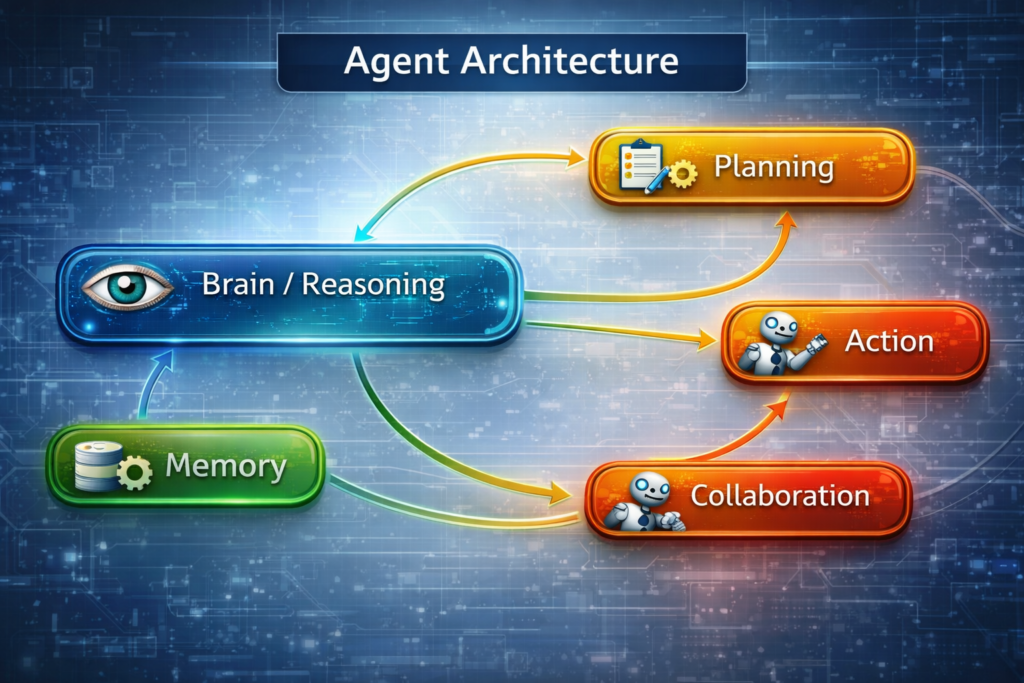
Figure 2: The integrated architecture of agentic AI systems
Perception: Agents ingest structured and unstructured data from multiple sources—APIs, databases, documents, sensors—to build contextual understanding.
Brain/Reasoning: Using large language models (LLMs) or multimodal models, agents analyze information, evaluate options, and determine optimal actions.
Planning: High-level goals are decomposed into executable subtasks with dependencies and sequencing.
Action: Agents execute through API calls, MCP servers, system commands, or agent-to-agent communication.
Memory: Short-term context and long-term knowledge enable consistent behavior across sessions.
Collaboration: Multi-agent systems coordinate specialized agents for complex workflows.
4.2 Enterprise Reference Architecture
For enterprise deployments, Trantor’s 2026 guide outlines a layered architecture :
| Layer | Components | Purpose |
|---|---|---|
| Foundation Models | OpenAI, Anthropic, Google models | Reasoning capabilities |
| Orchestration Engine | LangChain, AutoGen | Task planning, tool invocation |
| Tool & API Layer | ERP, CRM, databases | System connectivity |
| Memory & Knowledge | Vector DBs, knowledge graphs | Contextual reasoning |
| Governance & Guardrails | Policy engines, human-in-the-loop | Risk control |
| Monitoring & Observability | Logging, drift detection | Performance tracking |
4.3 The Role of MCP and A2A Protocols
Two emerging standards are critical for agentic AI deployment:
Model Context Protocol (MCP): Provides standardized interfaces for tool access, enabling agents to interact with diverse systems consistently .
Agent-to-Agent (A2A) Communication: Enables collaboration between specialized agents, supporting multi-agent orchestration.
Part 5: Governance—The Critical Enabler
5.1 Why Governance Determines Success
Autonomy without governance is risk. As enterprises deploy agentic AI, the organizations that succeed will not necessarily be those with the most powerful AI—they will be those that deploy it with the most discipline .
According to SAS’s Deepak Ramanathan, “When autonomy scales without governance, so does risk, especially in regulated industries” . Governance must be embedded at design time, not bolted on after deployment.
5.2 Four Pillars of Agentic AI Governance
Tech Mahindra’s framework for Human-Agent Collectives identifies four non-negotiable governance pillars :
Pillar 1: Security—Identity and Access Control
Every agent must have a distinct, traceable digital identity and operate under the Principle of Least Privilege. Agents should access only the data and systems necessary for defined tasks.
Pillar 2: Compliance—The Rules Engine
Compliance must be codified as enforceable policies that agents read—not informal guidelines. This includes regulatory requirements, ethical boundaries, and internal protocols.
Pillar 3: Observability—Immutable Audit Trails
Every action, tool call, and decision must be logged in secure, immutable audit trails. Traceability is essential for accountability and legal liability.
Pillar 4: Lifecycle Management—Human-in-the-Loop
For high-risk operations, predefined human intervention points must exist. Humans maintain ultimate accountability and the ability to halt anomalous behavior.
5.3 Risk Classification Framework
Not all agent actions carry equal risk. Enterprises should classify agents by:
| Risk Category | Characteristics | Governance Requirements |
|---|---|---|
| Low | Read-only, internal, low impact | Standard logging, basic policies |
| Medium | Writes data, internal, moderate impact | Approval thresholds, enhanced audit |
| High | Financial transactions, external impact | Human-in-the-loop, executive oversight |
Part 6: Real-World Applications and Case Studies
6.1 Customer Service: Beyond Chatbots
Traditional customer service AI provides chatbots that answer FAQs. Agentic AI transforms the entire service workflow.
MHTECHIN’s Approach: AI-powered customer service robots combine natural language processing, machine learning, and decision-making capabilities to not only understand customer queries but also initiate actions—processing returns, updating accounts, and escalating complex issues to human agents when needed .
Key capabilities:
- 24/7 availability with unlimited concurrent interactions
- Personalized responses based on customer history
- Automatic case creation and CRM updates
- Seamless escalation to human agents with full context
6.2 Sales Revenue Operations
The sales function exemplifies the agentic advantage. According to Momentum.io‘s Santiago Suarez Ordoñez, traditional AI “surfaces recommendations but requires human oversight to execute, often causing operational stalls” .
Agentic Sales Workflow:
- Call transcription and analysis
- Automatic CRM updates
- Follow-up email generation and sending
- Meeting scheduling
- Deal progression monitoring
The result: sales representatives spend less time on administrative tasks (up to 45% reduction) and more time on revenue-generating activities .
6.3 IT Operations and Incident Management
Agentic AI is transforming IT operations through autonomous incident resolution.
Use Case: IT Incident Resolution Agent
- Monitors infrastructure alerts
- Diagnoses root causes from logs
- Suggests fixes
- Executes approved remediation scripts
- Reduces mean time to resolution (MTTR) by 25-35%
6.4 Insurance Claims Processing
The insurance industry demonstrates agentic AI’s ability to handle complex, regulated workflows.
Agentic Claims Workflow:
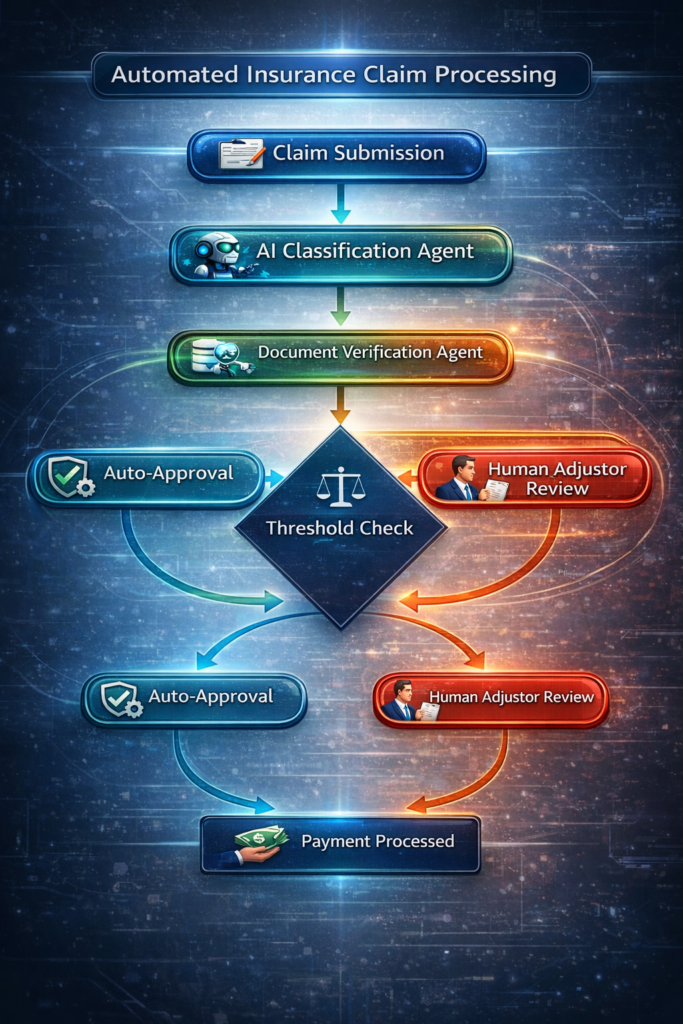
*Figure 3: Multi-agent workflow for insurance claims*
The system processes routine claims autonomously while escalating exceptions to human adjustors with complete case context.
6.5 Autonomous Driving
Autobrains has deployed the automotive industry’s first agentic AI system for advanced driver assistance systems (ADAS). Rather than a single monolithic model, the system uses specialized, scenario-focused agents activated only when relevant .
Advantages:
- Reduced compute load through selective activation
- Capability expansion without hardware redesign
- Learning from experience like human drivers
Part 7: The Adoption Journey—From Pilot to Production
7.1 Three Phases of Agentic AI Adoption
Deloitte’s framework outlines a phased approach to agentification :
| Phase | Characteristics | Human Role | Timeline |
|---|---|---|---|
| Phase 1: Augmentation | AI handles repetitive tasks, supports decisions | Operator remains accountable | 3-6 months |
| Phase 2: Coordination | AI manages multi-step processes across departments | Supervisor oversees workflows | 6-12 months |
| Phase 3: Autonomy | AI executes complex strategies independently | Director monitors outcomes | 12-24 months |
The pace varies by industry, risk tolerance, and organizational readiness.
7.2 The Readiness Imperative
Before deploying agentic AI, organizations must address foundational readiness. According to OroCommerce’s Jary Carter, “Before adding new tools or AI, it helps to audit your systems and decide what system owns what data” .
Readiness Checklist:
- System ownership and data lineage documented
- Fragmented systems consolidated
- Access controls and permissions defined
- Governance frameworks established
- Human oversight protocols designed
- Audit capabilities implemented
7.3 Enterprise Maturity Model
Trantor’s enterprise agentic AI maturity model outlines five levels :
| Level | Description | Characteristics |
|---|---|---|
| 1 | AI Assistants | Reactive, prompt-based, single-task |
| 2 | Task Automation Agents | Scripted workflows, limited adaptation |
| 3 | Multi-Step Workflow Agents | Goal decomposition, dynamic tool use |
| 4 | Multi-Agent Collaboration | Specialized agents, orchestration |
| 5 | Autonomous Enterprise Systems | Policy-aware, self-optimizing |
Most organizations currently operate at Levels 1-2, with leading adopters advancing to Level 3.
Part 8: Challenges and Risk Mitigation
8.1 Key Risks
Over-Autonomy: Agents making decisions beyond intended authority or scope .
Unintended API Actions: Tool calls producing unexpected results due to misinterpreted context.
Policy Drift: Agent behavior deviating from established guardrails over time.
Hallucinated Decisions: Agents confidently taking actions based on incorrect reasoning.
Escalation Failures: Critical situations not properly escalated to human oversight.
8.2 Mitigation Strategies
| Risk | Mitigation |
|---|---|
| Over-Autonomy | Clear action boundaries, explicit approval thresholds |
| Unintended Actions | Sandboxed testing, simulated execution before live |
| Policy Drift | Continuous evaluation, periodic recertification |
| Hallucinations | Chain-of-thought validation, output verification |
| Escalation Failures | Redundant escalation paths, human-in-the-loop design |
8.3 Regulatory Compliance
Agentic AI deployment must align with evolving regulations:
- EU AI Act: Risk-based classification with stricter requirements for high-risk systems
- GDPR: Data protection, consent management, deletion rights
- India’s Digital Personal Data Protection Act: Consent requirements, purpose limitation
Organizations should embed compliance into design, not treat it as an afterthought.
Part 9: The Future of Agentic AI
9.1 2026: The Turning Point
Industry leaders at the 2026 Cisco AI Summit declared this year a turning point for industrial-scale agentic AI deployment . Gartner predicts that 40% of enterprise applications will include task-specific AI agents by the end of 2026, up from less than 5% in 2025 .
9.2 Emerging Trends
Spatial Intelligence: Beyond language models, AI that understands 3D physical space will transform manufacturing, logistics, and healthcare.
Multi-Agent Ecosystems: The future belongs to coordinated multi-agent systems, not single agents .
Sovereign AI: Nations prioritizing AI infrastructure resilience will create fragmented markets with distinct requirements.
AI Teammates: The evolution from chatbots to persistent AI collaborators will redefine workplace roles .
9.3 Research Priorities
A 2026 arXiv paper identifies critical research priorities for responsible agentic AI advancement :
- Verifiable planning with guaranteed outcomes
- Scalable multi-agent coordination
- Persistent memory architectures
- Governance frameworks for autonomous systems
- Robustness against adversarial attacks
Part 10: Getting Started with Agentic AI
10.1 Strategic Assessment
Begin by identifying high-value, low-risk use cases. Internal processes with clear workflows and measurable outcomes are ideal starting points.
Evaluation Criteria:
- Clear business value (time savings, cost reduction, revenue impact)
- Manageable risk (internal, low financial exposure)
- Defined workflows (existing processes can be codified)
- Available data (structured, accessible, clean)
10.2 Pilot Design
Start with a controlled pilot that establishes:
- Clear success metrics
- Defined autonomy boundaries
- Human oversight protocols
- Audit and logging mechanisms
- Escalation paths
10.3 Scaling Gradually
As confidence grows, expand to:
- Additional use cases
- Higher autonomy levels
- Multi-agent coordination
- Cross-departmental workflows
10.4 Building Organizational Capability
Success requires more than technology. Invest in:
- Governance literacy: Teams must understand compliance requirements
- Hybrid intelligence skills: Combining analytics with reasoning capabilities
- Collaboration frameworks: Designing human-agent workflows
Conclusion
The shift from traditional AI to agentic AI represents a fundamental evolution in how artificial intelligence interacts with business operations. Traditional AI excels at insight generation but stops at the threshold of action. Agentic AI crosses that threshold—planning, executing, adapting, and delivering outcomes.
This autonomy matters because insights without action create no value. The 73% of insights that traditional AI captures but fails to execute represent lost opportunities, delayed responses, and competitive disadvantage .
But autonomy without governance introduces unacceptable risk. The organizations that succeed with agentic AI will not be those deploying the most powerful models—they will be those with the most disciplined approach to governance, security, and accountability .
The transition to agentic AI follows a predictable path: augmentation of existing workflows, then coordination across systems, then autonomous execution within guardrails. Organizations that begin this journey today—starting with controlled pilots, building governance frameworks, and investing in hybrid intelligence skills—will capture sustainable advantage.
As Rohit Madhok of Tech Mahindra notes, “This isn’t about job replacement; it’s about role redefinition. We are transitioning from a model in which technology augments human labor to one in which human strategy orchestrates digital autonomy” .
The question is no longer whether agentic AI will transform enterprise operations—it’s whether your organization is positioned to lead or follow.
Frequently Asked Questions (FAQ)
Q1: What is the main difference between agentic AI and traditional AI?
Traditional AI reacts to prompts by generating insights or content but cannot take independent action. Agentic AI proactively pursues goals, plans multi-step workflows, executes actions across systems, and adapts based on outcomes—all within defined guardrails .
Q2: Is agentic AI safe for regulated industries?
Yes, but only with strict governance controls. Success requires policy-based guardrails, human-in-the-loop for high-risk decisions, immutable audit trails, and compliance-by-design architecture .
Q3: Will agentic AI replace human workers?
No. Agentic AI redefines human roles from executors to directors. Humans maintain strategic control, set ethical boundaries, handle exceptions, and retain ultimate accountability. Agents handle tactical execution and optimization .
Q4: What percentage of insights from traditional AI actually get acted upon?
According to Gartner research, only 27% of insights captured by traditional AI tools translate into executed actions. The remaining 73% represent an “execution gap” that agentic AI is designed to close .
Q5: How do I start implementing agentic AI in my organization?
Begin with a controlled pilot for a low-risk internal process. Establish clear success metrics, autonomy boundaries, and human oversight protocols. Expand gradually based on learnings. Ensure foundational readiness: clean data, clear system ownership, and governance frameworks .
Q6: What are the biggest risks of agentic AI?
Key risks include over-autonomy (agents acting beyond intended scope), unintended API actions, policy drift, hallucinated decisions, and escalation failures. These are mitigated through layered governance, continuous evaluation, and human-in-the-loop design .
Q7: How is agentic AI different from RPA (Robotic Process Automation)?
RPA follows pre-scripted, deterministic rules. Agentic AI adapts dynamically, reasons about goals, selects appropriate tools, and learns from outcomes. RPA automates; agentic AI autonomously executes .
Q8: What governance frameworks exist for agentic AI?
Effective frameworks include four pillars: identity and access control (least privilege), rules engine (codified policies), immutable audit trails, and human-in-the-loop for high-risk operations

Leave a Reply