Introduction
Artificial Intelligence is evolving at an unprecedented pace. As AI models continue to grow from millions to billions—and even trillions—of parameters, running them efficiently on a single machine has become impractical. Organizations are increasingly adopting Distributed AI Systems, where compute resources, data, and intelligence are distributed across multiple interconnected machines to deliver scalable, resilient, and high-performance AI solutions.
Instead of relying on centralized infrastructure, distributed AI enables organizations to process data closer to where it is generated, reduce latency, improve fault tolerance, and support intelligent applications across cloud, edge, and on-premises environments. This architectural shift is powering the next generation of enterprise AI, autonomous agents, and real-time decision-making systems.
✔ Scale AI training across thousands of GPUs
✔ Run inference closer to users with lower latency
✔ Improve reliability through distributed computing
✔ Preserve data privacy with localized processing
✔ Enable intelligent autonomous systems across cloud and edge
What Are Distributed AI Systems?
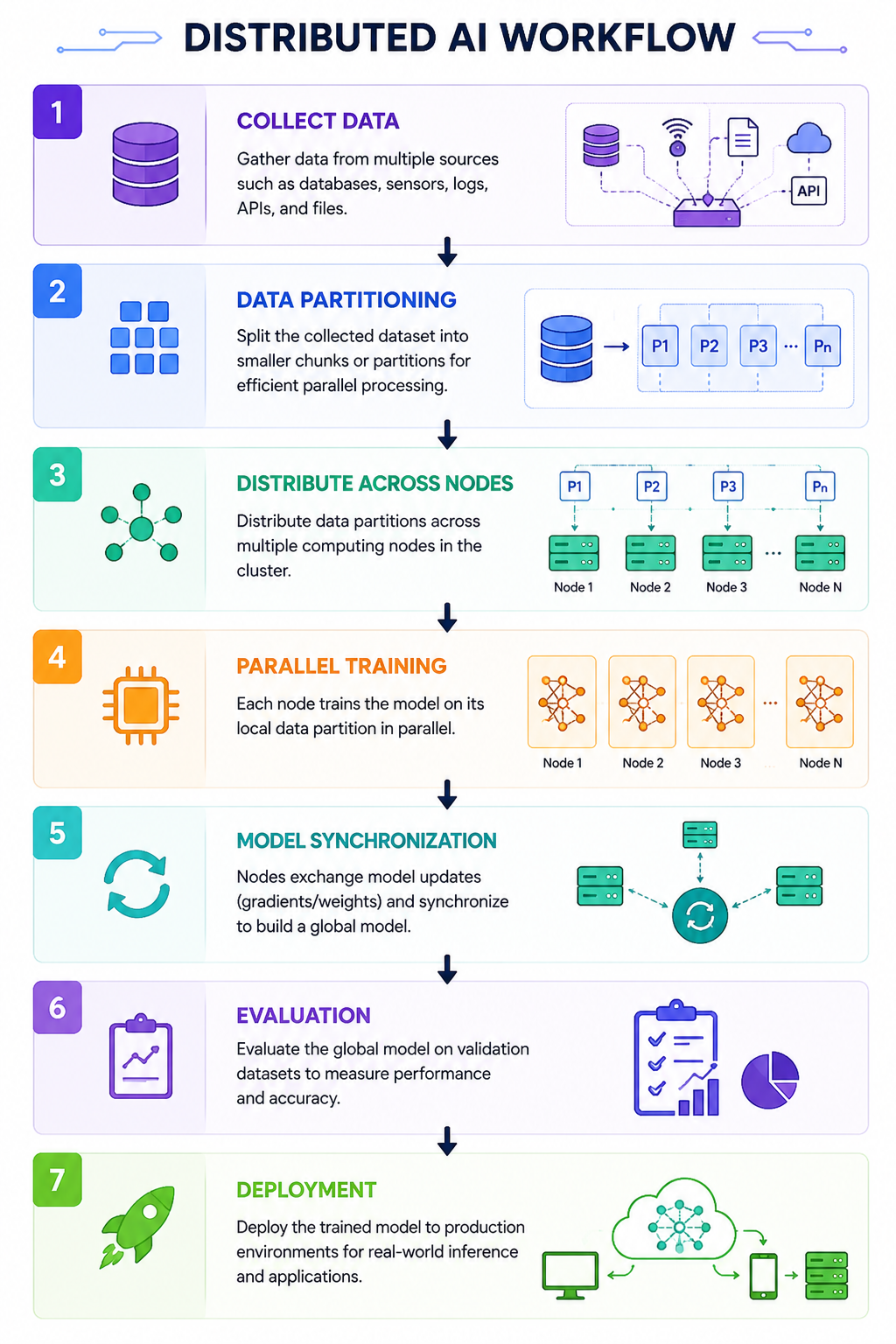
A Distributed AI System is an architecture where AI workloads—including model training, inference, and autonomous agent execution—are distributed across multiple interconnected computing nodes instead of relying on a single centralized machine. These nodes may span cloud platforms, private data centers, Kubernetes clusters, edge devices, or hybrid environments.
Rather than concentrating all computational resources in one location, distributed AI coordinates multiple systems to execute tasks simultaneously, synchronize model updates, and efficiently share computational workloads.
Instead of moving enormous datasets to a centralized server, distributed AI follows a “Model-Follow-Data” approach—bringing compute resources closer to where data is generated. This minimizes bandwidth consumption, reduces latency, and strengthens data privacy.
Why Distributed AI Matters
1. Massive Model Scaling
Training today’s large language models requires thousands of GPUs working together simultaneously. Distributed computing makes it possible to divide training across multiple machines, dramatically reducing training time while enabling larger and more sophisticated AI models.
2. Data Is Naturally Distributed
Modern enterprise data exists everywhere—across cloud platforms, IoT devices, manufacturing plants, healthcare systems, and regional data centers. Distributed AI processes data where it resides instead of transferring everything to one centralized location.
3. Faster AI Inference
As organizations deploy AI into production, inference becomes the dominant workload. Distributed inference enables AI responses to be generated closer to users, reducing latency while improving scalability and overall customer experience.
Architecture of Distributed AI Systems
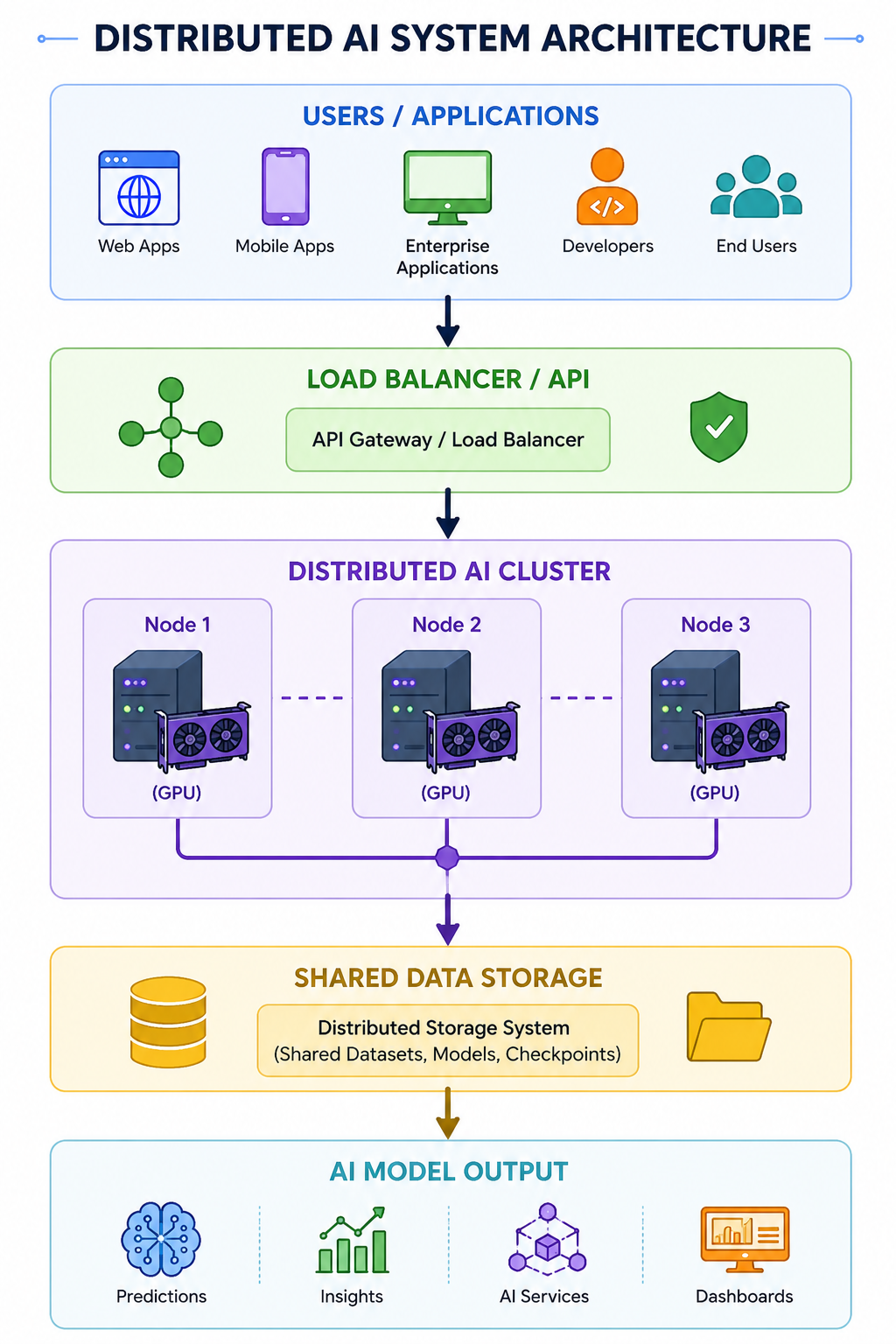
Modern distributed AI platforms typically follow a layered architecture that separates business logic, orchestration, computation, and data management. This modular design improves scalability, simplifies maintenance, and enables independent evolution of each layer.
Business Layer
The Business Layer provides AI capabilities to end users through applications, APIs, and intelligent services. It enables modular deployment, independent scaling, and simplified management of AI-powered applications.
Control Layer
The Control Layer coordinates distributed workloads by scheduling tasks, allocating computing resources, partitioning models, and ensuring efficient execution across multiple nodes.
Computing Power Layer
This layer performs the actual AI computation using CPUs, GPUs, TPUs, and AI accelerators. It manages distributed execution, parallel processing, and fault tolerance to maximize performance.
Data Layer
The Data Layer manages secure storage, distributed datasets, synchronization, and privacy-preserving mechanisms such as federated learning and differential privacy. It forms the foundation upon which distributed AI systems operate.
A successful distributed AI platform is not simply about connecting multiple machines—it is about intelligently coordinating compute, storage, networking, and AI models so they operate as one unified intelligent system.
Architecture of Distributed AI Systems
A distributed AI system follows a layered architecture where every layer performs a dedicated responsibility. Instead of relying on a single machine, intelligence is coordinated across multiple nodes that manage business logic, scheduling, computation, and secure data handling. This layered design improves scalability, resilience, and performance while simplifying enterprise AI deployment.
Acts as the interface between user-facing applications and AI services. It exposes AI capabilities as reusable microservices that can be independently deployed and scaled.
Coordinates task scheduling, resource allocation, model partitioning, and workload distribution across computing nodes.
Executes distributed AI workloads across CPUs, GPUs, and AI accelerators while optimizing parallel processing and fault tolerance.
Provides secure storage, synchronized access, privacy protection, and efficient transmission of enterprise data across distributed infrastructure.
How Distributed AI Systems Work
Distributed AI systems divide workloads among multiple nodes that process data simultaneously. Each node trains or performs inference independently before synchronizing model updates with the rest of the cluster. This coordinated execution enables massive scalability while maintaining model consistency.
Distributed Training Techniques
| Technique | Description |
|---|---|
| Data Parallelism | Replicates the same model across multiple nodes while each node processes a different batch of data. |
| Model Parallelism | Splits large models across multiple GPUs or servers where each node processes different layers. |
| Pipeline Parallelism | Executes different model stages simultaneously on separate computing nodes. |
| Federated Learning | Models are trained locally on edge devices while only model updates are shared with the central coordinator. |
Distributed AI vs Centralized AI
| Aspect | Centralized AI | Distributed AI |
|---|---|---|
| Data Movement | Data moves to compute | Compute moves to data |
| Latency | Higher | Lower |
| Privacy | Centralized datasets | Data remains local |
| Scalability | Limited by infrastructure | Near-linear scaling |
| Fault Tolerance | Single point of failure | Highly resilient |
Enterprise Use Cases
Distributed AI enables organizations to deploy intelligent systems across cloud environments, edge devices, and data centers. Instead of relying on a single centralized infrastructure, enterprises can distribute AI workloads wherever compute resources and data are available. This approach improves scalability, reduces latency, and supports real-time decision making across industries.
| Use Case | Business Value |
|---|---|
| Distributed AI Inference | Deploy LLMs across multiple GPU nodes for faster and scalable inference. |
| Multi-Agent Systems | Autonomous AI agents collaborate using MCP and A2A communication protocols. |
| Edge AI | Run inference close to IoT devices for low-latency intelligent applications. |
| Federated Learning | Train models across distributed datasets while preserving privacy. |
| Industrial Automation | Enable real-time AI decision making in manufacturing and smart factories. |
| Autonomous Systems | Coordinate AI across vehicles, drones, and robotic systems. |
Key Technologies Behind Distributed AI
Modern distributed AI platforms combine orchestration frameworks, AI libraries, communication protocols, and scalable infrastructure. Together, these technologies enable efficient model training, inference, monitoring, and collaboration across distributed environments.
| Technology | Purpose |
|---|---|
| Kubernetes | Container orchestration for AI workloads |
| PyTorch / TensorFlow | Distributed AI model training frameworks |
| NVIDIA NCCL | High-speed GPU communication |
| Ray | Distributed computing framework |
| Apache Spark | Large-scale distributed data processing |
| vLLM / SGLang | Distributed LLM inference engines |
| llm-d | Kubernetes-native distributed inference |
| Kubeflow | End-to-end MLOps platform |
| MCP | Standard protocol for AI agent communication |
| A2A | Google’s Agent-to-Agent collaboration protocol |
Challenges in Distributed AI
- Network Latency: Large model parameters and gradients require high-bandwidth, low-latency communication between distributed nodes.
- Data Synchronization: Cross-node dependencies require precise coordination and efficient communication strategies such as AllReduce.
- Fault Tolerance: Node failures should impact only the affected task rather than restarting the complete workflow.
- Security: Distributed AI systems must defend against prompt injection, malicious APIs, and unauthorized agent communication.
- Resource Management: Efficient scheduling of GPUs, CPUs, and network resources remains a major operational challenge.
- Organizational Complexity: Successful deployment requires infrastructure engineering, AI expertise, and operational maturity.
Distributed AI is not simply about connecting more machines. It requires intelligent orchestration, secure communication, efficient scheduling, and resilient infrastructure that allows AI models and agents to operate seamlessly across distributed environments.
Best Practices for Distributed AI Systems
Building successful distributed AI systems requires more than simply connecting multiple machines. Organizations should adopt proven engineering practices that improve scalability, reliability, observability, and operational efficiency while ensuring AI workloads remain secure and resilient.
- Adopt a Distributed-First Mindset – Design AI infrastructure assuming workloads will execute across multiple environments rather than a single centralized cluster.
- Leverage Kubernetes – Automate deployment, scaling, scheduling, and lifecycle management of distributed AI workloads.
- Implement Distributed Inference – Reduce latency and improve resource utilization by serving AI models across multiple compute nodes.
- Use Standard Communication Protocols – Adopt protocols like MCP and Google’s A2A to enable seamless collaboration between autonomous AI agents.
- Prioritize Observability – Continuously monitor GPU utilization, latency, throughput, resource consumption, and model health.
- Design for Fault Tolerance – Build automatic retry mechanisms, redundancy, checkpointing, and graceful recovery into every AI workflow.
Future Trends
Distributed AI continues to evolve rapidly as organizations move from experimental AI projects to production-scale intelligent systems. Several emerging technologies are shaping the future of enterprise AI infrastructure.
| Trend | Impact |
|---|---|
| Agentic AI | Autonomous AI agents collaborate across distributed environments to solve complex business problems. |
| Distributed Inference | Model serving becomes the default deployment strategy for enterprise AI. |
| Multi-Cloud AI | Organizations distribute workloads across multiple cloud providers to improve resilience and reduce vendor lock-in. |
| Decentralized Agent Registries | New standards simplify AI agent discovery, authentication, and collaboration. |
| Edge-to-Cloud Continuum | AI workloads move dynamically between edge devices and cloud infrastructure based on latency and resource requirements. |
How MHTECHIN Supports Distributed AI
Designing distributed AI infrastructure requires expertise in cloud computing, Kubernetes orchestration, AI engineering, networking, observability, and automation. MHTECHIN helps organizations build scalable distributed AI platforms that support enterprise workloads from strategy through production deployment.
- ✔ Distributed Infrastructure Design
- ✔ AI Agent Deployment & Integration
- ✔ Kubernetes-Based AI Orchestration
- ✔ Monitoring & Observability Solutions
- ✔ Performance Optimization
- ✔ Enterprise AI Consulting & Implementation
Conclusion
Distributed AI has become the foundation of modern enterprise artificial intelligence. As AI models continue to grow in complexity and organizations deploy intelligent services across cloud, edge, and on-premises environments, distributed architectures provide the scalability, resilience, and performance needed for production success.
Emerging technologies such as distributed inference, multi-agent collaboration, MCP, A2A, and edge-to-cloud computing are redefining how intelligent systems are built. Organizations that invest in distributed AI today will be better positioned to deliver faster, smarter, and more reliable AI-powered applications tomorrow.
Key Takeaways
- Distributed AI executes workloads across interconnected computing nodes.
- The model-follow-data approach minimizes data movement and improves efficiency.
- Distributed inference is becoming the standard for enterprise AI deployment.
- Key challenges include synchronization, latency, security, and resource management.
- Protocols like MCP and A2A enable collaboration between autonomous AI agents.
- Organizations adopting distributed AI gain scalability, resilience, and long-term flexibility.

Leave a Reply