Introduction
LLMOps focuses on operating AI reliably in cloud environments, while Edge AI Deployment enables intelligence directly on local devices. In reality, most enterprises require both—along with secure on-premises infrastructure—working together as one unified platform. This combination forms the foundation of Hybrid Cloud AI.
Rather than choosing between cloud and private infrastructure, organizations intelligently place workloads wherever they perform best. Latency-sensitive operations remain close to users, confidential data stays within enterprise boundaries, and compute-intensive AI tasks leverage cloud scalability whenever required.
What Is Hybrid Cloud AI?
Hybrid Cloud AI combines public cloud AI services, private on-premises infrastructure, and edge computing into a single coordinated architecture. Instead of processing every workload in one location, AI requests are intelligently routed to the environment that offers the best balance of performance, compliance, and cost.
Elastic compute, frontier AI models, burst capacity
Sensitive workloads, regulatory compliance, enterprise data
Low-latency inference close to users and connected devices
Why Hybrid Cloud AI Matters
Run steady AI workloads on owned infrastructure while using cloud GPUs only when additional capacity is required.
Keep confidential enterprise information inside private infrastructure while leveraging cloud AI where regulations permit.
Process AI close to users and devices for real-time decision making and improved customer experience.
Distribute workloads across environments to reduce downtime and improve resilience.
Utilize the latest cloud AI models while maintaining private enterprise infrastructure for mission-critical operations.
How Hybrid Cloud AI Works
Hybrid Cloud AI Architecture
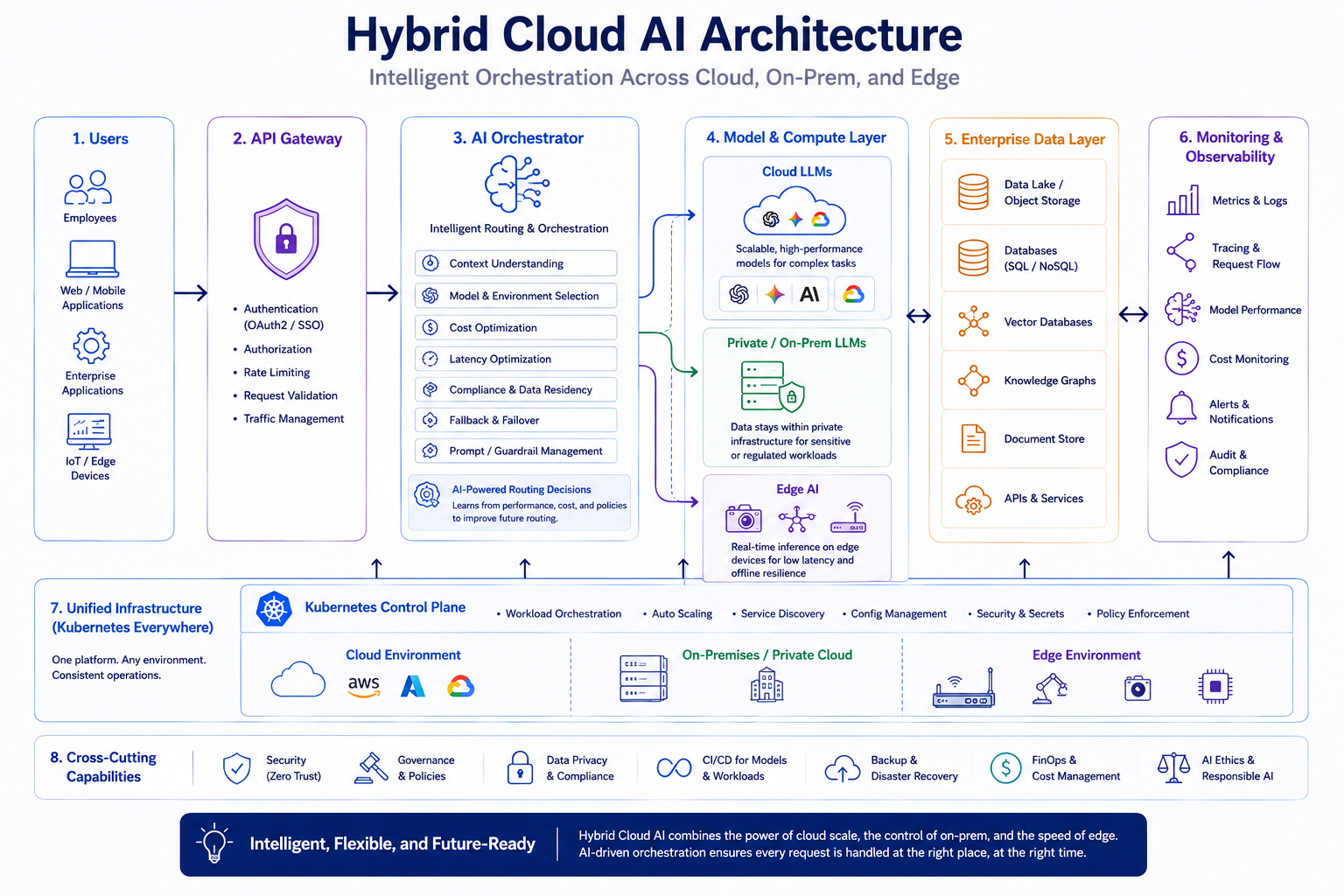
A modern Hybrid Cloud AI platform intelligently distributes AI workloads across cloud services, private infrastructure, and edge environments through a centralized orchestration layer. Instead of every request following the same path, the AI orchestrator evaluates latency, compliance, cost, and resource availability before selecting the optimal destination.
Unlike traditional deployments, Hybrid Cloud AI introduces an intelligent orchestration layer that dynamically routes AI requests based on workload sensitivity, compliance requirements, infrastructure availability, and operational cost.
Cloud AI vs On-Premises AI vs Hybrid Cloud AI
| Cloud AI | On-Premises AI | Hybrid Cloud AI |
|---|---|---|
| Elastic, pay-as-you-go compute | Fixed infrastructure capacity | Elastic cloud + owned infrastructure |
| Data leaves enterprise | Complete local control | Workload-specific data placement |
| Access to frontier AI models | Limited to local deployments | Best of both environments |
| Quick to deploy | Higher setup complexity | Most flexible at enterprise scale |
Enterprise Use Cases
Transaction data remains on-premises for compliance, while cloud GPUs retrain fraud detection models and synchronize updates back to production systems.
Patient imaging stays within hospital infrastructure while research, analytics, and model experimentation leverage secure cloud resources.
Factory-floor edge AI performs real-time quality inspection while centralized cloud analytics optimize operations across multiple facilities.
Edge AI enables inventory monitoring and loss prevention, while cloud AI forecasts demand across the complete retail network.
Sensitive workloads remain inside sovereign infrastructure while approved cloud AI services support citizen-facing applications.
Benefits of Hybrid Cloud AI
Allocate workloads to the most economical environment—steady workloads remain on owned infrastructure while burst workloads utilize cloud GPUs only when required.
Keep regulated or sensitive information inside private infrastructure while leveraging cloud AI services for non-sensitive processing.
Scale AI training and inference seamlessly by bursting into public cloud resources during peak demand without permanently over-provisioning infrastructure.
Distribute workloads across cloud, on-premises, and edge environments to improve resilience and minimize single points of failure.
Access both private AI infrastructure and frontier cloud AI models through one unified architecture, enabling the best execution environment for every workload.
Challenges of Hybrid Cloud AI
| Challenge | Impact |
|---|---|
| Orchestration Complexity | Managing workload placement across cloud, private infrastructure, and edge environments requires sophisticated orchestration. |
| GPU Utilization | Underutilized GPU infrastructure significantly increases the total cost of ownership. |
| Data Synchronization | Models, datasets, and configurations must remain synchronized across multiple environments. |
| Security & Governance | Consistent identity, compliance, and policy enforcement must span every deployment location. |
| Operational Complexity | Managing multiple cloud providers alongside on-premises infrastructure requires mature operational processes. |
Technologies Behind Hybrid Cloud AI
Best Practices
Determine which AI workloads require low latency, regulatory compliance, or burst cloud capacity before deciding where they should execute.
Deploy cloud, on-premises, and edge workloads through one orchestration layer to simplify operations.
Allow AI training and inference to expand into public cloud resources during peak demand instead of permanently over-provisioning infrastructure.
Maintain consistent security policies, monitoring, access control, and compliance across every environment.
Track infrastructure usage, GPU utilization, workload distribution, and operational costs to maximize ROI.
Future Trends in Hybrid Cloud AI
Future orchestration platforms will automatically decide whether workloads should execute in the cloud, on-premises, or at the edge by continuously optimizing for latency, compliance, cost, and available compute resources.
Organizations are increasingly building AI platforms that keep data and infrastructure within specific geographic or regulatory boundaries while still benefiting from modern AI capabilities.
Autonomous AI agents will increasingly operate across public cloud, private infrastructure, and edge devices, collaborating securely across multiple environments instead of remaining confined to a single platform.
Purpose-built AI infrastructure with high-density GPU clusters will support continuous model training, fine-tuning, and large-scale inference while integrating seamlessly into hybrid cloud architectures.
Hybrid AI platforms will increasingly distribute inference across edge devices and cloud infrastructure, enabling faster responses while reducing bandwidth requirements.
Future management platforms will provide centralized security, monitoring, policy enforcement, and compliance across every deployment environment from a single control plane.
How MHTECHIN Supports Hybrid Cloud AI
Building an effective Hybrid Cloud AI platform requires balancing cost, compliance, performance, and scalability across cloud, private infrastructure, and edge environments. Rather than treating these environments separately, MHTECHIN focuses on creating a unified AI architecture where every workload executes in its most suitable location.
Designing scalable AI platforms spanning cloud, on-premises, and edge environments.
Implementing intelligent workload routing, automation, and enterprise system integration.
Deploying Kubernetes-based AI platforms across hybrid environments with centralized management.
Providing unified observability, security policies, compliance, and operational visibility across every AI workload.
Conclusion
As AI workloads continue to grow in complexity, organizations increasingly require architectures capable of balancing latency, governance, and computational demand across multiple environments. Hybrid Cloud AI provides that foundation by connecting distributed infrastructure into one coordinated ecosystem.
With expertise in AI infrastructure, orchestration, cloud modernization, and enterprise integration, MHTECHIN helps organizations build secure, scalable, and production-ready Hybrid Cloud AI platforms that support long-term business growth.
Frequently Asked Questions (FAQs)
Hybrid Cloud AI combines public cloud, private infrastructure, and edge computing into one coordinated AI ecosystem.
Multi-cloud uses multiple cloud providers, whereas Hybrid Cloud AI integrates public cloud with private infrastructure and edge computing.
To optimize costs, improve regulatory compliance, reduce latency, and access both private and cloud-based AI resources.
Kubernetes acts as the unified orchestration platform for deploying and managing AI workloads consistently across hybrid environments.
Financial services, healthcare, manufacturing, retail, and government organizations benefit significantly from Hybrid Cloud AI deployments.
Related Reading in This Series
- 1. LLMOps
- 2. Edge AI Deployment

Leave a Reply