Introduction
Enterprise data is rarely centralized. It’s spread across databases, documents, CRMs, ERPs, APIs, and countless internal applications. Traditional search — including the vector and hybrid retrieval covered in this series — retrieves relevant documents, but it doesn’t explicitly understand how the entities inside those documents relate to one another.
Knowledge graphs address that gap. By organizing information into entities and the relationships between them, they let AI systems answer more complex questions and reason across multiple connected facts — something similarity-based retrieval alone consistently struggles with.
What Is a Knowledge Graph?
A knowledge graph is a structured representation of entities and the relationships between them.
Customer
   │
purchased
   │
Product
   │
manufactured by
   │
Company
Instead of information sitting in isolated records or documents, a knowledge graph makes the connections between those records explicit — so a system can traverse from a customer to a product to the company that made it, and reason across that chain rather than treating each fact independently.
Why Knowledge Graphs Matter
- Connected enterprise data — relationships that span multiple systems become explicit and queryable
- Better context — an entity’s meaning is enriched by everything it’s connected to, not just its own record
- Relationship-aware search — queries can follow connections, not just match similar text
- Explainable AI — a graph traversal shows exactly how an answer was derived, which is harder to demonstrate with pure similarity search
- Improved reasoning — multi-step, multi-hop questions become answerable rather than requiring several separate lookups
- Reduced duplicate information — entities are represented once and referenced from multiple contexts, rather than repeated across many documents
Why Businesses Are Exploring Knowledge Graph Integration
Organizations are increasingly investing in knowledge graph integration to unify disconnected enterprise data and improve AI-driven decision-making. By combining structured relationships with modern AI technologies, businesses can build more accurate search systems, support complex reasoning, and reduce information silos.
MHTECHIN helps organizations design AI architectures that integrate knowledge graphs with enterprise data, enabling intelligent search, GraphRAG, and relationship-aware AI solutions tailored to business needs.
How Knowledge Graph Integration Works
Enterprise data → Data extraction → Entity recognition → Relationship mapping → Knowledge graph → AI search / RAG / LLM → Response
Source data — documents, databases, APIs — is processed to extract entities (people, products, organizations, concepts) and the relationships between them, typically using LLMs for extraction from unstructured text. Those entities and relationships are stored as nodes and edges in a graph database, which can then be queried directly or used to ground retrieval for an LLM.
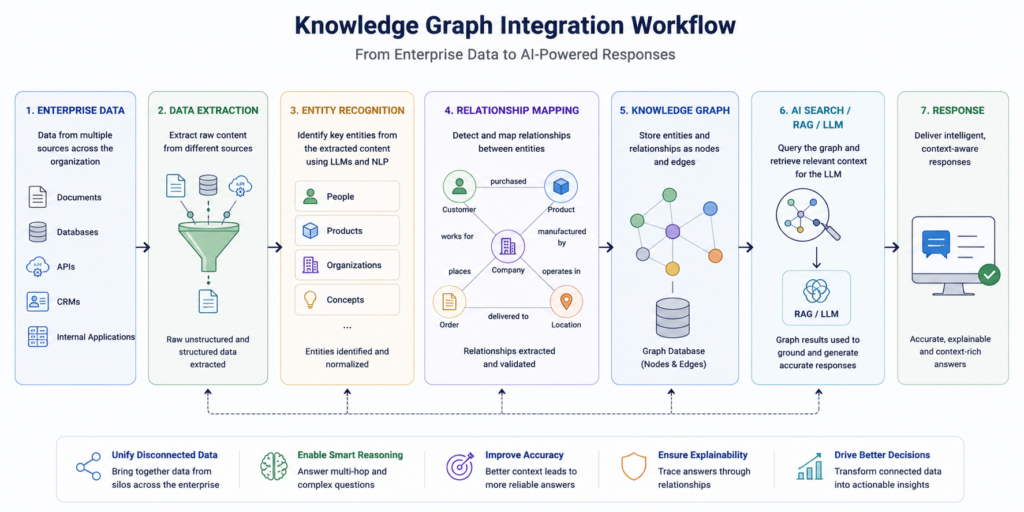
Core Components
- Data sources — the documents, databases, and systems the graph is built from
- Entity extraction — identifying the people, organizations, products, and concepts within source content
- Relationship extraction — identifying how those entities connect to one another
- Graph database — storing entities and relationships as nodes and edges
- Knowledge graph — the resulting structured network of connected information
- Query engine — enabling traversal and retrieval across the graph
- LLM integration — using graph-retrieved context to ground generated responses
- Monitoring — tracking graph quality, coverage, and staleness over time
Traditional Database vs. Knowledge Graph
| Traditional Database | Knowledge Graph |
|---|---|
| Stores tables | Stores entities & relationships |
| Best for transactions | Best for connected knowledge |
| SQL queries | Graph queries |
| Limited relationship discovery | Excellent relationship traversal |
| Structured records | Connected enterprise knowledge |
Knowledge Graph + RAG
This is where knowledge graphs and the rest of this series connect directly.
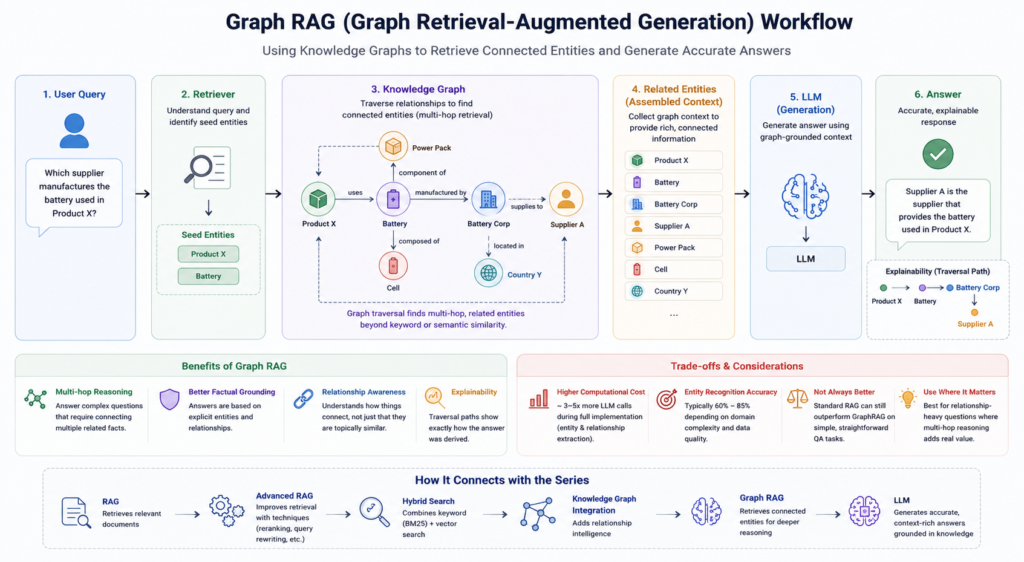
Traditional RAG retrieves documents that are textually or semantically similar to a query. Knowledge Graph RAG (often called GraphRAG) instead retrieves connected entities — following relationships across the graph to assemble context that answers questions spanning multiple facts, not just the single most similar passage.
This delivers a few distinct benefits over similarity-based retrieval alone:
- Multi-hop reasoning — answering questions that require connecting several related facts across different documents
- Better factual grounding — answers are traceable to explicit entities and relationships, not just similar-sounding text
- Relationship awareness — the system understands how things connect, not just that they’re topically related
- Explainability — a graph traversal path shows exactly how the system arrived at an answer
It’s worth being honest about the trade-off here: building a knowledge graph — particularly the entity and relationship extraction stage — is significantly more computationally expensive than standard vector RAG, commonly cited at 3 to 5 times the LLM calls at full implementation, with entity recognition accuracy typically landing somewhere between 60% and 85% depending on how domain-specific the content is. Lighter-weight approaches have emerged specifically to reduce this cost, and in some evaluated conditions, standard RAG still outperforms GraphRAG on straightforward question-answering tasks. GraphRAG isn’t a strict upgrade over vector RAG — it’s a different tool suited to relationship-heavy questions, best adopted where that trade-off clearly pays off.
Enterprise Use Cases
- Fraud detection — tracing suspicious relationships between accounts, transactions, and entities that isolated records wouldn’t reveal
- Supply chain — mapping dependencies across suppliers, components, and logistics partners
- Healthcare — connecting patient history, treatments, and outcomes across multiple systems
- Customer 360 — unifying a customer’s interactions, purchases, and support history into one connected view
- IT asset management — mapping dependencies between systems, applications, and infrastructure
- Recommendation systems — surfacing relevant products or content based on relationship patterns, not just similarity
- Compliance — tracing how policies, regulations, and business processes connect and depend on one another
- Cybersecurity — mapping relationships between users, systems, and access patterns to identify anomalies
Benefits
- Better search accuracy — retrieval that understands relationships, not just topic similarity
- Richer context — answers grounded in a connected web of facts rather than an isolated passage
- Explainable AI — traceable reasoning paths through the graph
- Better enterprise reasoning — support for genuinely multi-step questions
- Improved decision-making — decision-makers can see how conclusions were derived
- Reduced data silos — knowledge graphs connect information from multiple enterprise systems into a unified representation without requiring every application to share the same database.
- Data integration — a structured way to unify information scattered across many systems
- Better RAG quality — for relationship-heavy domains, more accurate grounding than similarity search alone
Challenges
- Building the graph — extraction and structuring require significant upfront engineering and, often, domain-specific prompt tuning
- Data quality — a knowledge graph is only as reliable as the source data and extraction accuracy feeding it
- Entity resolution — correctly identifying when different mentions refer to the same real-world entity is a genuinely hard problem
- Scalability — very large graphs introduce their own performance and query-complexity challenges
- Graph maintenance — relationships change as the business changes, and the graph needs ongoing updates to stay accurate
- Security — access to graph-derived answers needs to respect the same permissions as the underlying source data
- Governance — accountability for how relationships are defined, validated, and used needs clear ownership
Technologies
A number of established platforms and standards are used to build enterprise knowledge graphs:
- Neo4j — a widely used graph database, often considered a de facto standard in production GraphRAG deployments
- Amazon Neptune — supporting both property graph and RDF query models
- Azure Cosmos DB (Gremlin) — Microsoft’s graph database offering within Cosmos DB
- RDF — a standard model for representing data as subject-predicate-object relationships
- SPARQL — a query language for RDF-based graph data
- GraphQL — a query language commonly used to expose graph-structured APIs
- Apache Jena — an open-source framework for building RDF-based applications
- NetworkX — a Python library commonly used for graph analysis and prototyping
Organizations select graph technologies based on scale, existing infrastructure, and business requirements — there’s no single default choice that fits every enterprise context.
Best Practices
- Start with a clear business use case — a narrow, well-defined problem is far more tractable than an attempt at a comprehensive enterprise-wide graph from day one
- Define entity relationships carefully — the ontology (what counts as an entity, what relationships mean) shapes everything built on top of it
- Keep the graph updated — a stale graph produces increasingly unreliable relationship data over time
- Combine graph retrieval with vector search — knowledge graphs and vector-based RAG complement each other rather than replacing one another
- Apply governance — clear ownership over how the graph is built, validated, and maintained
- Monitor graph quality — track coverage, staleness, and extraction accuracy on an ongoing basis
- Validate relationships — extracted relationships, especially from unstructured text, benefit from spot-checking against source data before being trusted broadly
Future Trends
- Graph RAG — continuing to mature from an experimental technique into standard enterprise architecture
- Automated knowledge graph construction — LLMs are increasingly being used to identify entities and relationships automatically, reducing the manual effort required to build enterprise knowledge graphs.
- AI agents using knowledge graphs — agents querying graphs as one of several tools for grounding their reasoning
- Multimodal knowledge graphs — extending entities and relationships beyond text to images, tables, and other data types
- Real-time graph updates — reducing the lag between changes in source systems and changes reflected in the graph
- Graph neural networks (GNNs) — machine learning models designed to operate directly on graph-structured data
- Enterprise digital twins — connected, continuously updated representations of an organization’s systems and processes
Conclusion
Knowledge graphs complement — rather than replace — vector search, by making relationships explicit and enabling AI systems to answer more complex enterprise questions than similarity-based retrieval alone can handle. For many enterprises, the future isn’t choosing between vector search, hybrid retrieval, and knowledge graphs. It’s combining them—using vector search for semantic understanding, hybrid search for precise retrieval, and knowledge graphs for relationship-aware reasoning. Together, these technologies create AI systems that are more accurate, explainable, and capable of handling complex enterprise knowledge.
Frequently Asked Questions (FAQs)
1. What is a Knowledge Graph? A knowledge graph is a structured representation of entities and the relationships between them, allowing information to be traversed and reasoned over as a connected network rather than as isolated records.
2. How is a Knowledge Graph different from a database? Traditional databases store structured records optimized for transactions, typically queried with SQL. Knowledge graphs store entities and relationships explicitly, optimized for traversal and relationship discovery through graph queries.
3. What is Graph RAG? Graph RAG is a retrieval-augmented generation approach that retrieves connected entities from a knowledge graph, rather than relying solely on similarity-based document retrieval, to answer questions that require reasoning across multiple related facts.
4. Why are Knowledge Graphs useful for AI? They make relationships between pieces of information explicit and queryable, enabling multi-hop reasoning, more explainable answers, and better handling of questions that span multiple connected facts.
5. Which industries use Knowledge Graphs? Finance (fraud detection), healthcare, retail, supply chain, cybersecurity, and compliance-heavy industries are among the most common adopters, largely because these domains involve complex, interconnected relationships between entities.
6. Are Knowledge Graphs suitable for small businesses? They can be, but the extraction and maintenance overhead makes them most worthwhile when relationship-aware reasoning solves a clear, high-value business problem — starting with a narrow use case is generally more practical than a broad implementation.
7. What technologies are used to build Knowledge Graphs? Common options include graph databases like Neo4j, Amazon Neptune, and Azure Cosmos DB, standards like RDF and SPARQL, and tools like Apache Jena and NetworkX — the right choice depends on scale and existing infrastructure.
8. How do Knowledge Graphs improve enterprise search? By enabling search that follows relationships between entities, not just similarity between text — allowing systems to answer questions that require connecting multiple related facts across an organization’s data.

Leave a Reply