Introduction
Basic RAG — embed a query, search a vector database, pass the top matches to an LLM — is enough to meaningfully reduce hallucinations and ground responses in real data. But enterprise applications quickly run into its limits: complex queries, large and messy document collections, and accuracy requirements that a naive pipeline can’t consistently meet.
New to Retrieval-Augmented Generation (RAG)? Before exploring advanced optimization techniques, read our guide on introduction to Retrieval-Augmented Generation to understand the core concepts, architecture, and workflow. It assumes you already know what RAG is, why it matters, and how the basic pipeline works — and focuses entirely on the optimization techniques and advanced architecture.
Why Basic RAG Isn’t Always Enough
A naive “chunk → embed → cosine similarity → stuff into prompt” pipeline was always closer to a prototype than a production system. In practice, it runs into predictable failure modes:
- Irrelevant document retrieval — high similarity scores don’t always mean high relevance; two passages can be textually similar while serving completely different intents
- Missing context — a retrieved chunk can be technically accurate but meaningless without the surrounding context it was pulled from
- Long documents — naive chunking often splits paragraphs, tables, and arguments in ways that destroy their meaning
- Ambiguous queries — short, underspecified questions (“How do I reset it?”) give the retriever very little to work with
- Latency — retrieving too broadly, or running multiple retrieval passes, adds up in response time
- Duplicate information — large corpora often contain near-duplicate content across different documents, crowding out genuinely useful results
- Hallucinations despite retrieval — even with relevant context retrieved, a model can still ignore it or misapply it if the prompt isn’t constructed carefully
Hybrid Search
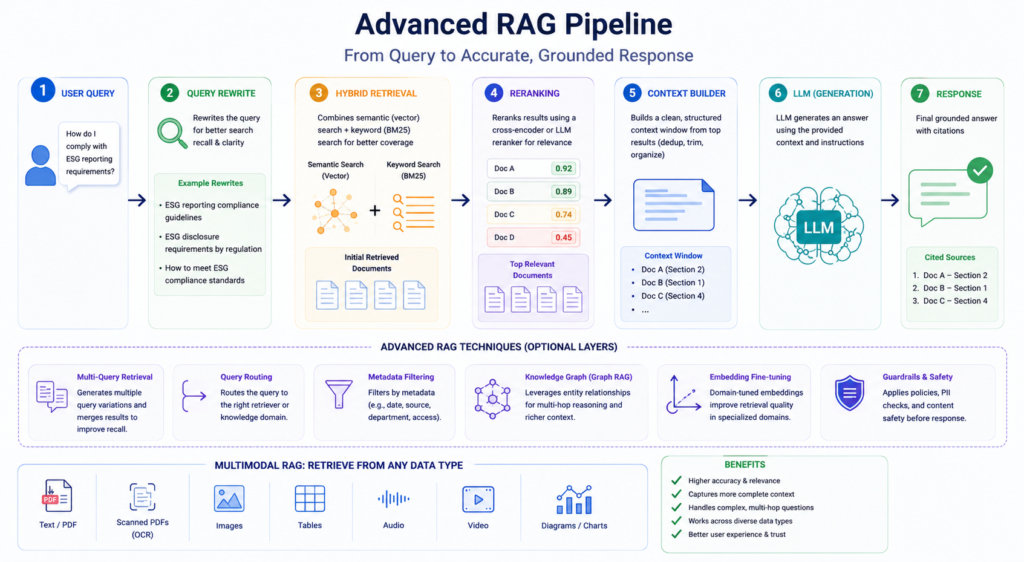
Hybrid search combines two complementary retrieval approaches:
- Semantic (vector) search — matches based on meaning, useful when a query and the relevant content use different wording for the same idea
- Keyword (BM25) search — matches based on exact term overlap, useful when precise terminology, product names, or codes matter more than paraphrased meaning
Semantic search alone can miss documents that use very specific, exact terminology the embedding model doesn’t weight heavily. Keyword search alone misses documents that express the same idea in different words. Combining both — then merging or reranking the results — consistently outperforms either approach used in isolation, which is why hybrid search has become close to a default expectation in production RAG rather than an advanced option.
Query Rewriting
Real user queries are often short, informal, and missing context that the retrieval system needs. Query rewriting uses an LLM to expand or clarify a query before it’s sent to the retriever.
Example: User query: “How do I reset it?” Rewritten query: “How do I reset my enterprise VPN password?”
The rewritten version gives the retriever far more to match against, particularly when the original query relies on conversational context the retriever doesn’t have access to.
Reranking
Initial retrieval — whether semantic, keyword, or hybrid — typically pulls back a broad candidate set, often 20 to 50 documents, prioritizing recall over precision. A reranker then reorders that candidate set using a more computationally expensive but more accurate relevance model, and only the top handful are passed to the LLM.
This two-stage approach — cast a wide net, then rerank for precision — is one of the most consistently effective upgrades to a basic RAG pipeline, and it pairs particularly well with the chunking improvements below.
Contextual Chunking
How a document is split into retrievable pieces has an outsized effect on retrieval quality — one analysis found that chunking strategy alone can swing recall by close to 9% on the same corpus. Several approaches are commonly used:
- Fixed-size chunks — simple, fast token-based splitting; a common default is in the 512–1024 token range
- Semantic chunks — splitting at natural meaning boundaries rather than a fixed token count; more accurate but significantly slower to compute at scale
- Section-based chunks — following a document’s existing structure (headers, sections) to keep related content together
- Hierarchical chunks — retrieving at a coarse level first, then drilling into finer detail within the relevant section
A related technique, contextual retrieval, prepends a short generated summary to each chunk before it’s embedded, so the chunk carries context about where it came from even in isolation. Anthropic’s published research on this technique found it reduced retrieval failures by 49% on its own, and by 67% when combined with reranking — one of the more substantial, well-documented gains available in this space, though it does require an additional processing step during ingestion.
The general lesson: chunking and retrieval method should be tuned together, not chosen independently — changing one often means revisiting the other.
Multi-Query Retrieval
Rather than sending a single query to the retriever, multi-query retrieval expands one question into several related queries, runs them in parallel, and merges the results — improving recall on queries that could reasonably be interpreted or phrased several different ways.
Example: Original query: “AI deployment” Expanded into:
- Enterprise AI deployment
- AI production deployment
- MLOps deployment
- AI infrastructure
This is particularly useful for broad or ambiguous queries where a single retrieval pass is likely to miss relevant content that uses different terminology.
Agentic RAG — covered at a high level in our earlier RAG guide — takes retrieval a step further by giving an AI agent control over the retrieval process itself. Instead of a single fixed retrieval step, the agent can:
- decide what to retrieve, and from which source
- call multiple tools or knowledge bases as needed
- refine or reformulate its search based on what it finds
- iterate until it has gathered enough evidence to answer confidently
This pattern is best suited to complex, multi-step workflows and cross-system reasoning — for straightforward enterprise search, hybrid retrieval with reranking is often sufficient and considerably cheaper to run.
Graph RAG
Graph RAG layers a knowledge graph on top of retrieval, explicitly capturing relationships between entities rather than treating each chunk as an isolated piece of text. This enables multi-hop reasoning — answering questions that require connecting information across multiple related documents or entities, which similarity-based retrieval alone tends to miss. It’s a higher-investment approach than hybrid or basic RAG, generally reserved for domains where relationship-aware reasoning delivers a clear return, such as complex compliance, research, or investigative use cases.
Enterprise knowledge isn’t only text. Multimodal RAG extends retrieval to: PDFs (including scanned or image-based documents), Images, Tables, Audio, Video
This is a fast-growing area of enterprise AI, particularly for industries where critical information lives in diagrams, scanned forms, recorded calls, or video documentation rather than clean text.
Best Practices
- Clean and organize documents — retrieval quality is capped by source quality; no technique fully compensates for messy, outdated, or poorly structured content
- Choose an appropriate chunk size — start from a well-tested default (commonly in the 512–1024 token range) and adjust based on measured retrieval performance, not intuition
- Evaluate retrieval quality directly — measure whether the right documents are being retrieved, separately from whether the final answer sounds good
- Monitor latency — especially for hybrid, multi-query, or agentic pipelines, where added retrieval steps compound response time
- Apply access controls at the retrieval layer — permissions need to be enforced before content is retrieved, not just at the interface
- Keep embeddings updated — stale indexes reintroduce the same staleness problem RAG was meant to solve
- Test with real user queries — production query patterns are often messier and more ambiguous than the queries used during development
Basic RAG vs Advanced RAG
| Basic RAG | Advanced RAG |
|---|---|
| Uses a single vector search to retrieve documents. | Combines techniques like Hybrid Search, Agentic RAG, Graph RAG, and reranking for improved retrieval. |
| Relies on fixed-size chunking and the original user query. | Uses contextual chunking, query rewriting, and multi-query retrieval for better relevance. |
| Best suited for simple Q&A and small knowledge bases. | Designed for complex enterprise search, large document repositories, and multi-step reasoning. |
| Easy to implement with lower cost and complexity. | Requires additional optimization and infrastructure but delivers higher accuracy and reliability. |
| Ideal for prototypes and proof-of-concept applications. | Built for production-grade AI systems requiring scalability, governance, and enterprise performance. |
Future Trends
- Self-improving retrieval — systems that learn from retrieval failures and successes over time
- Adaptive chunking — chunking strategies that adjust dynamically based on document type and query patterns rather than a single fixed approach
- Agentic RAG — continued growth as the default pattern for complex, multi-step enterprise workflows
- Graph-enhanced retrieval — wider adoption wherever relationship-aware reasoning justifies the added complexity
- Multimodal enterprise search — retrieval spanning text, images, tables, audio, and video as a standard capability rather than a specialized add-on
- Personalized retrieval — retrieval that accounts for a user’s role, history, or context, not just the query itself
Conclusion
Advanced RAG techniques extend basic retrieval by improving relevance, precision, and enterprise readiness — turning a working prototype into a system that holds up against messy real-world documents, ambiguous queries, and strict accuracy requirements. None of these techniques are mutually exclusive; most production-grade enterprise RAG systems combine several — hybrid search, reranking, and well-designed chunking as a strong baseline, with agentic or graph-based retrieval layered in where the workflow genuinely calls for it.
Frequently Asked Questions (FAQs)
1. What are Advanced RAG Techniques? Advanced RAG techniques are optimization strategies — such as hybrid search, reranking, contextual chunking, query rewriting, and agentic or graph-based retrieval — that improve on basic RAG’s accuracy, relevance, and reliability for enterprise use.
2. What is Hybrid RAG? Hybrid RAG combines semantic (vector) search with keyword (BM25) search, so retrieval captures both conceptually related content and content that shares exact terminology with the query.
3. What is reranking? Reranking is a second-stage step where a broader set of initially retrieved documents is reordered by a more accurate relevance model, so only the most genuinely relevant results are passed to the LLM.
4. Why is query rewriting useful? Because real user queries are often short or ambiguous. Rewriting expands or clarifies a query before retrieval, giving the system more to match against and improving the relevance of what’s retrieved.
5. What is contextual chunking? Contextual chunking refers to splitting documents in ways that preserve meaning — by section, semantic boundary, or hierarchy — and can include prepending short context summaries to each chunk before embedding, which published research has shown meaningfully reduces retrieval failures.
6. How does Graph RAG differ from traditional RAG? Traditional RAG retrieves based on similarity between isolated chunks. Graph RAG adds a knowledge graph layer that captures relationships between entities, enabling multi-hop reasoning across connected information.
7. What is Multimodal RAG? Multimodal RAG extends retrieval beyond text to include images, tables, audio, and video, allowing AI systems to draw on enterprise knowledge that isn’t stored as clean text.
8. Which RAG technique should enterprises start with? For most enterprise search use cases, hybrid search combined with reranking delivers a strong accuracy improvement at moderate cost and complexity. Agentic and graph-based retrieval are generally best reserved for workflows that specifically require multi-step reasoning or relationship-aware retrieval.

Leave a Reply