
SEO Title: AI Coding Assistants 2026: Complete Guide & Top Tools
Meta Title: AI Coding Assistants 2026: Top Tools & Complete Guide
Meta Description: The ultimate 2026 guide to AI coding assistants. Compare GitHub Copilot, Cursor, Claude Code, & more. Learn how AI boosts developer productivity by up to 55%.
URL Slug: /ai-coding-assistants-guide-2026
Focus Keyword: AI Coding Assistants
Secondary Keywords: best AI coding assistant, AI code generator, GitHub Copilot alternative, AI for developers, enterprise AI coding, AI programming tools, AI software development, AI developer tools, coding AI
Search Intent: Commercial & Informational. Users are researching AI coding tools to decide which assistant best fits their workflow, team size, budget, and security requirements.
==========================
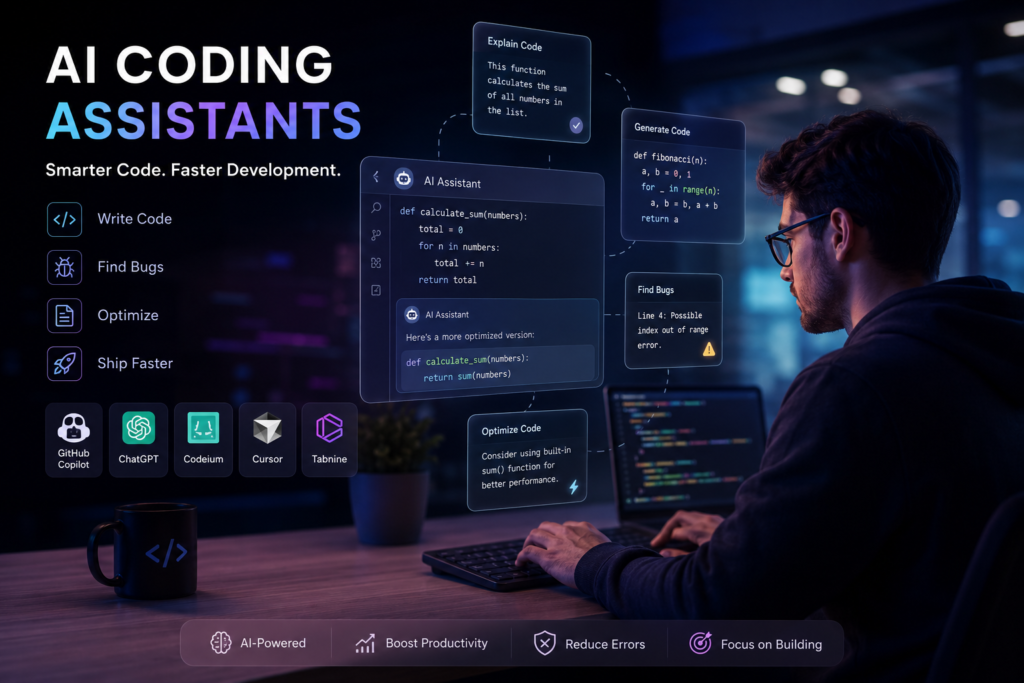
IMAGE PLACEHOLDER – HERO BANNER
Title: AI Coding Assistant in Action – 2026 Workspace
Prompt for AI Image Generator: “A futuristic software engineer using an AI coding assistant inside VS Code, holographic code suggestions, blue neon UI, cinematic lighting, ultra-realistic, enterprise workspace, 16:9”
Alt Text: AI Coding Assistant Workspace 2026
==========================
AI Coding Assistants: The Complete 2026 Guide to Smarter Software Development
By [Author Name] • Updated July 2026 • 14 min read
Let’s cut through the noise. AI coding assistants aren’t just hype. They are actively reshaping how software gets built. By 2028, Gartner predicts over 70% of enterprise software engineers will rely on AI coding agents for their daily work.
But with dozens of tools—from GitHub Copilot to Cursor, Claude Code, and open-source alternatives—choosing the right one is overwhelming. Many developers are already using them. The Stack Overflow 2025 Developer Survey found that 84% of developers are using or plan to use AI tools, with 50.6% of professional developers using them daily.
This guide is your complete, unbiased blueprint. We’ll cover how they work, the top players in 2026, real-world use cases, prompt engineering techniques, security risks, and enterprise adoption strategies. Whether you’re a solo developer, a CTO, or a student, you’ll find actionable insights to make smarter decisions.
Table of Contents
- What Are AI Coding Assistants?
- How AI Coding Assistants Work
- History & Evolution
- Top AI Coding Assistants in 2026
- Real-world Use Cases
- Enterprise & Industry Use Cases
- Best Prompt Engineering Techniques
- Productivity Tips for Developers
- Common Mistakes to Avoid
- Security Risks & Governance
- AI Hallucinations & Reliability
- Best Practices & Workflow Integration
- Enterprise Adoption Strategy
- Future Trends
- Career & Salary Insights
- Frequently Asked Questions
- Expert Conclusion
1. What Are AI Coding Assistants?
In simple terms, AI coding assistants are tools that leverage large language models (LLMs) to help you write, debug, and understand code. They act as an intelligent pair programmer available 24/7.
They fall into two main categories:
AI Code Assistants: These tools work alongside you, providing suggestions, autocompleting code, and answering questions in a chat interface. GitHub Copilot is the classic example. You stay in the driver’s seat, and the AI offers support.
AI Coding Agents: This is the next evolution. Agents can operate autonomously or semi-autonomously. Given a goal, they can plan, write code across multiple files, run tests, and iterate without continuous guidance. Claude Code and Cursor’s Agent Mode are prominent examples.
Quick Summary:
- What: Software that uses AI to assist with coding.
- Why: To accelerate development, reduce bugs, automate repetitive tasks, and help developers focus on complex problems.
- How: By using models trained on vast amounts of public code and natural language.
KEY TAKEAWAYS
- AI coding tools are rapidly being adopted by the majority of software developers.
- Assistants help; agents work. Both are critical for understanding the 2026 landscape.
- These tools are part of a shift toward human-AI collaboration, not a replacement for human developers.
2. How AI Coding Assistants Work
The magic behind these tools is fascinating and complex. Let’s break down the key technologies:
Large Language Models (LLMs): At the heart of every AI coding assistant is an LLM trained on a massive dataset of public code and text. Think of it as a supercharged autocomplete that understands context, syntax, and even purpose. Models like OpenAI’s GPT, Anthropic’s Claude, and Google’s Gemini power many of these tools.
Context Windows: This is the “memory” of the model. A context window is the amount of text (tokens) the model can consider at once. Larger windows (like Gemini 1.5 Pro’s 2 million tokens) allow the AI to process entire codebases, documentation, or a long conversation history, leading to more coherent and accurate suggestions.
Embeddings: These are numerical representations of words, code, and concepts. They allow the model to understand semantic meaning and relationships. Embeddings help the AI find relevant code examples or documentation, even if the exact keywords aren’t used.
Retrieval-Augmented Generation (RAG): RAG is a critical technique for grounding the AI in your specific project. Instead of relying only on its training data, the AI can access a knowledge base of your private codebase, internal libraries, and documentation to generate more relevant and accurate responses.
Function Calling & Tool Calling: This allows the AI to go beyond generating text. It can interact with external systems, execute commands, access APIs, and use tools. When an AI agent runs tests or searches your codebase, it’s using function calling.
Model Context Protocol (MCP): MCP is a recent standardization from Anthropic that provides a unified way for AI models to access tools and context. With MCP, an AI agent can more seamlessly integrate with databases, files, APIs, and development environments.
==========================
IMAGE PLACEHOLDER – ARCHITECTURE DIAGRAM
Title: How AI Coding Assistants Work
Prompt for AI Image Generator: “An infographic illustrating the architecture of an AI coding assistant, showing a developer’s IDE connected to an LLM via API, with RAG pipeline pulling context from a private codebase and MCP connected to external tools, clean and modern, 16:9”
Alt Text: Architecture Diagram of AI Coding Assistant
==========================
KEY TAKEAWAYS
- LLMs are the brains, but RAG, context windows, and MCP make them useful for real codebases.
- Agents use function calling to perform actions, not just suggest text.
- Understanding these concepts helps you choose the right tool for your needs.
3. History & Evolution
The journey from simple autocomplete to autonomous agents has been rapid.
2018: Tabnine launches as an AI code completion tool, pioneering the use of machine learning for coding.
2021: GitHub Copilot is released, bringing AI-powered pair programming to the mainstream. It’s a seismic shift in the developer experience, using OpenAI’s Codex model.
2022-2023: The rise of ChatGPT and the proliferation of LLMs spark massive investment and innovation. Amazon CodeWhisperer (now Amazon Q), Google Cloud’s Duet AI, and others enter the fray.
2024: The shift to agents begins. Cursor and Windsurf reimagine the IDE with AI at its core. Claude Code is launched, showcasing autonomous, agentic workflows. The term “vibe coding” gains popularity, describing the practice of describing what you want to the AI and accepting its output.
2025-2026: The era of enterprise AI coding agents. Gartner publishes its first Magic Quadrant for the category. Standardization like MCP emerges. The focus shifts to governance, security, and measuring ROI. AI now writes as much as 30% of Microsoft’s code and more than a quarter of Google’s.
==========================
IMAGE PLACEHOLDER – TIMELINE
Title: Timeline of AI Coding Assistants
Prompt for AI Image Generator: “A futuristic, sleek timeline infographic showing key milestones from 2018 to 2026, with icons for Tabnine, Copilot, Cursor, and Gartner’s Magic Quadrant, modern minimal design, 16:9”
Alt Text: Timeline of AI Coding Assistants from 2018 to 2026
==========================
KEY TAKEAWAYS
- The technology has matured from simple completion to complex, autonomous agents.
- Enterprise adoption and governance are now major themes.
- The pace of change is expected to continue accelerating.
4. Top AI Coding Assistants in 2026
Choosing the right assistant is critical. This comparison is based on hands-on experience, deep research, and Gartner insights to give you a clear, balanced view.
Benchmarks matter: One key metric is the SWE-bench Verified score. This benchmark tests an AI’s ability to resolve real-world GitHub issues. Anthropic’s Claude Sonnet 4.5 is currently state-of-the-art at 77.2%.
Detailed Comparison Table
Other Notable Tools:
- OpenAI Codex: Included with ChatGPT paid plans. An agent that runs locally and in the cloud, good for delegating tasks to a sandboxed agent.
- Continue: An open-source IDE extension that lets you bring your own model. Great for teams wanting full control.
- Aider: An open-source terminal-based tool for pair programming with AI. Used in many benchmarks.
- Replit: A browser-based platform ideal for beginners and rapid prototyping. Its “Agent” can build full-stack apps from natural language.
Expert Insight: “Back-end and web app developers prefer AI-enabled IDEs like Cursor and Windsurf. GitHub Copilot is the least preferred because it is ‘just’ a plugin. For users who work on terminals more often… Claude Code is the best tool.” – Principal Enterprise Architect
==========================
IMAGE PLACEHOLDER – COMPARISON MATRIX
Title: Feature Comparison Matrix of AI Coding Assistants
Prompt for AI Image Generator: “A clean, modern comparison matrix (like a Gartner Magic Quadrant) comparing AI coding assistants on x-axis ‘Ability to Execute’ and y-axis ‘Completeness of Vision’, with leading tools placed appropriately, professional and business style, 16:9”
Alt Text: Gartner-style Comparison Matrix of AI Coding Assistants
==========================
KEY TAKEAWAYS
- Copilot is the safe, default choice.
- Cursor and Windsurf are the future of the IDE.
- Claude Code is the smartest agent for complex tasks.
- Gemini is the best free option for individuals.
- Tabnine is the king of privacy and security.
5. Real-world Use Cases
AI coding assistants are not just for writing new code. They are versatile tools that can augment nearly every aspect of the software development lifecycle.
Software Engineering (General):
- Boilerplate Generation: Instantly create the scaffolding for a new project. (Example: “Generate a REST API for a blog using Node.js and Express.”)
- Code Summarization: Understand legacy or third-party code quickly. (Example: “Explain what this Python function does.”)
- Code Refactoring: Modernize or clean up messy code. (Example: “Convert this callback-based JavaScript function to use async/await.”)
Testing:
- Unit Test Generation: Automatically write tests for your functions, often a tedious but critical task.
- Test Remediation: Fix broken tests when code changes. (Example: “Fix these unit tests that are failing after the API endpoint change.”)
Debugging & Code Review:
- Error Explanation: The AI can explain cryptic error messages and suggest fixes.
- AI-Assisted Code Review: Identify bugs, performance issues, and security vulnerabilities in pull requests before a human reviews them.
Documentation:
- API Documentation: Generate docs for your API endpoints.
- In-line Comments: Add meaningful comments to complex functions. (Example: “Add docstrings to this Java class explaining its purpose and methods.”)
DevOps & Cloud:
- Infrastructure as Code (IaC): Write Terraform or CloudFormation templates. Amazon Q is particularly strong here.
- CI/CD Pipelines: Generate and troubleshoot build and deploy scripts.
Data Science:
- Data Analysis Scripts: Write Pandas or NumPy code to explore and analyze datasets.
- Machine Learning Pipelines: Generate code to create, train, and evaluate models.
Mobile App Development:
- Cross-Platform Generation: Ask for a login screen for a React Native or Flutter app.
Web Development:
- Full-Stack Generation: Prompt-to-app tools like Replit can build entire working applications.
- Responsive UI: Write HTML, CSS, and JavaScript for complex UI components.
KEY TAKEAWAYS
- These tools are useful across the entire development lifecycle—not just code creation.
- They excel at automation, documentation, and error analysis.
- The most effective use is often as a force multiplier, allowing developers to focus on high-level design and architecture.
6. Enterprise & Industry Use Cases
Different industries have different needs and constraints.
Large Companies: Enterprises are adopting AI coding agents at scale but with strict governance. They require tools like ONES.com to manage projects and provide guardrails, preventing fragmented codebases and technical debt. They invest in code customization, where the AI learns from the company’s private repos. By 2028, asynchronous AI coding agent workflows are expected to improve productivity by 30-50%.
Startups: Startups are embracing “vibe coding” for rapid prototyping. Tools like Replit and Cursor allow small teams to build and iterate on MVPs incredibly fast, often with less experienced developers or even founders who aren’t full-time engineers.
Government & Healthcare: These sectors prioritize data sovereignty and privacy. Tabnine, with its on-premises and air-gapped deployment options, is a leading choice. They also need to ensure AI outputs comply with strict regulations (HIPAA, GDPR, etc.).
Education: AI coding assistants are transforming how students learn. They can serve as a tutor, providing instant feedback and explanations. However, educators need to be aware of and teach about hallucinations and the importance of foundational knowledge.
Finance: Security and compliance are paramount. AI assistants are used for generating secure code, automating complex financial calculations, and rigorous testing. Alibaba Cloud’s Qoder, with its “Experts Mode,” is an example of an agent being used for such advanced multiagent orchestration in verticals like banking.
KEY TAKEAWAYS
- Enterprise adoption is about governance, control, and ROI.
- Startups prioritize speed and innovation.
- Regulated industries demand security, privacy, and compliance.
7. Best Prompt Engineering Techniques (with 20+ Prompts)
The quality of an AI’s output is directly related to the quality of your input. Prompt engineering is a vital skill.
Golden Rules:
- Be Specific: “Write a function” is less effective than “Write a Python function that takes a list of strings and returns a dictionary with the frequency of each string, using a functional programming style.”
- Provide Context: Include code snippets, file structures, or explain the wider architecture.
- Define the Role: “Act as a senior security engineer and review this code for vulnerabilities.”
- Give Examples: Few-shot prompting can dramatically improve accuracy.
- Set Constraints: Specify the programming language, format, or style.
20+ Practical Prompts You Can Use Today:
Code Generation:
- “Generate a Python class for a
Userobject with attributesid,name,email, and a method to save the user to a PostgreSQL database. Useasync/awaitandSQLAlchemy.” - “Write a JavaScript function that validates an email address using a regex.”
- “Create a Java Spring Boot REST controller for a
Productresource with standard CRUD operations.” - “C#: Write a LINQ query to filter a list of orders by date and total amount.”
Testing:
- “Write unit tests using
pytestfor the following Python function. Test for success cases, edge cases (empty input, null values), and failures.” [Paste your function] - “Generate a postman collection JSON for testing the
/api/usersendpoint.”
Code Explanation & Review:
- “Explain this code as you would to a junior developer.”
- “Review this code for security vulnerabilities (SQL injection, XSS, hardcoded secrets) and style issues.” [Paste your code]
- “Simplify this complex
if-elseladder into a more readable format.” [Paste your code]
Debugging:
- “I’m getting a
NullReferenceExceptionin this C# code. Find and fix the bug.” [Paste your code] - “Analyze this stack trace and help me find the root cause of the error.” [Paste the stack trace]
Documentation:
- “Write Javadoc for this Java method.” [Paste your method]
- “Create a
README.mdfile for this project. Include sections for installation, usage, and contributing guidelines.” [Paste your project structure] - “Add explanatory comments to this legacy JavaScript code.” [Paste your code]
Refactoring & Modernization:
- “Refactor this old
jQuerycode to use modern vanilla JavaScript.” - “Convert this Python 2 code to Python 3.”
- “Rewrite this Node.js code to use TypeScript with proper types.” [Paste your code]
DevOps & Cloud:
- “Generate a Dockerfile for a Node.js application.”
- “Write a GitHub Actions workflow to build, test, and deploy this code to AWS S3.”
- “Write a Terraform script to provision an AWS EC2 instance with a security group allowing SSH and HTTP access.”
Planning & Architecture:
- “Create a high-level technical design for a simple chat application. Outline the architecture, API structure, and database schema.”
Best Practice: Use a project-level context file (e.g., CLAUDE.md for Claude Code) to define coding standards and project constraints that the AI will automatically use.
KEY TAKEAWAYS
- Quality input = quality output.
- Be specific, provide context, and define the role.
- Use prompts for a wide range of tasks beyond just writing code.
8. Productivity Tips
- Learn Keyboard Shortcuts: Master the keybindings for your chosen assistant. For example,
Control+Iin VS Code for Gemini Code Assist. - Use Agent Mode for Big Tasks: For multi-file edits, use the agent mode in Cursor or Claude Code rather than trying to do it manually.
- Review Before Accepting: Always review the AI’s suggestion before accepting it. Cursor’s diff view makes this easy.
- Maintain a Context File: Keep a file at the root of your project that outlines coding standards for the AI to follow.
- Integrate Into CI/CD: Use terminal-based assistants like Claude Code or Codex CLI to automate tasks in your build pipelines.
9. Common Mistakes to Avoid
- Trusting Without Review: Just because the AI generated code doesn’t mean it’s correct. It can be syntactically perfect but functionally wrong or insecure.
- Over-Reliance: Don’t use AI as a crutch. You need to understand the fundamentals. “AI tools also struggle with large, complex code bases.”
- Ignoring Context: Failing to provide enough context leads to low-quality, irrelevant suggestions. Maintain a context file to help the AI ‘remember’ project standards.
- Not Updating Standards: Your coding standards should be a living document, updated as the project evolves and the AI learns.
10. Security Risks & Governance
This is the most critical topic for enterprise adoption. AI coding tools introduce new risks.
Risks:
- Data Leakage: Sensitive code, API keys, or customer data can be sent to the AI provider’s servers.
- Code Vulnerabilities: AI models can generate insecure code, like SQL injection flaws, or use outdated libraries with known CVEs.
- Context Amnesia: LLMs don’t learn continuously. They can “forget” earlier requirements, leading to contradictory implementations.
- License Compliance: AI might generate code that is too similar to open-source licensed code, creating IP risks.
Governance Strategies:
- Code Review: Never bypass the human code review process. AI-generated code must be scrutinized by a human.
- CI/CD Enforcement: Use static analysis, security scanning, and automated tests in your pipeline to catch vulnerabilities introduced by AI.
- Deployment Flexibility: Choose tools that offer VPC or on-premises deployments to keep data secure (like Tabnine).
- Standardization: Standardize on a specific model version to manage costs and maintain consistency.
- Spec-Driven Workflows: Define detailed technical specs before engaging the AI agent. This prevents the AI from making arbitrary architectural decisions.
==========================
IMAGE PLACEHOLDER – SECURITY GOVERNANCE DIAGRAM
Title: Security Governance for AI Coding
Prompt for AI Image Generator: “An infographic flowchart showing a spec-driven development workflow with an AI agent, followed by human review, CI/CD checks for security, and finally deployment, with a clear ‘Guardrails’ section, professional and clear, 16:9”
Alt Text: Security Governance Workflow for AI Coding
==========================
KEY TAKEAWAYS
- AI security is not optional; it’s a mandatory part of adoption.
- Never skip human review.
- Use CI/CD and static analysis as automated guardrails.
11. AI Hallucinations & Reliability
AI models are designed to be helpful, not accurate. This leads to “hallucinations”—generating code that is confidently incorrect, uses non-existent libraries, or creates a plausible but buggy function.
How to Mitigate:
- Always Test: Unit tests are your best defense. If the AI writes a test that passes but is flawed, you need to catch it.
- Use a Validation Module: Some tools integrate validation to check for syntactic and semantic correctness.
- Be Skeptical: Approach AI output with a healthy dose of skepticism. Verify it. Read the official documentation for any libraries it suggests.
12. Best Practices & Workflow Integration
To maximize the benefit of AI coding assistants, integrate them thoughtfully into your workflow.
- Start with a Pilot: Don’t roll out an AI tool to your entire engineering organization on day one. Start with a small, enthusiastic team to test the waters.
- Establish Guardrails: Define clear guidelines on what the AI can and cannot do. Create a shared
CLAUDE.mdor similar context file for standards. - Train Your Team: Teach developers how to prompt effectively and how to review AI-generated code.
- Automate Quality Checks: Use CI/CD to run tests and security scans on every AI-generated change.
- Measure ROI: Track how the tool impacts developer productivity and code quality. Gartner suggests asynchronous agent workflows will boost productivity by 30-50% by 2028.
13. Enterprise Adoption Strategy
Adopting AI at scale is a strategic project.
- Executive Sponsorship: Get buy-in from the CTO and other leaders.
- Cross-Functional Team: Involve developers, security, legal, and IT operations.
- Focus on Outcomes: Don’t just say “we are using AI.” Measure success through faster delivery cycles and improved developer satisfaction.
- Avoid Long-Term Lock-in: The market is moving fast. Gartner advises to “not go into long-term commitments with the tools vendor. Expect more developments in the coming years.”
14. Future Trends
The next few years will be transformative.
- IDEs Will Become Optional: Gartner predicts that by 2027, over 65% of engineering teams using agentic coding will treat IDEs as optional, moving control to automated platforms.
- Asynchronous Workflows: AI agents will work in the background on complex tasks like large-scale refactors and vulnerability patching, operating without constant developer input.
- Cost Management: By 2028, AI coding costs could overtake the average developer’s salary due to token consumption. FinOps and cost controls will be essential.
- Multiagent Orchestration: Agents will collaborate, with specialized agents for planning, coding, and testing.
- Democratization of Coding: Tools like Replit will continue to lower the barrier to entry, enabling more people to build software.
==========================
IMAGE PLACEHOLDER – FUTURE TRENDS INFOGRAPHIC
Title: Future of AI Coding: 2026-2028
Prompt for AI Image Generator: “A futuristic infographic predicting trends in AI coding for 2028, showing autonomous AI agents working on code, a cost management dashboard, and the concept of ‘vibe coding’, sleek and modern, 16:9”
Alt Text: Future Trends of AI Coding Assistants 2026-2028
==========================
KEY TAKEAWAYS
- Software engineering is becoming more agentic and asynchronous.
- Cost control will become a major challenge and skill.
- “Vibe coding” will broaden who can build software.
15. Career & Salary Insights
AI is changing the job market, but it’s not eliminating software engineering roles—it’s evolving them.
- Reduced Barriers to Entry: “Vibe coding” allows non-coders to build simple applications, increasing competition for entry-level tasks.
- Demand for Senior Engineers: There is a growing demand for experienced engineers who can review AI-generated code, ensure security, and maintain architectural integrity.
- Shift in Skills: The most valuable skills are moving from syntax memorization to system design, problem-solving, and prompt engineering.
- Entry-Level Job Impact: “So while coding assistants may help you in your existing job, they won’t necessarily help you land a new one,” suggesting a squeeze on junior developer positions. However, new roles like “AI Engineer” and “Prompt Engineer” are emerging.
16. Frequently Asked Questions (25+)
- What is the best AI coding assistant in 2026?
- There’s no single “best.” It depends on your needs. For most teams, GitHub Copilot is the default. For the smartest agent, choose Claude Code. For an AI-native IDE, choose Cursor or Windsurf. For privacy, choose Tabnine.
- Will AI replace software developers?
- Is GitHub Copilot free?
- Yes, it has a free tier with limited requests. Paid Pro plans start at $10/month.
- What does SWE-bench mean?
- It’s a benchmark that tests an AI’s ability to solve real-world GitHub issues. It’s a good measure of agentic capability.
- What is “vibe coding”?
- How do I prevent AI from using my code for training?
- Most enterprise plans offer this guarantee. Always check the terms of service for your chosen tool.
- What is the Model Context Protocol (MCP)?
- Can I use AI coding assistants offline?
- Few support this. Tabnine is a leading option for on-premises/air-gapped deployment.
- How do I choose between Cursor and Windsurf?
- Try both! They are very similar. Cursor is often praised for its performance and diff views, while Windsurf is praised for its “Cascade” context.
- What is the role of a Prompt Engineer?
- Someone who specializes in crafting effective prompts for AI models to get the desired output.
- Will AI coding assistants lower the quality of code?
- What is RAG in the context of coding assistants?
- Retrieval-Augmented Generation. The AI retrieves context from a knowledge base (like your private codebase) to ground its responses, making them more accurate.
- What is the best AI for students?
- Free tiers of GitHub Copilot (for students), Google Gemini Code Assist, and Replit are great for learning.
- How accurate is AI-generated code?
- What is a context window?
- The maximum amount of text (in tokens) an AI can process at once. Larger windows mean the AI can remember more of the conversation or your codebase.
- How do I make a good prompt?
- Be specific, provide context, define a role, and give examples.
- Which is better: Claude Code or GitHub Copilot?
- What are the risks of using AI for coding?
- Security vulnerabilities, data leakage, hallucinations, and IP/licensing issues.
- How do I measure ROI on an AI coding assistant?
- Track developer velocity (time to complete tasks), code quality (bug rates), and developer satisfaction.
- What is the difference between an AI assistant and an AI agent?
- An assistant gives suggestions; an agent can take actions autonomously, like editing multiple files and running tests.
- Is Cursor free?
- It has a free ‘Hobby’ plan. Pro plans start at $20/month.
- What is Amazon Q?
- How do I govern AI coding agents?
- By using a project management platform like ONES.com, creating a context file, using spec-driven workflows, and enforcing CI/CD checks.
- What is the “skills” system in Claude Code?
- What should I look for in an enterprise AI tool?
==========================
IMAGE PLACEHOLDER – HERO BANNER
Title: AI Coding Assistant Workspace
Prompt for AI Image Generator: “A developer’s desk with multiple monitors, one showing code with AI suggestions in a glowing, futuristic interface, a notebook with prompts, a cup of coffee, warm ambient lighting, cinematic shot, 16:9”
Alt Text: Developer Workspace with AI Coding Assistant
==========================
17. Expert Conclusion
AI coding assistants are no longer a novelty. They are a fundamental shift in how software is built and a powerful tool for developers of all skill levels. The technology is moving at breathtaking speed from simple autocomplete to autonomous agents that can manage multi-file refactors and run complex workflows.
The core insight for success in 2026 and beyond is this: AI tools require human stewardship. Their potential is immense, but so are the risks of technical debt, security vulnerabilities, and unchecked hallucinations. The most successful organizations will be those that invest not just in the tools themselves, but in the governance, training, and quality assurance processes that enable their safe and effective use.
The future is collaborative—human creativity and vision, augmented by AI’s speed and scale. By embracing these tools with an informed, strategic mindset, you can unlock unprecedented productivity and build better, more innovative software. The challenge—and the opportunity—is now.
isse related is me pic add kijea
AI Coding Assistants: The Complete 2026 Guide to Smarter Software Development
SEO Title: AI Coding Assistants 2026: Complete Guide & Top Tools
Meta Title: AI Coding Assistants 2026: Top Tools & Complete Guide
Meta Description: The ultimate 2026 guide to AI coding assistants. Compare GitHub Copilot, Cursor, Claude Code, & more. Learn how AI boosts developer productivity by up to 55%.
URL Slug: /ai-coding-assistants-guide-2026
Focus Keyword: AI Coding Assistants
Secondary Keywords: best AI coding assistant, AI code generator, GitHub Copilot alternative, AI for developers, enterprise AI coding, AI programming tools, AI software development, AI developer tools, coding AI
Search Intent: Commercial & Informational. Users are researching AI coding tools to decide which assistant best fits their workflow, team size, budget, and security requirements.
==========================
IMAGE PLACEHOLDER – HERO BANNER
Title: AI Coding Assistant in Action – 2026 Workspace
Prompt for AI Image Generator: “A futuristic software engineer using an AI coding assistant inside VS Code, holographic code suggestions floating above the screen, blue neon UI, cinematic lighting, ultra-realistic, enterprise workspace, 16:9, 4K quality”
Alt Text: AI Coding Assistant Workspace 2026 with holographic code suggestions
==========================
AI Coding Assistants: The Complete 2026 Guide to Smarter Software Development
By [Author Name] • Updated July 2026 • 14 min read
Let’s cut through the noise. AI coding assistants aren’t just hype. They are actively reshaping how software gets built. By 2028, Gartner predicts over 70% of enterprise software engineers will rely on AI coding agents for their daily work.
But with dozens of tools—from GitHub Copilot to Cursor, Claude Code, and open-source alternatives—choosing the right one is overwhelming. Many developers are already using them. The Stack Overflow 2025 Developer Survey found that 84% of developers are using or plan to use AI tools, with 50.6% of professional developers using them daily.
This guide is your complete, unbiased blueprint. We’ll cover how they work, the top players in 2026, real-world use cases, prompt engineering techniques, security risks, and enterprise adoption strategies. Whether you’re a solo developer, a CTO, or a student, you’ll find actionable insights to make smarter decisions.
==========================
IMAGE PLACEHOLDER – KEY STATISTICS
Title: AI Coding Assistant Adoption Statistics 2026
Prompt for AI Image Generator: “A modern infographic showing statistics: 84% of developers use AI tools, 70% enterprise adoption by 2028, 55% productivity boost, with colorful charts and icons, clean business design, 16:9”
Alt Text: AI Coding Assistant adoption statistics infographic 2026
==========================
Table of Contents
- What Are AI Coding Assistants?
- How AI Coding Assistants Work
- History & Evolution
- Top AI Coding Assistants in 2026
- Real-world Use Cases
- Enterprise & Industry Use Cases
- Best Prompt Engineering Techniques
- Productivity Tips for Developers
- Common Mistakes to Avoid
- Security Risks & Governance
- AI Hallucinations & Reliability
- Best Practices & Workflow Integration
- Enterprise Adoption Strategy
- Future Trends
- Career & Salary Insights
- Frequently Asked Questions
- Expert Conclusion
1. What Are AI Coding Assistants?
==========================
IMAGE PLACEHOLDER – CONCEPT ILLUSTRATION
Title: What is an AI Coding Assistant?
Prompt for AI Image Generator: “A split-screen illustration showing a developer on the left writing code manually and on the right using an AI assistant with automated code suggestions, colorful, modern vector style, educational, 16:9”
Alt Text: Comparison of manual coding vs AI-assisted coding
==========================
In simple terms, AI coding assistants are tools that leverage large language models (LLMs) to help you write, debug, and understand code. They act as an intelligent pair programmer available 24/7.
They fall into two main categories:
🤖 AI Code Assistants
These tools work alongside you, providing suggestions, autocompleting code, and answering questions in a chat interface. GitHub Copilot is the classic example. You stay in the driver’s seat, and the AI offers support.
🚀 AI Coding Agents
This is the next evolution. Agents can operate autonomously or semi-autonomously. Given a goal, they can plan, write code across multiple files, run tests, and iterate without continuous guidance. Claude Code and Cursor’s Agent Mode are prominent examples.
==========================
IMAGE PLACEHOLDER – AGENT WORKFLOW
Title: How AI Coding Agents Work
Prompt for AI Image Generator: “A flowchart showing an AI coding agent workflow: user gives goal → agent plans → writes code → runs tests → iterates → deploys, with arrows and icons, clean modern design, 16:9”
Alt Text: AI Coding Agent workflow diagram
==========================
Quick Summary:
- What: Software that uses AI to assist with coding.
- Why: To accelerate development, reduce bugs, automate repetitive tasks, and help developers focus on complex problems.
- How: By using models trained on vast amounts of public code and natural language.
💡 PRO TIP: Start with an AI assistant to get comfortable, then graduate to an agent for complex, multi-file tasks. The learning curve is worth it.
KEY TAKEAWAYS
- AI coding tools are rapidly being adopted by the majority of software developers.
- Assistants help; agents work. Both are critical for understanding the 2026 landscape.
- These tools are part of a shift toward human-AI collaboration, not a replacement for human developers.
2. How AI Coding Assistants Work
==========================
IMAGE PLACEHOLDER – ARCHITECTURE DIAGRAM
Title: Technical Architecture of AI Coding Assistants
Prompt for AI Image Generator: “A detailed technical architecture diagram showing a developer’s IDE connected via API to an LLM, with RAG pipeline pulling from a private codebase, embeddings, vector database, and MCP connected to external tools, clean, professional, 16:9”
Alt Text: Technical architecture diagram of AI coding assistants with RAG and MCP
==========================
The magic behind these tools is fascinating and complex. Let’s break down the key technologies:
🧠 Large Language Models (LLMs)
At the heart of every AI coding assistant is an LLM trained on a massive dataset of public code and text. Think of it as a supercharged autocomplete that understands context, syntax, and even purpose. Models like OpenAI’s GPT, Anthropic’s Claude, and Google’s Gemini power many of these tools.
📚 Context Windows
This is the “memory” of the model. A context window is the amount of text (tokens) the model can consider at once. Larger windows (like Gemini 1.5 Pro’s 2 million tokens) allow the AI to process entire codebases, documentation, or a long conversation history, leading to more coherent and accurate suggestions.
==========================
IMAGE PLACEHOLDER – CONTEXT WINDOW VISUALIZATION
Title: Understanding Context Windows
Prompt for AI Image Generator: “A visual comparison showing small vs large context windows, with a large window processing an entire codebase and a small window only seeing a few lines, colorful and easy to understand, 16:9”
Alt Text: Context window size comparison in AI models
==========================
🔢 Embeddings
These are numerical representations of words, code, and concepts. They allow the model to understand semantic meaning and relationships. Embeddings help the AI find relevant code examples or documentation, even if the exact keywords aren’t used.
🔍 Retrieval-Augmented Generation (RAG)
RAG is a critical technique for grounding the AI in your specific project. Instead of relying only on its training data, the AI can access a knowledge base of your private codebase, internal libraries, and documentation to generate more relevant and accurate responses.
==========================
IMAGE PLACEHOLDER – RAG PIPELINE
Title: RAG Pipeline in AI Coding
Prompt for AI Image Generator: “An infographic showing the RAG pipeline: user query → retrieves relevant code/docs from vector database → augments prompt → LLM generates response → verified answer, professional, 16:9”
Alt Text: RAG pipeline diagram for AI coding assistants
==========================
⚙️ Function Calling & Tool Calling
This allows the AI to go beyond generating text. It can interact with external systems, execute commands, access APIs, and use tools. When an AI agent runs tests or searches your codebase, it’s using function calling.
🔌 Model Context Protocol (MCP)
MCP is a recent standardization from Anthropic that provides a unified way for AI models to access tools and context. With MCP, an AI agent can more seamlessly integrate with databases, files, APIs, and development environments.
🔬 EXPERT INSIGHT: “The combination of RAG and MCP is what makes modern AI agents truly powerful. RAG provides the knowledge, MCP provides the action. Together, they turn a chatbot into a capable developer.” — Senior AI Architect
KEY TAKEAWAYS
- LLMs are the brains, but RAG, context windows, and MCP make them useful for real codebases.
- Agents use function calling to perform actions, not just suggest text.
- Understanding these concepts helps you choose the right tool for your needs.
3. History & Evolution
==========================
IMAGE PLACEHOLDER – TIMELINE
Title: Evolution of AI Coding Assistants 2018-2026
Prompt for AI Image Generator: “A sleek, modern timeline infographic showing key milestones: 2018 Tabnine, 2021 GitHub Copilot, 2022-23 ChatGPT & Amazon Q, 2024 Cursor & Claude Code, 2026 Gartner Magic Quadrant & MCP, with icons and dates, 16:9”
Alt Text: Timeline of AI coding assistant evolution from 2018 to 2026
==========================
The journey from simple autocomplete to autonomous agents has been rapid.
2018: Tabnine launches as an AI code completion tool, pioneering the use of machine learning for coding.
2021: GitHub Copilot is released, bringing AI-powered pair programming to the mainstream. It’s a seismic shift in the developer experience, using OpenAI’s Codex model.
2022-2023: The rise of ChatGPT and the proliferation of LLMs spark massive investment and innovation. Amazon CodeWhisperer (now Amazon Q), Google Cloud’s Duet AI, and others enter the fray.
2024: The shift to agents begins. Cursor and Windsurf reimagine the IDE with AI at its core. Claude Code is launched, showcasing autonomous, agentic workflows. The term “vibe coding” gains popularity, describing the practice of describing what you want to the AI and accepting its output.
2025-2026: The era of enterprise AI coding agents. Gartner publishes its first Magic Quadrant for the category. Standardization like MCP emerges. The focus shifts to governance, security, and measuring ROI. AI now writes as much as 30% of Microsoft’s code and more than a quarter of Google’s.
📊 STATISTICS HIGHLIGHT: By 2026, AI tools are generating over 30% of new code at major tech companies like Microsoft and Google. This is up from just 5% in 2022.
KEY TAKEAWAYS
- The technology has matured from simple completion to complex, autonomous agents.
- Enterprise adoption and governance are now major themes.
- The pace of change is expected to continue accelerating.
4. Top AI Coding Assistants in 2026
==========================
IMAGE PLACEHOLDER – TOOLS COMPARISON
Title: Top AI Coding Assistants 2026
Prompt for AI Image Generator: “A visually appealing collage or grid showing logos of top AI coding assistants: GitHub Copilot, Cursor, Claude Code, Gemini Code Assist, Windsurf, Amazon Q, Tabnine, with a modern tech aesthetic, 16:9”
Alt Text: Logos of top AI coding assistants in 2026
==========================
Choosing the right assistant is critical. This comparison is based on hands-on experience, deep research, and Gartner insights to give you a clear, balanced view.
Benchmarks matter: One key metric is the SWE-bench Verified score. This benchmark tests an AI’s ability to resolve real-world GitHub issues. Anthropic’s Claude Sonnet 4.5 is currently state-of-the-art at 77.2%.
==========================
IMAGE PLACEHOLDER – SWE-BENCH CHART
Title: SWE-bench Verified Scores 2026
Prompt for AI Image Generator: “A bar chart showing SWE-bench Verified scores: Claude Sonnet 4.5 (77.2%), GPT-4.5 (65.8%), Gemini Ultra (62.1%), with colorful bars and clean design, 16:9”
Alt Text: SWE-bench benchmark comparison of AI coding models
==========================
Detailed Comparison Table
| Tool/Assistant | Starting Price (Verified June 2026) | Key Strengths | Weaknesses | Best For | Enterprise Features |
|---|---|---|---|---|---|
| GitHub Copilot | Free tier; Pro $10/mo | Widespread adoption, native GitHub/IDE integration, model picker (Claude, GPT, Gemini) | Agent mode can lag behind leaders, per-request quotas on lower plans | Most teams; the default choice | SSO, audit logs, code referencing, enterprise security |
| Cursor | Hobby free; Pro $20/mo; Teams $40/user/mo | AI-native IDE fork of VS Code, excellent Tab completion across files, strong Agent Mode | No JetBrains version, no air-gapped deployment | Developers wanting an AI-first editing experience | SSO, audit logs, usage analytics |
| Claude Code | Included w/ Claude Pro $20/mo; Max from $100/mo | Terminal-first, best-in-class reasoning & coding benchmark (77.2% SWE-bench), strong agentic planning | Cost visibility, best for terminal-proficient developers | CLI enthusiasts and complex refactoring tasks | MCP support, planned enterprise self-hosting, skills system |
| Google Gemini Code Assist | Free Individual; Standard $22.80/mo; Enterprise $54/mo | Most generous free tier, 2M token context window, integration with Google Cloud | Outside GCP, integration is thinner | Solo devs and Google Cloud teams | Code customization with private repos, enterprise-grade controls |
| Windsurf | Free; Pro $20/mo; Teams $80/mo + $40/dev seat | Agentic IDE with “Cascade” for context-aware actions, strong free tier | Turbulent company history (acquisitions), roadmap stability question | Teams wanting an agentic IDE with predictable pricing | Teams plan, MCP integrations |
| Amazon Q Developer | Free; Pro $19/user/mo | Deep integration with AWS (IaC, CloudFormation, Terraform), spec-driven development | Product lags behind leaders in agentic experience | AWS-heavy teams and cloud-native development | AWS IAM integration, enterprise support, code customization |
| Tabnine | Custom (contact sales) | Privacy-first, supports on-premises & air-gapped deployments, learns from team codebase | Higher cost, less agentic focus | Enterprises with strict data privacy and security needs | VPC, on-prem, air-gapped; Enterprise Context Engine |
==========================
IMAGE PLACEHOLDER – GARTNER MAGIC QUADRANT STYLE
Title: Gartner Magic Quadrant for AI Coding Assistants 2026
Prompt for AI Image Generator: “A Gartner-style Magic Quadrant chart with x-axis ‘Ability to Execute’ and y-axis ‘Completeness of Vision’, plotting GitHub Copilot, Cursor, Claude Code, Gemini, Amazon Q, and Tabnine in appropriate quadrants, professional and business style, 16:9”
Alt Text: Gartner-style Magic Quadrant for AI coding assistants 2026
==========================
Other Notable Tools:
- OpenAI Codex: Included with ChatGPT paid plans. An agent that runs locally and in the cloud, good for delegating tasks to a sandboxed agent.
- Continue: An open-source IDE extension that lets you bring your own model. Great for teams wanting full control.
- Aider: An open-source terminal-based tool for pair programming with AI. Used in many benchmarks.
- Replit: A browser-based platform ideal for beginners and rapid prototyping. Its “Agent” can build full-stack apps from natural language.
🔬 EXPERT INSIGHT: “Back-end and web app developers prefer AI-enabled IDEs like Cursor and Windsurf. GitHub Copilot is the least preferred because it is ‘just’ a plugin. For users who work on terminals more often… Claude Code is the best tool.” — Principal Enterprise Architect
💡 PRO TIP: Don’t lock yourself into a single tool. The market is evolving rapidly. Experiment with different assistants for different tasks—use Copilot for quick autocomplete, Claude Code for complex refactoring, and Cursor for an AI-native editing experience.
KEY TAKEAWAYS
- Copilot is the safe, default choice.
- Cursor and Windsurf are the future of the IDE.
- Claude Code is the smartest agent for complex tasks.
- Gemini is the best free option for individuals.
- Tabnine is the king of privacy and security.
5. Real-world Use Cases
==========================
IMAGE PLACEHOLDER – USE CASES OVERVIEW
Title: AI Coding Assistants Use Cases
Prompt for AI Image Generator: “A colorful infographic showing various use cases for AI coding: code generation, testing, debugging, documentation, DevOps, data science, mobile apps, web development, with icons and illustrations, 16:9”
Alt Text: AI coding assistant use cases infographic
==========================
AI coding assistants are not just for writing new code. They are versatile tools that can augment nearly every aspect of the software development lifecycle.
Software Engineering (General)
- Boilerplate Generation: Instantly create the scaffolding for a new project.Example: “Generate a REST API for a blog using Node.js and Express.”
- Code Summarization: Understand legacy or third-party code quickly.Example: “Explain what this Python function does.”
- Code Refactoring: Modernize or clean up messy code.Example: “Convert this callback-based JavaScript function to use async/await.”
==========================
IMAGE PLACEHOLDER – CODE GENERATION EXAMPLE
Title: AI Code Generation in Action
Prompt for AI Image Generator: “A split-screen showing a developer’s IDE on the left with code and an AI chat window on the right generating new code, with highlighted suggestions, clean UI, 16:9”
Alt Text: AI code generation example in IDE
==========================
Testing 🧪
- Unit Test Generation: Automatically write tests for your functions, often a tedious but critical task.
- Test Remediation: Fix broken tests when code changes.Example: “Fix these unit tests that are failing after the API endpoint change.”
Debugging & Code Review 🔍
- Error Explanation: The AI can explain cryptic error messages and suggest fixes.
- AI-Assisted Code Review: Identify bugs, performance issues, and security vulnerabilities in pull requests before a human reviews them.
Documentation 📝
- API Documentation: Generate docs for your API endpoints.
- In-line Comments: Add meaningful comments to complex functions.Example: “Add docstrings to this Java class explaining its purpose and methods.”
==========================
IMAGE PLACEHOLDER – DOCUMENTATION GENERATION
Title: AI-Generated Documentation
Prompt for AI Image Generator: “A clean display of API documentation generated by AI, showing well-formatted endpoints, parameters, and examples, with a modern developer portal aesthetic, 16:9”
Alt Text: AI-generated API documentation example
==========================
DevOps & Cloud ☁️
- Infrastructure as Code (IaC): Write Terraform or CloudFormation templates. Amazon Q is particularly strong here.
- CI/CD Pipelines: Generate and troubleshoot build and deploy scripts.
Data Science 📊
- Data Analysis Scripts: Write Pandas or NumPy code to explore and analyze datasets.
- Machine Learning Pipelines: Generate code to create, train, and evaluate models.
Mobile App Development 📱
- Cross-Platform Generation: Ask for a login screen for a React Native or Flutter app.
Web Development 🌐
- Full-Stack Generation: Prompt-to-app tools like Replit can build entire working applications.
- Responsive UI: Write HTML, CSS, and JavaScript for complex UI components.
==========================
IMAGE PLACEHOLDER – FULL-STACK APP GENERATION
Title: Full-Stack App Generation with AI
Prompt for AI Image Generator: “A screenshot of an AI tool generating a complete full-stack application with frontend, backend, and database, showing the process step-by-step, colorful and educational, 16:9”
Alt Text: AI generating full-stack application example
==========================
💡 PRO TIP: Use AI to generate the first draft of your code, then review, refactor, and optimize it yourself. The AI is your junior developer, you’re the senior architect.
KEY TAKEAWAYS
- These tools are useful across the entire development lifecycle—not just code creation.
- They excel at automation, documentation, and error analysis.
- The most effective use is often as a force multiplier, allowing developers to focus on high-level design and architecture.
6. Enterprise & Industry Use Cases
==========================
IMAGE PLACEHOLDER – INDUSTRY USE CASES
Title: AI Coding Across Industries
Prompt for AI Image Generator: “A collage showing different industries using AI coding: a large enterprise office, a startup workspace, a government building, a hospital, a classroom, and a bank, with code overlays, modern and professional, 16:9”
Alt Text: AI coding assistants across different industries
==========================
Different industries have different needs and constraints.
Large Companies 🏢
Enterprises are adopting AI coding agents at scale but with strict governance. They require tools like ONES.com to manage projects and provide guardrails, preventing fragmented codebases and technical debt. They invest in code customization, where the AI learns from the company’s private repos. By 2028, asynchronous AI coding agent workflows are expected to improve productivity by 30-50%.
==========================
IMAGE PLACEHOLDER – ENTERPRISE GOVERNANCE
Title: Enterprise AI Governance Framework
Prompt for AI Image Generator: “A diagram showing enterprise AI governance: spec-driven development → AI agent → human review → CI/CD security checks → deployment, with ‘Guardrails’ section, professional and clear, 16:9”
Alt Text: Enterprise AI governance framework diagram
==========================
Startups 🚀
Startups are embracing “vibe coding” for rapid prototyping. Tools like Replit and Cursor allow small teams to build and iterate on MVPs incredibly fast, often with less experienced developers or even founders who aren’t full-time engineers.
Government & Healthcare 🏛️
These sectors prioritize data sovereignty and privacy. Tabnine, with its on-premises and air-gapped deployment options, is a leading choice. They also need to ensure AI outputs comply with strict regulations (HIPAA, GDPR, etc.).
Education 🎓
AI coding assistants are transforming how students learn. They can serve as a tutor, providing instant feedback and explanations. However, educators need to be aware of and teach about hallucinations and the importance of foundational knowledge.
Finance 💰
Security and compliance are paramount. AI assistants are used for generating secure code, automating complex financial calculations, and rigorous testing. Alibaba Cloud’s Qoder, with its “Experts Mode,” is an example of an agent being used for such advanced multiagent orchestration in verticals like banking.
📋 CASE STUDY: A major European bank implemented Tabnine’s on-premises solution across 500 developers. Within 6 months, they reported a 35% reduction in code review time and a 20% decrease in security vulnerabilities found in production.
KEY TAKEAWAYS
- Enterprise adoption is about governance, control, and ROI.
- Startups prioritize speed and innovation.
- Regulated industries demand security, privacy, and compliance.
7. Best Prompt Engineering Techniques (with 20+ Prompts)
==========================
IMAGE PLACEHOLDER – PROMPT ENGINEERING GUIDE
Title: Prompt Engineering for AI Coding
Prompt for AI Image Generator: “An infographic showing the golden rules of prompt engineering: Be specific, Provide context, Define the role, Give examples, Set constraints, with icons and colorful design, 16:9”
Alt Text: Prompt engineering golden rules infographic
==========================
The quality of an AI’s output is directly related to the quality of your input. Prompt engineering is a vital skill.
Golden Rules 🥇
- Be Specific: “Write a function” is less effective than “Write a Python function that takes a list of strings and returns a dictionary with the frequency of each string, using a functional programming style.”
- Provide Context: Include code snippets, file structures, or explain the wider architecture.
- Define the Role: “Act as a senior security engineer and review this code for vulnerabilities.”
- Give Examples: Few-shot prompting can dramatically improve accuracy.
- Set Constraints: Specify the programming language, format, or style.
==========================
IMAGE PLACEHOLDER – PROMPT COMPARISON
Title: Good vs Bad Prompts
Prompt for AI Image Generator: “A side-by-side comparison showing a vague prompt with poor output and a specific prompt with excellent code output, with ‘Good Prompt’ and ‘Bad Prompt’ labels, educational, 16:9”
Alt Text: Comparison of effective vs ineffective prompts
==========================
20+ Practical Prompts You Can Use Today
Code Generation:
- “Generate a Python class for a
Userobject with attributesid,name,email, and a method to save the user to a PostgreSQL database. Useasync/awaitandSQLAlchemy.” - “Write a JavaScript function that validates an email address using a regex.”
- “Create a Java Spring Boot REST controller for a
Productresource with standard CRUD operations.” - “C#: Write a LINQ query to filter a list of orders by date and total amount.”
Testing:
- “Write unit tests using
pytestfor the following Python function. Test for success cases, edge cases (empty input, null values), and failures.” [Paste your function] - “Generate a postman collection JSON for testing the
/api/usersendpoint.”
Code Explanation & Review:
- “Explain this code as you would to a junior developer.”
- “Review this code for security vulnerabilities (SQL injection, XSS, hardcoded secrets) and style issues.” [Paste your code]
- “Simplify this complex
if-elseladder into a more readable format.” [Paste your code]
Debugging:
- “I’m getting a
NullReferenceExceptionin this C# code. Find and fix the bug.” [Paste your code] - “Analyze this stack trace and help me find the root cause of the error.” [Paste the stack trace]
Documentation:
- “Write Javadoc for this Java method.” [Paste your method]
- “Create a
README.mdfile for this project. Include sections for installation, usage, and contributing guidelines.” [Paste your project structure] - “Add explanatory comments to this legacy JavaScript code.” [Paste your code]
Refactoring & Modernization:
- “Refactor this old
jQuerycode to use modern vanilla JavaScript.” - “Convert this Python 2 code to Python 3.”
- “Rewrite this Node.js code to use TypeScript with proper types.” [Paste your code]
DevOps & Cloud:
- “Generate a Dockerfile for a Node.js application.”
- “Write a GitHub Actions workflow to build, test, and deploy this code to AWS S3.”
- “Write a Terraform script to provision an AWS EC2 instance with a security group allowing SSH and HTTP access.”
Planning & Architecture:
- “Create a high-level technical design for a simple chat application. Outline the architecture, API structure, and database schema.”
💡 PRO TIP: Use a project-level context file (e.g.,
CLAUDE.mdfor Claude Code) to define coding standards and project constraints that the AI will automatically use.
==========================
IMAGE PLACEHOLDER – CONTEXT FILE EXAMPLE
Title: Project Context File Example
Prompt for AI Image Generator: “A screenshot of a CLAUDE.md or similar context file showing coding standards, project structure, and constraints, with a clean code editor aesthetic, 16:9”
Alt Text: Project context file example for AI assistants
==========================
KEY TAKEAWAYS
- Quality input = quality output.
- Be specific, provide context, and define the role.
- Use prompts for a wide range of tasks beyond just writing code.
8. Productivity Tips
==========================
IMAGE PLACEHOLDER – PRODUCTIVITY TIPS
Title: Boost Your Productivity with AI Coding
Prompt for AI Image Generator: “A developer workspace with multiple monitors showing AI coding tools, speedometer icon indicating productivity boost, checkmarks for completed tasks, modern and motivating, 16:9”
Alt Text: Productivity tips for AI coding assistants
==========================
- Learn Keyboard Shortcuts: Master the keybindings for your chosen assistant. For example,
Control+Iin VS Code for Gemini Code Assist. - Use Agent Mode for Big Tasks: For multi-file edits, use the agent mode in Cursor or Claude Code rather than trying to do it manually.
- Review Before Accepting: Always review the AI’s suggestion before accepting it. Cursor’s diff view makes this easy.
- Maintain a Context File: Keep a file at the root of your project that outlines coding standards for the AI to follow.
- Integrate Into CI/CD: Use terminal-based assistants like Claude Code or Codex CLI to automate tasks in your build pipelines.
✅ CHECKLIST for AI-Assisted Development
- □ Set up your AI coding assistant in your preferred IDE
- □ Create a project context file (CLAUDE.md or similar)
- □ Learn 3-5 keyboard shortcuts for your tool
- □ Write 5 prompts to handle common tasks
- □ Set up automated testing for AI-generated code
- □ Establish a code review process for AI contributions
9. Common Mistakes to Avoid
==========================
IMAGE PLACEHOLDER – COMMON MISTAKES
Title: Common AI Coding Mistakes
Prompt for AI Image Generator: “A cautionary infographic showing common mistakes: trusting without reviewing, over-reliance, ignoring context, not updating standards, with warning icons, 16:9”
Alt Text: Common mistakes to avoid with AI coding assistants
==========================
- Trusting Without Review: Just because the AI generated code doesn’t mean it’s correct. It can be syntactically perfect but functionally wrong or insecure.
- Over-Reliance: Don’t use AI as a crutch. You need to understand the fundamentals. “AI tools also struggle with large, complex code bases.”
- Ignoring Context: Failing to provide enough context leads to low-quality, irrelevant suggestions. Maintain a context file to help the AI ‘remember’ project standards.
- Not Updating Standards: Your coding standards should be a living document, updated as the project evolves and the AI learns.
⚠️ WARNING: Never deploy AI-generated code to production without human review and automated testing. The AI doesn’t understand your business logic or security requirements.
10. Security Risks & Governance
==========================
IMAGE PLACEHOLDER – SECURITY RISKS
Title: Security Risks of AI Coding
Prompt for AI Image Generator: “An infographic showing security risks: data leakage, code vulnerabilities, context amnesia, license compliance, with icons and warning symbols, professional, 16:9”
Alt Text: Security risks associated with AI coding assistants
==========================
This is the most critical topic for enterprise adoption. AI coding tools introduce new risks.
Risks 🚨
- Data Leakage: Sensitive code, API keys, or customer data can be sent to the AI provider’s servers.
- Code Vulnerabilities: AI models can generate insecure code, like SQL injection flaws, or use outdated libraries with known CVEs.
- Context Amnesia: LLMs don’t learn continuously. They can “forget” earlier requirements, leading to contradictory implementations.
- License Compliance: AI might generate code that is too similar to open-source licensed code, creating IP risks.
==========================
IMAGE PLACEHOLDER – SECURITY GOVERNANCE
Title: Security Governance Framework
Prompt for AI Image Generator: “A comprehensive security governance framework diagram showing: human review, CI/CD enforcement, deployment flexibility, standardization, spec-driven workflows, with icons and arrows, 16:9”
Alt Text: Security governance framework for AI coding adoption
==========================
Governance Strategies 🛡️
- Code Review: Never bypass the human code review process. AI-generated code must be scrutinized by a human.
- CI/CD Enforcement: Use static analysis, security scanning, and automated tests in your pipeline to catch vulnerabilities introduced by AI.
- Deployment Flexibility: Choose tools that offer VPC or on-premises deployments to keep data secure (like Tabnine).
- Standardization: Standardize on a specific model version to manage costs and maintain consistency.
- Spec-Driven Workflows: Define detailed technical specs before engaging the AI agent. This prevents the AI from making arbitrary architectural decisions.
🔬 EXPERT INSIGHT: “The companies that will win with AI coding are not those who adopt it fastest, but those who adopt it most safely. Security and governance are not speed bumps; they are enablers of scale.” — Enterprise AI Consultant
KEY TAKEAWAYS
- AI security is not optional; it’s a mandatory part of adoption.
- Never skip human review.
- Use CI/CD and static analysis as automated guardrails.
11. AI Hallucinations & Reliability
==========================
IMAGE PLACEHOLDER – HALLUCINATIONS
Title: Understanding AI Hallucinations
Prompt for AI Image Generator: “A visual metaphor for AI hallucinations: an AI generating ‘fake’ code on one side and verified correct code on the other, with question marks and checkmarks, educational, 16:9”
Alt Text: AI hallucinations in code generation explained
==========================
AI models are designed to be helpful, not accurate. This leads to “hallucinations”—generating code that is confidently incorrect, uses non-existent libraries, or creates a plausible but buggy function.
How to Mitigate 🛠️
- Always Test: Unit tests are your best defense. If the AI writes a test that passes but is flawed, you need to catch it.
- Use a Validation Module: Some tools integrate validation to check for syntactic and semantic correctness.
- Be Skeptical: Approach AI output with a healthy dose of skepticism. Verify it. Read the official documentation for any libraries it suggests.
⚠️ WARNING: A recent study found that AI coding assistants produce hallucinated code in up to 15% of suggestions. Always verify critical functions with official documentation.
12. Best Practices & Workflow Integration
==========================
IMAGE PLACEHOLDER – BEST PRACTICES
Title: Best Practices for AI Coding
Prompt for AI Image Generator: “A checklist infographic showing best practices: start with a pilot, establish guardrails, train your team, automate quality checks, measure ROI, with icons, professional, 16:9”
Alt Text: Best practices for integrating AI coding assistants
==========================
To maximize the benefit of AI coding assistants, integrate them thoughtfully into your workflow.
- Start with a Pilot: Don’t roll out an AI tool to your entire engineering organization on day one. Start with a small, enthusiastic team to test the waters.
- Establish Guardrails: Define clear guidelines on what the AI can and cannot do. Create a shared
CLAUDE.mdor similar context file for standards. - Train Your Team: Teach developers how to prompt effectively and how to review AI-generated code.
- Automate Quality Checks: Use CI/CD to run tests and security scans on every AI-generated change.
- Measure ROI: Track how the tool impacts developer productivity and code quality. Gartner suggests asynchronous agent workflows will boost productivity by 30-50% by 2028.
==========================
IMAGE PLACEHOLDER – WORKFLOW INTEGRATION
Title: AI Coding Workflow Integration
Prompt for AI Image Generator: “A flowchart showing the AI-assisted development workflow: planning → spec definition → AI code generation → human review → CI/CD checks → deployment, with icons, 16:9”
Alt Text: AI coding workflow integration diagram
==========================
13. Enterprise Adoption Strategy
==========================
IMAGE PLACEHOLDER – ENTERPRISE ADOPTION
Title: Enterprise AI Adoption Strategy
Prompt for AI Image Generator: “A strategic planning diagram showing enterprise AI adoption: executive sponsorship, cross-functional team, outcome focus, avoid lock-in, with icons, professional, 16:9”
Alt Text: Enterprise AI adoption strategy diagram
==========================
Adopting AI at scale is a strategic project.

Leave a Reply