Introduction
Imagine being able to test a new factory layout, rehearse a complex surgery, or optimize a city’s traffic flow—all without touching a single physical object. This is the promise of digital twins: living virtual replicas that evolve in real-time alongside their physical counterparts .
A digital twin is far more than a static 3D model. It is a dynamic, data-driven representation that continuously updates based on input from sensors, IoT devices, and operational systems . Digital twins don’t just look like their physical twins—they behave like them, enabling organizations to simulate, predict, and optimize like never before .
The numbers tell a compelling story. The global digital twin market is growing exponentially, from an estimated $29.63 billion in 2025 to $42.04 billion in 2026—a compound annual growth rate of 41.9%. Industry analysts project strong growth for the digital twin market. Research and Markets estimates it will reach approximately $169 billion by 2030, while Global Market Insights forecasts the market could exceed $428 billion by 2034.
What Are Digital Twins?
A digital twin is a virtual representation of a physical object, system, or process that mirrors its real-world counterpart in real time . The idea behind digital twins can be traced back to NASA’s Apollo program in the 1960s, where engineers maintained “living models” of spacecraft. The term “Digital Twin” itself was later introduced by Michael Grieves in the early 2000s. Today, the technology has matured significantly.
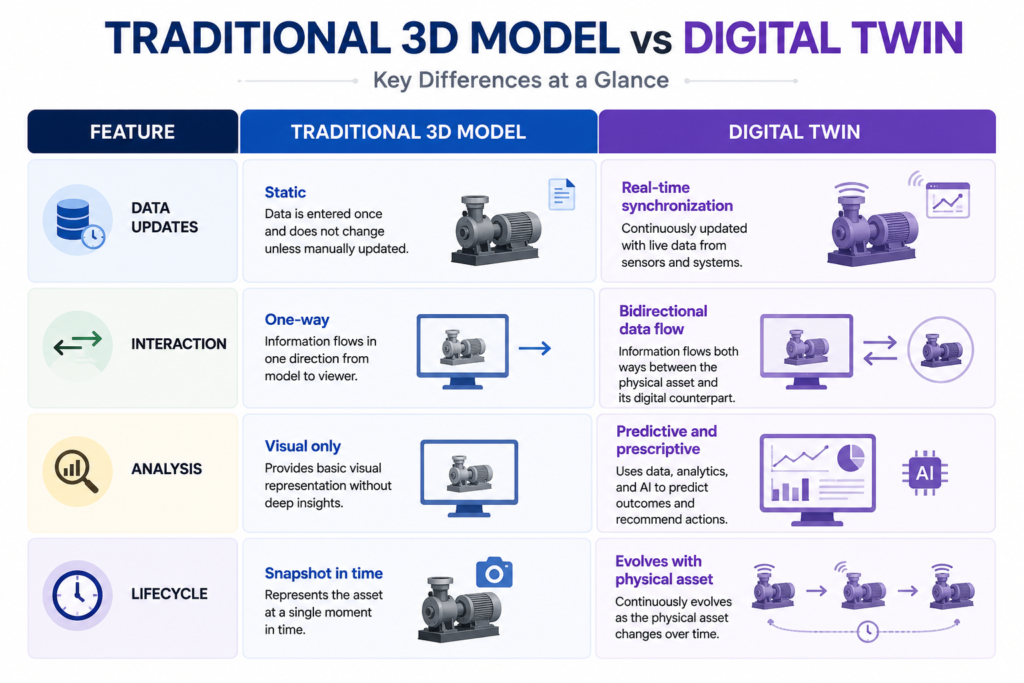
Digital twins integrate data from multiple sources—IoT sensors, cameras, satellite imagery, and operational systems—to create detailed, dynamic representations . They combine sensing (data collection), reasoning (AI/analytics), and action (simulation and optimization) into a unified cyber-physical framework .
Real-World Applications
Digital twins are being deployed across multiple industries, delivering measurable value .
1. Manufacturing
Digital twins are becoming a cornerstone of Industry 4.0 and Industry 5.0 . Manufacturers use them to:
- Monitor production lines in real-time, identifying inefficiencies before they cause downtime
- Simulate production processes and optimize robotic operations for increased throughput
- Predict equipment failures and schedule maintenance proactively—reducing downtime by 20-30%
- Support supply-chain optimization through demand forecasting and inventory adjustments
2. Healthcare
Digital twins are revolutionizing medicine by enabling personalized treatment and risk-free testing :
- Simulating human organs to test drugs and procedures before human trials
- Creating digital replicas of patients for surgical planning and rehearsal
- Monitoring and optimizing surgical robot performance in real-time
- Enabling personalized medicine with patient-specific treatment plans
3. Smart Cities
Cities are using digital twins to become more efficient, sustainable, and resilient :
- Optimizing traffic flow, energy consumption, and waste management
- Simulating urban planning scenarios before construction begins
- Managing infrastructure maintenance and disaster response
- Improving public safety and emergency response strategies
4. Energy
Energy companies are deploying digital twins to improve efficiency and grid resilience :
- Inspecting power lines, wind turbines, and solar panels virtually
- Optimizing energy grids in real-time through dynamic voltage regulation
- Reducing energy consumption by 15-20% through intelligent operations
- Supporting renewable energy integration and demand response
5. Construction and Infrastructure
Digital twins are transforming how buildings and infrastructure are designed, built, and maintained :
- Enabling efficient building design and urban planning
- Optimizing resource use and reducing costs through predictive maintenance
- Supporting collaborative engineering and virtual walkthroughs
Key Benefits
Challenges and Considerations
Despite its promise, digital twin adoption faces several challenges :
As industry leaders note, technology itself is no longer the limiting factor—the real challenge lies in organizational alignment and data readiness .
While implementing a full-scale digital twin requires industry-specific engineering and domain expertise, organizations also need a strong digital foundation to make it possible.
MHTECHIN supports this foundation through:
- Custom Software Development – Developing enterprise applications that integrate operational data and business workflows.
- Web & Mobile Application Development – Creating responsive web and mobile applications, dashboards, and user interfaces for business operations.
- Cloud Solutions – Supporting scalable cloud infrastructure for storing, processing, and managing large volumes of operational data.
- Artificial Intelligence & Machine Learning – Integrating AI capabilities for analytics, automation, and data-driven decision-making.
- Enterprise Solutions – Implementing CRM, ERP, and workflow automation systems that improve operational efficiency and data integration.
By combining software engineering, cloud technologies, AI, and enterprise solutions, MHTECHIN helps organizations build the digital foundation needed to support emerging technologies such as Digital Twins, IoT, and intelligent automation.
Conclusion
The era of static models is ending. Digital twins represent the next frontier—intelligent, dynamic virtual replicas that enable organizations to simulate, optimize, and innovate like never before .
From manufacturing and healthcare to smart cities and energy, digital twins are transforming how we design, build, and operate in the physical world . As the technology continues to evolve—integrating with AI foundation models, edge computing, and next-generation communication networks—its impact will only grow .
Digital twins aren’t replacing the physical world. They’re making it more intelligent, efficient, and sustainable.
Key Takeaways
- Digital twins are living virtual replicas that evolve alongside physical systems in real-time
- Applications span manufacturing, healthcare, smart cities, energy, and construction
- Key benefits include risk-free testing, predictive maintenance (20-30% downtime reduction), and potential cost reduction (30-50%)
- Challenges include data fragmentation, organizational silos, and cybersecurity risks
- MHTECHIN helps organizations build the digital foundation required to support Digital Twins through software engineering, cloud solutions, AI integration, and enterprise applications.
References
- Meng, W. et al., “Industrial digital twin for intelligent manufacturing,” ScienceDirect, 2026
- Research and Markets, “Digital Twins Market Report 2026”
- Satpathy, P.R. et al., “Digital Twins in energy and power systems,” Applied Energy, 2026
- IEEE Xplore, “Digital Twins in 2025: A Comprehensive Review,” 2026
- Research and Markets, “Digital Twin-as-a-Service Market Report 2026”
- “Exploring diverse use cases of digital twins,” ScienceDirect, 2024
- Global Market Insights, “Digital Twin Market Size & Share 2026-2034”

Leave a Reply