Introduction
Imagine a team of specialists working on a complex problem. One expert researches market trends, another analyzes financial data, a third drafts recommendations, and a fourth reviews the final output for quality. Each focuses on what they do best, communicating seamlessly to deliver results faster and more reliably than any individual could alone.
This is exactly how multi-agent systems (MAS) work. Instead of relying on a single AI to handle everything, multi-agent systems deploy teams of specialized AI agents that collaborate, communicate, and coordinate to tackle complex tasks . Each agent has a specific role, set of tools, and expertise domain—and together, they accomplish what no single agent could achieve.
The enterprise adoption of multi-agent systems is accelerating dramatically. According to Databricks’ 2026 State of AI Agents report, usage of multi-agent workflows has grown by 327% in just four months (June–October 2025) . Technology companies are building multi-agent systems nearly four times more than any other industry, reflecting early enterprise maturity .
In this comprehensive guide, you’ll learn:
- What multi-agent systems are and how they differ from single-agent architectures
- The key collaboration patterns: hierarchical, sequential, nested, group, and more
- How agents communicate through protocols like MCP and A2A
- Real-world enterprise applications with measurable ROI
- Step-by-step implementation using frameworks like AG2, LangGraph, and n8n
- Best practices for governance, cost management, and scaling
Part 1: What Are Multi-Agent Systems?
Definition and Core Concept
A multi-agent system (MAS) consists of multiple autonomous AI agents that interact within a shared environment to accomplish tasks . Rather than one agent handling everything, each agent specializes in a specific domain—data analysis, content generation, API integration, customer support—and coordinates with others to achieve complex goals.
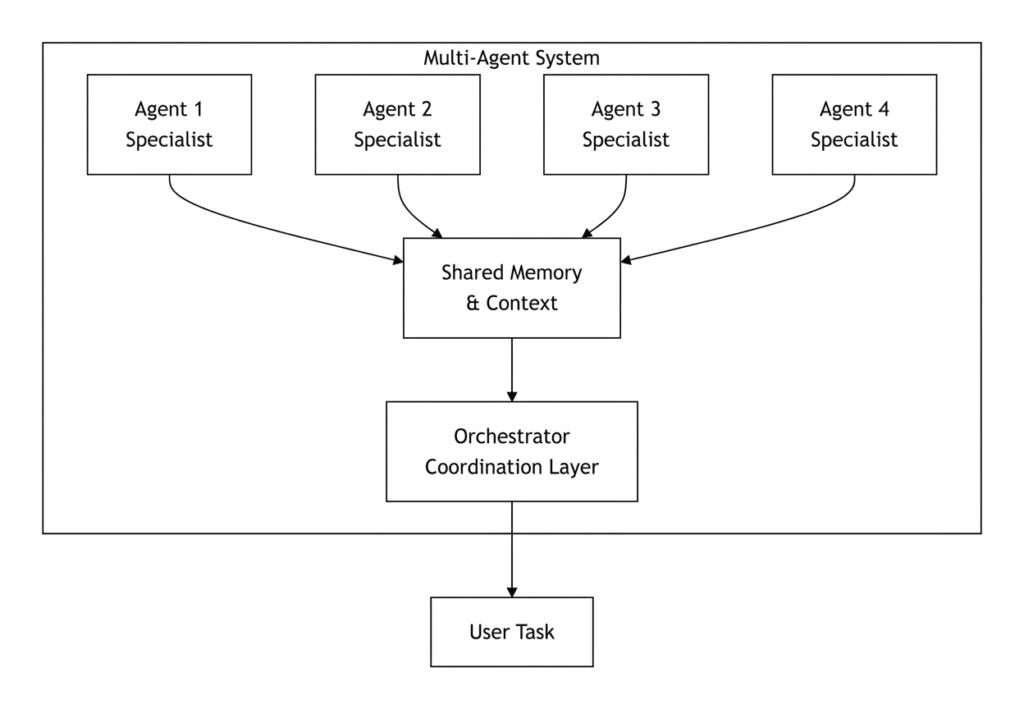
*Figure 1: Multi-agent systems distribute work across specialized agents coordinated through a shared memory and orchestration layer*
Single-Agent vs. Multi-Agent: The Critical Difference
Why Multi-Agent Systems Matter
The shift to multi-agent architectures is driven by three fundamental advantages:
1. Specialization Drives Quality
Just as a team of doctors with different specialties outperforms a single general practitioner, specialized AI agents achieve higher accuracy in their domains. Research shows multi-agent systems can outperform single agents by 90.2% on complex tasks .
2. Parallel Execution Enables Speed
Multiple agents working simultaneously on independent subtasks dramatically reduces completion time. Systems like Cursor 2.0 run up to 8 parallel coding agents, and Claude Code enables 10+ simultaneous instances for coordinated development .
3. Resilience Through Distribution
When one agent fails, the rest continue functioning. This distributed architecture makes multi-agent systems inherently more robust than monolithic alternatives .
Part 2: Multi-Agent Communication and Coordination
How Agents Communicate
Effective collaboration requires robust communication mechanisms. Agents can coordinate through:
Communication Patterns
Multi-agent systems use three primary communication patterns:
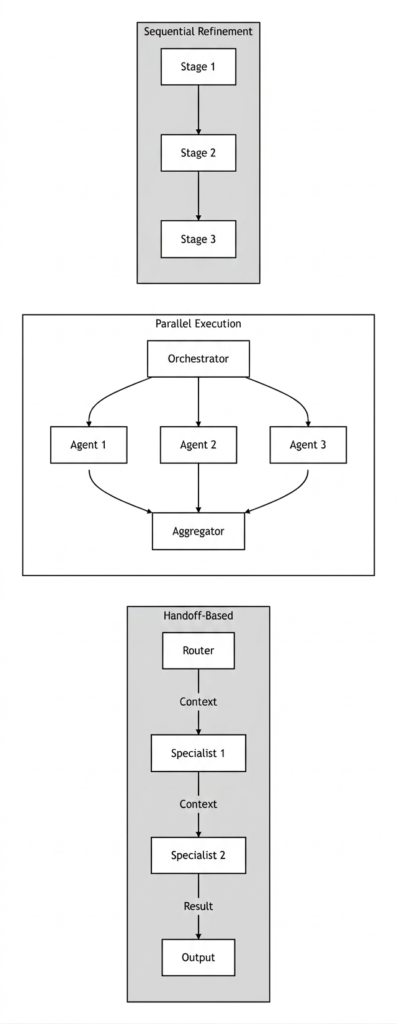
*Figure 2: Three primary communication patterns in multi-agent systems—handoff-based, parallel execution, and sequential refinement*
1. Handoff-Based Communication
Specialized agents pass context between stages. Example: Customer support router identifies intent → billing specialist handles payment → email agent formats response .
2. Parallel Execution
Multiple agents work simultaneously and results are combined. Example: Research agents perform concurrent web searches → synthesizer aggregates findings .
3. Sequential Refinement
Agents process in stages, each building on previous output. Example: Editor → Critic → Finalizer for content creation .
Part 3: Multi-Agent Architecture Patterns
The Complete Pattern Taxonomy
AG2’s Agent Pattern Cookbook provides a comprehensive taxonomy of multi-agent patterns, each mirroring real-world human workforce structures .
Basic Patterns
Advanced Patterns
Hierarchical Multi-Agent Systems (HMAS)
Hierarchical multi-agent systems organize agents into layered structures that help manage complexity and scale . These hierarchies establish clear authority relationships and defined communication channels, reducing indecision that might occur in fully egalitarian teams .
| Dimension | Description | Spectrum |
|---|---|---|
| Control Hierarchy | Distribution of decision-making power | Centralized → Decentralized → Hybrid |
| Information Flow | How data moves between levels | Top-down → Bottom-up → Bidirectional |
| Role Delegation | Task assignment mechanisms | Fixed → Dynamic → Emergent |
| Temporal Layering | Time horizons at each level | Strategic (long) → Tactical (medium) → Operational (short) |
| Communication Structure | Interaction patterns | Tree → Star → Mesh |
Pattern Selection Guide
Choose your pattern based on requirements :
| If You Need… | Choose Pattern |
|---|---|
| Simple question answering | Two Agent Chat |
| Fixed, repeatable workflows | Sequential Chat or Pipeline |
| Modular tasks with specialized teams | Nested Chat |
| Multiple perspectives on a problem | Group Chat |
| Adaptive routing based on content | Context-Aware Routing |
| Tiered support escalation | Escalation |
| Quality control and iteration | Feedback Loop |
| Large-scale organizational structure | Hierarchical |
| Dynamic team formation | Organic |
| Independent validation | Redundant |
| Centralized coordination | Star |
| Request classification | Triage |
Part 4: Real-World Enterprise Applications
Databricks 2026 State of AI Agents Report Findings
According to Databricks’ analysis of over 20,000 organizations (including 60% of the Fortune 500) :
- 327% growth in multi-agent workflow usage (June–October 2025)
- Technology companies building multi-agent systems at 4× rate of other industries
- 40% of top AI use cases focus on customer support, advocacy, and onboarding
Industry-Specific Use Cases
| Industry | Top Use Case | Percentage |
|---|---|---|
| Manufacturing & Automotive | Predictive maintenance | 35% |
| Retail & Consumer Goods | Market intelligence | 14% |
| Health & Life Sciences | Medical literature synthesis | 23% |
Source: Databricks 2026 State of AI Agents Report
Enterprise Multi-Agent Examples
| Application | Example System | Pattern Used |
|---|---|---|
| Customer Support | Intercom Fin 3, Respond.io | Role-based routing, procedures |
| Deep Research | Perplexity, GPT Researcher | Planner + Executor, parallel retrieval |
| Software Development | Cursor 2.0 (8 parallel agents), Claude Code (10+ instances) | Parallel execution |
| Data Analytics | Shopify (30+ MCP servers), cBioPortal | Tool-integrated agents |
| Content Creation | EditDuet (Editor + Critic), AniMaker (4-agent pipeline) | Sequential refinement |
Performance Metrics
Hexaware’s Agentverse platform reports measurable outcomes for enterprise multi-agent deployments :
| Metric | Improvement Target |
|---|---|
| Productivity Gains | 40–60% |
| Response Times | 60–80% faster |
| Customer Satisfaction | 20–35% improvement |
| Operational Costs | 20–50% reduction |
Part 5: Frameworks for Building Multi-Agent Systems
Visual Builders and Low-Code Platforms
Code-First Frameworks and SDKs
Framework Comparison
| Framework | Learning Curve | Control Level | Multi-Agent Patterns | Best Environment |
|---|---|---|---|---|
| n8n | Low | Medium | Handoff, sequential | Business automation |
| AG2 | Medium | High | Group chat, hierarchical | Complex conversations |
| LangGraph | High | Very High | All patterns | Production workflows |
| CrewAI | Medium | High | Role-based teams | Collaborative tasks |
| Google ADK | Medium | High | Sequential/parallel | Google Cloud |
Part 6: Step-by-Step Implementation Guide
Building a Hierarchical Multi-Agent System in AG2
AG2 provides powerful primitives for multi-agent systems. Here’s a practical implementation of a hierarchical support system.
Step 1: Configure LLM Settings
python
import os
from autogen import ConversableAgent, GroupChat, GroupChatManager, LLMConfig

# Configure LLM for all agents
llm_config = LLMConfig(
    api_type="openai",
    model="gpt-4o-mini",
    api_key=os.environ["OPENAI_API_KEY"]
)
Step 2: Create Specialized Agents
python
# Router agent for initial triage
router = ConversableAgent(
    name="Router",
    system_message="""You are a router agent. Analyze incoming queries and route them
    to the appropriate specialist: 'Billing' for payment issues, 'Technical' for bugs,
    or 'Product' for feature questions. Respond with ONLY the specialist name.""",
    llm_config=llm_config
)

# Billing specialist
billing = ConversableAgent(
    name="Billing",
    system_message="""You are a billing specialist. Handle payment issues, refunds,
    and account charges. Query the billing database when needed.""",
    llm_config=llm_config
)

# Technical support specialist
technical = ConversableAgent(
    name="Technical",
    system_message="""You are a technical support specialist. Troubleshoot bugs,
    error messages, and system issues. Access logs and documentation.""",
    llm_config=llm_config
)

# Product specialist
product = ConversableAgent(
    name="Product",
    system_message="""You are a product specialist. Answer feature questions,
    roadmap inquiries, and capability requests.""",
    llm_config=llm_config
)
Step 3: Implement Dynamic Routing with Group Chat
python
def route_to_specialist(agent, messages, sender):
    """Dynamic routing based on router output."""
    # Router analyzes query
    router_response = router.generate_reply(messages)

    # Route to appropriate specialist
    if "billing" in router_response.lower():
        return billing
    elif "technical" in router_response.lower():
        return technical
    elif "product" in router_response.lower():
        return product
    else:
        return billing  # Default

# Create group chat with routing
groupchat = GroupChat(
    agents=[router, billing, technical, product],
    messages=[],
    speaker_selection_method=route_to_specialist,
    max_round=10
)

# Create manager
manager = GroupChatManager(
    groupchat=groupchat,
    llm_config=llm_config
)
Step 4: Execute the System
python
# Example query
response = router.initiate_chat(
    manager,
    message="I was charged twice for my subscription this month. Can you help?"
)
Building with n8n Visual Builder
For teams preferring visual development, n8n offers a node-based approach :
Pattern: Hierarchical Multi-Agent with Supervisor
- AI Agent Node (Supervisor) : Central coordinator with Simple Memory
- Email Sub-Agent: Multiple Gmail operations (retrieve, draft, send, reply)
- Document Search Sub-Agent: Vector database queries and summarization
- Tool Parameters: Dynamic parameters filled during LLM runtime
- Reserve expensive reasoning models for supervisor planning
- Use cheaper models for sub-agent operations
- Test both configurations easily in n8n
Part 7: Costs, Trade-offs, and Governance
The Cost-Performance Trade-off
Anthropic’s research reveals a critical insight: multi-agent systems outperformed single agents by 90.2%, but consumed 15× more tokens . Token usage alone explained 80% of performance differences in their internal tests .
| Metric | Single-Agent | Multi-Agent |
|---|---|---|
| Performance | Baseline | +90.2% higher |
| Token Consumption | Baseline | 15× higher |
| Cost Efficiency | Lower | Higher per task, but faster completion |
When to Use Multi-Agent Systems
- Tasks involve multiple domains requiring deep expertise
- Parallel processing across different data sources is needed
- A single context window can’t hold everything
- Quality requirements justify higher token costs
- Tasks are simple and single-domain
- Latency is critical (real-time applications)
- Token budget is constrained
- The required expertise fits in one context window
Hybrid Approaches
Recent research suggests that hybrid agentic paradigms—request cascading between multi-agent and single-agent systems—can improve both efficiency and capability. One study found hybrid designs improve accuracy by 1.1–12% while reducing deployment costs by up to 20% .
Governance Essentials
- Businesses using AI governance put 12× more AI projects into production
- Customers using evaluation tools put 6× more AI projects into production
- Role-based access controls
- Immutable audit trails
- Observability and monitoring
- Policy guardrails
- Clear accountability structures
Part 8: Advanced Research and Future Directions
MACC: Multi-Agent Collaborative Competition
Recent research from AAMAS 2026 introduces MACC (Multi-Agent Collaborative Competition) , an institutional architecture that integrates a blackboard-style shared scientific workspace with incentive mechanisms designed to encourage transparency, reproducibility, and exploration efficiency .
Key Innovation: Enables independently managed agents to collaborate through structured incentives and shared workspaces—critical for scientific discovery applications .
BEACOF: Belief-Driven Adaptive Collaboration
Researchers at WWW 2026 introduced BEACOF, a belief-driven adaptive collaboration framework inspired by Perfect Bayesian Equilibrium . This framework:
- Models social interaction as a dynamic game of incomplete information
- Enables agents to iteratively refine probabilistic beliefs about peer capabilities
- Prevents coordination failures (groupthink or deadlocks)
MHTECHIN’s Multi-Agent Innovations
At MHTECHIN, we’re pushing the boundaries of multi-agent systems through :
- Multi-Agent Reinforcement Learning (MARL) : Algorithms that enable teams of agents to learn complex behaviors—training robots to play soccer, navigate environments, and cooperate on tasks
- Swarm AI: Decentralized systems inspired by nature (flocks of birds, ant colonies) for climate monitoring, disaster response, and global health applications
- MARL Applications: Robotics, autonomous vehicles, gaming, finance, and healthcare
Conclusion
Multi-agent systems represent a fundamental shift in how we deploy AI for complex tasks. By distributing work across specialized agents—each with defined roles, tools, and expertise—organizations can achieve:
- Superior performance (up to 90% better than single agents)
- Faster execution through parallel processing
- Greater resilience through distributed architecture
- Clearer accountability with role-specific agents
The enterprise adoption is accelerating rapidly—327% growth in just four months, with technology companies leading the charge . As Databricks’ Dael Williamson notes, “The conversation has moved on from AI experimentation to operational reality” .
However, success requires careful attention to costs (multi-agent systems consume 15× more tokens) , governance (12× more projects reach production with proper controls) , and pattern selection (choose the right architecture for your use case) .
Whether you’re building customer support systems, research agents, or software development assistants, multi-agent architectures provide the flexibility, specialization, and scalability needed for production-grade AI applications.
Frequently Asked Questions (FAQ)
Q1: What is a multi-agent system?
A multi-agent system (MAS) consists of multiple autonomous AI agents that interact within a shared environment to accomplish tasks. Each agent specializes in a specific domain, and they coordinate through communication protocols to achieve complex goals .
Q2: How do multi-agent systems differ from single-agent systems?
Single agents use one model to handle everything. Multi-agent systems distribute work across specialized agents with different models, prompts, and tools. The trade-off: multi-agent offers better specialization and parallel execution but requires coordination logic and uses more tokens .
Q3: What are the main multi-agent patterns?
Key patterns include Two Agent Chat, Sequential Chat, Nested Chat, Group Chat, Hierarchical, Star, Escalation, Feedback Loop, Redundant, and Triage. Each mirrors a real-world human workforce structure .
Q4: What protocols do agents use to communicate?
Agents communicate through Model Context Protocol (MCP) from Anthropic for tool access, Agent-to-Agent (A2A) from Google for peer-to-peer collaboration, shared memory systems, or framework-specific methods .
Q5: When should I use multi-agent instead of single-agent?
Use multi-agent when your task involves multiple domains requiring deep expertise, you need parallel processing across different data sources, or a single context window can’t hold everything .
Q6: What are the costs of multi-agent systems?
Multi-agent systems can outperform single agents by 90.2% but consume 15× more tokens. Token usage alone explains 80% of performance differences . Hybrid approaches (cascading between MAS and SAS) can reduce costs by up to 20% .
Q7: How do I get started building multi-agent systems?
Start with low-code platforms like n8n for rapid prototyping, or code-first frameworks like AG2, LangGraph, or CrewAI for complex workflows. Begin with simple patterns (Two Agent Chat) and scale to advanced patterns as needed .
Q8: What governance do multi-agent systems need?
Essential governance includes role-based access controls, immutable audit trails, observability, policy guardrails, and clear accountability structures. Organizations using AI governance put 12× more projects into production .

Leave a Reply