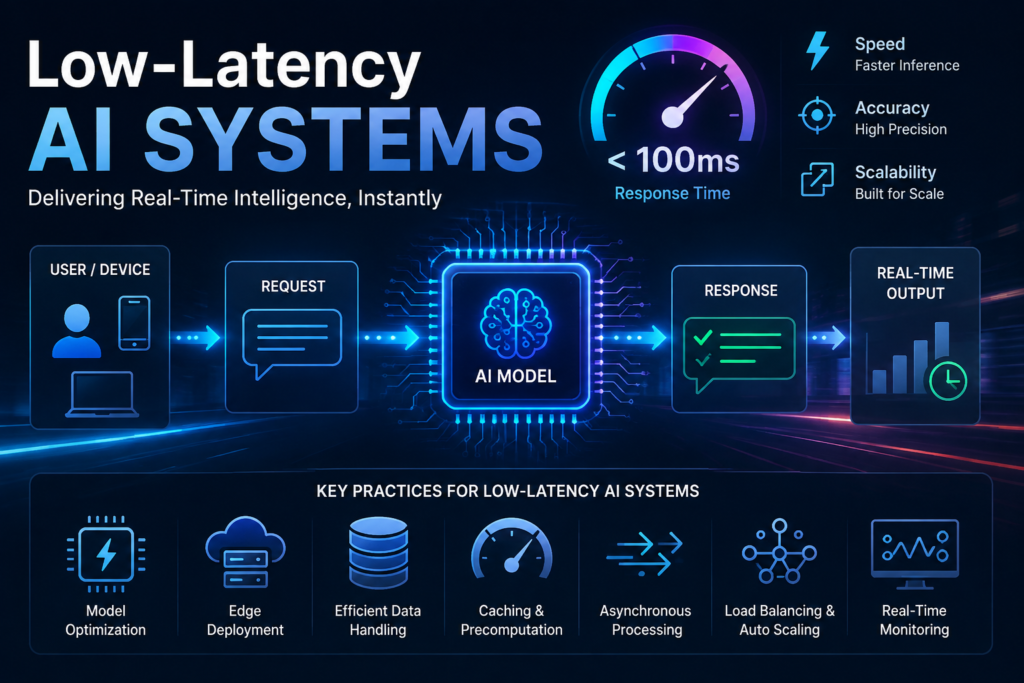
⚡ Low-Latency AI Systems: The Complete Enterprise Guide to Building Ultra-Fast AI Applications
🚀 The 50-Millisecond Deadline That Defines Modern AI
Imagine you’re in a self-driving car traveling at 60 mph. Suddenly, a child runs into the road. Your vehicle’s AI system must detect the child, decide to brake, and execute the action—all within 50 milliseconds. Miss that window, and the outcome changes from a near-miss to a tragedy.
Or consider a fraud detection system processing your credit card transaction. The AI must score the transaction before the payment completes—typically within 100-300 milliseconds. Any slower, and fraud slips through or legitimate customers face embarrassing declines.
This is the brutal reality of low-latency AI systems. It’s not about being “fast enough.” It’s about meeting hard deadlines where milliseconds separate success from failure, profit from loss, and in some cases, life from death.<div class=”callout callout-info”> 💡 **Expert Insight:** “In the paradigm of Physical AI, intelligence is not measured by model size or TOPS, but by latency, energy efficiency, and instant response”[citation:4]. </div>
📖 What Are Low-Latency AI Systems?
A low-latency AI system is an artificial intelligence application optimized to process data and generate predictions with minimal delay—typically measured in milliseconds. These systems enable real-time inference, where the time between receiving an input and delivering a response is virtually imperceptible to users.
🎯 Why Low Latency Matters
- Enhanced User Experience: Users expect AI responses to be instant. AI chatbots with sub-second response times feel natural; those that take seconds feel clunky and are abandoned.
- Safety-Critical Systems: In healthcare and autonomous vehicles, low latency ensures timely actions—detecting fraud before a transaction completes or braking to avoid a collision.
- Competitive Advantage: Amazon’s real-time recommendation engine accounts for 35% of its revenue, powered by AI that delivers predictions in milliseconds.
- Economic Viability: High latency translates directly to increased operational costs—prolonged GPU occupancy reduces capacity to serve multiple users affordably.
<div class=”callout callout-warning”> ⚠️ **Reality Check:** “A perfectly accurate model that delivers results 500ms late is worthless” in real-time systems[citation:2]. </div>
⚙️ How Low-Latency AI Systems Work: End-to-End Architecture
🔄 Request Lifecycle
- User Request: Client sends input data (text, image, sensor reading)
- API Gateway: Authentication, rate limiting, and routing
- Load Balancer: Distributes requests across inference servers using least-connections routing
- Cache Layer: Semantic cache serves semantically similar queries; KV cache reuses context
- Model Server: Optimized inference with GPU acceleration
- Inference Engine: Quantization, pruning, and speculative decoding
- Response: Streaming or full response returned to client
📊 Key Latency Metrics
Understanding these metrics is essential for building low-latency AI systems:
🛠 Key Optimization Techniques for Low-Latency AI
1. 📉 Model Optimization: Quantization
Quantization reduces the numerical precision of model weights, dramatically decreasing memory usage and computation time.
| Precision | Memory Reduction | Speed Gain | Best For |
|---|---|---|---|
| FP16 | ~2x | ~2x | General-purpose inference |
| INT8 | ~4x | ~2-4x | Production deployments |
| FP8 | ~4x | ~3-4x | Emerging hardware support |
| INT4 | ~8x | ~8x | Edge/constrained devices |
💡 Pro Tip: Research shows that FP8/INT8 quantization can deliver two to four times the efficiency compared to higher precisions, with minimal impact on output quality.
2. 🚀 Speculative Decoding
A smaller “draft” model predicts a sequence of tokens, which are then validated against the larger model in a single pass. When the draft model’s predictions are correct—which is often—inference speeds up dramatically because multiple tokens are confirmed at once.
3. 💾 KV Cache Optimization
For multi-turn conversations and long-context scenarios, KV cache reuse stores intermediate key-value pairs from transformer attention layers. This avoids recomputing the full context window on every exchange, significantly reducing TTFT.
4. 🧠 Semantic Caching
Semantic caching converts queries into vector embeddings and compares them against previously cached query-response pairs. If a new query is semantically close enough to a cached one, the system returns the cached response—dropping response times from hundreds of milliseconds to tens of milliseconds.
💡 Expert Tip: “Caching is the highest-leverage optimization for most AI applications. Before investing in faster hardware or model optimization, measure your cache hit rate”.
5. 🔄 Intelligent Load Balancing
AI workloads behave differently from traditional HTTP traffic:
- Least-connections routing: Sends requests to the server with the fewest active connections—critical for AI where request processing times vary by orders of magnitude
- Weighted load balancing: Assigns different capacities based on hardware (mixing A100 and T4 GPUs)
- Prompt-based routing: Simple queries to lightweight models; complex reasoning to larger models
🏢 Edge AI vs. Cloud AI
🔍 Key Insight: Edge inference is non-negotiable for autonomous vehicles and real-time industrial systems where cloud round-trips are too slow.
🔧 Comparison Tables
CPU vs. GPU for AI Inference
| Aspect | CPU | GPU |
|---|---|---|
| Parallelism | Limited cores | Thousands of cores |
| Latency | Lower for small batches | Higher for small batches |
| Throughput | Lower | Much higher |
| Best For | Small models, edge devices | Large models, high throughput |
Streaming Protocols for Real-Time AI
| Protocol | Typical Latency | Best For |
|---|---|---|
| WebRTC | <500ms | Teleoperation, browser playback |
| SRT | 50ms-1s (tunable) | Unreliable networks, mobile backhaul |
| RTSP | 2-5s | Legacy LAN deployments |
💡 Recommendation: “Ditch RTSP whenever possible. SRT handles unreliable networks gracefully; WebRTC delivers browser-based performance with sub-500ms latency”.
🌍 Real-World Enterprise Case Studies
🚗 Tesla: Autonomous Vehicle Decision-Making
Tesla’s self-driving vehicles rely on low-latency AI models to make real-time decisions. The system processes data from cameras, radar, and LiDAR to detect obstacles and navigate streets.
- How it works: Edge AI—models deployed directly on the vehicle’s onboard hardware
- Outcome: Real-time decision-making ensures safe navigation in complex scenarios
🛒 Amazon: Real-Time Product Recommendations
Amazon’s recommendation system delivers personalized product ideas within milliseconds of a user’s interaction.
- Technology: Lightweight algorithms optimized for low latency using distributed computing
- Outcome: Recommendations account for 35% of Amazon’s revenue
💳 PayPal: Real-Time Fraud Detection
PayPal uses low-latency models to analyze millions of transactions daily and detect fraudulent activities in real-time.
- How it works: AI models optimized for rapid inference, powered by GPUs
- Outcome: Saves millions annually by preventing fraud before completion
🎬 Netflix: Real-Time Content Recommendations
Netflix’s recommendation engine delivers personalized movie and show ideas to 230+ million subscribers worldwide.
- How it works: Hybrid of collaborative filtering and deep learning models deployed on edge servers globally
- Outcome: 75% of content watched comes from AI-driven recommendations
🎙️ OpenAI/Ultravox: Ultra-Low Latency Voice AI
Ultravox is a breakthrough multimodal LLM that combines Speech-to-Text and LLM into one model, eliminating the ASR bottleneck.
- Key Achievement: Achieves end-to-end latency of just 600ms (First Time to Audio)
- Technology: Direct audio-to-LLM processing without separate transcription stage
🛠 Popular Tools for Low-Latency AI
Inference Servers & Optimizers
Infrastructure & Scaling
- Kubernetes: Autoscaling and container orchestration
- Redis: Low-latency caching layer
- HAProxy: AI gateway with token-based rate limiting
💡 Expert Insight: “Using async I/O and concurrent model calls can drastically improve latency. Breaking a task into smaller parts processed in parallel allows smaller, faster models to handle each piece accurately, reducing overall latency from 3-15 seconds to under a second”.
🔐 Security Without Latency Penalty
Security checks on the critical path add significant latency if not designed for performance:
- AI gateways with inline WAF: Modern solutions provide 98.48% WAF accuracy without latency penalty
- Token-based rate limiting: Control by token consumption, not just request count
- Validate at the gateway layer: Block malicious inputs before they reach the model
📈 Best Practices for Low-Latency AI Systems
✅ Model-Level Optimization
- Use smaller, task-specific models—A 7B model fine-tuned for a specific task can outperform a 70B general-purpose model on that task while running significantly faster
- Apply quantization (FP16, INT8, FP8) for 2-4x efficiency boost
- Implement pruning to remove redundant parameters
- Use speculative decoding for faster generation
- Shorten output tokens—Optimize prompts for concise responses
✅ Infrastructure Optimization
- Implement semantic caching—Drop latency from hundreds to tens of milliseconds
- Use KV cache reuse for multi-turn conversations
- Deploy edge AI for sub-15ms latency in critical applications
- Use intelligent load balancing with least-connections routing
- Autoscale inference capacity to handle traffic spikes
✅ Network Optimization
- Enable HTTP/2 or HTTP/3 for multiplexing support
- Use connection pooling to avoid repeated handshakes
- Deploy inference closer to users—Eliminate round trips to centralized cloud regions
✅ Monitoring
- Measure latency by stage—Preprocessing, computation, post-processing
- Trace at the span level—Distributed tracing reveals where latency lives
- Monitor TTFT, ITL, and TPS per model and per backend
❌ Common Mistakes to Avoid
🚀 Future Trends in Low-Latency AI
🌐 Edge AI Explosion
5G and edge computing are enabling ultra-low latency applications in autonomous vehicles, smart cities, telemedicine, and industrial automation. Google’s LiteRT-LM powers Gemini Nano on wearables and Chromebooks, demonstrating the potential of on-device GenAI.
🤖 AI Agents
LLM-based agent systems face complex latency challenges: core inference, agent framework overhead, tool interactions, and communication delays. Optimizations across the full stack are essential for responsive agents.
🔧 Specialized Hardware
- Automaton Engine: Edge AI chip achieving sub-50ms latency with only 5-30W power consumption
- AMD AI Engines: Achieving microsecond-level latency for matrix-vector operations at the edge
- Neuromorphic chips and quantum computing: Promising faster, more efficient processing
⚡ 6G and Ultra-Low Latency
6G networks will support distributed split inference, with adaptive model partitioning at runtime across edge nodes.
🤖 Federated Learning
Enables devices to learn collaboratively while keeping data local.
🏁 Conclusion: The Foundation of Enterprise AI
Low-latency AI systems are the backbone of modern AI-powered applications and enterprise digital transformation. Autonomous vehicles, fraud detection, personalized experiences, and conversational AI all depend on sub-second predictions.
The ROI is tangible:
- Safety: Autonomous vehicles, healthcare diagnosis, industrial safety
- Revenue: Fraud detection, financial trading, personalized recommendations
- Customer satisfaction: Chatbots, AI assistants, real-time personalization
- Operational efficiency: Predictive maintenance, quality inspection, anomaly detection
Three Steps to Get Started
- Measure your current latency—Distributed tracing reveals where latency lives, rarely where you think
- Implement caching first—Semantic caching is often the highest-leverage optimization
- Choose the right deployment model—Edge, cloud, or hybrid based on your latency, privacy, and compute requirements
The teams that master low-latency AI ship applications that users trust, regulators approve, and businesses rely on. The teams that don’t fall behind as AI moves from “intelligent” to “instant.”

Leave a Reply