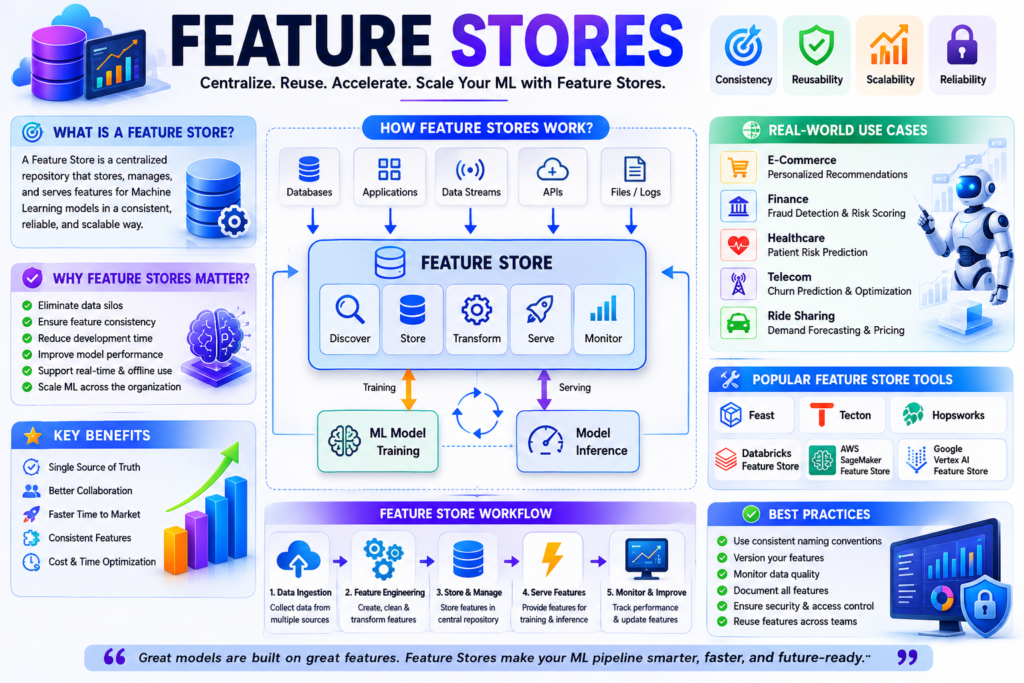
Feature Stores: The Complete Enterprise Guide to Managing Machine Learning Features at Scale
The Feature Engineering Jungle That Nearly Broke Uber
It’s 2017. Uber’s ML platform, Michelangelo, is serving millions of predictions daily across ride matching, pricing, fraud detection, and ETA estimation. But the data pipelines are in chaos. Different teams are creating the same features for different models—repeatedly, inconsistently, and with no governance. The “data pipeline jungle” has become a full-blown crisis .
A feature computed one way for training becomes a slightly different feature at inference time. Training-serving skew is creeping into production models. Teams cannot find existing features, so they rebuild them from scratch. Feature definitions are scattered across notebooks, code repositories, and tribal knowledge. Debugging production failures means tracking down which team owned which transformation. It’s a nightmare .
Uber’s solution was revolutionary: create a centralized repository for storing, sharing, and reusing features across multiple ML models and projects . They called it a feature store.
What began as an internal Uber innovation has become the foundation of enterprise AI. Today, feature stores are no longer niche infrastructure—they are the key front-end that helps organizations push the boundaries of data pipelines for machine learning and AI . This guide is the complete playbook for understanding, implementing, and scaling feature stores in enterprise AI.
What Is a Feature Store?
A feature store is a centralized platform or system where all the data features associated not with a single, specific dataset, but with an entire machine learning domain or organization are defined and managed . It acts as the “interface between models and data” .
In a feature store, features are described declaratively by specifying :
- Business semantics: What does this feature mean for the business?
- Source data: Where does the raw data come from?
- Transformation logic: How is the raw data transformed into a feature?
- Associated metadata: Who owns this feature? What’s the freshness SLA? What type is it?
- Availability: Is it for offline training, online serving, or both?
Why It Matters
Feature stores solve fundamental challenges that emerge when ML moves from experimentation to production :
- Consistency: Training and serving definitions stay in sync so the same feature logic is used both offline and in production, reducing training-serving skew
- Reusability: Features become available for immediate reuse by other models across the organization
- Collaboration: Teams can discover, share, and collaborate on high-quality features instead of rebuilding from scratch
Simple Analogy
If you’re familiar with app development, think of a feature store as a company-wide design system. Instead of each team redesigning buttons, typography, and color schemes from scratch, they use a shared, governed, and versioned library. Product teams know exactly what components are available, how to use them, and who owns them. Feature stores do for ML features what design systems do for UI components .
Enterprise Example: Fraud Detection
Consider an e-commerce company building fraud detection models . Features like “number of transactions in the last 24 hours” and “average transaction amount over the past week” are defined once in the feature store:
| Aspect | Example Feature: user_transaction_count_24h |
|---|---|
| Business Semantics | Number of transactions initiated by a user in the last 24 hours |
| Source Data | transactions event table (user_id, transaction_timestamp, status) |
| Transformation Logic | Count of initiated transactions per user_id over a rolling 24-hour window |
| Owner | Fraud ML team |
| Type | Integer |
| Freshness SLA | 5 minutes |
| Availability | Both offline training and online serving |
Any fraud detection model can now use this feature. The feature store ensures the same definition is used for training and real-time inference, eliminating skew .
Difference from a Database
While feature stores use database technology under the hood, they serve a fundamentally different purpose. A database stores raw data. A feature store manages transformed data suitable for direct use in machine learning models . Feature stores :
- Manage features as first-class entities with metadata and lineage
- Provide point-in-time correct retrieval for training (time-travel)
- Enable low-latency serving for real-time inference
- Orchestrate transformations from raw data to feature values
- Monitor feature quality, drift, and operational metrics
Why Feature Stores Are Critical for Enterprise AI
1. Feature Reusability
Developing new features is time-intensive, keeping data scientists locked into tasks that could have been completed more efficiently by repurposing an existing feature . A well-stocked feature store can be accessed to quickly create new ML models by eliminating the need to build each new feature from scratch .
2. Consistency Between Training and Serving
When there is a discrepancy between how features are defined for training and how they are implemented in serving pipelines, it leads to reduced performance of models in production . Feature stores keep definitions in sync—the same feature logic used offline for training is used online for inference .
3. Faster ML Development
Feature stores automate feature computation, backfills, and logging . Data scientists can productionize new features without extensive engineering support . As the Databricks blog notes, feature stores allow data scientists to build and deploy features within hours instead of months .
4. Data Quality and Governance
Feature stores track feature versions, lineage, and metadata . They provide a single registry for all ML features that’s easily accessible to all teams within the business . Feature stores also help :
- Track and manage operational metrics relating to feature storage (availability, capacity, utilization, staleness)
- Track feature serving metrics (throughput, latency, error rates)
- Monitor data quality and detect drift
5. Collaboration at Scale
Feature stores bring economies of scale to ML organizations by enabling collaboration. When a feature is registered in a feature store, it becomes available for immediate reuse by other models across the organization . This reduces duplication of data engineering efforts .
6. Data Leakage Prevention
Training models on future information that wouldn’t be available at prediction time leads to overly optimistic results that fail in production . Feature stores provide point-in-time correct feature values that prevent this common pitfall .
7. Production Reliability
“When something goes wrong in an ML system, it’s usually a data problem” . Feature stores are uniquely positioned to detect and surface such issues, calculating metrics on the features they store and serve that describe correctness and quality . They monitor for training-serving skew and data drift .
8. Cost Optimization
Feature stores help manage escalating infrastructure costs and efficiency, preventing redundant data processing and reducing the computational overhead as a result . By computing features once and reusing them many times, organizations reduce compute and storage costs .
9. AI Regulation Compliance
With the rise of agentic AI, feature stores have seen their value multiply due to providing the high-quality, real-time data features needed by state-of-the-art AI agents . Feature stores also align with new, stricter AI regulations regarding centralization and transparency .
How Feature Stores Work: The Complete Workflow
The feature store workflow spans the entire ML lifecycle :
text
┌─────────────────────────┐
│   RAW DATA SOURCES      │ - Data lakes, warehouses, streaming
└────────────┬────────────┘
             ▼
┌─────────────────────────┐
│   DATA INGESTION        │ - Batch, streaming, real-time
└────────────┬────────────┘
             ▼
┌─────────────────────────┐
│   FEATURE ENGINEERING   │ - Transform raw data into features
└────────────┬────────────┘
             ▼
┌─────────────────────────┐
│     VALIDATION          │ - Schema checks, quality gates
└────────────┬────────────┘
             ▼
┌─────────────────────────┐
│    FEATURE STORE        │ - Centralized repository
└────────────┬────────────┘
             ▼
┌─────────────────────────┐
│    OFFLINE STORE        │ - Historical data for training
└────────────┬────────────┘
             ▼
┌─────────────────────────┐
│    ONLINE STORE         │ - Current values for inference
└────────────┬────────────┘
             ▼
┌─────────────────────────┐
│    MODEL TRAINING       │ - Point-in-time correct features
└────────────┬────────────┘
             ▼
┌─────────────────────────┐
│  REAL-TIME INFERENCE    │ - Low-latency feature serving
└────────────┬────────────┘
             ▼
┌─────────────────────────┐
│      MONITORING         │ - Feature drift, data quality
└────────────┬────────────┘
             ▼
┌─────────────────────────┐
│   FEATURE UPDATES       │ - New versions, backfills
└─────────────────────────┘
The Dual-Layer Storage Architecture
At the heart of every feature store is a dual-layer design: offline and online storage . This separation isn’t arbitrary—it’s driven by fundamentally different requirements across the ML lifecycle .
- Manages feature data for batch processing and model training
- Stores months or years of historical feature values
- Built on scalable storage like data warehouses (BigQuery, Snowflake) or data lakes (S3, GCS)
- Provides point-in-time correct feature values (time-travel)
- Optimized for large-scale analytics, not low-latency queries
- Provides low-latency access to feature values for real-time model scoring
- Maintains only the latest feature values for each entity
- Optimized for sub-second response times (single-digit milliseconds)
- Typically built on key-value stores like Redis, DynamoDB, or Cassandra
- Designed for high query volumes
💡 PRO TIP: Think of the offline store as the “primary database” (complete history, optimized for analytics) and the online store as a “cache” (sub-millisecond access for live applications) .
Core Components of a Feature Store
Modern feature stores consist of five primary components :
1. Feature Registry
A centralized catalog of feature definitions and metadata. The registry is the main interface for exploring, developing, collaborating on, and publishing features across teams . It :
- Stores standardized feature definitions with business semantics, transformations, and metadata
- Enables feature discovery and sharing
- Tracks feature versions and lineage
- Configures feature store system behavior—automated jobs use the registry to schedule ingestion, transformation, and storage
2. Feature Storage (Offline Store)
Persists feature data for retrieval through feature serving layers . The offline storage layer is typically used to store months or years of feature data for training purposes . It’s often built on:
- Data warehouses: BigQuery, Snowflake, Redshift
- Data lakes: S3, GCS, Azure Data Lake
Expert Insight: Extending an existing data lake or data warehouse for offline feature storage is typically preferred to prevent data silos .
3. Feature Serving (Online Store)
Serves feature data to models at scale . Models require a consistent view of features across training and serving. Feature stores abstract away the logic and processing used to generate a feature, providing users an easy and canonical way to access all features in a company consistently across all environments .
- For online serving, a feature store delivers a single vector of features at a time made up of the freshest feature values, through a high-performance API backed by a low-latency database .
- For offline retrieval (e.g., for training), feature values are accessed through notebook-friendly SDKs that provide point-in-time correct views .
4. Transformation Engine
Orchestrates data pipelines to transform raw data into feature values . Feature stores manage three main types of data transformations :
| Feature Type | Definition | Common Input | Example |
|---|---|---|---|
| Batch Transform | Applied to data at rest | Data warehouse, data lake, database | User country, product category |
| Streaming Transform | Applied to streaming sources | Kafka, Kinesis, PubSub | # of clicks per user in last 30 minutes |
| On-Demand Transform | Produced based on data available only at prediction time | User-facing application | Is the user currently in a supported location? |
5. Monitoring
Feature stores calculate metrics on the features they store and serve that describe correctness and quality . They monitor :
- Data quality: Schema validation, correctness, freshness
- Drift: Training-serving skew, feature drift over time
- Operational metrics: Feature storage availability, capacity, staleness; serving latency, throughput, error rates
The Feature Lifecycle
The complete feature lifecycle from business problem to retirement :
text
┌─────────────────────────┐
│  BUSINESS PROBLEM       │ - What business problem are we solving?
└────────────┬────────────┘
             ▼
┌─────────────────────────┐
│   RAW DATA              │ - Identify source data
└────────────┬────────────┘
             ▼
┌─────────────────────────┐
│  FEATURE ENGINEERING    │ - Define transformation logic
└────────────┬────────────┘
             ▼
┌─────────────────────────┐
│    VALIDATION           │ - Schema checks, quality gates
└────────────┬────────────┘
             ▼
┌─────────────────────────┐
│     PUBLISHING          │ - Register in feature registry
└────────────┬────────────┘
             ▼
┌─────────────────────────┐
│      STORAGE            │ - Persist in offline store
└────────────┬────────────┘
             ▼
┌─────────────────────────┐
│    TRAINING             │ - Used for model training
└────────────┬────────────┘
             ▼
┌─────────────────────────┐
│    SERVING              │ - Available for online inference
└────────────┬────────────┘
             ▼
┌─────────────────────────┐
│    MONITORING           │ - Track quality and drift
└────────────┬────────────┘
             ▼
┌─────────────────────────┐
│    UPDATING             │ - New versions and backfills
└────────────┬────────────┘
             ▼
┌─────────────────────────┐
│    RETIREMENT           │ - Archive when no longer used
└─────────────────────────┘
Enterprise Use Cases
🏦 Banking: Fraud Detection
Feature stores power real-time fraud detection systems. Features like transaction velocity, location patterns, and device fingerprints must be available with millisecond latency . The feature store ensures consistency between training (historical fraud patterns) and serving (current transactions), and monitors for drift . Redis Feature Form is specifically designed for fraud detection, risk scoring, and similar workloads .
🏥 Healthcare: Clinical Decision Support
Feature stores provide the governed, auditable feature infrastructure required for healthcare ML applications. Features derived from EHR data, lab results, and patient history are versioned, documented, and monitored for quality . Compliance with HIPAA and other regulations is supported through RBAC and audit logs.
🛒 E-Commerce: Personalized Recommendations
E-commerce platforms use feature stores to serve real-time recommendation features like user session activity, viewed product categories, and purchase history . Features computed once in the feature store are reused across multiple models, accelerating development .
🚗 Automotive: Autonomous Vehicle Perception
Autonomous vehicle teams manage massive feature pipelines from sensor data. Feature stores track which sensor configurations, geographic regions, and weather conditions are used for each model, enabling targeted model improvements .
🏭 Manufacturing: Predictive Maintenance
Manufacturing uses feature stores to standardize features from IoT sensors. Consistent features across production lines enable reusable models for predictive maintenance .
💬 Customer Support: AI Assistants
Agentic AI systems in customer support require real-time features like conversation history, customer sentiment, and context. Feature stores enable AI agents to conduct complex, multi-step tasks by themselves .
🤖 Recommendation Systems
With the rise of personalization in retail and media, feature stores push the boundaries of analysis in real time for hyper-personalization . Recommendation systems rely on fresh features like recent interactions, time-of-day, and user context.
Feature Store vs Database vs Data Warehouse vs Data Lake
| Aspect | Feature Store | Database | Data Warehouse | Data Lake |
|---|---|---|---|---|
| Purpose | Manage ML features | Store operational data | Store structured analytics data | Store raw data in any format |
| Storage | Features (transformed data) | Current operational state | Aggregated, structured data | Raw, unstructured, semi-structured |
| Latency | Sub-10ms for online, batch for offline | Millisecond | Seconds to minutes | Seconds to minutes |
| Scalability | Designed for ML workloads | Moderate | Petabyte-scale | Petabyte-scale |
| Real-Time Support | Online store for low-latency | Yes | Limited | Limited |
| ML Usage | Direct input to models | Source for features | Feature computation source | Feature computation source |
| Time-Travel | Yes (point-in-time correct) | No | Sometimes (limited) | Sometimes |
| Metadata | Extensive (ownership, SLA, lineage) | Schema | Schema | Limited |
| Monitoring | Feature drift, quality, freshness | Performance | Performance | Data quality |
Feature stores complement these systems rather than replace them. They sit on top of data warehouses and data lakes, adding ML-specific capabilities .
Popular Feature Store Platforms
🔹 Feast
Type: Open source
Best for: Teams with sufficient engineering resources and eager to avoid vendor lock-in
Key capabilities:
- Flexible support of multiple storage backends
- Python SDK/CLI for defining and managing features
- Feature server for low-latency serving
- Pluggable architecture supporting multiple offline/online stores
- RBAC for security
Pros: Open source, platform-agnostic, strong community support, rich ecosystem
Cons: Requires self-hosting and operational management
Enterprise adoption: Charmed Feast, from Canonical, provides enterprise support, multi-cloud capabilities, and seamless integration with Kubeflow .
🔹 Tecton (Acquired by Databricks)
Type: Commercial, fully managed
Best for: Enterprises managing complex real-time data pipelines
Key capabilities:
- Declarative Feature APIs for feature experimentation
- Automated creation of managed feature pipelines for batch and streaming data
- Tight integration with Databricks platform
- Enterprise-grade security and governance
Pros: Databricks-native, powerful automation, real-time focus
Cons: Enterprise pricing, tied to Databricks ecosystem
🔹 Databricks Feature Store
Type: Integrated with Databricks platform
Best for: Teams already using Databricks for data and AI
Key capabilities:
- Native integration with Delta Lake
- MLflow integration for experiment tracking
- Feature discovery and sharing
- Governance and lineage
Pros: Seamless Databricks experience, integrated with existing data lake
Cons: Tied to Databricks platform
🔹 Google Cloud Vertex AI Feature Store
Type: Managed cloud service
Best for: Teams using Google Cloud and BigQuery
Key capabilities:
- Integration with Google BigQuery
- Support for GenAI models
- Online and offline storage
- Feature registry and monitoring
Pros: Serverless, integrated with Google Cloud ecosystem
Cons: Tied to GCP, vendor lock-in concerns
🔹 AWS SageMaker Feature Store
Type: Managed cloud service
Best for: Teams using AWS and SageMaker
Key capabilities:
- Tight integration with SageMaker
- Batch and real-time feature retrieval
- Feature lineage and metadata
Pros: AWS-native, integrated with SageMaker pipeline
Cons: Tied to AWS, vendor lock-in
🔹 Snowflake Feature Store
Type: Integrated with Snowflake platform
Best for: Teams using Snowflake for data warehousing
Key capabilities:
- Leverages Snowflake’s data platform
- Feature engineering and sharing
- Integration with Snowpark and ML frameworks
Pros: Native to Snowflake, leverages existing data infrastructure
Cons: Tied to Snowflake platform
🔹 Redis Feature Form
Type: Managed commercial
Best for: Teams needing enterprise-ready feature serving with Redis performance
Key capabilities:
- Built on Redis for sub-millisecond online serving
- Unified batch and streaming pipelines
- Workspaces for multi-tenancy
- Atomic DAG updates and fine-grained job control
- Enhanced RBAC and security
Pros: Redis-native performance, enterprise-grade security, multi-tenant support
Cons: Commercial, vendor lock-in
🔹 Hopsworks
Type: Open source, enterprise platform
Best for: End-to-end ML platforms with integrated feature store
Key capabilities: Full ML platform with feature store, model registry, and serving
🔹 Azure Machine Learning Feature Store
Type: Managed cloud service
Best for: Teams using Azure ML
Key capabilities: Integration with Azure ML, online and offline stores, feature metadata management
30+ Best Practices for Enterprise Feature Stores
Feature Design and Development
- Define features declaratively with business semantics, source data, transformation logic, and metadata
- Specify freshness SLA for every feature to ensure real-time reliability
- Reuse features across models and teams to avoid duplicated effort
- Version features to track changes and enable rollback
- Document features with ownership, description, and usage examples
- Use consistent naming conventions across the organization
- Design for point-in-time correctness (time-travel) to prevent data leakage
Storage and Infrastructure
- Extend existing data lakes or warehouses for offline storage to prevent data silos
- Use low-latency stores (Redis, DynamoDB) for online storage
- Consider cost-performance tradeoffs for offline vs online storage
- Implement data validation before and after feature creation
- Automate backfills for newly registered features
Serving and Performance
- Precompute features for low-latency performance—reducing feature serving to a lightweight database lookup is the ideal pattern
- Use feature SDKs for consistent access across environments
- Monitor feature serving latency to maintain SLAs
- Implement canary deployments for feature changes
Governance and Security
- Implement RBAC to restrict access to sensitive feature data
- Use encryption for feature data at rest and in transit
- Enable audit logging for compliance (GDPR, HIPAA, SOC 2)
- Track feature lineage for debugging and compliance
- Use workspaces for multi-tenancy to isolate teams and data
- Implement feature retirement policies—archive features not used by any models
Monitoring and Quality
- Monitor feature drift—compare online feature values to offline training values
- Monitor data quality—schema validation, correctness, freshness
- Track operational metrics—storage capacity, staleness, serving throughput, latency, error rates
- Alert on SLA violations—when freshness SLA is breached
Process and Collaboration
- Use a multi-team architecture with platform team managing core objects and teams managing their own feature services
- Automate feature pipelines with CI/CD integrations
- Maintain a feature catalog for discovery and sharing
- Regularly review feature usage to identify candidates for retirement
Common Mistakes to Avoid
❌ Duplicating Features Across Teams
The problem: Different teams build the same features independently, wasting engineering effort and creating inconsistency .
How to avoid: Maintain a centralized feature catalog and encourage discovery and reuse .
❌ No Feature Validation
The problem: Features enter the store without quality checks, compromising model reliability .
How to avoid: Implement schema validation and quality gates before publishing .
❌ Inconsistent Training and Serving Definitions
The problem: Training-serving skew causes catastrophic and hard-to-debug model performance problems .
How to avoid: Use the feature store’s transformation definitions consistently for both environments .
❌ Missing Metadata
The problem: Features without ownership, description, or freshness SLA become unusable .
How to avoid: Always register features with complete metadata .
❌ Lack of Monitoring
The problem: Feature drift degrades model performance silently .
How to avoid: Monitor feature drift, data quality, and operational metrics from day one .
❌ No Versioning
The problem: Feature changes impact models without tracking .
How to avoid: Use atomic DAG updates and versioned feature definitions .
❌ Ignoring Real-Time Requirements
The problem: Features available only for batch training can’t serve real-time inference .
How to avoid: Design features for both offline and online availability from the start .
❌ Treating a Database as a Feature Store
The problem: Raw data in a database isn’t ready for ML use .
How to avoid: Use a feature store to manage transformed features, not just raw data .
Security and Governance
🔒 Role-Based Access Control (RBAC)
Feature stores must restrict access based on user roles. Feast supports RBAC to ensure only authorized users access or modify resources . Redis Feature Form provides workspace-scoped access controls and API key pairs .
🔒 Encryption
Encrypt feature data at rest and in transit. Redis Feature Form includes mTLS and encrypted internal transport .
🔒 Audit Logs
Every feature change, access, and deployment must be logged. Redis Feature Form includes audit logs and secret-provider improvements .
🔒 Regulatory Compliance (GDPR, HIPAA, SOC 2, EU AI Act)
Feature stores provide the feature governance and lineage required for compliance . Centralized feature management aligns with transparency standards .
🔒 Data Lineage
Track bidirectional lineage—which features are used by which models, and which models depend on which features . This is essential for debugging and compliance .
🔒 Data Privacy
Features derived from sensitive data require careful access control. Use anonymization or de-identification when appropriate .
Enterprise Feature Store Architecture
The complete enterprise feature store architecture integrates with existing data infrastructure :
text
┌─────────────────────────────────────────────────────────────────┐
│                    DATA SOURCES                                 │
│  ┌──────────┐  ┌──────────┐  ┌──────────┐  ┌──────────┐      │
│  │  Data    │  │  Data    │  │ Streaming│  │  Data    │      │
│  │  Lake    │  │ Warehouse│  │   Data   │  │  Sources │      │
│  └──────────┘  └──────────┘  └──────────┘  └──────────┘      │
└─────────────────────────────────────────────────────────────────┘
                               │
                               ▼
┌─────────────────────────────────────────────────────────────────┐
│              FEATURE ENGINEERING & VALIDATION                   │
│  ┌──────────────────────────────────────────────────────────┐  │
│  │   Transform raw data into features using Spark/Pandas   │  │
│  │   Validate schema, quality, and freshness              │  │
│  └──────────────────────────────────────────────────────────┘  │
└─────────────────────────────────────────────────────────────────┘
                               │
                               ▼
┌─────────────────────────────────────────────────────────────────┐
│                    FEATURE STORE                               │
│  ┌────────────────────────────────────────────────────────┐    │
│  │               FEATURE REGISTRY                        │    │
│  │  ┌───────────┐  ┌───────────┐  ┌───────────┐      │    │
│  │  │  Entity   │  │  Feature  │  │  Feature  │      │    │
│  │  │  Defs     │  │  Views    │  │  Services │      │    │
│  │  └───────────┘  └───────────┘  └───────────┘      │    │
│  └────────────────────────────────────────────────────────┘    │
│  ┌──────────────────────────────────────────────────────────┐  │
│  │            OFFLINE STORE                                │  │
│  │  ┌─────────────────────────────────────┐              │  │
│  │  │  Data Lake / Data Warehouse         │              │  │
│  │  │  (BigQuery, Snowflake, Delta Lake)  │              │  │
│  │  └─────────────────────────────────────┘              │  │
│  └──────────────────────────────────────────────────────────┘  │
│  ┌──────────────────────────────────────────────────────────┐  │
│  │            ONLINE STORE                                 │  │
│  │  ┌──────────────────────────────────────────────────┐  │  │
│  │  │  Key-Value Store (Redis, DynamoDB, Cassandra)   │  │  │
│  │  └──────────────────────────────────────────────────┘  │  │
│  └──────────────────────────────────────────────────────────┘  │
└─────────────────────────────────────────────────────────────────┘
                               │
          ┌────────────────────┼────────────────────┐
          ▼                    ▼                    ▼
┌─────────────────┐  ┌─────────────────┐  ┌─────────────────┐
│   MODEL         │  │   MODEL         │  │   REAL-TIME     │
│   TRAINING      │  │   SERVING       │  │   INFERENCE     │
│   (Batch)       │  │   (Online)      │  │   (Online)      │
└─────────────────┘  └─────────────────┘  └─────────────────┘
                               │
                               ▼
┌─────────────────────────────────────────────────────────────────┐
│                     MONITORING                                  │
│  ┌──────────┐  ┌──────────┐  ┌──────────┐  ┌──────────┐      │
│  │ Feature  │  │ Feature  │  │  Latency │  │ Data     │      │
│  │ Quality  │  │ Drift    │  │  Monitor │  │ Alerts   │      │
│  └──────────┘  └──────────┘  └──────────┘  └──────────┘      │
└─────────────────────────────────────────────────────────────────┘
Real-World Enterprise Case Studies
Google: Vertex AI Feature Store
Google Cloud’s feature store integrates with BigQuery and supports state-of-the-art generative AI models . It provides serverless feature management with online and offline storage, enabling teams to scale feature pipelines without infrastructure management.
Uber: The Original Feature Store
Uber coined the term “feature store” in 2017 to simplify what they labeled as a “data pipeline jungle” and enforce feature governance and consistency . Their internal feature store, part of the Michelangelo platform, became the blueprint for the industry .
Airbnb: Home Recommendations
Airbnb’s feature store powers personalized home recommendations with real-time features like user session activity, search history, and property interactions. The feature store enables reuse across multiple recommendation models, accelerating development.
Spotify: Music Discovery
Spotify’s feature store manages features for music recommendation models—listening history, user preferences, song embeddings. Consistent features across models improve recommendation quality and reduce engineering duplication.
Netflix: Personalization at Scale
Netflix’s feature store enables A/B testing of different feature versions and rapid experimentation for recommendation algorithms. Feature versioning and lineage support debugging and rollback.
Tesla: Autonomous Vehicle Models
Tesla’s feature store manages sensor data features from vehicle fleets, enabling consistent features across geographic regions and weather conditions. This supports safety-critical model validation and continuous improvement.
Microsoft: Azure ML Feature Store
Azure’s managed feature store integrates with Azure ML, providing online and offline stores, feature registry, and monitoring. It supports enterprise use cases from fraud detection to predictive maintenance.
SEO FAQ Section
1. What is a feature store in machine learning?
A feature store is a centralized platform that stores, manages, and serves machine learning features consistently across training and inference . It provides a single source of truth for feature definitions, enabling reuse, governance, and monitoring .
2. Why do you need a feature store?
Feature stores solve critical challenges: ensuring consistency between training and serving, enabling feature reuse across teams, preventing data leakage through point-in-time correctness, and providing governance and monitoring .
3. What is the difference between a feature store and a database?
A database stores raw data; a feature store manages transformed features ready for machine learning models . Feature stores add metadata, lineage, point-in-time correctness, and low-latency serving capabilities .
4. What is an offline store in a feature store?
The offline store manages historical feature data for batch processing and model training . Built on data warehouses or data lakes, it enables point-in-time correct feature retrieval .
5. What is an online store in a feature store?
The online store provides low-latency access to the latest feature values for real-time model scoring . Optimized for sub-second response times, it’s typically built on key-value stores like Redis or DynamoDB .
6. Who created the first feature store?
Uber coined the term “feature store” in 2017 as part of their Michelangelo ML platform, to simplify the “data pipeline jungle” and enforce feature governance and consistency .
7. What are the components of a feature store?
The five primary components are: Feature Registry, Transformation Engine, Storage (Offline and Online Store), Feature Serving Layer, and Monitoring .
8. What is the feature registry?
The feature registry is a centralized catalog of feature definitions and metadata. It serves as the main interface for exploring, developing, and publishing features across teams, providing the foundation for governance and discovery .
9. What is training-serving skew?
Training-serving skew occurs when features used for training differ from those used for online inference . Feature stores prevent this by using the same feature definitions consistently across both environments .
10. What is point-in-time correctness?
Point-in-time correctness, or “time-travel,” ensures that each training example uses only feature values that were available at that historical moment, preventing data leakage .
11. What are popular feature store tools?
Popular tools include Feast (open source), Tecton (Databricks), Google Vertex AI Feature Store, AWS SageMaker Feature Store, Redis Feature Form, and Databricks Feature Store .
12. What is Feast?
Feast is the leading open-source feature store, supporting multiple storage backends and providing a Python SDK for feature management . It’s platform-agnostic and ideal for teams avoiding vendor lock-in .
13. What is Tecton?
Tecton is a commercial feature store platform founded by former Uber engineers . It was acquired by Databricks in August 2025 and now integrates with the Databricks platform .
14. What are the benefits of a feature store?
Key benefits include: feature reuse, consistency between training and serving, faster ML development, data quality and governance, collaboration at scale, cost optimization, and AI regulation compliance .
15. How does a feature store prevent data leakage?
Feature stores provide point-in-time correct feature values, ensuring that training examples use only information available at that historical moment . This prevents models from learning from future information .
16. What is feature drift?
Feature drift is when the distribution of online feature values diverges from the training distribution . Feature stores monitor drift to detect data quality issues that could degrade model performance .
17. What is a feature catalog?
A feature catalog is a searchable repository of all available features, including their definitions, metadata, owners, and usage. It enables feature discovery and sharing across teams .
18. How do you implement a feature store?
Start by identifying existing feature pipelines, choose a tool (Feast for open source, a cloud provider’s managed solution, or a commercial platform), define feature registries, set up offline and online stores, and implement monitoring .
19. What is the difference between batch and streaming features?
Batch features are computed from data at rest (e.g., user country), while streaming features are computed from real-time data sources (e.g., clicks in the last 30 minutes) . Feature stores handle both types consistently .
20. How do feature stores support AI regulations?
Feature stores provide centralized feature management, audit trails, lineage tracking, and governance controls that align with transparency and accountability requirements in regulations like the EU AI Act .
21. What are workspaces in a feature store?
Workspaces allow multi-tenancy, enabling teams to isolate providers, data, authorization, and observability . This is essential for organizations with multiple ML teams and shared platform infrastructure .
22. Can I use a feature store with any cloud?
Yes, open-source tools like Feast are platform-agnostic and can run on any cloud or on-premises . Cloud providers offer managed solutions tied to their platforms .
23. What is a feature transformation engine?
The transformation engine orchestrates data pipelines that transform raw data into feature values, supporting batch, streaming, and on-demand transformations .
24. How does feature monitoring work?
Feature stores monitor data quality (schema validation, correctness), drift (training-serving skew), and operational metrics (latency, throughput, storage utilization) . This helps detect issues before they impact model performance .
25. What is the future of feature stores?
Feature stores are becoming increasingly critical with the rise of agentic AI, where high-quality, real-time features are essential for autonomous agents . They are also aligning with AI governance requirements and enterprise platform strategies .
Future Trends
🤖 AI Agents
With the rise of agentic AI, feature stores have seen their value multiply due to providing the high-quality, real-time data features needed by state-of-the-art AI agents to conduct complex, multi-step tasks autonomously .
🧠 Foundation Models and GenAI
Feature stores are evolving to support GenAI workloads, including retrieval-augmented generation (RAG) and prompt engineering. Feast is already investing in Generative AI and RAG . Google’s Vertex AI Feature Store stands out for its integration with GenAI models .
⚡ Real-Time Feature Serving
The demand for real-time feature serving is accelerating. Redis Feature Form’s unified batch and streaming pipelines reduce custom pipeline work . The need for sub-millisecond feature serving is growing across use cases like AdTech real-time bidding and fraud detection .
📊 AI Observability
The integration between feature stores and observability is deepening. Feature stores monitor feature quality and drift, providing insights into model health . MLflow 3 connects training observability to production monitoring.
🔗 Feature Lineage
End-to-end lineage from raw data to features to model outputs is becoming the norm. Feature stores track bidirectional lineage, helping organizations understand which features are used by which models and who owns them .
☁ Cloud-Native AI
Cloud providers are deepening their feature store integrations. AWS SageMaker, Google Vertex AI, Azure ML, Databricks, and Snowflake all offer integrated feature stores . Redis Feature Form strengthens the managed feature store ecosystem .
📦 MLOps Platforms
Feature stores are converging with MLOps platforms. Databricks acquired Tecton, integrating feature management with their platform . Canonical’s Charmed Feast integrates with Kubeflow . Platforms are offering feature stores as a core component of the MLOps stack.
🛡 AI Governance
Feature stores align with new, stricter AI regulations regarding centralization and transparency . Governance capabilities—RBAC, audit logs, lineage, and monitoring—are becoming essential for regulatory compliance .
🚀 Autonomous AI Systems
Self-improving AI systems need robust feature management to audit and understand changes. Feature stores provide the governance and lineage required for autonomous systems.
🏢 Enterprise AI Platforms
Organizations increasingly acknowledge the significance of data infrastructure rather than machine learning models built in isolation. Feature stores are the glue and foundation to help them make this shift .
Conclusion: The Foundation of Enterprise AI
Feature stores have gained significant traction in line with the latest AI advances and the rising organizational needs to keep up with continuous advances and evolving goals and needs . They are quickly proving to be critical infrastructure for data science teams putting machine learning into production .
- Faster development: Build and deploy features in hours instead of months
- Reduced costs: Compute features once, reuse them many times
- Improved model quality: Consistent features reduce training-serving skew
- Better collaboration: Teams share and discover features
- Regulatory compliance: Complete lineage and governance
Three Steps to Get Started
- Identify your use case: Start with a single domain (e.g., fraud detection, recommendations) where feature reuse and consistency are critical .
- Choose the right tool: Feast for open source and flexibility , a cloud provider’s managed solution for integration, or a commercial platform like Redis Feature Form for enterprise performance .
- Start small, scale gradually: Define a handful of critical features, set up the registry and storage, integrate with one model, then expand .
The choice is clear: Feature stores are no longer a nice-to-have. They are a must-have for organizations serious about enterprise AI. The teams that adopt feature stores ship better AI products faster. The teams that don’t spend their days debugging the feature engineering jungle. Choose wisely.
This article draws on production experience from teams deploying ML applications at enterprise scale, with insights from Databricks, Feast, Redis, Google Cloud, AWS, Snowflake, and leading feature store platforms .

Leave a Reply