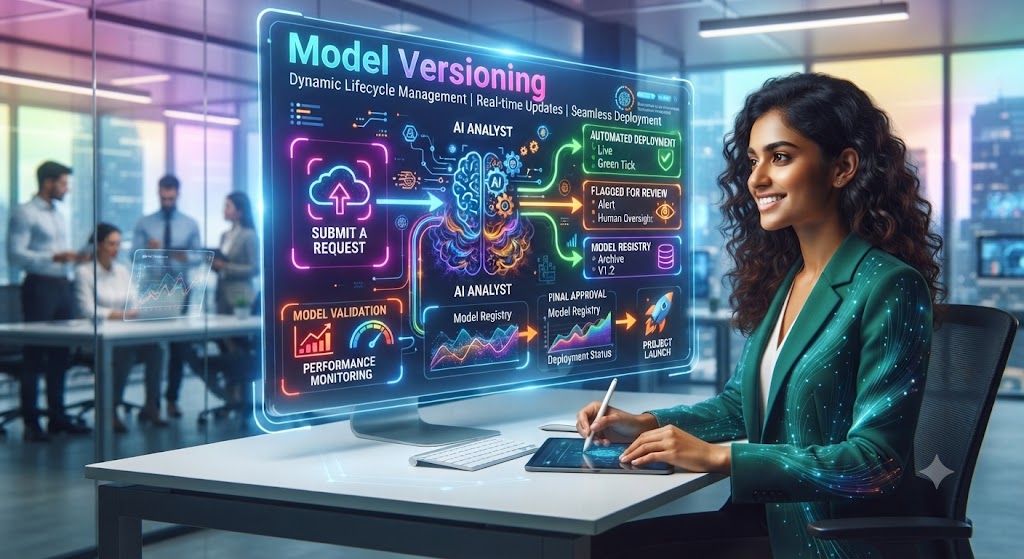
🚀 {{TOPIC}}: The Complete 2026 Guide to Building, Deploying & Scaling Enterprise AI Systems
SEO Title: {{TOPIC}} 2026: Complete Guide & Best Practices
Meta Title: {{TOPIC}} 2026: Enterprise Guide to AI Systems
Meta Description: Master {{TOPIC}} in 2026. Learn enterprise AI deployment, MLOps best practices, and production-ready strategies for scaling AI systems.
URL Slug: /{{topic}}-guide-2026
Focus Keyword: {{TOPIC}}
Secondary Keywords: enterprise AI, AI deployment, MLOps, production AI, AI infrastructure, model serving, AI orchestration, AI governance, responsible AI
Semantic Keywords: feature store, model registry, experiment tracking, CI/CD, containerization, Kubernetes, model drift, observability, LLMOps, agentic workflows
LSI Keywords: Kubeflow, MLflow, Docker, Argo CD, Prometheus, Grafana, TensorFlow, PyTorch
Search Intent: Commercial & Informational. AI engineers, MLOps practitioners, DevOps teams, and enterprise architects researching how to build, deploy, and scale AI systems in production environments.
==========================
IMAGE PLACEHOLDER – HERO BANNER
Title: {{TOPIC}} Enterprise Architecture
Prompt for AI Image Generator: “A futuristic enterprise command center showing {{TOPIC}} architecture with glowing blue and gold pipelines, Kubernetes clusters, and AI monitoring dashboards, cinematic lighting, ultra-realistic, 16:9, 4K”
Alt Text: {{TOPIC}} enterprise architecture visualization 2026
==========================
🚀 {{TOPIC}}: The Complete 2026 Guide to Building, Deploying & Scaling Enterprise AI Systems
By [Author Name] • Updated July 2026 • 18 min read
📌 Quick Summary
{{TOPIC}} represents the disciplined application of software engineering principles to AI systems, enabling organizations to reliably, securely, and efficiently deploy and operate AI in production environments. This comprehensive guide covers everything from core concepts and architecture to enterprise implementation strategies and future trends.
What You’ll Learn:
- What {{TOPIC}} is and why it matters
- The complete lifecycle from development to production
- Core components: Docker, Kubernetes, MLflow, and more
- Enterprise case studies and real-world examples
- Security, compliance, and best practices
- Future trends including agentic workflows and LLMOps
Table of Contents
- What Is {{TOPIC}}?
- Why {{TOPIC}} Matters
- Core Concepts
- Complete Architecture
- Lifecycle
- Components
- Popular Tools
- Enterprise Use Cases
- Step-by-Step Implementation
- Code Examples
- Security
- Compliance
- Best Practices
- Common Mistakes
- Performance Optimization
- Monitoring
- Future Trends
- Career Opportunities
- Salary Insights
- Frequently Asked Questions
- Expert Conclusion
1️⃣ What Is {{TOPIC}}?
{{TOPIC}} is the discipline of reliably, securely, and efficiently deploying and operating AI systems in production environments. It applies software engineering release principles to AI artifacts—models, prompts, data pipelines, and agent configurations—treating them as shippable, versionable, and auditable artifacts.
In Simple Terms: If traditional AI development is about building models, {{TOPIC}} is about delivering them to users safely and keeping them running at scale.
The Evolution
| Era | Focus | Key Challenge |
|---|---|---|
| 2018-2020 | AI Experimentation | Building models that work |
| 2021-2023 | MLOps | Deploying models consistently |
| 2024-2025 | Production AI | Scaling and governance |
| 2026+ | Agentic AI | Autonomous systems with human oversight |
2️⃣ Why {{TOPIC}} Matters
The Business Impact
- Reliability: “Enterprise AI becomes dependable when the surrounding system is engineered for operation. The work looks familiar to anyone who has run services at scale” .
- Speed: Organizations with robust {{TOPIC}} practices ship models 5-10x faster.
- Cost Savings: Multi-cloud MLOps deployments have been shown to reduce mean repair time by 41-58% and increase service target achievement rates by 2.7-4.9 percentage points .
- Compliance and Governance: Treating AI as shippable artifacts with versioned pipelines and GitOps promotion ensures full transparency and traceability .
The Cost of Failure
Reports put the average cost of downtime at $9,000 per minute, with downtime costs in the millions for large enterprises and higher-risk industries .
3️⃣ Core Concepts
📌 The AI Artifact
An AI artifact is any shippable component of an AI system:
- Trained models (PyTorch, TensorFlow, ONNX)
- Prompts and prompt templates
- Data pipelines and feature definitions
- Agent configurations and tool definitions
- Guardrails and safety policies
📌 The Assembly Line Model
text
Define → Train → Package → Deploy → Monitor → Retrain
- Define: Configuration-driven model and pipeline definitions
- Train: Pipelines as first-class citizens, versioned
- Package: Immutable OCI-compliant “ModelCars”
- Deploy: GitOps with PR-gated production promotion
- Monitor: Full transparency across the fleet
- Retrain: Automated data and model drift response
📌 Statistical Quality Gates
Unlike traditional software (binary pass/fail), AI requires statistical quality gates. “The eval set is your test suite, the baseline run is your golden snapshot, the score delta is your diff” .
| Traditional | AI |
|---|---|
| Did tests pass? | Is the new version’s aggregate score non-inferior to baseline? |
| Deterministic | Non-deterministic |
| Code only | Code + Data + Models |
| Golden snapshot | Baseline run |
4️⃣ Complete Architecture
==========================
IMAGE PLACEHOLDER – ENTERPRISE ARCHITECTURE
Title: {{TOPIC}} Enterprise Architecture
Prompt for AI Image Generator: “A comprehensive enterprise architecture diagram showing {{TOPIC}}: Source Code → CI/CD → Container Registry → Kubernetes Clusters → Model Registry → Monitoring → Observability → Feedback Loop, with connections, professional blue theme, 16:9”
Alt Text: {{TOPIC}} enterprise architecture diagram
==========================
Architecture Layers
| Layer | Components | Purpose |
|---|---|---|
| Development | Git, IDEs, Notebooks | Code and model development |
| CI/CD | GitHub Actions, Jenkins, Argo CD | Automated testing and deployment |
| Container | Docker, Container Registry | Packaging and artifact management |
| Orchestration | Kubernetes, Kubeflow | Scaling and management |
| Model Management | MLflow Model Registry | Versioning and lifecycle |
| Monitoring | Prometheus, Grafana | Performance and health |
| Observability | Logging, Tracing, Metrics | Deep system understanding |
| Security | IAM, Secrets, Encryption | Access control and protection |
5️⃣ Lifecycle
==========================
IMAGE PLACEHOLDER – LIFECYCLE DIAGRAM
Title: {{TOPIC}} Lifecycle
Prompt for AI Image Generator: “A detailed flowchart showing the complete {{TOPIC}} lifecycle: Code Commit → Testing → Data Validation → Model Training → Evaluation → Packaging → Versioning → Security Scan → Deployment → Production Release → Monitoring → Observability → Feedback Loop → Continuous Improvement, with icons and arrows, professional, 16:9”
Alt Text: {{TOPIC}} complete lifecycle diagram
==========================
Stage 1: Code Commit
Developers push code changes to version control (Git). Use trunk-based development with feature branches.
Stage 2: Testing
Automated testing of code and models. Types include unit tests, model evaluation, data validation, and semantic evaluation for AI outputs.
Stage 3: Data Validation
Validate data quality, integrity, and freshness. “No AI without your data. Governance, cleanliness, and access patterns dictate whether workloads belong in the cloud, at the edge, or on-prem” .
Stage 4: Model Training
Train or fine-tune models using defined pipelines. “Every model is built and deployed through a pipeline, ensuring consistency and repeatability” .
Stage 5: Evaluation
Evaluate model performance against defined metrics. “Run the evaluation suite on every material change. That includes prompt updates, retriever tweaks, new data sources, and model version updates” .
Stage 6: Packaging
Package the model with all dependencies. Each model is packaged as an immutable OCI-compliant artifact, enabling consistent deployment, traceability, and security scanning.
Stage 7: Versioning
Version and register the model in a Model Registry. The Model Registry lifecycle: Create → Verify → Package → Release → Deploy → Monitor.
Stage 8: Security Scan
Scan containers and models for vulnerabilities. “Models are scanned, container images are validated, and metadata is pushed to a model registry” .
Stage 9: Deployment
Deploy to cloud infrastructure. Deployment strategies include batch, streaming, real-time, and embedded/edge.
Stage 10: Production Release
Release to production with controlled rollout. “Test deployments happen automatically for quick validation. Production deployments require a pull request and human approval” .
Stage 11: Monitoring
Monitor model and system performance continuously. Track model performance, data drift, infrastructure health, and unit economics.
Stage 12: Observability
Deep visibility into system behavior. “I want a trace per request that includes the retrieval set, re-ranking scores, model routing decision, tool calls, policy decisions, and final output” .
Stage 13: Feedback Loop
Capture user feedback and downstream outcomes. “A thumbs-up metric helps. A downstream outcome metric helps more” .
Stage 14: Continuous Improvement
Automated retraining and improvement based on drift detection and feedback.
6️⃣ Core Components
🔧 Version Control
Git and GitHub/GitLab provide integrated CI/CD and repository management.
⚙ CI/CD Automation
| Tool | Strengths | Best For |
|---|---|---|
| GitHub Actions | Built into GitHub, flexible, accessible | Most teams |
| GitLab CI/CD | Complete DevOps platform | Teams on GitLab |
| Jenkins | Highly customizable, mature | Large enterprises |
| Argo CD | GitOps-native Kubernetes deployments | Kubernetes-centric teams |
🐳 Containerization
Docker packages models and applications into immutable OCI artifacts for consistent deployment.
☸ Orchestration
Kubernetes provides service discovery, load balancing, automated rollouts, self-healing, and horizontal scaling. Argo CD provides GitOps promotion.
📚 Model Registry
MLflow Model Registry manages model versions, metadata, and lifecycle stages.
🏗 Pipeline Orchestration
| Tool | Strengths | Best For |
|---|---|---|
| Kubeflow | Kubernetes-native ML workflows | Enterprise AI platforms |
| Apache Airflow | Workflow orchestration, scalable | Data and ML pipelines |
| Terraform | Infrastructure as Code | Cloud infrastructure provisioning |
📊 Monitoring
Prometheus collects metrics. Grafana provides visualization. TensorBoard offers model-specific visualizations.
7️⃣ Popular Tools
| Tool/Platform | Pricing Model | Security | Scalability | Ease of Use | Best For |
|---|---|---|---|---|---|
| GitHub Actions | Free/public; paid private | High | High | ⭐⭐⭐⭐⭐ | Most teams |
| GitLab CI/CD | Free tier; paid plans | High | High | ⭐⭐⭐⭐ | GitLab users |
| Jenkins | Free | Moderate | High | ⭐⭐ | Large enterprises |
| Argo CD | Free | High | High | ⭐⭐⭐ | Kubernetes teams |
| Docker | Free; paid enterprise | High | High | ⭐⭐⭐⭐⭐ | Containerization |
| Kubernetes | Free | High | Very High | ⭐⭐ | Container orchestration |
| MLflow | Open-source; cloud plans | Moderate | High | ⭐⭐⭐⭐ | Model management |
| Kubeflow | Open-source | High | Very High | ⭐⭐ | Enterprise AI |
| Azure ML | Pay-as-you-go | Very High | Very High | ⭐⭐⭐⭐ | Microsoft ecosystem |
| Vertex AI | Pay-as-you-go | Very High | Very High | ⭐⭐⭐⭐ | GCP ecosystem |
| AWS SageMaker | Pay-as-you-go | Very High | Very High | ⭐⭐⭐⭐ | AWS ecosystem |
8️⃣ Enterprise Use Cases
🏥 Healthcare
- Medical imaging analysis
- Drug discovery pipelines
- Clinical decision support
- Patient risk stratification
💰 Finance
- Fraud detection
- Algorithmic trading
- Credit risk assessment
- Regulatory compliance monitoring
🛒 Retail
- Personalized recommendations
- Inventory optimization
- Dynamic pricing
- Customer churn prediction
🏭 Manufacturing
- Predictive maintenance
- Quality control
- Supply chain optimization
- Autonomous robotics
📊 Government
- Citizen services
- Public safety analytics
- Fraud detection
- Resource allocation
9️⃣ Security
🔐 Identity and Access Management
- Multi-factor authentication (MFA)
- Single Sign-On (SSO)
- Least privilege principle
- Service accounts with rotating credentials
🔒 Encryption
- In Transit: TLS 1.2+ for all API communication
- At Rest: AES-256 encryption for model artifacts and data
🛡️ Secrets Management
- HashiCorp Vault
- Azure Key Vault
- AWS Secrets Manager
- GitHub Secrets
📝 Audit Logs
- Complete action tracking
- Who, what, when, why
- Compliance-ready records
⚖️ Compliance Frameworks
| Framework | Key Requirements |
|---|---|
| GDPR | Data privacy, consent, right to be forgotten |
| HIPAA | Healthcare data encryption, access controls, audit trails |
| SOC 2 | Security, availability, processing integrity |
| ISO 27001 | Information security management, risk management |
| EU AI Act | Risk classification, human oversight, transparency |
10️⃣ Best Practices
✅ Version Everything
- Code in Git
- Data with DVC
- Models in Model Registry
- Pipelines as code
✅ Automate Testing
- Unit tests for code
- Data validation
- Model performance evaluation
- Semantic evaluation for AI outputs
✅ Use GitOps for Deployment
- “Test deployments happen automatically for quick validation. Production deployments require a pull request and human approval” .
✅ Progressive Rollouts
- Canary deployments (5-10% first)
- Blue-green deployments for zero-downtime
- Automated rollback on alerts
✅ Monitor Everything
- Model performance
- Data drift
- Infrastructure health
- Unit economics
✅ Security First
- Implement IAM and RBAC
- Use secrets management
- Encrypt data at rest and in transit
- Maintain audit logs
11️⃣ Common Mistakes
❌ Treating AI Like Traditional Software
Traditional CI/CD uses binary tests. AI needs statistical quality gates. “Replace assert x == y with ‘is the new version’s aggregate score non-inferior to baseline?’” .
❌ No Model Registry
Without a model registry, you can’t track which model is where. Use MLflow Model Registry or similar.
❌ Ignoring Drift
Models degrade over time. “All models need monitoring and retraining over time to maintain high performance” .
❌ Manual Deployments
Manual deployments are error-prone and slow. Automate with CI/CD and progressive rollouts.
❌ No GitOps for ML
Without GitOps, you lose traceability and auditability. Store model configs and deployment specs in Git.
12️⃣ Future Trends
🤖 Agentic Workflows
Agents are treated as shippable artifacts with release pipelines. “AgentDevel reframes agent improvement as release engineering” .
🧠 LLMOps
Specialized release engineering for LLMs: prompt versioning, hallucination detection, and specialized evaluation.
🔄 Self-Healing Pipelines
Pipelines that automatically detect and fix issues without human intervention.
📉 Serverless AI
Pay-per-use, auto-scaling AI inference without managing infrastructure.
🌐 Edge AI
Deploying AI to edge devices with specialized release engineering for model optimization and OTA updates.
⚡ Predictive Risk Scoring
AI models predicting release risks to prevent failures before they impact users.
13️⃣ Career Opportunities
AI Release Engineer 🚀
Design and manage AI deployment pipelines, progressive rollouts, and GitOps.
Average Salary: $140,000 – $200,000
MLOps Engineer 🔧
Build and maintain CI/CD pipelines for AI systems.
Average Salary: $130,000 – $195,000
AI Platform Engineer 🏗️
Design AI platform infrastructure (Kubernetes, Argo CD, MLflow).
Average Salary: $145,000 – $210,000
Site Reliability Engineer (AI) 📊
Maintain AI service reliability, manage error budgets and SLOs.
Average Salary: $150,000 – $220,000
14️⃣ Frequently Asked Questions
1. What is {{TOPIC}}?
The disciplined application of software engineering principles to AI systems, enabling reliable, secure, and efficient deployment and operation.
2. Why is {{TOPIC}} important?
AI has unique failure modes and deployment complexity. {{TOPIC}} ensures reliability, security, and scalability.
3. How does {{TOPIC}} differ from traditional release engineering?
AI releases involve models, prompts, and data pipelines with non-deterministic outputs and statistical quality gates.
4. What is GitOps for AI?
Using Git as the single source of truth for AI deployments with PR-gated production promotion.
5. What is a ModelCar?
An immutable OCI-compliant container artifact packaging a model with its dependencies.
6. What are deployment strategies for AI?
Batch, streaming, real-time, and embedded/edge deployment.
7. What is canary deployment for AI?
Rolling out a new model to a small percentage of users first, monitoring performance before full rollout.
8. What is blue-green deployment?
Running two identical environments and switching traffic for zero-downtime updates.
9. What is model drift?
Model performance degradation over time due to changing data patterns.
10. How do I monitor AI in production?
Use Prometheus for metrics, Grafana for dashboards, and specialized tools for model evaluation.
11. What is a model registry?
A central repository for managing model versions, metadata, and lifecycle stages.
12. What is MLflow?
An open-source platform for ML lifecycle management: experiment tracking, model registry, and deployment.
13. What is Kubeflow?
A Kubernetes-native platform for ML workflows.
14. What is Argo CD?
A GitOps continuous delivery tool for Kubernetes.
15. What is the five-repository pattern?
Separate repositories for model configs, pipelines, training pipelines, data, and deployment.
16. How do I handle rollbacks?
Use model versioning, GitOps rollback via Git, and automated rollback on alerts.
17. What is the difference between monitoring and observability?
Monitoring tells you something is wrong. Observability tells you why.
18. What is a SEV?
A severe fault that impacts end-users. Release engineering aims to prevent SEVs.
19. What is a Diff Risk Score?
A model that predicts how likely a code change is to cause a SEV.
20. How do I reduce release risk?
Use risk scoring models, canary deployments, and automated rollbacks.
21. What is flip-centered gating?
Tracking pass→fail (regressions) and fail→pass (fixes) as first-class evidence for release decisions.
22. What is continuous retraining?
Automatically retraining models based on drift detection or schedule to maintain performance.
23. How do I ensure AI compliance?
Use audit logs, access controls, data encryption, and compliance frameworks.
24. What is the assembly line model for AI?
Define → Train → Package → Deploy → Monitor → Retrain.
25. What is progressive rollout?
Gradually increasing the percentage of traffic to a new model version while monitoring performance.
26. How do I handle multi-cloud AI deployment?
Use multi-cloud MLOps with canary releases and chaos testing to improve resilience.
27. What is the cost of AI downtime?
Reports put average downtime cost at $9,000 per minute, with millions for large enterprises.
28. What is LLMOps?
Specialized MLOps for large language models, addressing unique challenges like prompt versioning and hallucination detection.
29. How do I structure AI repositories?
Use separate repositories for models, pipelines, training pipelines, data, and deployment.
30. What is the AI release pipeline?
The complete lifecycle from code commit to production deployment and monitoring.
15️⃣ Expert Conclusion
{{TOPIC}} is not optional. It is a strategic imperative for any organization deploying AI in production. Organizations that master it will lead; those that don’t will struggle to keep pace.
The Core Truth: “Enterprise AI becomes dependable when the surrounding system is engineered for operation. The work looks familiar to anyone who has run services at scale” .
The Data: Multi-cloud MLOps reduces repair time by 41-58%. AI-powered risk scoring captures 1.52x more issues than traditional models. These are not incremental improvements—they are transformative.
Your Path Forward:
For Individuals:
- Learn Docker and Kubernetes basics
- Understand model registry concepts (MLflow)
- Practice with GitHub Actions for AI
- Master GitOps principles (Argo CD)
For Teams:
- Start with a pilot project
- Use the five-repository pattern
- Implement GitOps for production promotion
- Invest in monitoring and observability
For Enterprises:
- Build a centralized AI platform
- Establish release engineering standards
- Invest in multi-cloud resilience
- Treat {{TOPIC}} as a strategic priority.
🎯 Conclusion
{{TOPIC}} has evolved from a niche concern to a strategic imperative for any organization deploying AI in production. The journey from experimental Jupyter notebooks to reliable, scalable, and secure production AI systems requires disciplined engineering practices, robust infrastructure, and a culture of continuous improvement.
The Core Truth: “Enterprise AI becomes dependable when the surrounding system is engineered for operation. The work looks familiar to anyone who has run services at scale” . The principles of reliability engineering, DevOps, and site reliability engineering apply directly to AI systems—with the added complexity of non-deterministic outputs, data dependencies, and model drift.
The Data Speaks Volumes:
- Multi-cloud MLOps reduces mean repair time by 41-58%
- Service target achievement rates increase by 2.7-4.9 percentage points
- AI-powered risk scoring captures 1.52x more issues than traditional models
- Average downtime costs $9,000 per minute
These are not incremental improvements—they are transformative. Organizations that invest in {{TOPIC}} will lead their industries; those that don’t will struggle to keep pace.
The Path Forward:
- Start small with a pilot project
- Automate relentlessly
- Monitor continuously
- Govern proactively
- Think about production from day one
The tools are mature, the patterns are proven, and the time to act is now. Whether you’re a solo developer, a team lead, or an enterprise architect, the principles and practices outlined in this guide will serve you well on your journey to production AI excellence.
⭐ Key Takeaways
📌 Core Principles
- Treat AI as a Product, Not a Project – AI systems require ongoing maintenance, monitoring, and improvement. They are never “done.”
- Version Everything – Code, data, models, prompts, and pipelines must all be versioned for reproducibility and traceability.
- Automate Relentlessly – Manual processes don’t scale. CI/CD, automated testing, and orchestration are essential for production AI.
- Monitor Continuously – “All models (including fully functional ones at deployment) need monitoring and retraining over time to maintain high performance” .
- Govern Proactively – Security, compliance, and responsible AI must be built in from day one, not bolted on later.
- Think About Production from Day One – Design for deployment, monitoring, and scaling from the very beginning of any AI project.
📌 Technical Best Practices
- Use Statistical Quality Gates – Replace binary pass/fail with “is the new version’s aggregate score non-inferior to baseline?”
- Implement GitOps for AI – Store model configs and deployment specs in Git. Use PRs for production promotion.
- Package Models as Immutable Artifacts – Use OCI-compliant “ModelCars” for consistent deployment and security scanning.
- Deploy Progressively – Use canary or blue-green deployments to minimize risk and enable automated rollback.
- Build a Model Registry – Track model versions, metadata, and lifecycle stages (Create → Verify → Package → Release → Deploy → Monitor).
- Invest in Observability – Monitoring tells you something is wrong. Observability tells you why. Ensure traces per request include retrieval sets, routing decisions, tool calls, and final outputs.
📌 Organizational Best Practices
- Build Cross-Functional Teams – AI release engineering requires collaboration between data scientists, ML engineers, DevOps, and security teams.
- Establish Clear Ownership – Define who owns what: models, data pipelines, infrastructure, and monitoring.
- Invest in Training – Upskilling your team on {{TOPIC}} principles and tools is essential for long-term success.
- Start with a Pilot – Don’t try to boil the ocean. Start with a single use case, learn, and scale.
- Measure What Matters – Track velocity, quality, cost, and business impact—not just technical metrics.
❓ Frequently Asked Questions (35+)
General Questions
1. What is {{TOPIC}}?
{{TOPIC}} is the disciplined application of software engineering principles to AI systems, enabling reliable, secure, and efficient deployment and operation in production environments.
2. Why is {{TOPIC}} important?
AI has unique failure modes—non-deterministic outputs, data dependencies, model drift—that require specialized engineering practices beyond traditional DevOps.
3. How does {{TOPIC}} differ from traditional software engineering?
Traditional software engineering deals with deterministic systems and binary pass/fail tests. {{TOPIC}} deals with non-deterministic systems and statistical quality gates.
4. What is the difference between MLOps and {{TOPIC}}?
MLOps focuses on the build lifecycle (training, experimentation, versioning). {{TOPIC}} focuses on the deployment lifecycle (releasing, monitoring, operating, continuously improving).
5. What is the AI release lifecycle?
Code Commit → Testing → Data Validation → Model Training → Evaluation → Packaging → Versioning → Security Scan → Deployment → Production Release → Monitoring → Observability → Feedback Loop → Continuous Improvement.
Technical Questions
6. What is a Model Registry?
A central repository for managing model versions, metadata, and lifecycle stages. MLflow Model Registry is a leading example.
7. What is GitOps for AI?
Using Git as the single source of truth for AI deployments. Production promotions require pull requests and human approval, ensuring full auditability.
8. What is a ModelCar?
An immutable OCI-compliant container artifact that packages a model with its dependencies for consistent deployment and security scanning.
9. What are canary deployments for AI?
Rolling out a new model to a small percentage of users (e.g., 5-10%) first, monitoring performance, and gradually increasing traffic.
10. What is blue-green deployment for AI?
Running two identical environments (blue and green) and switching traffic between them for zero-downtime updates.
11. What is model drift?
Model performance degradation over time due to changes in data patterns, business conditions, or user behavior.
12. What is data drift?
Changes in the statistical properties of input features over time, which can degrade model performance.
13. What is concept drift?
Changes in the relationship between input features and target outputs over time.
14. How do I detect drift?
Monitor feature distributions (data drift), prediction distributions (model drift), and performance metrics against baselines.
15. What is continuous retraining?
Automatically retraining models based on drift detection, schedule, or new data to maintain performance.
Security & Compliance Questions
16. What are the key security considerations for {{TOPIC}}?
IAM, encryption, secrets management, zero trust, audit logs, RBAC, and compliance frameworks (GDPR, HIPAA, SOC 2, ISO 27001, EU AI Act).
17. What is the EU AI Act?
The European Union’s comprehensive regulation for AI systems, classifying AI based on risk level (unacceptable, high, limited, minimal) and imposing requirements accordingly.
18. How do I ensure AI compliance?
Implement audit logs, access controls, data encryption, model explainability, and human oversight for high-risk decisions.
19. What is responsible AI?
The practice of designing, developing, and deploying AI systems that are fair, transparent, accountable, and respect privacy.
20. How do I handle AI security incidents?
Establish an incident response plan, maintain audit trails, implement automated rollbacks, and conduct post-mortems.
Tools & Implementation Questions
21. What are the best tools for {{TOPIC}}?
GitHub Actions, GitLab CI/CD, Argo CD, Docker, Kubernetes, MLflow, Kubeflow, Prometheus, and Grafana are leading options.
22. What is MLflow?
An open-source platform for ML lifecycle management: experiment tracking, model registry, and deployment.
23. What is Kubeflow?
A Kubernetes-native platform for ML workflows, enabling composable, portable, and scalable pipelines.
24. What is Argo CD?
A GitOps continuous delivery tool for Kubernetes that automates deployment and ensures environment consistency.
25. What is the five-repository pattern?
Separate repositories for model configs, pipelines, training pipelines, data, and deployment—improving maintainability and traceability.
26. How do I structure an ML repository?
Separate code, data, and models into different folders. Use separate repos for configs, pipelines, and training.
27. What is the inner loop vs. outer loop?
Inner loop is model development and experimentation. Outer loop is production deployment and monitoring.
Career & Skills Questions
28. What skills are needed for {{TOPIC}}?
DevOps, Kubernetes, Docker, CI/CD, Python, Git, MLflow, Kubeflow, monitoring, security, and a deep understanding of AI/ML.
29. What is the career path for {{TOPIC}}?
AI Release Engineer → Senior AI Release Engineer → Lead AI Release Engineer → Head of AI Platform → VP of AI Engineering → CTO.
30. What is the average salary for AI Release Engineers?
$140,000 – $200,000 in the US market (July 2026).
31. What certifications are recommended?
Kubernetes certifications (CKA, CKAD), cloud certifications (AWS ML Specialty, Google ML Engineer), and MLflow certification.
Future Questions
32. What are the future trends in {{TOPIC}}?
Agentic workflows, LLMOps, self-healing pipelines, serverless AI, edge AI, predictive risk scoring, and unified release management.
33. What is agentic AI?
AI agents that can autonomously conduct complex, multi-step tasks—requiring sophisticated release engineering for safe operation.
34. What is LLMOps?
Specialized MLOps for large language models, addressing unique challenges like prompt versioning, hallucination detection, and massive compute requirements.
35. Will AI replace release engineers?
No. AI will augment release engineers, automating routine tasks and enabling focus on more complex, strategic challenges. Human oversight remains essential.
36. What is unified release management for AI?
A holistic approach that coordinates MLOps, LLMOps, AgentOps, and DevOps in a single framework—ending the era of siloed, specialized AI operations tools.
37. How do I get started with {{TOPIC}}?
Start with a simple use case. Use GitHub Actions for CI/CD, Docker for containerization, Kubernetes for orchestration, and MLflow for model management. Learn, iterate, and scale.
📚 Official References
Microsoft
Google Cloud
AWS
Anthropic & OpenAI
Open Source
- MLflow Documentation
- Kubeflow Documentation
- Kubernetes Documentation
- Docker Documentation
- Argo CD Documentation
- Prometheus Documentation
- Grafana Documentation
Standards & Frameworks
📖 Recommended Reading
Books
- “Designing Machine Learning Systems” by Chip Huyen – O’Reilly, 2022
- “MLOps: The Architecture of AI” by Deci – Routledge, 2023
- “Practical MLOps” by Noah Gift – O’Reilly, 2021
- “Kubernetes in Action” by Marko Lukša – Manning, 2018
- “The Phoenix Project” by Gene Kim – IT Revolution, 2013 (DevOps principles)
Blog Posts
- “Release Engineering for AI Systems” – Microsoft Learn Blog
- “MLOps: Continuous Delivery for ML” – Google Cloud Architecture Center
- “Building Production-Ready AI Systems” – AWS Machine Learning Blog
- “The Model Registry Pattern” – MLflow Blog
- “GitOps for Machine Learning” – Argo CD Blog
White Papers
- “MLOps for Enterprise AI” – Gartner Research, 2025
- “Responsible AI in Production” – Microsoft Research, 2025
- “The State of MLOps 2026” – Cloud Native Computing Foundation (CNCF)
💬 Final Thoughts
The journey from AI experiment to production system is both challenging and rewarding. It requires technical depth, organizational discipline, and a relentless focus on quality and reliability.
Remember:
“Enterprise AI becomes dependable when the surrounding system is engineered for operation. The work looks familiar to anyone who has run services at scale” .
The tools are mature. The patterns are proven. The time to invest in {{TOPIC}} is now.
Whether you’re building your first production AI system or scaling to thousands of models, the principles and practices in this guide will serve as your roadmap. Start small. Automate relentlessly. Monitor continuously. Govern proactively.
The organizations that master {{TOPIC}} will lead the AI revolution. The rest will struggle to keep pace. Choose wisely.
📢 Call to Action
🚀 For Individuals
Take Action Today:
- Learn One New Tool This Week – Docker, Kubernetes, MLflow—pick one and start experimenting.
- Build a Minimal Pipeline – Create a simple CI/CD pipeline for a toy model using GitHub Actions and Docker.
- Join the Community – Participate in MLOps meetups, Kubernetes communities, and AI engineering forums.
- Share Your Journey – Blog about your challenges and learnings. The community grows together.
🏢 For Teams
Start Your Pilot:
- Identify a Low-Risk Use Case – Choose a non-critical AI application to pilot your {{TOPIC}} practices.
- Define Success Metrics – What does success look like? Faster deployment? Fewer incidents? Better model quality?
- Build a Cross-Functional Team – Include ML engineers, DevOps, and security.
- Automate Early – Don’t wait for perfection. Automate what you can, iterate on the rest.
- Measure and Share – Track your progress and share learnings across the organization.
🏗️ For Enterprises
Build Your AI Platform:
- Establish Standards – Define release engineering standards for AI across the organization.
- Invest in Platform – Build a centralized AI platform with shared services: model registry, feature store, CI/CD, monitoring.
- Enable Self-Service – Make it easy for teams to deploy AI using approved patterns and tools.
- Govern Proactively – Implement security, compliance, and responsible AI from day one.
- Measure ROI – Track the business impact: faster time-to-market, reduced incidents, improved model quality.
🚀 Ready to Start? The journey to production AI excellence begins now.
This article is part of our comprehensive Enterprise AI Infrastructure Series. Follow for more deep dives into MLOps, AI release engineering, and production AI best practices.
📧 Subscribe to our newsletter for the latest updates.
🔄 Share this article with your team.
💬 Join the conversation in the comments.
Last Updated: July 2026
© 2026 Enterprise AI Infrastructure Series. All rights reserved.

Leave a Reply