Introduction
Getting a large language model to produce an impressive result in a controlled demo is, at this point, genuinely straightforward. Capable models are widely accessible, APIs are simple to integrate, and initial tooling has matured considerably. What remains hard — and where most enterprise AI initiatives actually stall — is everything that happens after that first successful call: hallucinations that show up unpredictably in production, prompts that drift and degrade over time, retrieval quality that’s difficult to measure, costs that climb faster than expected, latency under real load, and the monitoring, security, and governance needed to trust the system with real business processes.
This is not a model capability problem. It’s an operations problem — and it’s exactly the problem LLMOps exists to solve.
What Is LLMOps?
LLMOps is, roughly, what DevOps is to software and MLOps is to traditional machine learning — a set of practices for managing the full lifecycle of a production system, applied specifically to large language models. But that comparison undersells how different the day-to-day work actually is. Most enterprise teams building with LLMs aren’t training models from scratch; they’re integrating model APIs into products, iterating on prompts, managing retrieval, calling tools, and trying to keep the whole system debuggable as it grows more complex. LLMOps is best understood as the discipline covering everything that happens around the model call, including:
- Prompt engineering — designing and refining the instructions that shape model behavior
- Evaluation — systematically measuring output quality, not just spot-checking it
- Deployment — getting LLM-powered features into production reliably
- Monitoring — tracking behavior, quality, and cost continuously after launch
- Governance — ensuring outputs are auditable, compliant, and appropriately controlled
- Versioning — tracking changes to prompts, models, and retrieval configurations over time
- Continuous improvement — using production feedback to keep refining the system
Why LLMOps Matters
- LLMs change rapidly — new model versions, capabilities, and pricing shift frequently enough that systems built around a single fixed model choice age quickly
- Prompts evolve — a single word change in a prompt can meaningfully shift accuracy, tone, or behavior, and prompts have effectively become core application logic for the large majority of enterprises using LLMs
- Costs increase quickly — token usage scales with adoption, and without visibility, spend can climb well ahead of expectations
- Hallucinations must be monitored — not just tested for once before launch, but tracked continuously as usage patterns evolve
- Enterprise compliance — regulated industries need auditable records of what the system did and why
- Secure deployment — LLM applications often touch sensitive data and need the same security discipline as any other production system
LLMOps Lifecycle
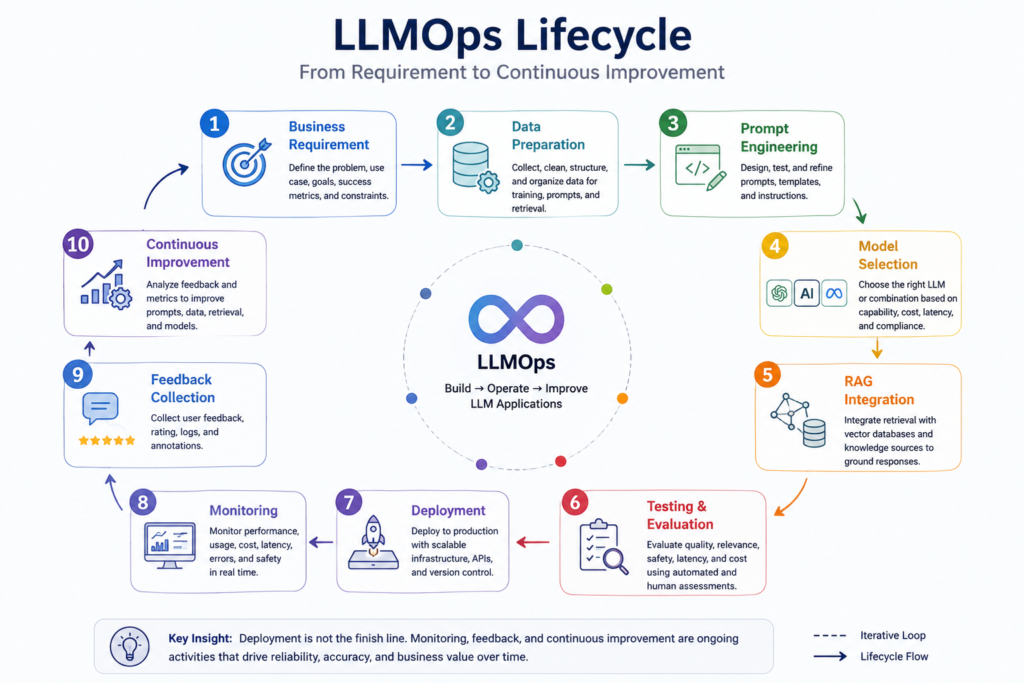
A mature LLMOps practice generally follows a recognizable lifecycle:
Business requirement → Data preparation → Prompt engineering → Model selection → RAG integration → Testing & evaluation → Deployment → Monitoring → Feedback collection → Continuous improvement
The critical detail this lifecycle makes visible: deployment isn’t the finish line. Monitoring, feedback collection, and continuous improvement come after it and typically account for a large share of the ongoing work — which is exactly where naive LLM projects tend to stop investing once something is “live.”
Core Components
- Large language models — the reasoning core of the application
- Prompt management — versioning, testing, and controlling changes to prompts as first-class application logic
- Vector database — supporting retrieval for grounded, RAG-based responses
- RAG pipeline — connecting the model to relevant, current enterprise knowledge
- Model gateway — routing requests across models and providers, and centralizing cost tracking
- APIs — connecting the LLM application to enterprise systems
- Evaluation framework — systematically measuring output quality, often using a combination of ground-truth comparison and LLM-as-judge techniques
- Monitoring — tracing, logging, and tracking behavior in production
- Guardrails — filtering and compliance checks applied at both input and output stages
- Human feedback — structured collection of corrections and preferences to inform ongoing improvement
LLMOps Architecture
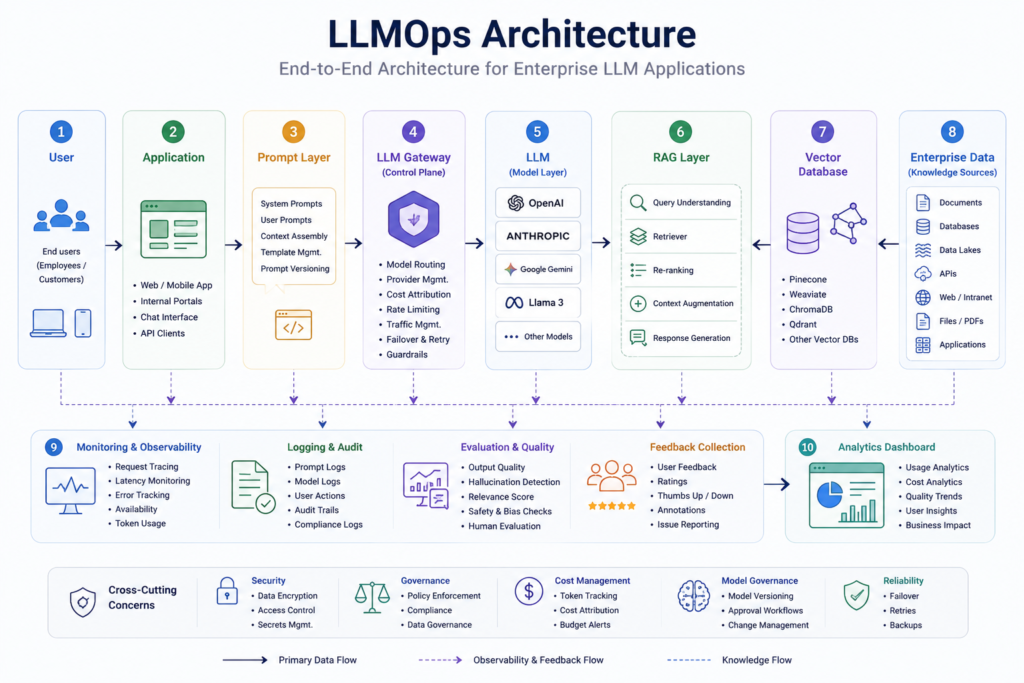
A representative enterprise LLMOps architecture looks like this:
User → Application → Prompt layer → LLM gateway → LLM → RAG → Vector database → Enterprise data → Monitoring → Analytics dashboard
The LLM gateway is worth calling out specifically — it’s become a standard architectural layer in 2026 enterprise deployments, sitting between the application and the underlying models to handle routing across providers, cost attribution, and traffic management, rather than wiring the application directly to a single model API.
Traditional MLOps vs. LLMOps
| MLOps | LLMOps |
|---|---|
| ML models | Large language models |
| Model retraining | Prompt iteration |
| Structured datasets | Structured + unstructured knowledge |
| Accuracy metrics | Quality, relevance, hallucination, latency |
| Batch inference | Interactive conversational AI |
The shift from “retrain the model” to “iterate the prompt and retrieval” as the primary lever for improvement is probably the single biggest practical difference — it changes both how fast teams can improve a system and what kind of monitoring actually catches regressions.
Enterprise Use Cases
- Enterprise Chatbots — Deliver instant, AI-powered responses to employee and customer queries using enterprise knowledge and business systems.
- AI Customer Support — Automate ticket resolution, answer customer inquiries, and intelligently escalate complex issues to human support teams.
- Knowledge Assistants — Help employees quickly find accurate information from enterprise documents, policies, manuals, and internal knowledge bases.
- Document Search — Enable natural language search across contracts, reports, SOPs, technical documentation, and other enterprise content.
- AI Copilots — Assist employees with drafting content, summarizing information, generating code, analyzing data, and completing daily business tasks.
- Healthcare Assistants — Support healthcare professionals by retrieving clinical information, summarizing patient records, and assisting with administrative workflows.
- Legal Research — Accelerate legal analysis by searching case law, contracts, regulations, and compliance documents while providing relevant references.
- Software Development Assistants — Help developers generate code, explain complex logic, review pull requests, debug applications, and create technical documentation.
- HR Assistants — Streamline recruitment, employee onboarding, policy assistance, leave management, and HR-related support through conversational AI.
Challenges
- Hallucinations — confidently incorrect outputs that require continuous monitoring, not one-time testing
- Prompt drift — small, often undocumented prompt changes that gradually shift behavior in unintended ways
- Context window limitations — constraints on how much information can be provided to the model at once
- Retrieval failures — the RAG-specific failure modes covered earlier in this series, which directly affect LLM output quality
- Latency — response time under real production load and traffic patterns
- Cost optimization — keeping token spend proportional to the value delivered as usage scales
- Security — protecting the application and its data from misuse
- Compliance — meeting regulatory requirements for auditability and data handling
- Data privacy — ensuring sensitive information is handled appropriately throughout the pipeline
- Model versioning — tracking which model version produced which output, and managing transitions between versions
- Vendor lock-in — architectural decisions that make it difficult to switch model providers later
A trend worth flagging: as more enterprise systems shift from single-model applications to multi-step AI agents calling tools and APIs, observability and governance get meaningfully harder — tracing and evaluating a sequence of actions across systems is a different, more demanding problem than monitoring a single model call, and it’s currently where much of the frontier of LLMOps tooling is being built.
Technologies Used
A broad ecosystem of models, frameworks, and tooling supports enterprise LLMOps today. These are presented as common industry technologies, not a specific implementation:
Model providers — OpenAI, Anthropic Claude, Google Gemini, Azure AI Foundry, AWS Bedrock
Frameworks — LangChain, LangGraph, LlamaIndex
Experiment tracking & model registry — MLflow
Observability & evaluation — LangSmith, Langfuse, Arize (Phoenix and AX)
Vector databases — Weaviate, Pinecone, ChromaDB
Graph databases — Neo4j
Infrastructure — Docker, Kubernetes
Most enterprise LLMOps stacks combine several specialized tools rather than relying on one platform for everything — commonly a tracing/prompt-management tool, a separate observability platform, a model registry, and an LLM gateway for cost attribution and routing, working together rather than any single tool covering the full stack.
Best Practices
- Use RAG instead of fine-tuning when appropriate — for giving the model access to current or proprietary knowledge, RAG is generally faster and cheaper to keep updated
- Version prompts — treat prompts as application logic requiring the same version control and rollback discipline as code
- Evaluate continuously — not just before launch, but as an ongoing part of operating the system
- Monitor hallucinations — track them as a first-class production metric, not an occasional spot-check
- Track token usage — cost visibility needs to be built in from the start, not discovered after a large bill
- Secure enterprise data — apply the same data protection discipline to LLM pipelines as any other system handling sensitive information
- Apply human review — particularly for high-stakes or customer-facing outputs
- Optimize latency — measure and address response time as a standard operational metric
- Maintain audit logs — every input, output, and decision path should be traceable
- Monitor costs — continuously, not just periodically, since usage patterns and pricing both shift over time
Future Trends
- Agentic LLMOps — operational practices extending to cover multi-step, tool-using AI agents, not just single-turn model calls
- Multi-agent orchestration — LLMOps practices adapting to the coordination challenges covered in our Multi-Agent Architectures guide
- Autonomous evaluation — increasing use of LLM-as-judge techniques to catch quality regressions at scale, faster than manual review can
- AI observability — maturing from a novelty into required infrastructure, with dedicated tracing, cost tracking, and evaluation tooling now standard
- Prompt optimization — more systematic, data-driven approaches to improving prompts rather than manual trial and error
- MCP integration — the Model Context Protocol becoming a standard way to connect LLM applications to tools and data sources
- Self-healing AI pipelines — systems that detect and adapt to certain classes of failure automatically
- Enterprise AI governance — growing emphasis on auditability and control as LLM applications take on more consequential work
How MHTECHIN Supports Enterprise LLMOps
MHTECHIN helps organizations design and deploy enterprise AI applications by integrating LLMs with secure APIs, RAG pipelines, AI workflow automation, monitoring, governance, and scalable cloud infrastructure. Rather than focusing solely on model deployment, MHTECHIN emphasizes building reliable AI systems that align with enterprise security, compliance, and operational requirements — the operational discipline that determines whether an LLM application delivers durable value or quietly becomes a liability.
Conclusion
LLMOps is about operating enterprise AI reliably — not just deploying an LLM. It ties together everything this series has covered: the deployment discipline from our first guide, the retrieval and grounding techniques from RAG through Knowledge Graph Integration, the coordination patterns from Agentic AI Systems and Multi-Agent Architectures, and the process automation from AI Workflow Automation — all brought under a single operational framework of monitoring, governance, evaluation, and continuous improvement.
The organizations that succeed with enterprise AI aren’t the ones with the most impressive demo. They’re the ones that treat everything after the demo — prompt management, retrieval quality, cost visibility, hallucination monitoring, security, and governance — as seriously as the model itself. That discipline is what LLMOps actually is.
Frequently Asked Questions (FAQs)
1. What is LLMOps? LLMOps is the set of practices — prompt management, evaluation, deployment, monitoring, and governance — used to build, deploy, and reliably operate large language model applications in production.
2. How is LLMOps different from MLOps? MLOps centers on training and retraining traditional ML models against structured datasets. LLMOps centers on prompt iteration, retrieval integration, and monitoring for quality, relevance, and hallucination — working with pre-trained models rather than training from scratch, and often handling interactive, conversational use cases rather than batch inference.
3. Why is LLMOps important? Because building an LLM demo is easy, but operating one reliably — managing cost, latency, hallucinations, security, and compliance at scale — requires structured, ongoing operational discipline that most organizations underestimate.
4. What are the stages of the LLMOps lifecycle? A typical lifecycle runs from business requirement through data preparation, prompt engineering, model selection, RAG integration, testing and evaluation, deployment, monitoring, feedback collection, and continuous improvement.
5. Which tools are used in LLMOps? Common categories include model providers (OpenAI, Anthropic, Google, Azure, AWS Bedrock), frameworks (LangChain, LangGraph, LlamaIndex), observability and evaluation platforms (LangSmith, Langfuse, Arize), vector databases (Pinecone, Weaviate, ChromaDB), and infrastructure tools like Docker and Kubernetes — most enterprise stacks combine several rather than relying on one platform.
6. What are the biggest LLMOps challenges? Hallucinations, prompt drift, retrieval failures, latency, cost control, security, compliance, and — increasingly — the added complexity of observing and governing multi-step AI agents rather than single model calls.
7. Does LLMOps require RAG? Not strictly, but most enterprise LLM applications rely on RAG to ground responses in current, proprietary knowledge, which makes retrieval quality and RAG pipeline health a core part of what LLMOps needs to monitor.
8. How does LLMOps reduce hallucinations? Primarily through continuous monitoring and evaluation rather than elimination — tracking hallucination rates as an ongoing production metric, grounding responses through RAG, applying guardrails at input and output stages, and incorporating human review for high-stakes outputs.

Leave a Reply