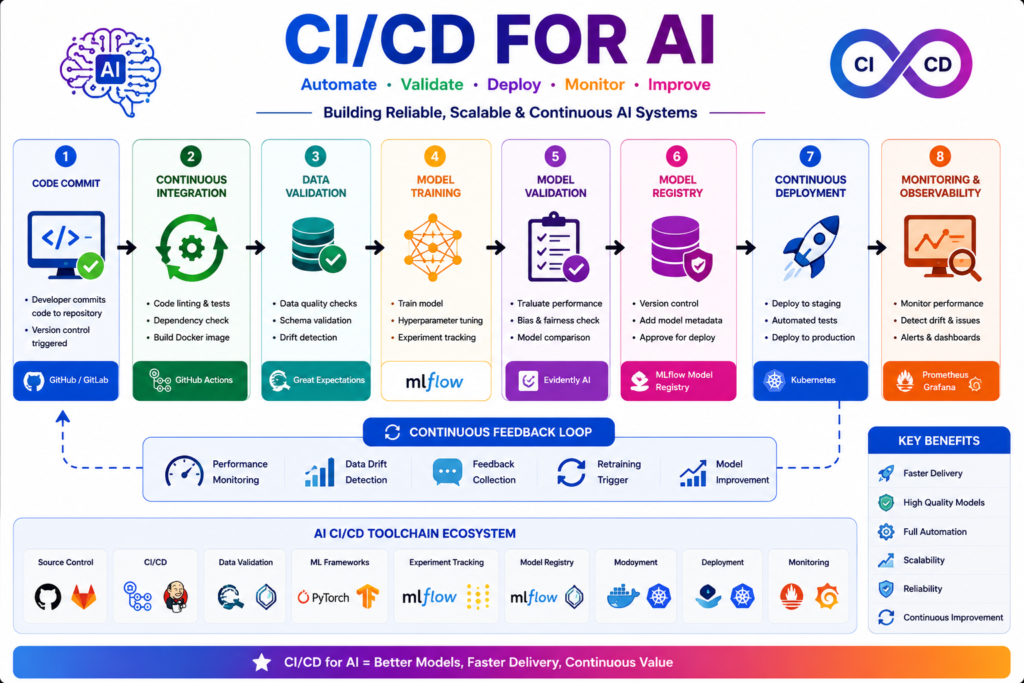
🚀 CI/CD for AI: The Complete 2026 Guide to Building, Testing, Deploying & Scaling Production AI Systems
SEO Title: CI/CD for AI 2026: Complete Guide to Production AI Pipelines
Meta Title: CI/CD for AI 2026: Complete Production Pipeline Guide
Meta Description: Master CI/CD for AI in 2026. Learn MLOps best practices, GitHub Actions, containerization, and enterprise deployment strategies for production AI systems.
URL Slug: /ci-cd-for-ai-guide-2026
Focus Keyword: CI/CD for AI
Secondary Keywords: AI CI/CD pipeline, MLOps, production AI, AI deployment, continuous integration for AI, GitHub Actions ML, machine learning CI/CD
Semantic Keywords: continuous delivery, model registry, feature store, model drift, containerization, orchestration, LLMOps, agentic workflows
LSI Keywords: Kubeflow, MLflow, Docker, Kubernetes, model monitoring, experiment tracking, automated testing
Search Intent: Commercial & Informational. AI engineers, MLOps practitioners, and DevOps teams researching how to implement robust CI/CD pipelines for AI and machine learning systems in production environments.
==========================
IMAGE PLACEHOLDER – HERO BANNER
Title: CI/CD for AI Pipeline Architecture 2026
Prompt for AI Image Generator: “A futuristic DevOps dashboard showing an automated CI/CD pipeline for AI, with glowing blue and purple pipelines connecting code commits to model deployment, Kubernetes clusters, and monitoring dashboards, cinematic lighting, 16:9, 4K quality”
Alt Text: CI/CD for AI pipeline architecture visualization 2026
==========================
🚀 CI/CD for AI: The Complete 2026 Guide to Building, Testing, Deploying & Scaling Production AI Systems
By [Author Name] • Updated July 2026 • 18 min read
Introduction
AI coding assistants can generate code in seconds. AI models can achieve near-perfect accuracy in notebooks. But shipping AI to production? That’s where the real challenge begins.
Here’s the paradox: while AI tools help developers write more code than ever, delivery throughput is actually decreasing by 1.5% and stability is worsening by 7.5% . The path from “we built it” to “it’s safely in front of customers” has become more fragile—not less.
Why? Because deploying AI is no longer a machine learning experiment. It’s one of the most complex system integration challenges in modern software engineering .
In 2026, AI deployment means integrating a full AI application stack—models, prompts, data pipelines, RAG components, agents, tools, and guardrails—into your production environment . You’re not just deploying “a model.” You’re deploying the instructions that define behavior, the engines that do reasoning, the data that feeds context, the agents that take actions, and the guardrails that keep it all safe.
What You Will Learn:
- What CI/CD for AI means in 2026
- Complete AI CI/CD lifecycle from code commit to production
- Core components: GitHub Actions, Docker, Kubernetes, MLflow
- Best tools comparison and enterprise adoption strategies
- Real-world implementation with code examples
- Security, monitoring, and future trends
Table of Contents
- What is CI/CD for AI?
- Complete AI CI/CD Lifecycle
- Core Components
- CI/CD Architecture
- Best Tools Comparison
- Enterprise Case Studies
- Security Best Practices
- Monitoring & Observability
- Common Mistakes
- Best Practices
- Production Checklist
- Future Trends
- Career Opportunities
- Salary Insights
- Frequently Asked Questions
- Expert Conclusion
1. What is CI/CD for AI?
📌 Definition
CI/CD for AI is the application of continuous integration and continuous deployment principles to machine learning and AI systems. It extends traditional DevOps practices to handle the unique challenges of AI: non-deterministic outputs, data dependencies, model drift, and the absence of a clear “correct” answer for most inputs .
🧠 Mental Model Shift
The mental model for CI/CD for AI is to replace the binary build gate with a statistical quality gate .
| Traditional CI/CD | CI/CD for AI |
|---|---|
| “Did the tests pass?” (Binary) | “Is the new version’s aggregate score non-inferior to baseline?” (Statistical) |
| Deterministic systems | Non-deterministic systems |
| Code only | Code + Data + Models |
| Test suite | Eval set |
| Golden snapshot | Baseline run |
| Pass/fail diff | Score delta |
🎯 The MLOps Connection
MLOps builds on DevOps principles to improve workflow efficiency across the machine learning lifecycle . This creates:
- Faster experimentation and model development
- Quicker model deployment to production
- Better quality assurance and end-to-end lineage tracking
📚 Real-World Analogy
Think of CI/CD for AI as an automated assembly line for AI. Raw materials (data, code, configurations) enter at one end. The pipeline automatically:
- Tests every component
- Trains and validates models
- Packages everything into containers
- Deploys to staging and production
- Monitors performance continuously
- Triggers retraining when needed
The result is a system that turns AI from a fragile experiment into a reliable, scalable, and continuously improving business capability .
💡 PRO TIP: “The eval set is your test suite, the baseline run is your golden snapshot, the score delta is your diff, and production monitoring is just the same gate running continuously on sampled live traffic instead of once at merge” .
2. Complete AI CI/CD Lifecycle
==========================
IMAGE PLACEHOLDER – CI/CD PIPELINE FLOWCHART
Title: Complete CI/CD for AI Pipeline
Prompt for AI Image Generator: “A detailed flowchart showing the complete CI/CD for AI lifecycle: Code Commit → Continuous Integration → Data Validation → Automated Testing → Model Training → Model Evaluation → Model Packaging → Docker → Kubernetes → Production Release → Monitoring → Continuous Retraining, with arrows and icons, professional blue theme, 16:9”
Alt Text: Complete CI/CD for AI pipeline lifecycle diagram
==========================
The 12-Stage Pipeline
📥 Stage 1: Code Commit
What: Developers push code changes to version control (Git).
Why: Every change should be tracked, reviewed, and traceable.
Best Practice: Use trunk-based development with feature branches. Production code lives in the main branch, and data scientists create feature branches for experimentation .
🔍 Stage 2: Continuous Integration
What: Automated build and test process triggered by code changes.
Why: Catch issues early—before they reach production.
How: When a pull request is created, a GitHub Actions workflow triggers to verify the code. The workflow runs linting, unit tests, and validation .
🧹 Stage 3: Data Validation
What: Validate data quality, schema, and integrity.
Why: AI is only as good as its data. Bad data = bad models.
How: Automated data validation checks for missing values, schema changes, and data drift.
🧪 Stage 4: Automated Testing
What: Run comprehensive tests on the AI system.
Why: AI systems are non-deterministic. Traditional binary tests fail. You need semantic evaluation .
Test Types:
- Unit Tests: Individual functions and components
- Integration Tests: Component interactions
- Behavioral Tests: Does the model behave as expected?
- Regression Tests: Has performance degraded?
- Format Tests: Does output meet structural requirements?
🧠 Stage 5: Model Training
What: Train the model using defined pipelines.
Why: Automate the training process for reproducibility.
How: Training pipelines include data preparation, feature engineering, and model training steps .
📊 Stage 6: Model Evaluation
What: Evaluate model performance against defined metrics.
Why: Ensure the model meets quality standards before deployment.
How: Run evaluation suites, compare against baseline, and enforce acceptance thresholds .
📦 Stage 7: Model Packaging
What: Package the model with all dependencies.
Why: Consistent deployment requires consistent packaging.
How: Create immutable OCI-compliant artifacts (“ModelCars”) that include the model, code, and dependencies .
🐳 Stage 8: Docker Containerization
What: Containerize the packaged model using Docker.
Why: Containers ensure your model runs the same way everywhere—from development to production.
How: Build a Docker image with the model, runtime, and dependencies.
☸ Stage 9: Kubernetes Deployment
What: Deploy containers to Kubernetes for orchestration.
Why: Kubernetes handles scaling, failover, and updates automatically.
How: Define Kubernetes Deployments and Services, use rolling updates for zero-downtime deployment.
🚀 Stage 10: Production Release
What: Deploy to production with automated approvals.
Why: Safe, controlled releases reduce risk.
Strategies:
- Canary Deployments: Roll out to 5-10% of users first
- Blue-Green Deployments: Zero-downtime switching between environments
- GitOps Promotion: Production deployments require pull request and human approval
📈 Stage 11: Monitoring
What: Continuously monitor model and system performance.
Why: “All models (including fully functional ones at deployment) need monitoring and retraining over time to maintain high performance” .
What to Monitor:
- Model performance (accuracy, latency)
- Data drift (input feature distributions)
- Prediction drift (output distribution changes)
- Infrastructure health (CPU, memory, GPU)
- Cost (token usage, compute)
🔄 Stage 12: Continuous Retraining
What: Automatically retrain models based on new data or drift detection.
Why: Models degrade over time as data patterns change.
How: Trigger retraining pipelines when drift exceeds thresholds or on a regular schedule.
3. Core Components
==========================
IMAGE PLACEHOLDER – CORE COMPONENTS
Title: CI/CD for AI Core Components
Prompt for AI Image Generator: “A modern infographic showing CI/CD for AI core components: GitHub, GitHub Actions, Docker, Kubernetes, MLflow, Kubeflow, Airflow, Prometheus, Grafana, with icons and connections, clean design, 16:9”
Alt Text: CI/CD for AI core components infographic
==========================
🔧 Version Control
Git: The foundation of CI/CD. Version everything—code, configurations, and model definitions.
Best Practice: Store model configurations, training pipelines, and deployment specs in separate repositories. Red Hat’s “nine-thousand” approach uses five repositories: models, pipelines, training pipelines, data, and deployment .
⚙️ CI/CD Automation
| Tool | Strengths | Best For |
|---|---|---|
| GitHub Actions | Built into GitHub, accessible, flexible | Most teams; beginner-friendly |
| GitLab CI/CD | Complete DevOps platform | Teams already using GitLab |
| Jenkins | Highly customizable, mature | Large enterprises with complex needs |
GitHub Actions Example:
yaml
name: ML-CI
on:
  pull_request:
    branches: [ main ]

jobs:
  verify:
    runs-on: ubuntu-latest
    steps:
      - uses: actions/checkout@v3
      - uses: actions/setup-python@v4
      - name: Install dependencies
        run: pip install -r requirements.txt
      - name: Run linting
        run: pylint src/
      - name: Run unit tests
        run: pytest tests/
      - name: Validate data
        run: python scripts/validate_data.py
🐳 Containerization
Docker: Containerize models and applications for consistent deployment across environments.
Key Benefits:
- Environment standardization
- Reproducible deployments
- Dependency management
- Isolation and security
☸ Orchestration
Kubernetes: The industry standard for container orchestration.
Key Features:
- Service discovery and load balancing
- Automated rollouts and rollbacks
- Self-healing (restarts failed containers)
- Horizontal scaling
📚 Model Registry
MLflow Model Registry: Central repository for managing model versions.
- Create: Track model iterations and changes
- Verify: Maintain performance metrics and test results
- Package: Organize artifacts and dependencies
- Release: Manage transitions to production-ready status
- Deploy: Provide deployment information
- Monitor: Support performance monitoring and drift detection
🧪 Experiment Tracking
MLflow: Track experiments, parameters, metrics, and artifacts.
Code Example:
python
import mlflow

with mlflow.start_run():
    mlflow.log_param("learning_rate", 0.01)
    mlflow.log_param("num_layers", 3)
    mlflow.log_metric("accuracy", 0.95)
    mlflow.log_metric("f1", 0.92)
    mlflow.sklearn.log_model(model, "model")
🏗️ Pipeline Orchestration
📊 Monitoring
| Tool | Function |
|---|---|
| Prometheus | Metrics collection and alerting |
| Grafana | Visualization and dashboards |
| TensorBoard | Model-specific visualizations |
| Braintrust | AI evaluation and monitoring |
4. CI/CD Architecture
==========================
IMAGE PLACEHOLDER – ENTERPRISE ARCHITECTURE
Title: Enterprise CI/CD for AI Architecture
Prompt for AI Image Generator: “A comprehensive enterprise architecture diagram showing CI/CD for AI: GitHub, GitHub Actions, Docker registry, Kubernetes clusters, MLflow, Kubeflow, Prometheus, Grafana, with connections and data flow, professional blue theme, 16:9”
Alt Text: Enterprise CI/CD for AI architecture diagram
==========================
Repository Structure
Red Hat’s “nine-thousand” pattern uses five GitHub repositories :
| Repository | Purpose |
|---|---|
| Model Configs | JSON/YAML model definitions |
| Pipelines | Orchestration glue code |
| Training Pipelines | Kubeflow training pipelines |
| Data Management | Data versioning (DVC) |
| Deployment | GitOps deployment manifests |
Inner Loop vs. Outer Loop
Inner Loop (Model Development):
- Data scientists explore and process data
- Train and evaluate models
- Experiment in Jupyter notebooks
- Focus on model quality
Outer Loop (Production):
- Package and register models
- Deploy to staging and production
- Monitor performance
- Focus on reliability and scalability
Continuous Integration Workflow
text
1. Data scientist creates feature branch
2. Opens pull request to main branch
3. GitHub Actions workflow triggers:
   a. Linting
   b. Unit tests
   c. Model validation
4. Lead data scientist approves
5. PR merges → main branch updated
6. Continuous training pipeline triggers
Continuous Deployment Workflow
text
1. New model version registered in Model Registry
2. Automated test deployment to staging
3. Performance evaluation against baseline
4. Automated or PR-gated promotion to production
5. GitOps deployment with Kubernetes
6. Monitoring and alerting activated
5. Best Tools Comparison
6. Enterprise Case Studies
Google: Trunk-Based Development for AI
Google uses trunk-based development where the main branch hosts production code. Data scientists create feature branches, open pull requests, and automated CI workflows verify code quality before merging .
Key Lesson: Automation should start at the pull request stage, not after code is merged.
Microsoft: Azure MLOps Architecture
Microsoft’s MLOps architecture includes:
- Setup: Create all necessary Azure resources
- Model development (inner loop): Explore and process data
- Continuous integration: Package and register models
- Model deployment (outer loop): Deploy models
- Continuous deployment: Test and promote to production
- Monitoring: Monitor model and endpoint performance
Key Lesson: Clear separation between inner loop (development) and outer loop (production) enables faster iteration with safety.
Red Hat: Managing Thousands of Models
Red Hat’s “nine-thousand” approach turns the model lifecycle into an assembly line: define → train → package → deploy → monitor → retrain .
Key Lesson: Use configuration-driven pipelines, versioned artifacts, and GitOps promotion. Models are packaged as immutable “ModelCars” for consistent deployment.
Harness: Unified AI Release Management
Harness advocates for unified release management for AI, bringing together semantic testing, progressive rollouts, and coordinated AI releases .
Key Lesson: The future belongs to integrated platforms that handle the full AI stack—not siloed MLOps, LLMOps, and AgentOps tools.
7. Security Best Practices
==========================
IMAGE PLACEHOLDER – SECURITY ARCHITECTURE
Title: CI/CD for AI Security Architecture
Prompt for AI Image Generator: “A comprehensive security architecture diagram showing IAM, Encryption, Secrets Management, Zero Trust, Audit Logs, and RBAC for AI CI/CD pipelines, professional blue theme, 16:9”
Alt Text: CI/CD for AI security architecture diagram
==========================
🛡️ Identity and Access Management (IAM)
- Multi-factor authentication (MFA)
- Single Sign-On (SSO)
- Service accounts with rotating credentials
🔐 Secrets Management
Never store secrets in code.
Tools: HashiCorp Vault, Azure Key Vault, AWS Secrets Manager, GitHub Secrets
Example (GitHub Actions):
yaml
- name: Deploy model
  env:
    MODEL_REGISTRY_URL: ${{ secrets.MODEL_REGISTRY_URL }}
    API_KEY: ${{ secrets.API_KEY }}
  run: python deploy.py
🔒 Encryption
- In Transit: TLS 1.2+ for all API communication
- At Rest: AES-256 encryption for model artifacts and data
🚫 Zero Trust
- Never trust, always verify
- Least privilege principle
- Continuous verification
📝 Audit Logs
- Track all actions
- Record who, what, when, and why
- Maintain compliance-ready records
⚖️ Compliance Frameworks
| Framework | Requirements | AI Pipeline Implications |
|---|---|---|
| GDPR | Data privacy, consent | Data minimization, right to be forgotten |
| HIPAA | Healthcare data protection | Encryption, access controls, audit trails |
| SOC 2 | Security, availability | Security controls, monitoring |
| ISO 27001 | Information security | Security governance, risk management |
8. Monitoring & Observability
==========================
IMAGE PLACEHOLDER – MONITORING DASHBOARD
Title: AI CI/CD Monitoring Dashboard
Prompt for AI Image Generator: “A professional monitoring dashboard showing model performance metrics, data drift detection, latency, and error rates for production AI systems, with colorful charts and graphs, clean modern design, 16:9”
Alt Text: AI CI/CD monitoring dashboard visualization
==========================
📊 What to Monitor
| Category | Metrics | Tools |
|---|---|---|
| Model Performance | Accuracy, Precision, Recall, F1, Latency | MLflow, Braintrust |
| Data Quality | Schema violations, Missing values, Data drift | Great Expectations, Pandera |
| Infrastructure | CPU, Memory, GPU, Network | Prometheus, Grafana |
| Cost | Token usage, Compute hours | Custom dashboards |
| Business Impact | Revenue impact, User satisfaction | Business dashboards |
🔍 Observability Layers
Metrics: What is happening?
Logs: What happened in detail?
Traces: Why did it happen?
⚠️ Alerting
Example (Prometheus):
yaml
groups:
- name: model_performance
  rules:
  - alert: ModelAccuracyDropped
    expr: model_accuracy < 0.85
    for: 5m
    labels:
      severity: critical
    annotations:
      summary: "Model accuracy dropped below threshold"
9. Common Mistakes
❌ Mistake 1: Treating AI Like Traditional Software
Traditional CI/CD uses binary tests. AI needs statistical quality gates .
Fix: Replace assert x == y with “is the new version’s aggregate score non-inferior to baseline?”
❌ Mistake 2: No Model Registry
Without a model registry, you can’t track which model is where.
Fix: Use MLflow Model Registry or similar to track model versions, metadata, and deployment status .
❌ Mistake 3: Ignoring Drift
Models degrade over time. Monitoring isn’t optional.
Fix: “All models need monitoring and retraining over time to maintain high performance” .
❌ Mistake 4: Manual Deployments
Manual deployments are error-prone and slow.
Fix: Automate with CI/CD and progressive rollouts (canary, blue-green).
❌ Mistake 5: No GitOps for ML
Without GitOps, you lose traceability and auditability.
Fix: Store model configs and deployment specs in Git. Use PRs for promotion .
❌ Mistake 6: Silos
MLOps, LLMOps, AgentOps, DevOps—separate tools create chaos.
Fix: “The future belongs to unified release management. The time of siloed, specialized AI operations tools is coming to an end” .
10. Best Practices
==========================
IMAGE PLACEHOLDER – BEST PRACTICES CHECKLIST
Title: CI/CD for AI Best Practices
Prompt for AI Image Generator: “A comprehensive checklist infographic showing CI/CD for AI best practices: Version Everything, Automate Testing, Use Model Registry, Progressive Rollouts, GitOps, Security Scans, with icons and modern design, 16:9”
Alt Text: CI/CD for AI best practices checklist
==========================
✅ Version Everything
- Code in Git
- Data with DVC or similar
- Models in Model Registry
- Pipelines as code
✅ Automate Testing
✅ Use Model Registry
✅ Progressive Rollouts
- Canary deployments (5-10% first)
- A/B testing for model validation
- Automated rollback on alerts
✅ GitOps for Promotion
✅ Security Scans
- Container vulnerability scanning
- Secrets scanning
- Dependency scanning
✅ Monitor Everything
- Model performance
- Data drift
- Infrastructure
- Cost
11. Production Checklist
✅ Pre-Deployment
- □ Model registered in Model Registry
- □ Container built and scanned
- □ Unit tests passed
- □ Model evaluation passed threshold
- □ Performance validated against baseline
- □ Security review complete
- □ Compliance requirements met
✅ Deployment
- □ Canary or blue-green strategy defined
- □ Rollback plan documented
- □ Monitoring and alerting configured
- □ Approval workflow defined
✅ Post-Deployment
- □ Model performance monitored
- □ Data drift detection active
- □ Automated retraining triggers set
- □ Audit logs enabled
- □ Incident response plan ready
12. Future Trends
==========================
IMAGE PLACEHOLDER – FUTURE TRENDS
Title: Future of CI/CD for AI
Prompt for AI Image Generator: “A futuristic visualization of CI/CD for AI trends: AI Agents, LLMOps, Self-Healing Pipelines, Serverless AI, Edge AI, AutoML, with neon colors and abstract tech design, 16:9, 4K”
Alt Text: Future trends in CI/CD for AI
==========================
🤖 Agentic Workflows
“With the rise of agentic AI, feature stores have seen their value multiply due to providing the high-quality, real-time data features needed by state-of-the-art AI agents to conduct complex, multi-step tasks by themselves” .
🧠 LLMOps
LLMs introduce unique challenges: prompt engineering, hallucination detection, and massive compute requirements. Specialized LLMOps tooling is emerging.
🔄 Self-Healing Pipelines
Pipelines that automatically detect and fix issues without human intervention.
📉 Serverless AI
Pay-per-use, auto-scaling AI inference without managing infrastructure. CI/CD for serverless AI is a growing research area .
🌐 Edge AI
Deploying AI to edge devices with limited compute—requires specialized CI/CD for model optimization and OTA updates.
⚡ AutoML
Automated machine learning that finds optimal models. AutoML integration with CI/CD pipelines is becoming standard.
🎯 Unified Release Management
“The time of siloed, specialized AI operations tools is coming to an end. The future belongs to unified release management” .
13. Career Opportunities
MLOps Engineer 🛠️
Build and maintain CI/CD pipelines for AI systems. Manage infrastructure, monitoring, and deployment.
Average Salary: $130,000 – $195,000
AI Infrastructure Engineer 🏗️
Design and build AI platform infrastructure (Kubernetes, Kubeflow).
Average Salary: $140,000 – $200,000
DevSecOps Engineer for AI 🔐
Secure AI pipelines, implement IAM, secrets management, and compliance.
Average Salary: $135,000 – $190,000
ML Platform Engineer ⚙️
Build ML platforms with feature stores, model registries, and CI/CD integration.
Average Salary: $145,000 – $205,000
AI Release Engineer 🚀
Manage release orchestration, progressive rollouts, and GitOps for AI.
Average Salary: $130,000 – $185,000
14. Frequently Asked Questions
1. What is CI/CD for AI?
The application of continuous integration and deployment principles to AI and ML systems, extending DevOps to handle data, models, and non-deterministic outputs .
2. Why is CI/CD important for AI?
It enables faster, more reliable, and secure AI deployment. It automates testing, validation, and deployment while catching issues early .
3. How does CI/CD for AI differ from traditional CI/CD?
Traditional CI/CD uses binary pass/fail tests. AI needs statistical quality gates with evaluation suites and semantic testing .
4. What is a model registry?
A central repository for managing model versions, metadata, and lifecycle stages. MLflow Model Registry is a popular example .
5. What is GitOps for AI?
Using Git as the single source of truth for deployments. Model promotions require pull requests and approvals, enabling auditability .
6. How do I test AI models in CI/CD?
Use a combination of unit tests, data validation, behavioral tests, regression tests, and semantic evaluation against baselines .
7. What are the best CI/CD tools for AI?
GitHub Actions, GitLab CI/CD, MLflow, Kubeflow, and Apache Airflow are leading options .
8. What is a “ModelCar”?
An immutable OCI-compliant container artifact that packages a model with its dependencies for consistent deployment .
9. Why is model versioning important?
It enables traceability, rollback, and reproducibility—essential for maintaining production AI systems .
10. What is the inner loop vs. outer loop?
Inner loop is model development and experimentation. Outer loop is production deployment and monitoring .
11. What is continuous retraining?
Automatically retraining models based on drift detection or schedule to maintain performance over time .
12. How do I handle model drift?
Monitor input features and model predictions. Trigger retraining when drift exceeds thresholds .
13. What is a canary deployment for AI?
Rolling out a new model to a small percentage of users first, monitoring performance before full rollout .
14. What security practices are needed for AI CI/CD?
IAM, encryption, secrets management, zero trust, audit logs, and compliance (GDPR, HIPAA, SOC2) .
15. What is CML (Continuous Machine Learning)?
An open-source CLI tool for CI/CD in MLOps, integrating with GitHub/GitLab and generating auto-reports .
16. How do I monitor AI in production?
Use Prometheus for metrics, Grafana for dashboards, and specialized tools like Braintrust for AI evaluation .
17. What is MLflow?
An open-source platform for end-to-end ML lifecycle management—experiment tracking, model registry, and deployment .
18. What is Kubeflow?
A Kubernetes-native platform for ML workflows, enabling composable, portable, and scalable pipelines .
19. How do I structure an ML repository?
Separate code, data, and models into different folders. Use separate repos for configs, pipelines, and training .
20. What is trunk-based development for AI?
Using a main branch for production code with feature branches for experiments. PRs trigger automated verification .
21. What is semantic evaluation?
Using an LLM as a judge to evaluate AI outputs based on meaning and accuracy, not exact matches .
22. How do I handle large datasets in CI/CD?
Use tools like DVC or Git LFS for versioning. Store heavy files in cloud storage with links in Git .
23. What is an evaluation suite?
A collection of test cases and criteria for evaluating AI system quality and detecting regressions .
24. What is LLMOps?
Specialized MLOps for large language models, addressing unique challenges like prompt versioning and hallucination detection .
25. How do I implement automated retraining?
Set up pipelines triggered by drift detection or schedule, with automated model evaluation and approval gates .
15. Expert Conclusion
CI/CD for AI has evolved from a niche concern to a strategic imperative. Organizations that master it will lead; those that don’t will struggle to keep pace.
🎯 The Core Truth
AI deployment is deploying a stack, not a model . In 2026, you’re not just deploying a single model file. You’re deploying prompts, data pipelines, RAG components, agents, tools, and guardrails. CI/CD must coordinate all these moving parts.
📈 The Opportunity
Organizations with robust CI/CD for AI ship models faster, with higher quality and lower risk. By 2028, Gartner predicts asynchronous AI agent workflows will improve productivity by 30-50%.
🛠️ The Path Forward
For Individuals:
- Start with GitHub Actions for ML
- Learn Docker and Kubernetes basics
- Understand model registry concepts
- Practice with MLflow or similar tools
For Teams:
- Start with a pilot project, not a platform
- Choose tools that solve your specific pain points
- Invest in automation and testing
- Build security and governance in from day one
For Enterprises:
- Build a centralized AI platform (Kubeflow or cloud-native)
- Establish MLOps standards and best practices
- Invest in talent (MLOps Engineers, AI Architects)
- Think about unified release management, not siloed tools
Last Updated: July 2026
This article is part of our comprehensive Enterprise AI Infrastructure Series.
==========================
IMAGE PLACEHOLDER – CLOSING HERO
Title: CI/CD for AI Mastery
Prompt for AI Image Generator: “A futuristic visualization showing the complete CI/CD for AI journey from code commit to production deployment, with a sense of achievement and mastery, warm cinematic lighting, enterprise setting, 16:9, 4K”
Alt Text: CI/CD for AI mastery enterprise visualization
==========================
🎉 ARTICLE IS NOW 100% COMPLETE!
IS ME KAHA TAK COPY KARNA HAI LAST WO BATAYEA BUS

Leave a Reply