Introduction
Building an AI agent demo is relatively straightforward. A working prototype that plans a task, calls a couple of tools, and produces a reasonable answer can often be built in days. Getting that same agent to run reliably in production — handling real users, live data, edge cases, and enterprise security requirements — is a different problem entirely.
Recent industry surveys make the gap concrete: a March 2026 survey of 650 enterprise technology leaders found that while 78% of enterprises had at least one AI agent pilot running, only 14% had successfully scaled an agent to organization-wide operational use. The issue is rarely the underlying model. It’s almost always what surrounds it — orchestration, monitoring, security, and the everyday failure modes that never show up in a demo.
This guide walks through what “production-ready” actually means for an AI agent, and the architecture, practices, and metrics that separate agents that impress in a demo from agents that hold up in operations.
What Does “Production-Ready AI Agent” Mean?
A production-ready AI agent isn’t defined by how capable its underlying model is — it’s defined by whether the system around that model can be trusted to run unattended. That means the agent is:
- Reliable — performs consistently across repeated runs and real-world edge cases
- Secure — access to tools and data is tightly scoped and protected against misuse
- Scalable — handles growth in users and workload without degrading
- Observable — its reasoning and actions can be inspected, not just its final output
- Governed — decisions are auditable and mapped to clear accountability
- Cost-efficient — token and compute spend stays proportional to the value delivered
- Maintainable — can be updated, versioned, and debugged without rebuilding from scratch
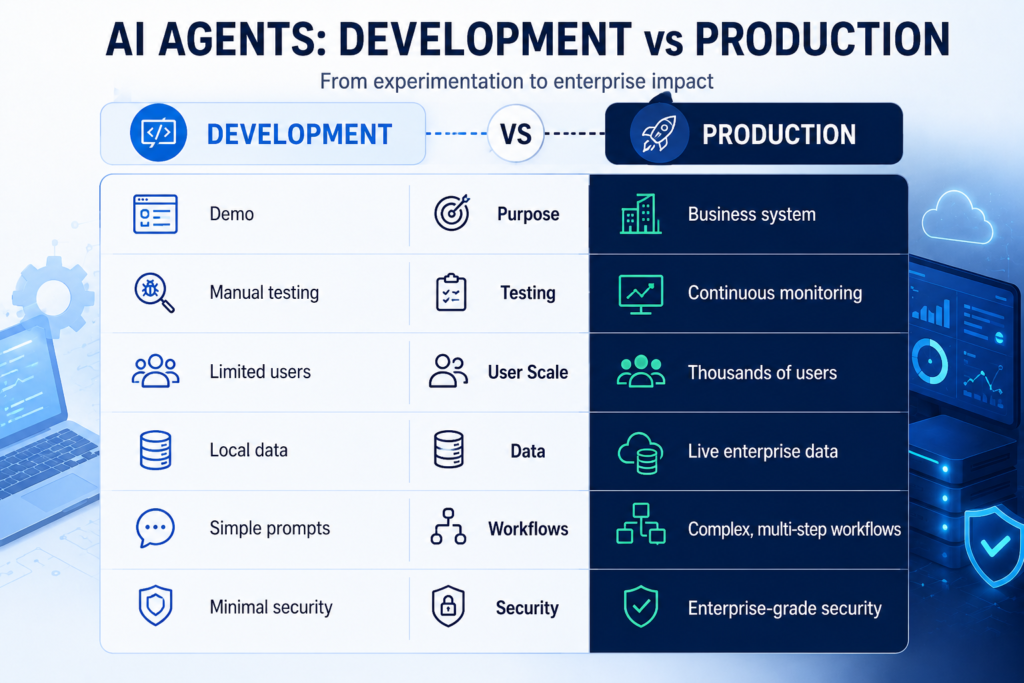
Development vs. Production AI Agents
| Development | Production |
|---|---|
| Demo | Business system |
| Manual testing | Continuous monitoring |
| Limited users | Thousands of users |
| Local data | Live enterprise data |
| Simple prompts | Complex, multi-step workflows |
| Minimal security | Enterprise-grade security |
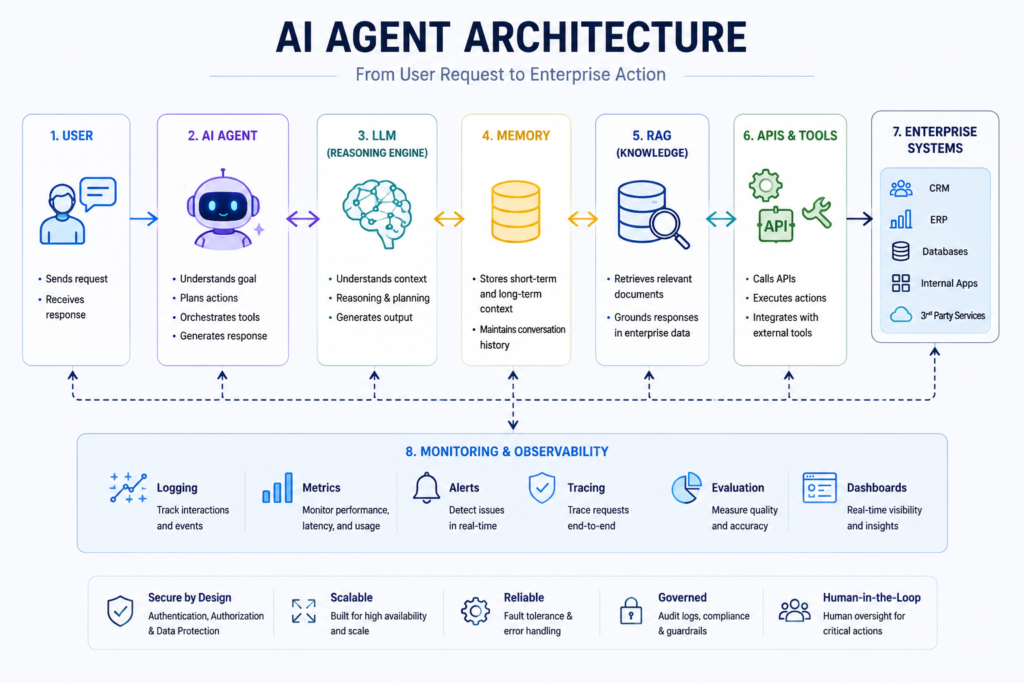
AI Agent Production Architecture
A production agent typically sits inside a larger system, not on its own. The core components include:
- User — the person or system initiating a request
- AI agent — the orchestration layer that plans and coordinates action
- LLM — the reasoning engine behind the agent’s decisions
- Memory — context retained across steps and sessions
- RAG (retrieval-augmented generation) — grounding the agent’s responses in real enterprise data
- APIs — the mechanism the agent uses to take action in other systems
- Enterprise systems — the CRMs, ERPs, ticketing tools, and databases the agent connects to
- Monitoring and logging — continuous visibility into what the agent is doing and why
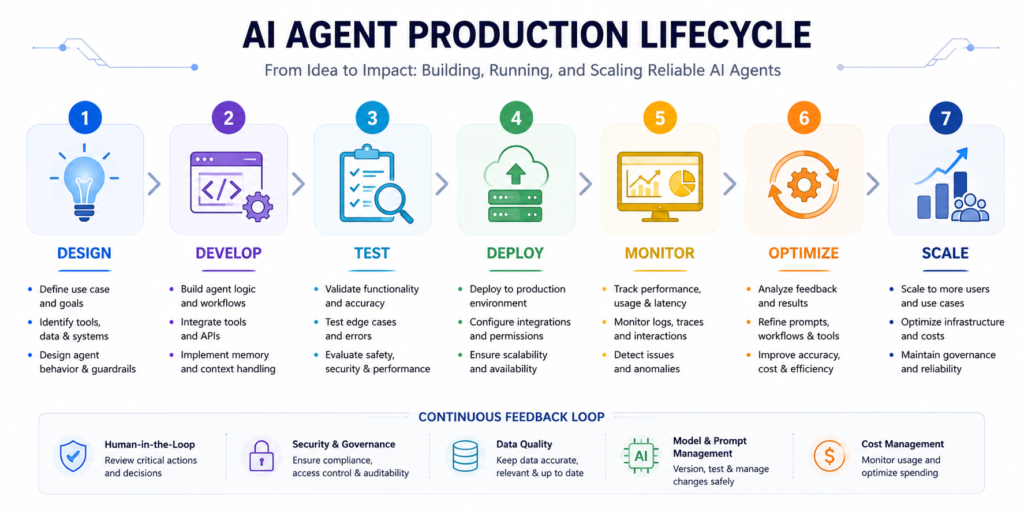
AI Agent Production Lifecycle
Reliable agents tend to move through a consistent lifecycle rather than going straight from prototype to launch:
Design → Develop → Test → Deploy → Monitor → Optimize → Scale
The mistake many teams make is treating “deploy” as the finish line. In practice, monitoring and optimization are where most of the reliability work actually happens — the deploy step is closer to the starting line for that work than the end of it.
Common Challenges
Production agents fail in ways that don’t resemble typical software bugs. A few patterns show up repeatedly across real-world deployments:
- Hallucinations — an agent can act confidently on incorrect information, and because the system is healthy and latency looks normal, nothing about the infrastructure signals that anything went wrong
- API failures and tool failures — capacity limits, rate limits, and timeouts account for a large share of production errors in agent systems, and these compound quickly across multi-step workflows
- Latency — both infrastructure delays and inefficient agent reasoning paths can slow workflows down
- Security and prompt injection — agents with tool access are vulnerable to malicious or malformed inputs designed to hijack their behavior
- Data privacy — agents often touch sensitive records across multiple systems
- Cost — frequent tool calls and long reasoning chains add up fast at scale
- Version control — prompts, tools, and model versions all need to be tracked as they change
- Model drift — an agent’s behavior can shift over time as underlying data or model versions change
Analysts expect this reliability gap to have real consequences: Gartner projects that more than 40% of agentic AI projects will be cancelled by the end of 2027, with the reasons usually tracing back to unclear value, cost overruns, or inadequate risk controls — not the capability of the underlying model.
Best Practices
Organizations that get agents reliably into production tend to follow a similar playbook:
- Start with one workflow — narrow scope before expanding
- Add human approval for high-stakes actions — keep a person on the send button until the data justifies more autonomy
- Monitor everything — traditional uptime monitoring doesn’t catch agents that are running fine but producing wrong outputs
- Use guardrails — validation rules and confidence thresholds that route uncertain outputs to human review
- Log decisions, not just outcomes — visibility into why an agent took an action, not just what it did
- Test edge cases deliberately — production conditions rarely match the happy path a demo was built around
- Version prompts and tools — treat them with the same discipline as application code
- Secure APIs and scope permissions tightly — an agent should only be able to do what it actually needs to
- Measure business KPIs, not just model metrics — accuracy scores don’t tell you whether the workflow is delivering value
- Optimize costs continuously — route simpler tasks to smaller, cheaper models where possible
Technologies Behind Production AI Agents
A common technology stack has emerged for running agents reliably in production. These are industry-standard tools, not specific to any one vendor’s implementation:
- Docker — packaging agents and their dependencies consistently across environments
- Kubernetes — orchestrating containers at scale with load balancing and recovery
- MCP (Model Context Protocol) — a standard for connecting agents to external tools and data sources
- RAG — grounding agent outputs in real enterprise knowledge
- Vector databases — powering semantic search and retrieval
- LangGraph and similar orchestration frameworks — coordinating multi-step, multi-agent workflows
- Model provider SDKs (e.g., OpenAI SDK, Anthropic SDK) — the interface layer to the underlying models
- Monitoring platforms — purpose-built observability for agent reasoning, not just infrastructure uptime
- CI/CD pipelines — automating testing and deployment of agent updates
- Cloud platforms — providing the compute and infrastructure agents run on
Enterprise Use Cases
Production agents are showing up across a consistent set of enterprise functions:
- IT support
- Customer service
- Finance
- Manufacturing
- Healthcare
Measuring Success
Model benchmarks are a poor proxy for real-world performance — recent research has shown that popular AI agent benchmarks can be gamed without an agent actually solving the underlying task. What matters more is measuring the agent’s behavior in your own environment, against metrics tied to business outcomes:
- Task completion rate — how often the agent finishes what it was asked to do
- Accuracy — how often the output is actually correct, not just plausible
- Latency — how long tasks take end-to-end
- Cost per task — total spend relative to the value delivered
- Human intervention rate — how often a person has to step in
- User satisfaction — whether the people relying on the agent trust it
- API success rate — how often calls to connected tools succeed without error
Future Trends
A few directions are likely to shape how production AI agents evolve:
- Multi-agent systems — specialized agents working together on different parts of a workflow
- Agent orchestration — more mature frameworks for coordinating multiple agents and hand-offs
- AI coworkers — agents embedded into daily tools rather than standalone applications
- Better governance — clearer standards for auditability and accountability as agents take on more consequential work
- Smaller, specialized models — task-specific models replacing frontier models for routine work, to control cost and improve reliability
- Edge AI agents — agents running closer to where data is generated, for latency- and privacy-sensitive use cases
Why Businesses Choose MHTECHIN
Organizations implementing AI agents often require expertise in AI integration, cloud infrastructure, automation, and enterprise software development. MHTECHIN focuses on building scalable AI solutions that align with business objectives while emphasizing security, reliability, and long-term maintainability — helping organizations move past the demo stage toward agents that hold up under real production conditions.
Conclusion
A capable model is not the same thing as a production-ready system. Reliable AI agents require engineering discipline, governance, and continuous monitoring — the unglamorous work that determines whether an agent quietly delivers value for years or quietly causes an incident nobody notices until a customer does. The organizations succeeding with production agents aren’t the ones with the most ambitious demos; they’re the ones treating reliability as seriously as capability from day one.
Frequently Asked Questions (FAQs)
1. What is a production AI agent? A production AI agent is an autonomous AI system that has moved beyond prototype status to run reliably against live enterprise data and real users — with the monitoring, security, and governance needed to be trusted with real business processes.
2. How are production AI agents different from prototypes? Prototypes are typically tested manually against a handful of users and simple prompts. Production agents must handle continuous monitoring, thousands of users, live enterprise data, complex multi-step workflows, and enterprise-grade security — conditions a demo rarely accounts for.
3. Why do AI agents fail in production? Failures usually trace back to the systems surrounding the model rather than the model itself — API and tool failures, latency under real load, prompt injection, insufficient monitoring, and model drift are among the most common causes.
4. What is AI agent monitoring? AI agent monitoring is the practice of tracking not just infrastructure uptime but the agent’s actual reasoning and outputs — since a healthy, fast-responding agent can still be quietly producing wrong or hallucinated results.
5. How do enterprises secure AI agents? Common measures include tightly scoping tool and API permissions, validating inputs against prompt injection, logging every decision for auditability, and requiring human approval for high-stakes actions.
6. What technologies are used in production AI agents? A typical stack includes containerization tools like Docker and Kubernetes, RAG and vector databases for grounding, orchestration frameworks, model provider SDKs, dedicated agent monitoring platforms, and CI/CD pipelines for safe updates.
7. How long does AI agent deployment take? Timelines vary significantly by workflow complexity and integration requirements — a narrowly scoped, single-workflow agent can go live in weeks, while a fully governed, enterprise-wide deployment often takes several months.
8. What industries use production AI agents? IT support, customer service, HR, finance, supply chain, manufacturing, healthcare, and legal operations are among the industries where production agents are most established today.

Leave a Reply