Introduction
Artificial Intelligence is rapidly evolving from systems that simply generate content to systems capable of planning, reasoning, and taking action. This next stage, known as Agentic AI, enables AI applications to pursue goals, interact with external tools, and execute multi-step workflows with minimal human intervention.
Unlike traditional AI models that respond to individual prompts, Agentic AI systems can maintain context, make decisions, and adapt their actions based on changing conditions. As organizations explore new ways to improve productivity and automate complex business processes, Agentic AI is emerging as an important capability across industries.
In this article, we explore how Agentic AI systems work, their core components, enterprise use cases, benefits, challenges, and the technologies that make autonomous AI possible.
What Are Agentic AI Systems?
Agentic AI systems are AI applications built to pursue a goal rather than simply respond to a single prompt. Instead of producing one output and stopping, an agentic system can break a goal into steps, decide which tools or data sources it needs, carry out those steps, and adjust its approach based on what it finds along the way.
This is a meaningful departure from traditional AI, which is typically reactive — it answers the question it’s given and nothing more. Agentic systems, by contrast, are built around a few defining characteristics:
- Autonomy — operating with reduced need for step-by-step human direction
- Goal-oriented reasoning — working toward an outcome, not just a single response
- Planning — breaking a broad objective into a sequence of smaller tasks
- Tool usage — calling APIs, databases, or other software to complete a task
- Memory — retaining context across steps and interactions
- Decision-making — choosing between possible next actions based on results so far
How Agentic AI Systems Work
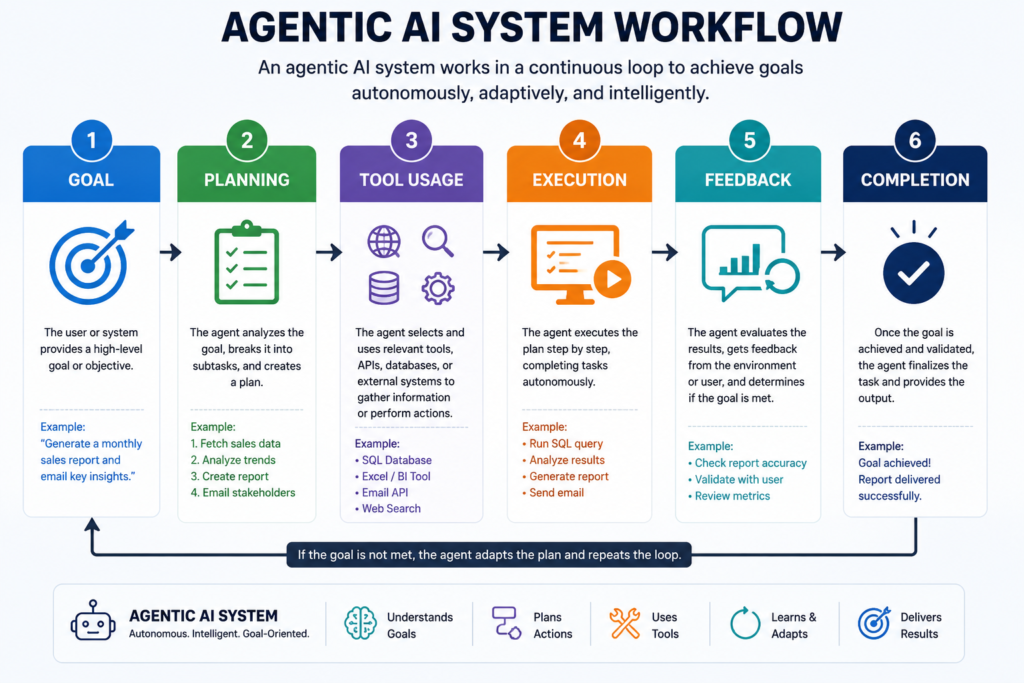
Most agentic systems follow a recognizable lifecycle, even though the underlying implementation varies by platform:
- Receive a goal — a task or outcome is defined, either by a person or another system
- Understand context — the agent gathers relevant information about the current state
- Create a plan — the goal is broken into a sequence of steps
- Use external tools — the agent calls APIs, databases, search tools, or other software as needed
- Execute tasks — each step in the plan is carried out
- Evaluate results — the agent checks whether the outcome matches the goal
- Improve or retry — if the result falls short, the agent adjusts its approach and tries again
Traditional AI vs. Agentic AI
| Traditional AI | Agentic AI |
|---|---|
| Responds to prompts | Pursues goals |
| Single interaction | Multi-step execution |
| Limited context | Maintains context across steps |
| Human-driven | Semi-autonomous |
| Reactive | Proactive |
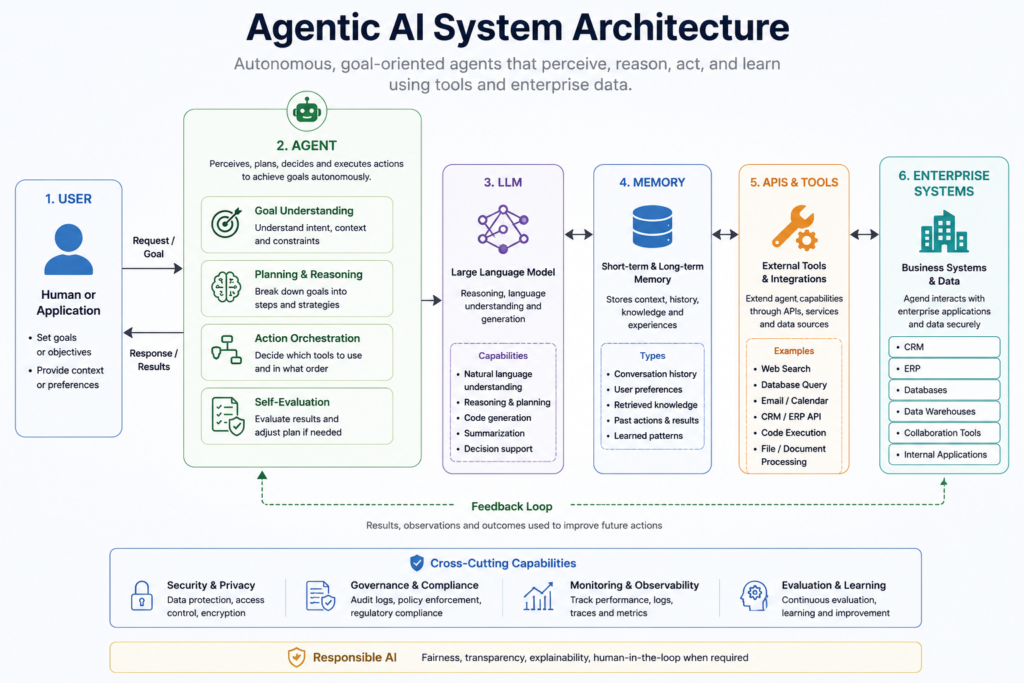
Core Components of an Agentic AI System
Large language model — the reasoning engine that interprets goals, evaluates options, and generates plans.
Memory — stores context from earlier steps so the agent doesn’t lose track of what it’s already done or learned.
Planning module — breaks a broad objective into an ordered set of smaller, executable tasks.
Tool integration — connects the agent to APIs, databases, web search, calendars, CRMs, and other enterprise systems so it can actually take action, not just generate text.
Feedback loop — evaluates whether an action produced the intended outcome and adjusts subsequent steps accordingly.
Real Enterprise Use Cases
Agentic AI is already being applied to specific, bounded workflows across industries:
- IT helpdesk automation — triaging tickets, resolving common issues, and escalating complex cases
- Customer support — handling multi-step requests that span several systems, not just answering FAQs
- HR onboarding — coordinating documentation, account provisioning, and scheduling across multiple tools
- Supply chain management — monitoring inventory signals and coordinating reordering or logistics actions
- Financial reporting — pulling data from multiple systems and assembling structured reports
- Sales intelligence — researching accounts and preparing context ahead of outreach or meetings
- Healthcare workflow assistance — supporting administrative and scheduling tasks alongside clinical staff
Benefits of Agentic AI Systems
- Increased productivity — routine multi-step work is handled without constant human input
- Reduced manual work — fewer repetitive tasks land on employees’ desks
- Faster decision-making — information gathering and initial analysis happen automatically
- Better scalability — workflows can expand without a proportional increase in headcount
- 24/7 operations — agents don’t require business hours to act
- Improved customer experiences — faster, more complete responses to multi-part requests
Challenges and Considerations
Agentic AI’s momentum is real, but so are its growing pains. While interest in Agentic AI is growing rapidly, many organizations are still evaluating how to deploy these systems reliably in production. Challenges such as governance, integration complexity, security, and operational costs mean that successful implementation requires careful planning rather than experimentation alone. That gap is worth taking seriously before committing to an agentic rollout. Key considerations include:
- Hallucinations — agents can act confidently on incorrect information if not properly grounded
- Security — autonomous systems with tool access need tightly scoped permissions
- Data privacy — agents often touch sensitive systems and records across the organization
- Governance — decisions made by agents need to be auditable and explainable
- Human oversight — high-stakes actions should still involve a human checkpoint
- Cost — running agents at scale, especially with frequent tool calls, adds up
- Integration complexity — connecting agents reliably to existing enterprise systems is nontrivial work
Technologies Behind Agentic AI
Agentic AI systems rely on a combination of artificial intelligence models, enterprise integration technologies, and automation platforms. Each component plays a distinct role in enabling autonomous decision-making, tool usage, and reliable execution of complex workflows.
- Large language models — the reasoning core of the agent
- Retrieval-augmented generation (RAG) — grounding responses in relevant enterprise data
- Vector databases — enabling semantic search over large knowledge bases
- Model Context Protocol (MCP) — an emerging open standard for connecting agents to external tools and data sources in a consistent way
- APIs — the mechanism agents use to actually take action in other systems
- Workflow engines — coordinating multi-step processes and hand-offs
- Cloud platforms — providing the compute and infrastructure agents run on
- MLOps — keeping agent behavior monitored, versioned, and reliable over time
Why Businesses Are Exploring Agentic AI
Organizations are exploring agentic AI to automate complex workflows, reduce repetitive manual tasks, and improve operational efficiency. As enterprise AI matures, autonomous agents are becoming an important part of digital transformation strategies — not as a replacement for existing systems, but as a way to extend what automation can reliably handle. Businesses are also exploring Agentic AI because it enables automation across multiple applications without requiring users to manually coordinate every step. By combining reasoning, memory, and tool integration, agentic systems can support faster operations while improving consistency across complex business processes.
MHTECHIN focuses on AI development, enterprise integration, and building scalable AI architectures that support this shift — helping organizations design agentic workflows around clear goals, appropriate guardrails, and the existing systems they already depend on.
Future of Agentic AI
A few directions are likely to shape how agentic AI develops over the next few years:
- Multi-agent collaboration — specialized agents coordinating with each other on different parts of a task
- AI assistants integrated into enterprise workflows — agents embedded into daily workflows alongside employees rather than as standalone tools
- Autonomous business processes — end-to-end workflows that run with minimal manual intervention
- Human-AI collaboration — clearer patterns for where agents act independently and where a person stays in the loop
- Responsible AI — growing emphasis on governance, auditability, and oversight as agents take on more consequential tasks
As organizations gain more experience with autonomous AI systems, Agentic AI is expected to become an increasingly important component of enterprise software. Rather than replacing employees, these systems are more likely to function as intelligent collaborators that automate repetitive workflows while allowing people to focus on strategic decision-making, creativity, and oversight.
Conclusion
Agentic AI isn’t about replacing people — it’s about automating the routine, multi-step work that currently consumes a disproportionate share of employees’ time, so that strategic decisions stay where they belong: with people. The organizations getting real value from agentic AI tend to be the ones that start with a specific, well-bounded workflow, build in oversight from the start, and treat production reliability as seriously as the underlying model’s capability.
As organizations continue to adopt AI-driven automation, Agentic AI is likely to play an increasingly important role in enterprise operations. Businesses that implement these systems with strong governance, security, and human oversight will be better positioned to improve operational efficiency while maintaining trust and accountability.
Frequently Asked Questions (FAQs)
1. What is Agentic AI? Agentic AI refers to AI systems that can pursue a goal across multiple steps — planning, using tools, taking action, and evaluating results — rather than simply responding to a single prompt.
2. How is Agentic AI different from Generative AI? Generative AI focuses on producing content — text, images, code — in response to a prompt. Agentic AI uses similar underlying models but adds planning, tool use, and multi-step execution to actually carry out a task, not just describe one.
3. How is Agentic AI different from AI agents? The terms are closely related. “AI agent” typically refers to an individual autonomous system performing a task, while “agentic AI” describes the broader approach and architecture — including systems where multiple agents collaborate.
4. What industries benefit from Agentic AI? Early traction is strongest in IT operations, customer support, financial services, supply chain management, HR, and healthcare administration — generally workflows that are repetitive, multi-step, and well-documented.
5. Is Agentic AI secure for enterprises? It can be, but security depends heavily on implementation — scoped permissions, monitored tool access, and human checkpoints for high-stakes actions are essential rather than optional.
6. What technologies power Agentic AI systems? Common components include large language models, retrieval-augmented generation, vector databases, the Model Context Protocol (MCP) for tool connectivity, APIs, workflow engines, and MLOps tooling for ongoing monitoring.
7. Can small businesses adopt Agentic AI? Yes — turnkey agentic platforms have lowered the barrier to entry considerably, though the same governance and oversight principles that apply to large enterprises still matter at smaller scale.
8. What challenges should organizations consider before implementing Agentic AI? Hallucinations, security and data privacy, governance and auditability, the need for human oversight on important decisions, ongoing cost, and the real complexity of integrating agents with existing systems.

Leave a Reply