Introduction
In the race to deliver software faster, organizations have accumulated a staggering array of tools. Cloud platforms, container orchestration, CI/CD pipelines, monitoring solutions, and security tooling—each solving a specific problem, but together creating a tangled web of complexity that slows developers down rather than accelerating them.
Enter platform engineering: the discipline that treats internal developer infrastructure as a product, enabling development teams to ship software with speed, security, and consistency. Gartner predicts that by 2026, 80% of large software engineering organizations will have dedicated platform engineering teams . The discipline has moved from emerging best practice to foundational capability—and for good reason.
What Is Platform Engineering?
Platform engineering is the practice of designing, building, and maintaining self-service capabilities that enable developers to deliver software faster with reduced cognitive load . It provides a secure, scalable, and automated path to production by combining reusable components, tools, and governance to minimize complexity while ensuring compliance and observability .
The tangible outcome of platform engineering is an Internal Developer Platform (IDP) —a centralized set of tools, services, and workflows that provide developers with self-service access to the infrastructure they need . According to Gartner, an IDP is “a set of tools, services, automations and information maintained as a product by a dedicated platform team” that orchestrates with other platforms to simplify the developer experience .
Think of an IDP as a self-service interface that developers use to provision resources, deploy code, monitor applications, and manage configurations—all within approved boundaries. Instead of every team figuring out their own way to configure servers, networks, security protocols, and deployments, teams use ready-made “golden paths” that already follow the company’s rules and best practices .
Why Organizations Are Evolving Beyond Traditional DevOps
DevOps revolutionized software delivery by breaking down silos between development and operations teams, enabling continuous integration and delivery. But as systems have grown more complex—spanning multiple clouds, containers, microservices, and compliance requirements—DevOps practices alone have been pushed to their limits .
The challenge is that DevOps toolchains are often inaccessible to developers. While DevOps teams implement CI/CD systems and Infrastructure as Code tools, developers frequently struggle to interact with deployment logs, provision their own test environments, or understand complex Kubernetes configurations . This creates a bottleneck where developers must wait for operations teams to handle infrastructure requests.
The hidden cost of complexity is real. Research shows that 69% of developers lose 8 or more hours weekly—a full day—to inefficiencies like poor documentation and complex build processes . That’s time not spent building features, innovating, or delivering business value.
DevOps vs Platform Engineering: Understanding the Relationship
It is important to note that platform engineering does not replace DevOps. Rather, it is a route to DevOps success—a way to implement DevOps principles at scale .
| Aspect | DevOps | Platform Engineering |
|---|---|---|
| Primary Goal | Improve collaboration, automate software delivery | Build internal platforms that abstract infrastructure complexity |
| Focus | Cultural methodology, broad impact | Product methodology, developer experience |
| Audience | Everyone involved with the project | Developers (primary users) |
| Method | Short feedback loops, automation | Self-service tools, golden paths, standardized workflows |
| Outcome | Faster, more reliable releases | Reduced cognitive load, improved developer productivity |
As one analysis puts it: “DevOps is a culture; an IDP is a tangible product that scales it” . DevOps brings the culture, collaboration, and automation. Platform engineering systematizes those principles into reusable, scalable tools that developers can use independently . They are not competitors—they are complementary forces that, when combined, enable organizations to ship software faster and more reliably than either approach could achieve alone.
Internal Developer Platforms (IDPs) and Golden Paths
An Internal Developer Platform (IDP) is the tangible outcome of a platform engineering effort. It is not a single tool but a curated suite of tools, services, and workflows made available to developers .
Golden paths are the pre-configured, approved workflows within an IDP. They guide developers through the software delivery lifecycle using standardized tools and processes. For example, a golden path might allow a developer to:
- Spin up a new microservice with a single command
- Provision a preview environment for testing
- Deploy code to production with built-in security and compliance checks
Gartner highlights that “IDPs ease complexity and release the productivity of software teams by reducing the cognitive load of modern toolchains” .
Key Benefits of IDPs
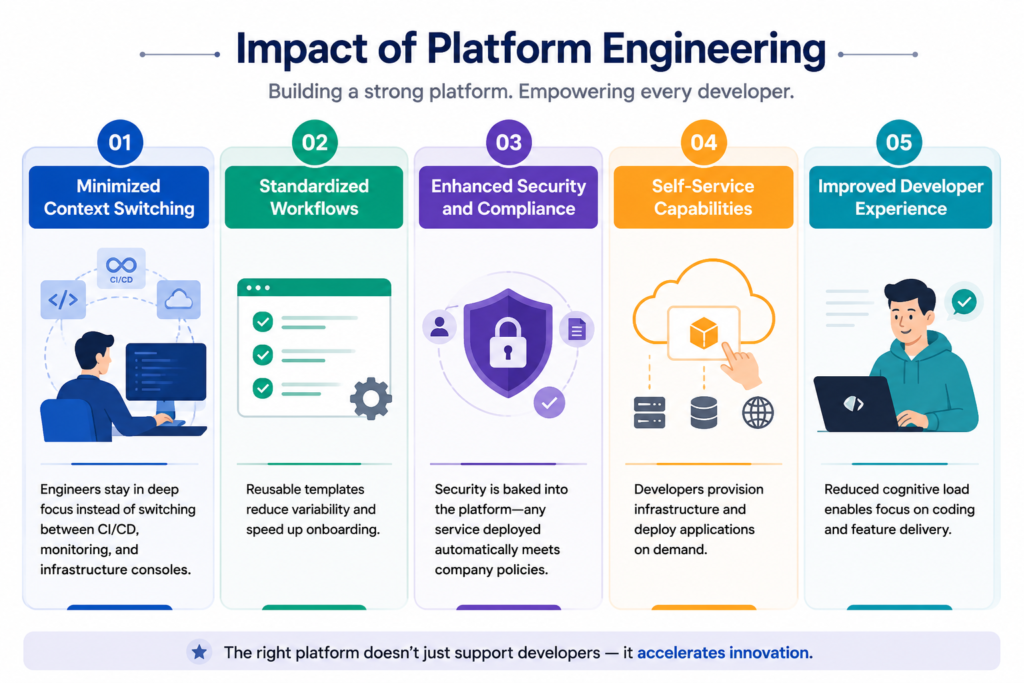
Real-World Impact: The Numbers That Matter
The benefits of platform engineering are measurable and significant:
- Reduced deployment time—A financial services client reduced deployment time from three weeks to 15 minutes through platform engineering
- Faster deployments—A 2025 Google Cloud–Forrester study found that a well-adopted platform can reduce deployment time by up to 75%
- Reduced infrastructure costs—A 2024 Forrester study found that organizations with platform engineering teams reduced infrastructure costs by 20-30% while improving deployment frequency by 40%
- Improved reliability—Critical incident counts drop by approximately 20% after implementing a platform engineering approach
- Enhanced productivity—Gartner notes that AI-augmented tools will boost developer productivity by 30–50% across coding and bug fixing
- Wide adoption forecast—By 2028, 85% of organizations with platform engineering teams will provide internal developer portals, up from 60% in 2025
Key Technologies in Platform Engineering
Platform engineering leverages several foundational technologies :
- Kubernetes and Containers – Container orchestration for scalable, portable applications
- Infrastructure as Code (IaC) – Defining and deploying cloud infrastructure consistently through code
- CI/CD Pipelines – Automating builds, tests, and deployments
- Developer Portals – Self-service interfaces for developers to access platform capabilities
- Observability Tools – Pre-configured logging, metrics, and tracing for faster debugging
Challenges in Platform Engineering
Despite its benefits, platform engineering adoption faces several challenges:
- Shortage of Skilled Professionals – The skills gap limits adoption, with organizations struggling to find qualified platform engineers
- Cultural Resistance – Shifting from traditional ops-led models to self-service platforms requires organizational change
- Implementation Complexity – Tools like Backstage require significant development skills spanning TypeScript, Node.js, React, YAML, PostgreSQL, and containerization—often leading to disillusionment when organizations misconstrued it as a ready-to-use portal
- Product Mindset Requirement—The biggest risk is skipping the product mindset; an IDP that doesn’t listen to its users will be bypassed
Building an internal developer platform requires expertise across multiple domains—cloud infrastructure, container orchestration, CI/CD pipelines, security, and developer experience. MHTECHIN supports organizations with the technologies that form the foundation of modern platform engineering:
Cloud Solutions – Supporting cloud migration, scalable infrastructure, and cloud-native application deployment.
DevOps & Automation – Helping streamline software delivery through CI/CD practices, infrastructure automation, and deployment workflows.
Custom Software Development – Building scalable enterprise applications, web platforms, and tailored software solutions.
Enterprise Applications – Implementing ERP, CRM, and workflow automation solutions that improve operational efficiency and system integration.
By combining software engineering, cloud technologies, DevOps practices, and enterprise solutions, MHTECHIN helps organizations build the digital foundation that supports modern platform engineering initiatives, enabling more efficient, scalable, and reliable software delivery.
The Future of Platform Engineering
As AI adoption accelerates, platform engineering is becoming the foundation for AI-native enterprises . Gartner’s 2026 Hype Cycle for Platform Engineering identifies Agent Experience (AX) as an emerging discipline—the idea that backend systems need to be designed for AI agents as users, not just humans. APIs, workflows, and documentation must be machine-readable and agent-friendly .
By the end of 2026, 40% of enterprise applications are expected to have task-specific AI agents inside them. The platforms underneath those agents will determine whether they create value or create chaos .
Platform engineering is no longer just about making developers happy. It is about building the engineered foundations that move ideas from ambition to adoption, experimentation to scale, and technology investment to measurable business value.
Key Takeaways
- Platform engineering treats internal developer infrastructure as a product, providing self-service tools and workflows
- DevOps and platform engineering are complementary—DevOps brings the culture, platform engineering systematizes it
- Internal Developer Platforms (IDPs) provide golden paths that guide developers through standardized, secure workflows
- Gartner predicts 80% of large software engineering organizations will have platform teams by 2026
- Key benefits include faster time-to-market, reduced cognitive load, enhanced security, and improved developer productivity
- Challenges include skills shortages, cultural resistance, and implementation complexity
References
- Fujitsu, “Redefining the future of IT: How Platform Engineering supercharges transformation,” 2025
- Coherent Solutions, “DevOps vs Platform Engineering: Key IDP Considerations,” 2025
- BairesDev, “Platform Engineering: Why CTOs Build Internal Developer Platforms,” 2026
- OpsWorks Co., “DevOps vs Platform Engineering: Not a Choice, But a Combination”

Leave a Reply