Introduction
Just a few years ago, we relied on AI primarily for answers. Today, we ask it to perform tasks. Tomorrow, it may already be sensing, deciding, and acting in the world around us.
While the spotlight remained on chatbots and text generation, a quieter revolution was unfolding. At the 2026 World Artificial Intelligence Conference (WAIC) in Shanghai, six robots collaborated for over 15 hours to build a model of the Great Wall using 80,000 building blocks. A smart pharmacy demonstrated robots from different manufacturers working together to retrieve and deliver medicines. Visitors even controlled a game using nothing more than brain signals through a lightweight EEG device.
This is Physical AI—the next evolution of artificial intelligence, where intelligence moves beyond software and into the physical world.
Why Physical AI Matters
Artificial intelligence is no longer confined to screens. It is entering factories, hospitals, farms, warehouses, and homes, enabling machines to perceive their surroundings, make decisions, and perform real-world actions.
The shift is happening faster than many realize.
- Yesterday: AI answered questions and generated content.
- Today: AI powers robots, drones, and autonomous systems.
- Tomorrow: AI will collaborate with humans as intelligent teammates, continuously learning and adapting to real-world environments.
Physical AI isn’t replacing digital AI—it is expanding its capabilities into the physical world.
Traditional AI vs Physical AI
| Traditional AI | Physical AI |
|---|---|
| Generates text and images | Performs physical actions |
| Operates inside software | Operates in real environments |
| Responds to prompts | Continuously senses and reacts |
| Focuses on information | Focuses on execution |
| Example: ChatGPT | Examples: Robots, drones, smart devices |
The Physical AI Ecosystem
Physical AI combines three essential layers: sensing, reasoning, and action.
Cameras, sensors, and IoT devices gather data from the physical world. The AI decision engine—the brain—processes this data, makes decisions, and plans actions. Finally, actuators—robots, drones, smart devices—execute those decisions in the real world.
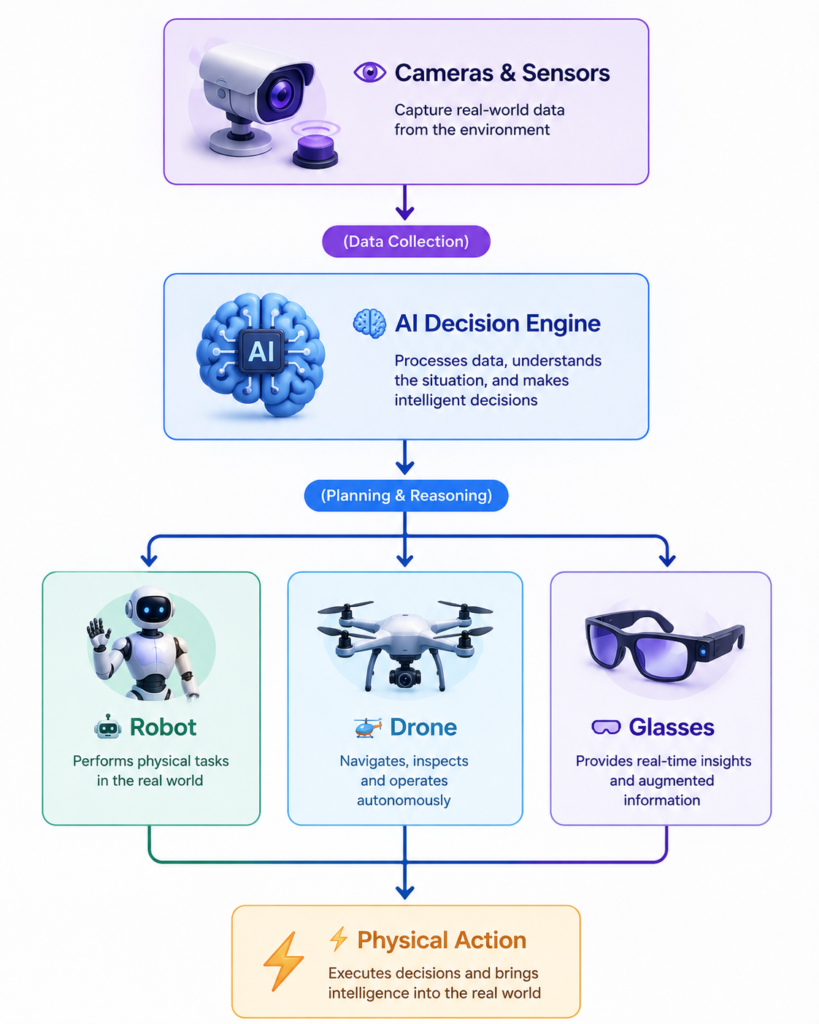
This isn’t science fiction. This is happening right now.
WAIC 2026 – What We Saw
The World Artificial Intelligence Conference in Shanghai gave us a preview of the physical AI future. Among the many demonstrations at WAIC 2026, four examples highlighted the growing maturity of Physical AI technologies.:
Robot-built Great Wall
Six robots worked continuously for 15 hours to build a model of the Great Wall from 80,000 building blocks. They coordinated their movements, divided tasks, and corrected errors without human intervention.
Smart Pharmacy
Three robots from different manufacturers collaborated to retrieve and deliver medicines. One robot located the prescription, another picked it from the shelf, and a third delivered it to the counter—all working in perfect synchronization.
EEG Gaming
A lightweight EEG cap let users play Black Myth: Wukong using only brain signals. No controllers. No keyboards. Just thought-driven interaction. This is brain-computer interface technology moving from labs to living rooms.
AI Smart Glasses
Weighing just 40 grams, these glasses offered swappable batteries, real-time translation, navigation overlays, and contactless payments. AI is leaving the phone and moving to eyewear.
The Numbers That Matter
Industry forecasts and market analyses indicate that Physical AI is transitioning from research and pilot deployments toward broader commercial adoption.
| Statistic | What It Means |
|---|---|
| 50% | Industrial tasks automated by 2028 (Gartner) |
| 80% | People interacting with robots daily by 2030 (Globant) |
| $280B | Global robotics market by 2034 (GlobalData) |
| 23M | Commercial drones in daily use by 2032 (Gartner) |
These projections highlight the scale and speed at which Physical AI is expected to reshape industries over the coming decade.
Industries Being Transformed
Physical AI is touching every sector of the economy:
Healthcare – Surgical robots perform procedures with precision beyond human capability. AI-powered diagnostic tools analyze medical images in seconds. Smart hospitals use robots for patient monitoring and medication delivery.
Manufacturing – Factories are becoming autonomous. Robots assemble, inspect, and package products with minimal human oversight. Predictive maintenance systems prevent breakdowns before they happen.
Agriculture – Drones monitor crop health, spray pesticides precisely, and even plant seeds. Autonomous tractors till fields without drivers. AI optimizes irrigation and harvest timing.
Logistics – Warehouse robots retrieve and sort packages. Delivery drones and autonomous vehicles handle last-mile logistics. Supply chains are becoming self-optimizing.
Energy – Robots inspect power lines, wind turbines, and solar panels. AI optimizes energy grids in real-time. Drones monitor pipeline integrity and detect leaks.
Smart Homes – Robot vacuums are just the beginning. Smart home systems anticipate your needs—adjusting temperature, ordering groceries, and managing security autonomously.
Looking Ahead
2026 – Robot Assistants
Consumer robots become capable of meaningful household tasks—cleaning, organizing, and assisting with daily routines. Early adopters embrace AI companions.
2027 – Factory Automation
Manufacturing achieves new levels of autonomy. Entire production lines run with minimal human oversight, with robots handling quality control and maintenance.
2028 – Multi-Agent Robots
Robots learn to collaborate. Multiple agents share tasks, coordinate actions, and optimize workflows collectively—building things no single robot could handle alone.
2030 – Robots Everywhere
Integration becomes seamless. Robots are part of daily life—in homes, hospitals, offices, and public spaces. They’re not machines you use; they’re companions you interact with.
The Strengths and Limitations
| Strength | Why It Matters |
|---|---|
| 24/7 operation | Robots don’t sleep, take breaks, or get tired |
| Precision | Machines perform tasks with superhuman accuracy |
| Safety | Dangerous jobs can be delegated to robots |
| Scalability | Physical AI systems can be replicated globally |
| Limitation | What It Means |
|---|---|
| Security risks | Physical systems connected to networks are vulnerable to attacks |
| High cost | Deployment requires significant capital investment |
| Job displacement | Some roles will be automated away |
| Human oversight | Even autonomous systems need supervision |
Turning Physical AI into reality
Adopting Physical AI is not only about intelligent machines—it also requires a strong digital foundation. Scalable software, cloud infrastructure, AI integration, and enterprise systems are essential for organizations preparing for the next wave of automation.
MHTECHIN helps bridge this gap by delivering:
- Custom Software Development – Building scalable enterprise applications, web platforms, and tailored software solutions.
- Web & Mobile App Development – Creating responsive web applications and native or cross-platform mobile apps for modern businesses.
- Cloud Solutions – Supporting cloud migration, infrastructure optimization, and scalable digital environments.
- Artificial Intelligence & Machine Learning – Integrating AI-driven capabilities into business processes to improve automation and decision-making.
- Enterprise Solutions – Implementing CRM, ERP, and workflow automation systems that enhance operational efficiency.
By combining software engineering, cloud technologies, AI, and enterprise solutions, MHTECHIN helps organizations build the digital foundation needed to adopt emerging technologies—including the next generation of AI-driven systems.
References:
- World Artificial Intelligence Conference (WAIC) 2026 – Official Conference Highlights
- Gartner – Top Strategic Technology Trends: Physical AI
- GlobalData – Global Robotics Market Forecast
- Globant – Technology Trends Report 2026
PHYSICAL AI: When Intelligence Leaves the Screen developed by Shreya Rathi

Leave a Reply